As of November 9, 2026, I’d plan China-to-USA FBA shipments around Christmas and January – not count on new shipments for Black Friday. My first step: work backward from when inventory must be ready to sell, including customs, delivery, and Amazon receiving.
Here’s how I’d plan the remaining weeks:
- Choose freight by SKU: Compare FCL, LCL, and air using stock cover, margin, shipment size, and the assigned fulfillment center.
- Check the whole timeline: Ocean shipping to the West Coast may take 25–40 days door to door; air transit alone may take 5–10 days. Neither guarantees sellable stock by your target date.
- Finish prep before departure: Confirm labels, customs documents, import responsibility, and trucking and delivery arrangements.
- Review stock weekly: Track sellable units, receiving delays, and demand. Move late inventory into January planning.
My rule: <u>delivered does not mean ready to sell</u>. I’d treat holiday dispatch dates as planning targets, then book only against a confirmed schedule with time for receiving.
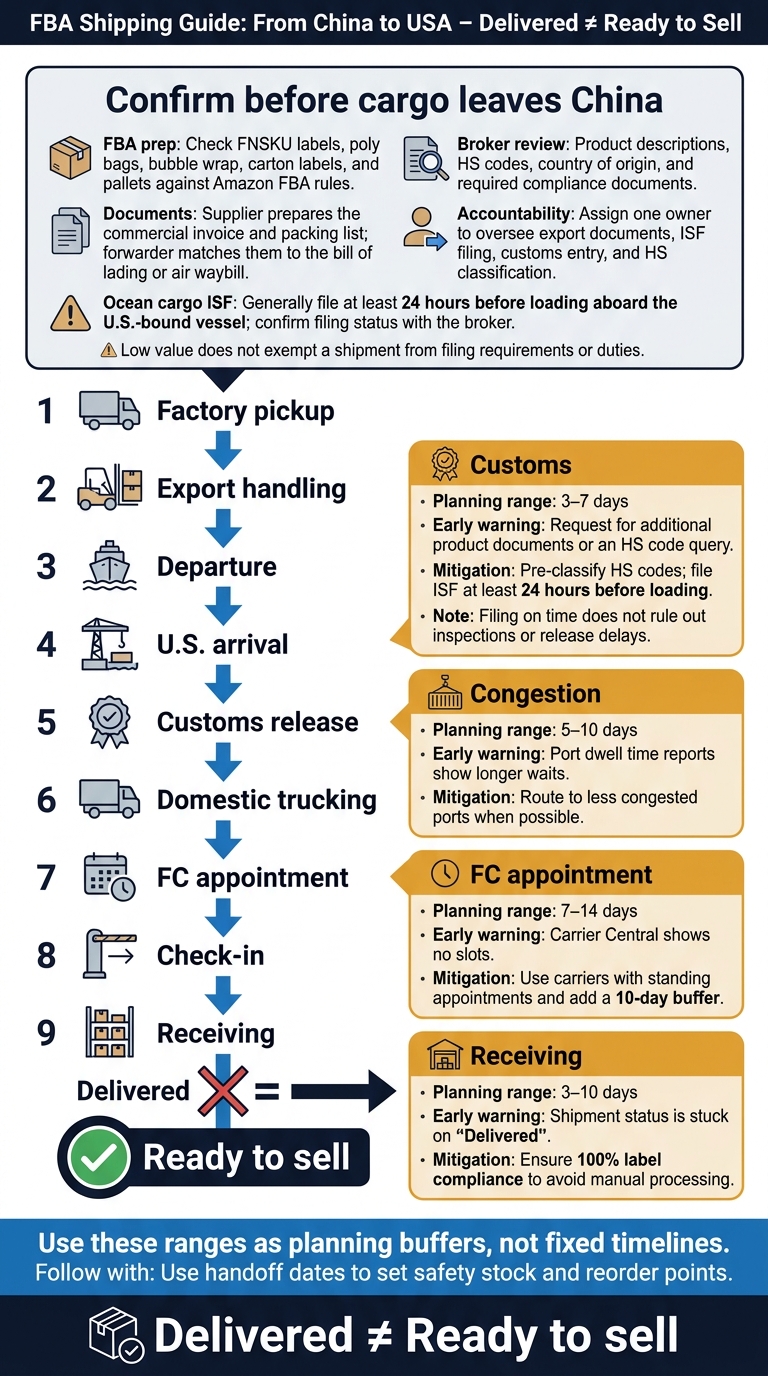
China-to-USA FBA Shipping: Handoffs and Delay Buffers
How to Ship from China to Amazon FBA Explained
sbb-itb-f9a91f9
2. Choose Ocean or Air Freight for Each SKU
Match each SKU’s freight method to the time left for inventory to become sellable. Choose based on volume, stock cover, margin, and FC assignment – not freight price alone. Compare quotes from factory pickup through delivery to the assigned Amazon FC. A port-only quote doesn’t cover the same work as a door-to-FC quote.
Compare FCL, LCL, and Air Freight
Get confirmed quotes for the actual origin, departure point, and assigned U.S. fulfillment center.
| Method | Best use | Quote scope | Cost focus | Major risks | Remaining Q4 role |
|---|---|---|---|---|---|
| FCL – full container load | Larger base-stock shipments | Factory pickup through assigned FC delivery | Compare total container cost and delivered cost per unit | Clearance and delivery delays | Later Q4 demand, but only when the confirmed schedule allows |
| LCL – less than container load | Smaller ocean shipments | Factory pickup through assigned FC delivery, including consolidation | Itemize shared-container charges and destination handling | Consolidation and release delays | Replenishment that can wait through extra handling time |
| Air freight | Urgent stock gaps with enough margin | Factory pickup through assigned FC delivery, including cargo acceptance and flight cutoff dates | Compare total shipment cost and added cost per unit | Capacity, clearance, and receiving delays | Targeted restocks, not the full base-stock order |
Ask for itemized quotes that show pickup, linehaul, destination handling, and delivered cost per unit. Add Amazon receiving time to each quoted timeline. Compare all quotes in USD, with exclusions and expiration dates clearly stated.
Split Base Stock and Urgent Restocks
Use the Q4 calendar and follow a step-by-step guide to ship to Amazon FBA to separate base stock from urgent restocks. Ship base stock by ocean, then use air only to bridge the gap until that ocean inventory becomes sellable. Check the added air cost per unit against the contribution margin those sales would retain. Assign ocean orders to December or later demand only if the confirmed schedule supports it.
Ask FCLGO to coordinate freight, customs, FBA prep (labeling and palletizing), and final-mile delivery to Amazon fulfillment centers. Request route-specific schedules and itemized quotes. Confirm the importer of record before booking. For a DDP shipment, name who files entry and pays duties. Otherwise, secure the broker and bond.
Once you choose the lane, lock in prep, customs, and delivery dates before cargo leaves China.
3. Check FBA Prep, Customs, and Delivery
Once you’ve chosen the shipping lane, confirm prep requirements, filings, and delivery dates before cargo leaves China.
Confirm FBA Prep and Shipment Details
Before booking, check that FNSKU labels, poly bags, bubble wrap, carton labels, and pallets meet Amazon FBA rules.
Prepare Customs Documents Before Departure
Ask your supplier to prepare the commercial invoice and packing list. Your forwarder should then match those documents to the bill of lading or air waybill.
Before departure, have your broker review product descriptions, HS codes, country of origin, and required compliance documents. Assign one owner to oversee export documents, ISF filing, customs entry, and HS classification.
Low value does not exempt a shipment from filing requirements or duties.
For ocean cargo, the Importer Security Filing (ISF) generally must be filed at least 24 hours before loading aboard the U.S.-bound vessel. Check the filing status with your broker. Filing on time does not rule out inspections or release delays.
Track Handoffs and Shipping Delays
Track each handoff separately: factory pickup, export handling, departure, U.S. arrival, customs release, domestic trucking, FC appointment, check-in, and receiving.
Allow room for delays at these stages:
| Delay source | Likely impact | Early warning sign | Mitigation |
|---|---|---|---|
| Customs | 3–7 days | Request for additional product documents or an HS code query | Pre-classify HS codes; file ISF at least 24 hours before loading |
| Congestion | 5–10 days | Port dwell time reports show longer waits | Route to less congested ports when possible |
| FC appointment | 7–14 days | Carrier Central shows no slots | Use carriers with standing appointments and add a 10-day buffer |
| Receiving | 3–10 days | Shipment status is stuck on “Delivered” | Ensure 100% label compliance to avoid manual processing |
Use these ranges as planning buffers, not fixed timelines, and use the handoff dates to set safety stock and reorder points.
4. Set Stock Buffers and Review Weekly
Calculate Net Replenishment Needs
Use the delivery and receiving delays from the previous steps to set your replenishment horizon. Cover the full period from production through Amazon receiving – not just transit. Count only confirmed inbound units expected to be sellable within that window. Keep late or uncertain shipments in a separate bucket.
Set SKU Safety Stock and Reorder Points
Set safety stock for each SKU based on demand volatility, lead-time risk, margin, and FBA capacity. Your reorder point should equal expected demand over the full lead time plus safety stock. Count only sellable inventory and confirmed inbound units when checking that point.
Avoid ordering excess stock that adds storage fees and leaves you with post-holiday leftovers.
Review Sales and December Stock Needs
Each week, review sales, forecasts, sellable units, stock cover, FBA capacity, receiving status, and shipment milestones. Check fast-moving SKUs more often. After Black Friday (November 27) and Cyber Monday (November 30), check sales daily and update your December demand forecast.
Give each at-risk SKU a dated action: expedite, cut the next order, pause replenishment, or switch from ocean to air when stock falls below safety stock. During December reviews, flag January dispatch needs for any SKU still short on cover. Feed those decisions into the remaining Q4 shipment plan.
5. Finalize the Remaining Q4 Shipping Plan
As of November 9, 2026, the ocean-freight windows for Black Friday and Cyber Monday have passed. Air freight is no longer reliable for either event. For Christmas inventory, treat mid-November ocean departures and first-week-of-December air departures as planning targets – not receiving dates.
With only Christmas inventory and January prep left, decide which SKUs still warrant ocean or air freight. Book only shipments that can become sellable inventory before year-end. Before cargo leaves China, confirm Amazon requirements, freight capacity, booking and delivery dates, handoff owners, FBA prep, and import responsibility. Keep only shipments that can clear customs, arrive, and complete receiving on time.
Block out receiving time on the calendar, and move late units into January planning. Start planning January 2027 dispatches now: Lunar New Year falls on February 6, and many factories shut down for 2–3 weeks. Account for that next production risk when scheduling shipments.
FAQs
How do I calculate whether an air restock is profitable?
Compare the landed cost per unit for air and ocean shipping. Include freight, duties, taxes, brokerage, FBA prep, and final delivery. The difference is your air freight premium per unit.
Choose air if the expected cost of a stockout – lost sales, lower organic search rankings, and advertising to recover – exceeds the total air premium for your restock.
What if my FBA shipment misses its holiday window?
Missing the holiday window is risky. Inventory that arrives in January generally won’t be useful until the following year. Work backward from the date your inventory needs to be in stock at the Amazon fulfillment center, not the date production ends.
If you expect to miss that deadline, send a small, urgent portion by air freight to help preserve your product ranking. Ship the rest by ocean.
How much safety stock should I hold for Q4?
Keep at least 2–4 extra weeks of safety stock beyond your estimated port-to-port ocean transit time. Increase that cushion during peak periods. FCLGO lists total replenishment buffers of 20–25 days under normal conditions and 35–45 days during Q4 to account for customs, fulfillment center receiving and appointment delays, and variability.
For LCL shipments, add 14–21 days for the West Coast or 20–30 days for the East Coast, plus another 10–14 days from August through December.
发表回复