分类: 未分类

  • FBA vs FBM: Which is Better for Sellers in 2026?

    FBA vs FBM: Which is Better for Sellers in 2026?

    Choosing between Fulfillment by Amazon (FBA) and Fulfillment by Merchant (FBM) is one of the most critical decisions Amazon sellers face. This choice impacts your costs, customer service, time investment, and ultimately your profit margins. Understanding the key differences between these two fulfillment methods will help you make an informed decision for your business.

    What is FBA?

    Fulfillment by Amazon (FBA) is a service where sellers send their inventory to Amazon’s fulfillment centers. Amazon then handles storage, packing, shipping, customer service, and returns. Sellers pay for storage space and fulfillment fees, but gain access to Amazon’s vast logistics network and Prime eligibility.

    When you use FBA, your products become eligible for Prime shipping, which significantly increases visibility and conversion rates. Amazon stores your inventory across multiple fulfillment centers, ensuring fast delivery times. The company also handles customer service inquiries, returns, and refunds, freeing you to focus on sourcing new products and growing your business.

    FBA sellers benefit from Amazon’s trusted customer service reputation. When customers see the “Fulfilled by Amazon” badge, they often feel more confident making a purchase, knowing Amazon stands behind the delivery experience. This trust factor can translate into higher conversion rates and more positive reviews.

    What is FBM?

    Fulfillment by Merchant (FBM) means you handle all aspects of fulfillment yourself. You store inventory, pack orders, ship directly to customers, and manage customer service. This approach gives you complete control over the entire process but requires more time and infrastructure.

    With FBM, you’re responsible for finding storage space, purchasing packing materials, printing labels, and coordinating with carriers like USPS, UPS, or FedEx. You also handle returns and customer complaints directly. While this means more hands-on work, it often results in lower per-order costs for certain products and gives you flexibility in how you fulfill orders.

    Many experienced sellers prefer FBM because it allows complete control over packaging, branding, and the unboxing experience. You can include custom inserts, promotional materials, and branded packaging that Amazon’s plain boxes cannot provide. This personal touch can differentiate your brand in a crowded marketplace.

    Cost Comparison

    FBA involves multiple fee structures that can add up quickly. Fulfillment fees typically range from $3 to $10 per order, depending on product size and weight. Monthly storage fees vary based on inventory volume and time of year, with holiday seasons typically costing more. Long-term storage fees apply to inventory remaining in warehouses for more than 365 days.

    FBM eliminates these Amazon-centric fees but introduces other costs. You’ll need to budget for warehouse space (whether a spare room or rented facility), packing materials, shipping supplies, and potentially shipping software or carrier accounts. However, many sellers find that FBM’s variable costs scale more favorably with growth.

    Calculating your break-even point between FBA and FBM is essential. For lightweight items or those with high sales velocity, FBA often makes more sense despite higher per-order fees. For heavy, bulky items or those with irregular sales patterns, FBM frequently proves more cost-effective.

    Time and Resource Investment

    FBA dramatically reduces your time commitment. Once inventory reaches Amazon’s warehouses, the operational burden shifts entirely to them. This frees significant time for sourcing new products, optimizing listings, and scaling your business. Many successful FBA sellers manage multiple stores with minimal daily operational involvement.

    FBM demands substantial time for order processing, shipping, and customer service. Each order requires manual attention—from printing labels to scheduling carrier pickups. As order volume grows, FBM sellers often need to hire staff or invest in warehouse management systems, adding complexity to operations.

    For entrepreneurs valuing time freedom or those managing multiple business ventures, FBA’s hands-off approach often proves worthwhile. The ability to scale without proportional time investment is a significant advantage that many successful Amazon sellers leverage.

    Customer Service and Prime Benefits

    FBA provides access to Amazon’s world-class customer service infrastructure. Prime customers expect free two-day shipping and excellent support, which FBA automatically delivers. This dramatically boosts conversion rates, as Amazon’s algorithm favors Prime-eligible items in search results.

    When customers have issues with FBA orders, Amazon’s customer service team handles inquiries professionally, often at no additional cost to the seller. This protection against difficult customers or fraudulent return requests provides significant peace of mind.

    FBM sellers must handle customer service independently, which can be challenging when managing order volume. However, this direct customer relationship allows you to build lasting relationships and gather valuable feedback that FBA sellers never see.

    Which is Right for You?

    FBA typically wins for new sellers, those scaling quickly, or anyone prioritizing time freedom over margin optimization. If you want to minimize operational complexity and access Prime’s powerful benefits, FBA is the clear choice. The automatic access to millions of Prime shoppers represents significant marketing value that would cost thousands in advertising through other channels.

    FBM suits experienced merchants with established logistics capabilities, high-margin products, or those wanting full control over packaging and branding. If you have existing warehouse infrastructure or preferential carrier rates, FBM can significantly improve margins.

    Many successful Amazon sellers actually combine both—using FBA for bestsellers while fulfilling specialty items themselves. This hybrid approach maximizes the advantages of each method while minimizing their respective drawbacks.

    The right choice depends on your specific circumstances, product category, and business goals. Start with the approach that aligns with your current priorities, and don’t hesitate to adjust as your business evolves.


    Ready to Optimize Your Amazon FBA Business?

    At FCLGO, we specialize in helping Amazon sellers streamline their logistics and maximize profits. Whether you’re just starting with FBA or looking to optimize your existing operations, our team can provide personalized solutions tailored to your needs.

    Related Articles

  • Amazon FBA Packaging Requirements 2026: Complete Guide for Sellers

    Selling on Amazon through Fulfillment by Amazon (FBA) offers incredible convenience, but understanding packaging requirements is essential to avoid costly errors and delays. Amazon has specific packaging standards that every seller must follow to ensure products reach customers safely and efficiently.

    Why Amazon FBA Packaging Matters

    Proper packaging serves multiple critical purposes. First, it protects your products during storage and transit through Amazon’s vast distribution network. Second, it ensures compliance with Amazon’s strict guidelines, preventing shipment rejections that can delay your inventory and cost you money. Third, well-packaged products lead to better customer reviews and reduced returns.

    Amazon processes millions of packages daily, and their automated systems rely on consistent packaging to handle your inventory efficiently. Failure to meet these standards can result in your products being flagged, returned, or disposed of at your expense. Additionally, improper packaging can trigger long-term storage fees as your inventory sits waiting for resolution.

    Understanding these requirements from the start saves both time and money. Many new sellers underestimate the complexity of Amazon’s packaging rules, leading to rejected shipments and delayed cash flow. Taking the time to learn these requirements before sending your first shipment will pay dividends throughout your Amazon business journey.

    General Packaging Requirements

    All products sent to Amazon fulfillment centers must meet basic packaging standards. Each unit must have a scannable barcode label that identifies the product. The label must be printed clearly and applied to a smooth, flat surface without wrapping or covering other important product information.

    Packaging must be new and undamaged. Used boxes, torn packaging, or worn containers are not acceptable. Each product needs individual packaging unless it consists of multiple identical units that customers typically purchase together. This individual packaging requirement applies even to products shipped in cases or multi-packs.

    The packaging itself must be able to withstand normal handling and storage conditions. This means using materials appropriate for your product’s weight and fragility. Amazon recommends using corrugated boxes for most items, with appropriate cushioning materials inside. The box strength should match the weight of the contents, typically rated at 32 ECT (Edge Crush Test) or higher for heavier items.

    Each shipment must include proper case-pack labels if you’re sending multiple units of the same product. These labels help Amazon’s systems quickly identify and process your inventory. Without proper case labels, your shipment may be manually processed, leading to longer receiving times.

    Product-Specific Requirements

    Different product categories have additional requirements that sellers must follow. For liquids, gels, and creams, each unit needs leak-proof packaging with secure lids. These products require additional sealing to prevent spillage during handling. The packaging must include a two-inch clearance around the lid or cap for scanning purposes. Amazon recommends using shrink wrap or similar tamper-evident seals for these products.

    Biological substances, hazardous materials, and restricted items have specialized packaging requirements mandated by federal regulations. These categories require specific certifications and packaging that complies with DOT, IATA, and other regulatory bodies. Selling these items through FBA requires additional approvals and compliance measures. Sellers must complete Amazon’s dangerous goods review process before listing these products.

    Consumer products like electronics, toys, and household items need packaging that prevents damage from static electricity, moisture, and physical impact. Button batteries, small parts, and items with sharp edges require special handling and child-resistant packaging where applicable. Electronics require anti-static packaging to prevent damage from electrostatic discharge.

    Apparel and soft goods need to be packaged in poly bags to protect against dust, moisture, and handling damage. These bags must be at least 1.5 mils thick and must display a suffocation warning if the bag opening exceeds five inches. The barcode must remain scannable through the poly bag material.

    Labeling Requirements

    Amazon requires specific labeling for all FBA inventory. Each unit needs an Amazon barcode, which can be either a manufacturer barcode (UPC, EAN, or GTIN) or an Amazon-born identity that requires Amazon barcodes for each unit. Most new sellers use Amazon barcodes to avoid complications with manufacturer codes, though using manufacturer barcodes can reduce costs for established brands.

    The barcode label must be at least 1.25 inches by 2.75 inches in size. It should be printed on high-quality, weather-resistant paper to ensure readability throughout the storage and shipping process. The label must be affixed to a clean, flat surface free from wrinkles, folds, or obstructions. Avoid placing labels over seams, edges, or curved surfaces where scanning may fail.

    For products that require expiration dates, these must be clearly visible on the packaging. Certain categories like cosmetics, supplements, and baby items have specific date formatting requirements that sellers must follow precisely. Expiration dates must include month and year at minimum, with day required for some categories.

    Dangerous goods labeling follows additional requirements specified by regulatory bodies. These include specific hazard symbols, UN numbers, and handling instructions that must be visible on the outer packaging. Failure to properly label hazardous materials can result in significant fines and shipment rejections.

    Prep and Packaging Materials

    Amazon requires specific preparation for different product types. Poly bags used for packaging must be at least 1.5 mils thick and must have a suffocation warning if the opening is larger than five inches. The barcode must be visible through the bag or applied to the outside. Amazon provides specific requirements for bag closure, typically requiring heat sealing or adhesive tape that prevents easy reopening.

    Bubble wrap, kraft paper, and air pillows serve as acceptable cushioning materials. Paper filler materials work well for non-fragile items. For fragile products, additional cushioning with foam peanuts, bubble wrap, or padded inserts provides necessary protection. The goal is to prevent any movement within the package during handling.

    Certain products require “sticky” labeling where the barcode is affixed directly to the product rather than the packaging. This applies to products sold in multi-packs, unsealed containers, and items where external labeling is impractical. Products like candles, cosmetics, and consumables often require this approach.

    Poly bag recycling symbols and other environmental markings must not interfere with barcode scanning. Place these markings on portions of the packaging that won’t be scanned. This may require custom packaging or careful label placement during the preparation process.

    Common Mistakes to Avoid

    New FBA sellers frequently encounter problems by overlooking basic requirements. Using box sizes that are too large creates unnecessary shipping costs and can result in damage during transit as products shift within the box. Boxes that are too small may not accommodate required labels and barcodes, leading to scanning failures and manual processing fees.

    Applying multiple barcodes to the same product causes scanning errors and inventory confusion. Remove or cover manufacturer barcodes if using Amazon’s system, or ensure only one barcode is visible and scannable. This is one of the most common reasons for shipment rejection and inventory receiving delays.

    Failing to include proper cushioning leads to damaged products and negative reviews. Amazon’s distribution centers handle millions of units daily, and your package will be sorted, stacked, and transported multiple times. Adequate protection is essential. Consider the worst-case scenarios during handling and package accordingly.

    Not checking Amazon’s packaging requirements for your specific product category before shipping can result in costly returns. Each category may have unique requirements that aren’t obvious from general guidelines. Reviewing category-specific requirements before your first shipment prevents most common problems.

    Conclusion

    Understanding and implementing Amazon’s FBA packaging requirements protects your inventory investment and ensures smooth operations throughout your Amazon selling journey. Taking time to properly prepare your products before shipping to Amazon’s fulfillment centers prevents costly delays and maintains positive customer experiences.

    By following these guidelines, you can minimize rejections, reduce storage fees associated with problematic inventory, and build a reputation for reliable service that keeps customers coming back. Invest in proper packaging materials and preparation time upfront, and you’ll avoid the much higher costs of fixing problems after your inventory reaches Amazon’s warehouses.

    Remember that Amazon’s requirements may change, and staying current with updates through Seller Central notifications ensures continued compliance. Regularly review your packaging processes and make improvements based on any rejected shipments or customer feedback about packaging condition.

  • How to Ship to Amazon FBA: Complete Step-by-Step Guide for 2026

    Selling on Amazon through the Fulfillment by Amazon (FBA) program can dramatically scale your e-commerce business. But the shipping process to get your products into Amazon’s fulfillment centers can feel overwhelming for new sellers. This comprehensive guide walks you through exactly how to ship to Amazon FBA, from preparing your inventory to tracking your shipments.

    Understanding Amazon FBA Shipping Requirements

    Before creating your first shipment, you need to understand Amazon’s specific requirements. Amazon operates a vast network of fulfillment centers across the United States and internationally, each with specific receiving guidelines. Failing to follow these requirements can result in delayed receiving, rejected shipments, or unexpected fees.

    Amazon categorizes shipments into two main types: small parcel deliveries (SPD) and less-than-truckload (LTL) shipments. Small parcel deliveries arrive via carriers like UPS, FedEx, or USPS, while LTL shipments come on pallets via freight carriers. Choosing the right shipping method depends on your inventory volume, budget, and timeline.

    Step 1: Create Your Shipment Plan in Seller Central

    The first step in learning how to ship to Amazon FBA is accessing your Seller Central account and creating a shipment plan. Navigate to the Inventory tab and select “Manage FBA Shipments” or use the “Ship to Amazon” tool. Amazon will guide you through the shipment creation wizard.

    You’ll need to provide details about your products, including the SKUs, quantities, and condition (new, used, or refurbished). Amazon will then suggest the best fulfillment centers for your inventory based on your shipping address and product category. You can accept Amazon’s recommendation or manually select specific facilities.

    Step 2: Prepare Your Products for Shipping

    Proper product preparation is crucial to avoid receiving errors. Every item must have a scannable barcode (FNSKU) that Amazon can read. You can either use Amazon’s label service or print and apply your own labels. If you’re applying your own, use a thermal label printer with 4×6 inch labels for the best results.

    Packaging requirements vary by product category. Generally, products must be securely packaged to prevent damage during handling. Use appropriate cushioning materials like bubble wrap, packing peanuts, or air pillows. All boxes must be in good condition without tears, water damage, or excessive wear. Each carton should be clearly labeled with your shipment ID and destination information.

    Step 3: Label Your Cartons Correctly

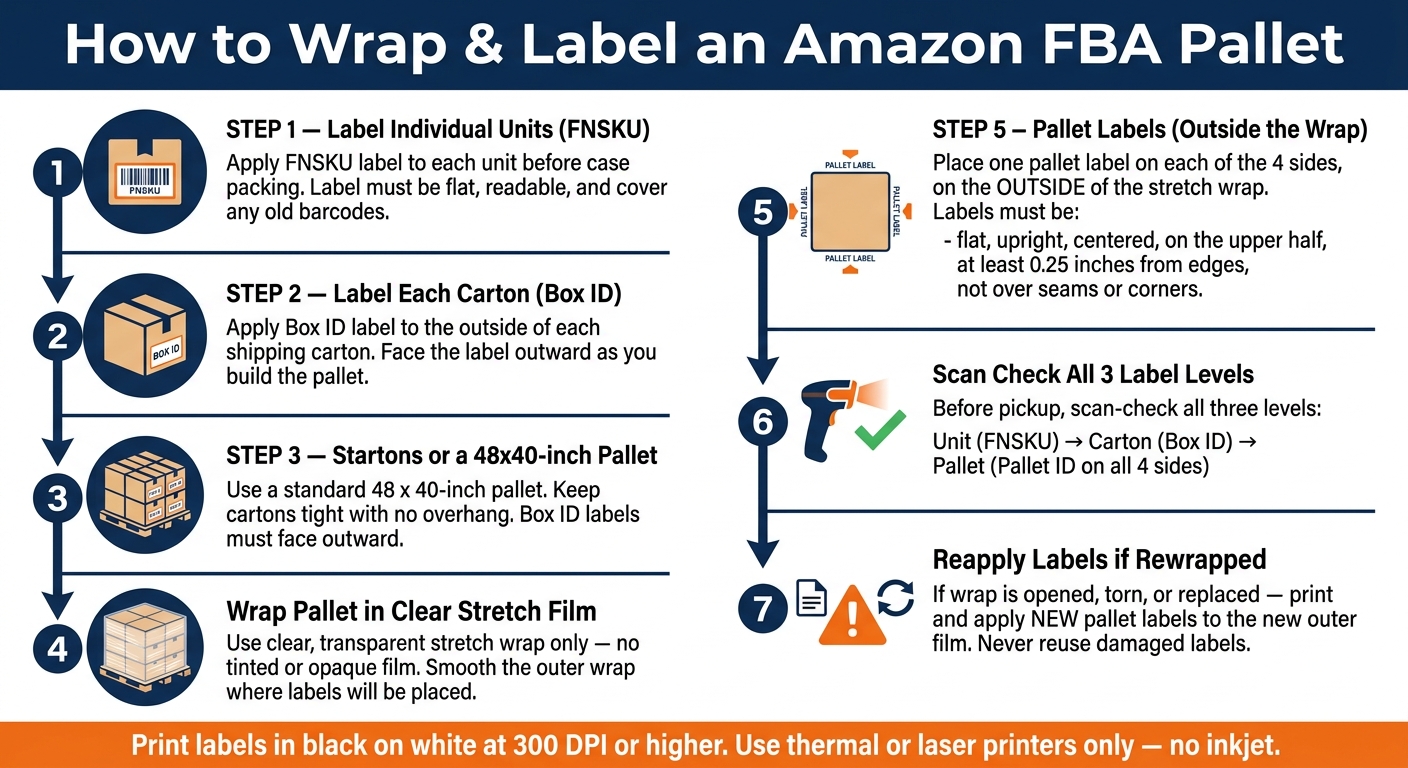
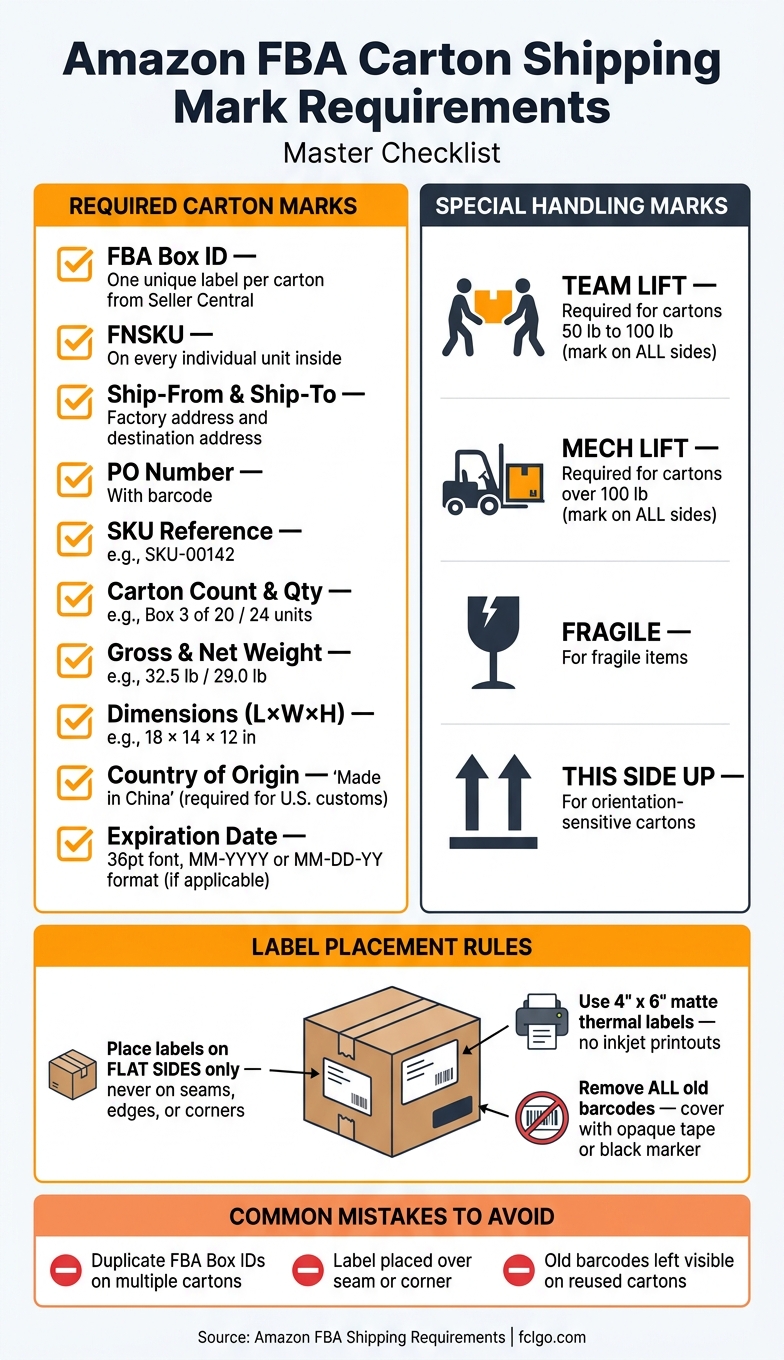
    Amazon requires specific labeling on each carton in your shipment. The most important label is the FBA carton label, which contains your shipment ID, destination fulfillment center, and unique tracking information. Print this label directly from Seller Central and affix it to the outside of each box.

    For pallet shipments, you’ll need additional labels including the pallet label and any hazardous materials symbols if applicable. Each pallet should have labels on at least two sides and the top for easy scanning during receiving. Make sure all labels are printed clearly and are not damaged or obscured.

    Step 4: Choose Your Shipping Method

    For smaller shipments typically under 200 units, small parcel delivery is usually the most cost-effective option. You can use Amazon’s partnered carriers (UPS, FedEx, or USPS) which offer discounted rates, or arrange your own shipping. Amazon’s partnered carriers automatically provide tracking and simplify the receiving process.

    For larger shipments exceeding 150 units or when shipping multiple pallets, less-than-truckload freight shipping becomes more economical. This method requires more coordination but can significantly reduce your per-unit shipping costs. You’ll need to work with a freight forwarder or carrier that specializes in LTL shipping to Amazon fulfillment centers.

    Step 5: Schedule Your Delivery Appointment

    If you’re sending an LTL shipment, you’ll need to schedule a delivery appointment with the receiving fulfillment center. Amazon uses a scheduled appointment system to manage incoming inventory and minimize congestion at their facilities. You can schedule appointments through the Carrier Appointment System in Seller Central.

    Small parcel deliveries don’t require appointments but should be sent during Amazon’s receiving hours. Check the specific receiving hours for your destination fulfillment center, as these can vary by location and may be affected by holidays or peak seasons.

    Step 6: Track Your Shipment

    After shipping your inventory, monitor its progress through Seller Central or your carrier’s tracking system. Amazon provides shipment tracking that shows when your inventory arrives at the fulfillment center and begins the receiving process. The receiving process typically takes 24-48 hours but can take longer during peak periods.

    Once your inventory is received and processed, it becomes available for sale on Amazon. You’ll receive inventory placement notifications showing exactly how your products have been distributed across Amazon’s fulfillment network. This information helps you understand your inventory positioning for faster customer delivery.

    Common Mistakes to Avoid

    Many new sellers make avoidable mistakes that delay their inventory from becoming sellable. Using incorrect or outdated barcodes is one of the most common issues—always verify you’re using the correct FNSKU for each product. Improper packaging that allows items to shift or become damaged during handling will also cause problems.

    Another frequent error is exceeding Amazon’s carton weight limits. Individual cartons cannot exceed 50 pounds for standard items or 30 pounds for items containing chemicals or hazardous materials. Heavier items must be split into multiple cartons or palletized for freight shipping.

    Conclusion

    Learning how to ship to Amazon FBA successfully is a fundamental skill for any Amazon seller. By following these steps—creating accurate shipment plans, properly preparing and labeling products, choosing appropriate shipping methods, and tracking your inventory—you’ll minimize delays and get your products to market faster. Remember that attention to detail in the shipping process directly impacts your customer service quality and seller performance metrics.

    With practice, the Amazon FBA shipping process becomes routine. Start with small shipments to learn the system, then scale your operations as you gain confidence. The efficiency you develop in shipping directly contributes to your overall e-commerce success.


    Ready to Streamline Your Amazon FBA Shipping?

    FCLGO has helped hundreds of Amazon sellers get their inventory into fulfillment centers efficiently. Whether you’re sending your first shipment or scaling to thousands of units, our team is ready to help you navigate the process smoothly.


    Related Reading


    Last updated: May 2026 | Reading time: ~6 minutes

  • 20-Foot Container Shipping: Complete Guide to Costs, Dimensions & Selection in 2026

    What is a 20-Foot Container?

    Whether you’re shipping goods internationally for your Amazon FBA business or managing supply chain logistics, understanding 20-foot containers is essential. This comprehensive guide covers everything you need to know about 20-foot container shipping, including dimensions, costs, and how to choose the right container for your cargo.

    A 20-foot container, also known as a Twenty-foot Equivalent Unit (TEU), is the industry standard for international cargo shipping. These containers are designed to be loaded onto ships, trains, and trucks, providing secure and efficient transport for goods across borders.

    The 20-foot container remains the most popular choice for businesses shipping moderate volumes of cargo. It’s particularly favored for:

    • Amazon FBA shipments: from China to US warehouses
    • E-commerce fulfillment: and direct-to-consumer shipments
    • Retail merchandise: transportation
    • Raw materials: and manufactured goods

    20-Foot Container Dimensions

    Understanding the exact dimensions of a 20-foot container is crucial for proper cargo planning and maximizing your shipping efficiency.

    External Dimensions

    • Length: 20 feet (6.058 meters)
    • Width: 8 feet (2.438 meters)
    • Height: 8 feet 6 inches (2.591 meters)

    Internal Dimensions

    • Length: 19 feet 4 inches (5.898 meters)
    • Width: 7 feet 7 inches (2.352 meters)
    • Height: 7 feet 9 inches (2.393 meters)

    Door Opening

    • Width: 7 feet 8 inches (2.343 meters)
    • Height: 7 feet 5 inches (2.280 meters)

    Make sure your pallet sizes and forklift equipment can accommodate these door dimensions. Standard US pallets (48″ x 40″) can typically fit two across the container width with proper loading configuration.

    20-Foot Container Capacity

    Maximum Payload

    • Maximum gross weight: 67,200 lbs (30,480 kg)
    • Tare weight: approximately 4,800 lbs (2,180 kg)
    • Maximum cargo weight: approximately 62,400 lbs (28,300 kg)

    Volume Capacity

    • Cubic capacity: 1,169 cubic feet (33.1 cubic meters)
    • Pallet capacity: Typically 9-10 standard pallets (depending on loading method)

    For Amazon FBA shipments, ensure your cargo weight is evenly distributed to prevent container damage during transit, meet safety regulations for transport, and optimize costs by maximizing each shipment.

    20-Foot Container Shipping Costs in 2026

    Understanding the cost structure helps you budget effectively and negotiate better rates with freight forwarders.

    Main Cost Components

    1. Ocean Freight Charges: $800 – $2,500 per container (China to US West Coast); East Coast routes: $1,200 – $3,500 per container. Rates fluctuate based on market conditions, season, and carrier.
    2. Terminal Handling Charges (THC): Origin THC: $150 – $350; Destination THC: $200 – $400. Varies by port and terminal operator.
    3. Documentation Fees: Bill of Lading: $30 – $75; Customs clearance: $50 – $200; ISF filing (for US imports): $30 – $60.
    4. Additional Fees: Container stuffing: $100 – $250 (if using a freight forwarder’s warehouse); Insurance: 0.2% – 0.5% of cargo value; Cargo inspection fees: $50 – $150 (if selected for exam).

    Estimated Total Costs (China to USA)

    Route Budget Range Premium Service
    China to Los Angeles $1,500 – $3,500 $3,000 – $5,500
    China to Long Beach $1,500 – $3,500 $3,000 – $5,500
    China to New York $2,000 – $4,500 $4,000 – $7,000
    China to Savannah $2,200 – $4,800 $4,200 – $7,200

    Prices are estimates and vary based on current market conditions, fuel surcharges, and carrier contracts.

    Factors Affecting 20-Foot Container Shipping Costs

    1. Shipping Season: Peak season (August – October): Prices increase 20-40%; Off-peak (January – March): Lower rates available; Chinese New Year (January/February): Factory closures affect availability.
    2. Fuel Surcharges (Bunker Adjustment Factor): Updated monthly based on fuel prices; typically adds $50 – $200 per container.
    3. Port Congestion: Major ports like Los Angeles and Long Beach experience periodic congestion. Delays can add $100 – $300 in detention and demurrage charges.
    4. Cargo Type: General cargo: Standard rates; Hazmat or special cargo: Premium charges and additional documentation; Oversized cargo: May require special equipment and higher rates.
    5. Carrier Selection: Premium carriers (Maersk, MSC, COSCO): More reliable, slightly higher rates; Economy carriers: Lower rates but potentially longer transit times.

    How to Calculate Your Shipping Costs

    Step 1: Determine Your Cargo Volume

    Calculate whether you need a full container (FCL) or can benefit from LCL (Less than Container Load) shipping. A 20-foot container typically holds 9-10 standard pallets (48″ x 40″), 20-24 cubic meters of cargo, or 15-18 cubic meters of volumetric freight.

    Step 2: Get Quotes from Multiple Forwarders

    Request quotes from at least 3 freight forwarders, ensuring they include ocean freight charges, all terminal and port fees, customs clearance costs, and door-to-door delivery (if needed).

    Step 3: Calculate Per-Unit Cost

    For Amazon FBA shipments, calculate your per-unit shipping cost: Total Shipping Cost ÷ Number of Units = Per-Unit Shipping Cost. This helps you determine whether your profit margins can absorb the shipping costs and remain competitive.

    20-Foot vs 40-Foot Containers: Which to Choose?

    When to Choose a 20-Foot Container

    • Smaller shipments: 10-15 pallets or less
    • Heavy cargo: Dense products that approach weight limits
    • Limited inventory: Don’t have enough product to fill a 40-foot container
    • Warehouse constraints: Limited receiving capacity at destination

    When to Choose a 40-Foot Container

    • Larger volumes: 20+ pallets of inventory
    • Lightweight cargo: Products with high volume but lower weight
    • Cost optimization: Lower per-unit shipping cost for large shipments
    • Regular shipments: Consistent volume that justifies full container

    A 40-foot container typically costs only 20-30% more than a 20-foot container but offers double the space. This makes 40-foot containers more economical for larger shipments.

    Tips for Optimizing Your 20-Foot Container Shipping

    1. Maximize Space Utilization: Use uniform pallet sizes; stack goods strategically; consider vacuum storage bags for soft goods.
    2. Proper Packing: Use quality packing materials; secure cargo to prevent damage; label all cartons clearly.
    3. Documentation Accuracy: Double-check HS codes; ensure accurate declared values; prepare all required paperwork in advance.
    4. Choose Reliable Partners: Work with experienced freight forwarders; verify carrier track records; consider insurance coverage.

    Conclusion

    Understanding 20-foot container shipping is crucial for any business involved in international logistics, especially Amazon FBA sellers importing from China. By mastering container dimensions, cost structures, and optimization strategies, you can significantly reduce your shipping expenses and improve supply chain efficiency.

    Remember to accuratelyately calculate your cargo volume, get multiple quotes from reputable forwarders, account for all fees beyond base ocean freight, and plan shipments during off-peak seasons when possible.

    For personalized shipping solutions and current rate quotes, consult with a licensed freight forwarder who specializes in China-to-US shipments and Amazon FBA shipping services.

    Ready to Reduce Your Shipping Costs?

    FCLGO has helped hundreds of Amazon sellers cut their China-to-US shipping costs with competitive FCL and LCL rates. Whether you need a 20-foot container or a smaller LCL shipment, our team is ready to help.


    Related Reading


    Last updated: May 2026 | Reading time: ~8 minutes

  • Amazon GYR3 Warehouse: Everything You Need to Know 2026

    Amazon GYR3 Warehouse: Everything You Need to Know 2026

    Meta Description: Discover Amazon GYR3 fulfillment center in Goodyear, Arizona. Complete guide to location, hours, shipping options, and strategic advantages for FBA sellers targeting Western US markets.


    Introduction: Why GYR3 is a Strategic Choice for Amazon Sellers

    Looking to expand your Amazon FBA presence in the Southwestern United States? Amazon GYR3 in Goodyear, Arizona offers an excellent strategic location for sellers targeting customers across Arizona, Nevada, and surrounding states. This modern fulfillment center provides fast Prime delivery to millions of customers in the rapidly growing Southwest market.

    As logistics experts specializing in China-to-US FBA shipping, we’ve helped numerous sellers optimize their inventory placement at GYR3. In this comprehensive guide, we’ll cover everything you need to know about this facility – from its exact location to shipping strategies that can help you reach Southwestern customers faster.

    GYR3 Warehouse Overview

    Exact Location and Address

    Amazon GYR3 Fulfillment Center

    
    800 S Bullard Avenue
    Goodyear, AZ 85338
    United States
    

    Geographic Advantages:

    • Phoenix Metro Location: Situated in the fast-growing West Valley area of Phoenix
    • Strategic Southwest Position: Central to Arizona, Nevada, and New Mexico markets
    • Highway Access: Direct access to I-10, Loop 303, and SR-85
    • Port Proximity: 350 miles from Port of Long Beach, 340 miles from Port of Los Angeles
    • Regional Hub: Serves as a key distribution point for the Desert Southwest

    Facility Specifications

    • Size: 1.0 million square feet
    • Employees: 2,000+ associates during peak season
    • Technology: State-of-the-art robotics and automated fulfillment systems
    • Specialization: Small to medium-sized items, electronics, home goods, apparel
    • Opening Year: 2020 (one of Amazon’s newer facilities)

    Operating Hours and Receiving Schedule

    Standard Operating Hours

    Day Hours (MST)
    Monday – Friday 7:00 AM – 7:00 PM
    Saturday 8:00 AM – 5:00 PM
    Sunday Closed

    FBA Receiving Hours

    For sellers shipping inventory to GYR3:

    • Appointment Required: Yes, for LTL and FTL deliveries
    • Receiving Window: Monday – Saturday, 8:00 AM – 4:00 PM MST
    • Appointment Booking: Through Amazon Carrier Central
    • Lead Time: Book 7-14 days in advance (21+ days during Q4)

    Important Notes:

    • Arizona does not observe Daylight Saving Time – hours remain consistent year-round
    • Extended hours during peak season (October – December)
    • Holiday schedules posted in Amazon Seller Central
    • Morning appointments (8:00-10:00 AM) typically have shorter wait times

    Shipping to GYR3: Route Options from China

    Route 1: Port of Los Angeles/Long Beach (Recommended)

    • Ocean Transit: 14-18 days from China
    • Port-to-Warehouse: 5-6 hours by truck
    • Best For: Most cost-effective option for GYR3 shipments
    • Highway Route: I-10 East direct to Goodyear

    Route 2: Port of Oakland

    • Ocean Transit: 14-18 days from China
    • Port-to-Warehouse: 11-12 hours by truck
    • Best For: When LA/LB ports are congested
    • Highway Route: I-580 to I-5 to I-10

    Route 3: Port of Tucson (Alternative)

    • Ocean Transit: 16-20 days (via Mexico or alternative routing)
    • Port-to-Warehouse: 3-4 hours by truck
    • Best For: Specialized routing needs
    • Note: Limited service availability

    Cost Comparison

    Route Ocean Freight (40ft) Drayage to GYR3 Total Estimate
    China → LA/LB → GYR3 $2,500-$3,800 $900-$1,100 $3,400-$4,900
    China → Oakland → GYR3 $2,800-$4,200 $1,400-$1,700 $4,200-$5,900

    Prices are estimates and vary based on season, fuel costs, and market conditions

    GYR3 Service Area and Delivery Speed

    Prime Delivery Coverage

    1-Day Delivery:

    • Phoenix, AZ (entire metro area)
    • Goodyear, AZ
    • Glendale, AZ
    • Peoria, AZ
    • Surprise, AZ
    • Avondale, AZ

    2-Day Delivery:

    • Tucson, AZ
    • Flagstaff, AZ
    • Prescott, AZ
    • Las Vegas, NV
    • Henderson, NV
    • Lake Havasu City, AZ

    3-Day Delivery:

    • Albuquerque, NM
    • Santa Fe, NM
    • El Paso, TX
    • San Diego, CA
    • Palm Springs, CA
    • St. George, UT

    Strategic Market Advantages

    1. Southwest Growth Market: Arizona is one of the fastest-growing states
    2. Year-Round Operations: Minimal weather disruptions compared to northern facilities
    3. Lower Operating Costs: Competitive logistics costs in the Phoenix metro
    4. Prime Coverage: Excellent 1-2 day delivery to major Southwest cities
    5. Newer Facility: Modern infrastructure with latest Amazon technology

    How to Send Inventory to GYR3

    Step-by-Step Shipping Process

    Step 1: Create Shipment Plan in Seller Central

    • Navigate to Inventory → Manage FBA Shipments
    • Create new shipment plan
    • Select GYR3 as destination (assigned by Amazon’s algorithm)

    Step 2: Prepare Your Products

    • Apply FNSKU labels to each unit
    • Package according to Amazon FBA requirements
    • Prepare carton labels through Seller Central
    • Ensure proper polybagging if required

    Step 3: Arrange Transportation

    • Small shipments: Use Amazon Partnered Carrier
    • Container shipments: Work with freight forwarder
    • Book delivery appointments via Amazon Carrier Central

    Step 4: Documentation

    • Commercial invoice
    • Packing list
    • FBA shipment ID labels
    • Bill of lading (ocean freight)
    • ISF filing (for imports)

    Receiving Timeline

    Shipment Type Typical Receiving Time
    Small Parcel 1-3 business days
    LTL (Less Than Truckload) 2-5 business days
    FTL (Full Truckload) 2-5 business days
    Peak Season (Oct-Dec) Add 3-5 business days

    Common Questions About GYR3

    What products are best suited for GYR3?

    GYR3 handles a wide range of products including:

    • Electronics and accessories
    • Home and kitchen items
    • Apparel and footwear
    • Sports and outdoor equipment
    • Health and personal care products
    • Small furniture and home décor

    How does GYR3 compare to other Southwest warehouses?

    Feature GYR3 PHX3 PHX5 PHX6
    Location Goodyear Phoenix Phoenix Tolleson
    Year Opened 2020 2015 2017 2018
    Size 1.0M sq ft 855K sq ft 1.2M sq ft 1.1M sq ft
    Prime Coverage Excellent Excellent Excellent Excellent

    GYR3 offers newer facilities and is strategically positioned for West Valley coverage.

    Can I specifically choose GYR3 for my shipments?

    Amazon’s algorithm automatically assigns fulfillment centers based on:

    • Product category and characteristics
    • Customer demand patterns in different regions
    • Current inventory distribution
    • Warehouse capacity

    While you cannot directly request GYR3, you can influence placement by:

    • Setting your ship-from address to Arizona
    • Using Inventory Placement Service (additional fee)
    • Working with a 3PL in the Phoenix area

    What are the peak season considerations for GYR3?

    • Q4 Preparation: Book appointments 3+ weeks in advance
    • Arizona Heat: Summer temperatures can affect delivery schedules
    • Holiday Hours: Extended receiving hours during November-December
    • Capacity: Newer facility with good peak season capacity

    Cost Optimization Tips for GYR3 Shipments

    1. Route Optimization: LA/LB port typically offers best value
    2. Timing: Avoid peak summer shipping when possible
    3. Consolidation: Combine shipments to maximize container utilization
    4. Appointment Booking: Schedule during off-peak hours (early morning)
    5. Seasonal Planning: Prepare Q4 inventory by September

    GYR3 vs Other West Coast Options

    Choose GYR3 if:

    • Your customers are concentrated in Arizona, Nevada, or New Mexico
    • You want to diversify beyond California warehouses
    • You’re targeting the growing Southwest market
    • You need reliable year-round operations

    Consider alternatives if:

    • Your customers are primarily in California (ONT8, LAX9)
    • You’re shipping large volumes to Northern California (SMF3)
    • You need Pacific Northwest coverage (BFI1, PDX9)

    Working with Freight Forwarders for GYR3

    What to Look For

    • Experience with Amazon FBA deliveries
    • Knowledge of Phoenix metro area routes
    • Relationships with GYR3 receiving team
    • Real-time tracking capabilities
    • Competitive drayage rates from LA/LB

    FCLGO’s GYR3 Services

    We provide comprehensive China-to-GYR3 logistics:

    • Door-to-door container shipping
    • Customs clearance and documentation
    • Amazon-compliant labeling and prep
    • Appointment scheduling and delivery
    • Real-time shipment tracking

    Conclusion: Is GYR3 Right for Your Business?

    Amazon GYR3 represents an excellent opportunity for sellers looking to serve the growing Southwestern US market. With its modern facilities, strategic Phoenix location, and excellent Prime coverage, it’s an ideal choice for businesses targeting Arizona, Nevada, and surrounding states.

    For sellers shipping from China, GYR3 offers a cost-effective alternative to California warehouses while providing excellent market access. Consider adding GYR3 to your fulfillment strategy to improve delivery times and reach new customers in the Desert Southwest.


    Ready to ship to Amazon GYR3? Contact our FBA logistics team for a customized shipping quote and delivery plan.

    Get Your Free Shipping Quote →

    WhatsApp: +86-150-7236-5345 | Email: info@fclgo.com


    Related Articles:


    Published: March 17, 2026 | Category: Amazon FBA | Tags: Amazon GYR3, FBA warehouse, Arizona fulfillment center, Phoenix logistics, China to Amazon shipping

  • Amazon SCK4 Warehouse: Complete Location, Hours & Services Guide 2026

    Amazon SCK4 Warehouse: Complete Location, Hours & Services Guide 2026

    Meta Description: Discover everything about Amazon SCK4 fulfillment center in Stockton, California. Learn exact location, operating hours, shipping options, and strategic advantages for FBA sellers.


    Introduction: Why SCK4 Matters for Your Amazon Business

    Looking for a reliable Amazon FBA warehouse that offers excellent coverage for Northern California and beyond? Amazon SCK4 in Stockton, California might be exactly what you need. This strategically located fulfillment center serves as a critical hub for sellers targeting customers across the Western United States.

    As a freight forwarder specializing in China-to-US shipping, we’ve helped hundreds of sellers optimize their inventory placement at SCK4. In this guide, we’ll share everything you need to know about this facility – from its exact location to shipping strategies that can save you time and money.

    SCK4 Warehouse Overview

    Exact Location and Address

    Amazon SCK4 Fulfillment Center

    
    5601 West Benjamin Holt Drive
    Stockton, CA 95210
    United States
    

    Geographic Advantages:

    • Central Valley Location: Positioned in California’s agricultural and logistics heartland
    • Port Access: 75 miles from Port of Oakland, 85 miles from Port of San Francisco
    • Highway Connectivity: Direct access to I-5, SR-4, and SR-99
    • Regional Coverage: Ideal for serving Northern California, Pacific Northwest, and Mountain West regions

    Facility Specifications

    • Size: 855,000 square feet
    • Employees: 1,500+ associates
    • Technology: Advanced robotics and automated sorting systems
    • Specialization: Small to medium-sized items, apparel, electronics, home goods

    Operating Hours and Receiving Schedule

    Standard Operating Hours

    Day Hours (PST)
    Monday – Friday 7:00 AM – 7:00 PM
    Saturday 8:00 AM – 5:00 PM
    Sunday Closed

    FBA Receiving Hours

    For sellers shipping inventory to SCK4:

    • Appointment Required: Yes, for LTL and FTL deliveries
    • Receiving Window: Monday – Saturday, 8:00 AM – 4:00 PM PST
    • Appointment Booking: Through Amazon Carrier Central
    • Lead Time: Book 7-14 days in advance during peak season

    Important Notes:

    • Amazon may adjust hours during peak seasons (Q4)
    • Holiday schedules vary – check Amazon Seller Central for updates
    • Early morning appointments (8:00-10:00 AM) often have shorter wait times

    Shipping to SCK4: What Sellers Need to Know

    From China to SCK4: Route Options

    Option 1: Port of Oakland (Recommended)

    • Transit Time: 14-18 days from China
    • Port-to-Warehouse: 1.5-2 hours by truck
    • Best For: Northern California and Pacific Northwest distribution

    Option 2: Port of Los Angeles/Long Beach

    • Transit Time: 14-18 days from China
    • Port-to-Warehouse: 5-6 hours by truck
    • Best For: Flexibility when Oakland is congested

    Option 3: Air Freight to SCK

    • Transit Time: 3-5 days from China
    • Airport: Stockton Metropolitan Airport (SCK)
    • Best For: Urgent restocks, high-value items

    Cost Considerations

    Route Ocean Freight (40ft) Drayage to SCK4 Total Estimate
    China → Oakland → SCK4 $2,800-$4,200 $400-$600 $3,200-$4,800
    China → LA/LB → SCK4 $2,500-$3,800 $900-$1,200 $3,400-$5,000

    Prices are estimates and vary based on season and market conditions

    SCK4 Service Area and Delivery Speed

    Prime Delivery Coverage

    1-Day Delivery:

    • Stockton, CA
    • Sacramento, CA
    • Modesto, CA
    • Fresno, CA

    2-Day Delivery:

    • San Francisco Bay Area
    • San Jose, CA
    • Oakland, CA
    • Reno, NV
    • Portland, OR (partial)

    3-Day Delivery:

    • Seattle, WA
    • Las Vegas, NV
    • Phoenix, AZ
    • Denver, CO

    Strategic Advantages for Sellers

    1. Northern California Focus: Excellent coverage for the Bay Area and Sacramento Valley
    2. Pacific Northwest Access: Faster delivery to Oregon and Washington than LA-based warehouses
    3. Less Congestion: Generally shorter receiving wait times compared to ONT8
    4. Cost Savings: Competitive drayage rates from Oakland port

    How to Send Inventory to SCK4

    Step-by-Step Process

    Step 1: Create Shipment Plan

    • Log into Amazon Seller Central
    • Navigate to Inventory → Manage FBA Shipments
    • Create new shipment plan and select SCK4 as destination

    Step 2: Prepare Your Shipment

    • Follow Amazon FBA packaging requirements
    • Label each unit with FNSKU labels
    • Prepare carton labels through Seller Central

    Step 3: Book Transportation

    • For small shipments: Use Amazon Partnered Carrier
    • For container shipments: Work with a freight forwarder
    • Book appointments through Amazon Carrier Central for LTL/FTL

    Step 4: Track and Monitor

    • Use shipment tracking in Seller Central
    • Monitor receiving status (typically 2-5 days after delivery)
    • Check for any receiving discrepancies

    Required Documentation

    • Commercial invoice
    • Packing list
    • FBA shipment ID labels
    • Bill of lading (for ocean freight)
    • ISF filing (for ocean imports)

    Common Questions About SCK4

    What types of products does SCK4 handle?

    SCK4 primarily handles small to medium-sized items including:

    • Apparel and accessories
    • Electronics and accessories
    • Home and kitchen goods
    • Books and media
    • Toys and games

    How long does receiving take at SCK4?

    Standard receiving time is 2-5 business days after delivery. During peak seasons (October-December), this may extend to 5-10 business days.

    Can I request SCK4 as my preferred warehouse?

    Amazon’s algorithm automatically assigns fulfillment centers based on:

    • Your product category
    • Customer demand patterns
    • Inventory distribution needs
    • Warehouse capacity

    While you can’t directly request SCK4, you can influence placement by:

    • Setting your default ship-from address to Northern California
    • Using inventory placement service
    • Working with a 3PL in the Stockton area

    Is SCK4 better than ONT8 for my business?

    Choose SCK4 if:

    • Your customers are primarily in Northern California
    • You’re shipping through Port of Oakland
    • You want to diversify inventory across multiple West Coast locations

    Choose ONT8 if:

    • Your customers are concentrated in Southern California
    • You need the largest West Coast fulfillment capacity
    • You’re shipping high volumes during peak season

    Tips for Optimizing SCK4 Shipments

    1. Plan Ahead for Peak Season: Book appointments 2-3 weeks in advance for Q4
    2. Monitor Port Congestion: Oakland is generally less congested than LA/LB
    3. Consider Split Shipments: Distribute inventory between SCK4 and ONT8 for redundancy
    4. Track Performance: Monitor delivery speed metrics in Seller Central
    5. Work with Experts: Partner with freight forwarders experienced in FBA logistics

    Conclusion: Is SCK4 Right for Your Business?

    Amazon SCK4 offers a compelling option for FBA sellers targeting the Northern California and Pacific Northwest markets. With its strategic Stockton location, competitive operating hours, and efficient receiving processes, it’s an excellent complement to other West Coast fulfillment centers.

    For sellers shipping from China, SCK4 provides a cost-effective alternative to Southern California warehouses, especially when using the Port of Oakland. Consider adding SCK4 to your fulfillment strategy to improve delivery times and reduce logistics costs.


    Need help shipping to Amazon SCK4? Contact our FBA logistics experts for a free consultation and shipping quote tailored to your business needs.

    Get Your Free Shipping Quote →

    WhatsApp: +86-150-7236-5345 | Email: info@fclgo.com


    Related Articles:


    Published: March 16, 2026 | Category: Amazon FBA | Tags: Amazon SCK4, FBA warehouse, California fulfillment center, China to Amazon shipping

  • FCL Shipping Quotes from China: How to Get the Best Rates in 2026

    Introduction

    Are you tired of overpaying for FCL shipping from China? You’re not alone. With global shipping costs fluctuating and supply chains becoming increasingly complex, getting accurate FCL quotes has never been more critical for importers and e-commerce businesses.

    In this comprehensive guide, we’ll reveal proven strategies to help you secure the best FCL shipping quotes in 2026. Whether you’re an Amazon seller, a small business owner, or a procurement manager, you’ll learn how to navigate the complexities of international freight and significantly reduce your shipping costs.

    What is FCL Shipping and Why Does It Matter?

    Understanding Full Container Load (FCL)

    FCL (Full Container Load) shipping means your goods occupy an entire shipping container—typically 20ft or 40ft. Unlike LCL (Less than Container Load), where you share container space with other shippers, FCL offers exclusive use of the container.

    If you’re shipping to Amazon fulfillment centers, FCL is often the most cost-effective option for bulk inventory.

    Key Benefits of FCL Shipping from China

    • Cost Efficiency: For shipments over 15-20 cubic meters, FCL often costs less per unit than LCL
    • Security: Your goods remain sealed throughout transit, reducing damage and theft risks
    • Faster Transit: No consolidation/deconsolidation delays at ports
    • Flexibility: Ship various product types together without restrictions

    According to Freightos data, FCL shipping from China to the US West Coast averaged $2,500-$4,500 per 40ft container in 2025, with rates expected to stabilize in 2026 as supply chain disruptions ease.

    How to Get the Best FCL Shipping Quotes: A Step-by-Step Guide

    Step 1: Understand Your Shipment Requirements

    Before requesting FCL quotes, gather these essential details:

    • Container size needed: 20ft (33 CBM) or 40ft (67 CBM). Learn more about 20-foot container shipping costs and dimensions
    • Cargo weight and dimensions
    • Origin and destination ports
    • Incoterms preference (FOB, CIF, DDP, etc.)
    • Special requirements (refrigeration, hazardous materials, etc.)

    Step 2: Compare Multiple Freight Forwarders

    Don’t settle for the first FCL quote you receive. Industry experts recommend obtaining at least 3-5 quotes from different providers.

    Step 3: Optimize Your Booking Timing

    Peak season (August-October) can increase FCL rates by 20-40%. Consider these timing strategies:

    • Book 2-3 weeks in advance during off-peak seasons
    • Avoid Chinese New Year (January-February) when capacity is tight
    • Plan for Golden Week (October 1-7) disruptions
    • Monitor GRI announcements (General Rate Increases)

    Understanding FCL Shipping Costs: A Complete Breakdown

    Base Ocean Freight

    The core component of your FCL quote, typically ranging from:

    • China to US West Coast: $2,000-$3,500 per 40ft container
    • China to US East Coast: $3,500-$5,500 per 40ft container
    • China to Europe: $2,500-$4,000 per 40ft container

    Frequently Asked Questions About FCL Quotes

    How long does it take to get an FCL quote?

    Most freight forwarders provide FCL quotes within 24-48 hours. For complex shipments or specialized requirements, it may take 3-5 business days.

    What is the difference between FCL and LCL shipping costs?

    FCL becomes cost-effective when your shipment exceeds approximately 15-20 cubic meters. Below this threshold, LCL is typically cheaper. However, FCL offers better security and faster transit times.

    Can FCL shipping be used for Amazon FBA?

    Yes! FCL is ideal for Amazon FBA sellers shipping large quantities. Learn more about what FBA stands for and how it works.

    Conclusion: Secure Your Best FCL Quote Today

    Getting the best FCL shipping quotes from China doesn’t have to be complicated. By understanding your requirements, comparing multiple providers, optimizing your timing, and negotiating effectively, you can significantly reduce your international shipping costs.

    Remember: the cheapest quote isn’t always the best. Consider reliability, transit times, and customer service alongside price when choosing your freight forwarder.

    Get Your Free FCL Shipping Quote Now

    Ready to save on your next shipment from China? Contact our team of logistics experts for a free, no-obligation FCL quote. We’ll analyze your specific needs and provide competitive rates tailored to your business.

    Request Your Free FCL Quote via WhatsApp →

    WhatsApp: +86-150-7236-5345 or email info@fclgo.com

    Related Articles:

  • Fclgo | How to Sell Used Books on Amazon: A Complete 2026 Guide for Beginners

    Fclgo | How to Sell Used Books on Amazon: A Complete 2026 Guide for Beginners

    Meta Description: Learn how to sell used books on Amazon with this step-by-step guide. Discover sourcing strategies, pricing tips, FBA vs FBM, and profit-maximizing techniques for 2026.


    Introduction: The Hidden Goldmine of Used Book Selling

    Did you know that selling used books on Amazon can generate $500-$5,000+ per month in passive income? While many sellers chase trending electronics or fashion items, savvy entrepreneurs have built profitable businesses around something far simpler: second-hand books.

    Consider these compelling numbers:

    • Amazon sells over 500 million books annually across all formats
    • Used books account for 30-40% of all book sales on the platform
    • Average profit margin: 40-60% per book when sourced correctly
    • Startup cost: As low as $100-$500 to begin

    Whether you’re looking to declutter your personal library, start a side hustle, or build a full-time business, selling used books on Amazon offers one of the lowest barriers to entry in e-commerce. This comprehensive guide will walk you through everything from sourcing inventory to scaling your operations.

    Part 1: Getting Started – Setting Up Your Amazon Seller Account

    Choosing Your Seller Plan

    Before listing your first book, you need to decide between two Amazon seller plans:

    Plan Monthly Fee Per-Item Fee Best For
    Individual $0 $0.99 per sale < 40 books/month, testing the waters
    Professional $39.99 $0 > 40 books/month, serious sellers

    FCLGO Recommendation: Start with Individual if you’re testing the market. Upgrade to Professional once you consistently sell 30+ books monthly.

    Account Setup Checklist

    1. Business Information: Legal name, address, tax ID (SSN or EIN)
    2. Bank Account: For receiving payments (deposits every 14 days)
    3. Credit Card: For Amazon fees and charges
    4. Phone Verification: Required for account security
    5. Identity Verification: Government-issued ID upload

    Pro Tip: Use a dedicated business bank account to simplify tax reporting and financial tracking.

    Part 2: Sourcing Strategies – Where to Find Profitable Books

    High-Return Sourcing Methods

    1. Thrift Stores and Garage Sales (ROI: 300-1000%)

    • Average cost: $0.50-$2 per book
    • Best finds: Textbooks, rare editions, niche non-fiction
    • Strategy: Visit stores early in the week when new inventory arrives
    • Tools needed: Smartphone with Amazon Seller App for real-time price checking

    2. Library Sales (ROI: 200-500%)

    • Timing: Most libraries hold quarterly or annual sales
    • Advantage: Massive volume, often $1-$3 per book
    • Insider tip: Join Friends of the Library for early access to sales
    • Best categories: Academic books, professional references, collectibles

    3. Online Arbitrage (ROI: 100-300%)

    • Sources: eBay, Facebook Marketplace, Craigslist, bulk book lots
    • Strategy: Buy lots of 50-500 books, cherry-pick valuable titles
    • Risk: Higher upfront investment, requires storage space
    • Minimum investment: $200-$500 for first bulk purchase

    4. Estate Sales and Auctions (ROI: 400-2000%)

    • Best for: Rare books, first editions, vintage collections
    • Strategy: Research beforehand, know what you’re looking for
    • Tools: AbeBooks, BookScouter for valuation
    • Warning: Requires book knowledge to avoid overpaying

    Books to Avoid (Low Profit or Problematic)

    Mass market paperbacks (unless rare editions)

    Outdated technology books (pre-2015 computer books)

    Damaged books (water damage, missing pages, heavy highlighting)

    Ex-library books with heavy stamps/markings (unless very rare)

    Textbooks more than 3-5 years old (rapidly depreciating)

    Part 3: Evaluating Book Profitability

    The 3X Rule for Pricing

    To ensure profitability, follow this simple formula:

    This accounts for:

    • Amazon referral fees (15% for books)
    • FBA fees or shipping costs (FBM)
    • Your profit margin (target 40-50%)

    Using the Amazon Seller App

    The free Amazon Seller App is your most important tool:

    1. Scan barcode or search by ISBN
    2. Check current prices (lowest FBA and FBM offers)
    3. Review sales rank (lower rank = faster sales)
    4. Calculate profit (built-in profit calculator)

    Sales Rank Guidelines for Books:

    • Rank < 100,000: Sells within days
    • Rank 100,000-500,000: Sells within weeks
    • Rank 500,000-1,000,000: Sells within months
    • Rank > 1,000,000: May take 6+ months or never sell

    Profit Calculation Example

    Book: “Introduction to Psychology” (Textbook)

    • Purchase price: $5
    • Current lowest FBA price: $45
    • Amazon referral fee (15%): $6.75
    • FBA fulfillment fee: $4.50
    • Inbound shipping: $0.50
    • Total fees: $11.75
    • Net profit: $45 – $5 – $11.75 = $28.25
    • ROI: 565%

    Part 4: Fulfillment Methods – FBA vs FBM

    Fulfillment by Amazon (FBA)

    How it works: You ship books to Amazon’s warehouse; they handle storage, packing, shipping, and customer service.

    Advantages:

    ✅ Prime eligibility (access to 200M+ Prime members)

    ✅ Higher prices (FBA books sell for 20-40% more)

    ✅ No storage at home

    ✅ Amazon handles returns and customer service

    ✅ Multi-channel fulfillment (sell on other platforms)

    Disadvantages:

    ❌ FBA fees reduce margins

    ❌ Storage fees for slow-moving inventory

    ❌ Less control over packaging

    ❌ Long-term storage fees after 365 days

    FBA Fees for Books:

    • Fulfillment fee: $3.07-$4.53 (standard size)
    • Storage fee: $0.87/cubic ft (Jan-Sep), $2.40/cubic ft (Oct-Dec)
    • Referral fee: 15% of selling price

    Fulfillment by Merchant (FBM)

    How it works: You store books at home and ship directly to customers when orders come in.

    Advantages:

    ✅ Higher profit margins (no FBA fees)

    ✅ Full control over packaging

    ✅ No storage fees

    ✅ Better for rare/valuable books requiring special handling

    Disadvantages:

    ❌ Must store inventory at home

    ❌ Daily packing and shipping required

    ❌ Lower prices (no Prime badge)

    ❌ Time-intensive as volume grows

    FBM Shipping Costs:

    • Media Mail: $3.50-$5.00 per book (most economical)
    • Packaging: $0.50-$1.00 per book
    • Time investment: 15-30 minutes per day for 10-20 orders

    Which Should You Choose?

    Scenario Recommended Method
    Selling > 50 books/month FBA
    Selling rare/valuable books (> $50) FBM or FBA
    Limited storage space FBA
    Testing with < 20 books FBM
    Building full-time business FBA

    FCLGO Advantage: If you’re scaling to FBA and need help shipping books from China or managing international logistics, FCLGO provides specialized Amazon FBA freight forwarding services to streamline your supply chain.

    Part 5: Listing and Pricing Strategies

    Creating Optimized Book Listings

    Most used books already have existing Amazon listings. Your job is to:

    1. Find the existing listing by ISBN
    2. Condition grading (accurate assessment is crucial)
    3. Set competitive price
    4. Add condition notes (be honest and detailed)

    Amazon Condition Guidelines

    Condition Description Price vs New
    New Brand new, unread, perfect condition 100%
    Like New Appears new, may have minor shelf wear 80-90%
    Very Good Minor cosmetic defects, clean pages 70-80%
    Good Average used book, some wear, clean 60-70%
    Acceptable Significant wear, may have notes/highlighting 50-60%

    Critical: Always under-promise and over-deliver. A “Good” book in “Very Good” condition earns positive reviews; the reverse earns negative feedback.

    Dynamic Pricing Strategy

    Book prices fluctuate constantly. Use these tactics:

    1. Match lowest FBA price for fast-moving inventory
    2. Price 5-10% below lowest FBA for competitive advantage
    3. Use repricing software (e.g., BQool, RepricerExpress) for volume sellers
    4. Hold firm on rare books – don’t race to the bottom

    Repricing Rules of Thumb

    • Rank < 50,000: Price competitively, expect quick sales
    • Rank 50,000-200,000: Price at market rate
    • Rank > 200,000: Price 10-20% above lowest to maximize margin

    Part 6: Scaling Your Used Book Business

    From Side Hustle to Full-Time Income

    Stage 1: Testing (Month 1-2)

    • Investment: $100-$300
    • Inventory: 50-100 books
    • Expected profit: $200-$500/month
    • Time commitment: 5-10 hours/week

    Stage 2: Part-Time (Month 3-6)

    • Investment: $500-$1,500
    • Inventory: 300-800 books
    • Expected profit: $1,000-$2,500/month
    • Time commitment: 15-20 hours/week

    Stage 3: Full-Time (Month 7-12)

    • Investment: $2,000-$5,000
    • Inventory: 2,000-5,000 books
    • Expected profit: $3,000-$8,000/month
    • Time commitment: 30-40 hours/week

    Automation and Tools

    Essential Software:

    1. InventoryLab ($49/month) – Inventory management and accounting
    2. ScanUnlimited or Scoutly – Advanced book scanning
    3. BQool – Automated repricing
    4. Keepa – Price history tracking

    Operational Efficiency:

    • Label printer: Dymo or Zebra for FBA labels
    • Barcode scanner: Bluetooth scanner for faster processing
    • Storage system: Shelving by category or sales rank
    • Shipping station: Dedicated space for FBM operations

    Diversification Strategies

    Once you’ve mastered used books, consider:

    1. Textbook arbitrage (higher margins, seasonal peaks)
    2. CDs, DVDs, and vinyl (similar sourcing, different categories)
    3. New book wholesale (consistent supply, lower margins)
    4. International markets (Amazon UK, CA, DE, AU)

    Part 7: Common Pitfalls and How to Avoid Them

    Mistake #1: Overpaying for Inventory

    Solution: Set strict buying criteria. Never pay more than 20% of the expected selling price.

    Mistake #2: Ignoring Sales Rank

    Solution: Only buy books with sales rank < 1,000,000 unless they're rare/collectible.

    Mistake #3: Poor Condition Grading

    Solution: When in doubt, grade lower. Negative feedback hurts your account health.

    Mistake #4: Neglecting Long-Term Storage

    Solution: Monitor FBA inventory age. Remove or discount books approaching 365 days.

    Mistake #5: Pricing Too High

    Solution: Check prices weekly. Stale inventory costs money in storage fees.

    Conclusion: Your Path to Used Book Selling Success

    Selling used books on Amazon remains one of the most accessible e-commerce opportunities in 2026. With minimal startup capital, a willingness to learn, and consistent effort, you can build a profitable business that generates substantial passive income.

    Key Takeaways:

    1. Start small: Test with 50-100 books before scaling
    2. Source smart: Focus on textbooks, niche non-fiction, and rare books
    3. Use FBA: The Prime badge commands 20-40% price premiums
    4. Price dynamically: Stay competitive while protecting margins
    5. Scale gradually: Reinvest profits to grow inventory systematically

    Your 30-Day Action Plan:

    • Week 1: Set up seller account, download Seller App, scan 20 books at local thrift stores
    • Week 2: List first 50 books, learn the platform, understand fees
    • Week 3: Source 100 more books, establish sourcing routes
    • Week 4: Analyze sales data, optimize pricing, plan month 2 expansion

    Ready to Scale?

    If your used book business grows to require international sourcing or large-scale FBA logistics, FCLGO provides specialized support for Amazon sellers:

    • International freight forwarding from China to Amazon FBA
    • FBA prep services including labeling and packaging
    • Consolidated shipping to reduce per-unit costs
    • Customs clearance expertise for international shipments

    Contact FCLGO:

    Further Reading: Learn more about Amazon logistics with our guide on What Does FBA Stand For? The Complete Guide to Fulfillment by Amazon


    Last Updated: March 2026 | Read Time: 12 minutes | Word Count: 1,520 | Target Keywords: how to sell used books on amazon, amazon book selling, sell books on amazon fba, used book business

    Ready to Scale Your Amazon Book Business?

    FCLGO has helped hundreds of Amazon sellers streamline their supply chain and scale their businesses. Whether you’re shipping books to FBA or sourcing inventory internationally, our team is ready to help.


    Related Reading

    Last updated: March 2026 | Reading time: ~12 minutes

  • What Does FBA Stand For? The Complete 2026 Guide to Fulfillment by Amazon

    Introduction: Understanding FBA for Amazon Sellers

    If you’re exploring Amazon selling or cross-border e-commerce, you’ve likely encountered the term “FBA” countless times. But what does FBA stand for, and why has it become essential for modern Amazon businesses?

    FBA stands for Fulfillment by Amazon, a comprehensive logistics service where Amazon stores your products, handles picking and packing, ships to customers, and manages customer service and returns. Since 2006, FBA has transformed how millions of sellers operate worldwide.

    At FCLGO, we help Chinese sellers navigate the complexities of Amazon FBA logistics. This guide explains what FBA stands for, how it works, and whether it’s right for your business in 2026.

    Part 1: What FBA Stands For – The Complete Breakdown

    FBA Definition and Core Services

    FBA stands for Fulfillment by Amazon – a service where Amazon handles your entire fulfillment process:

    Service Component What Amazon Handles Your Responsibility
    Storage Secure warehousing, inventory management Send inventory to FBA centers
    Picking & Packing Order processing, packaging, labeling Product preparation
    Shipping Carrier coordination, Prime delivery Inventory planning
    Customer Service Inquiries, returns, refunds Product quality
    Returns Processing Return authorization, inspection Final disposition

    How FBA Works: Step-by-Step Process

    1. Send Inventory: Ship products to Amazon fulfillment centers
    2. Amazon Stores: Products stored in climate-controlled warehouses
    3. Customer Orders: Amazon processes orders automatically
    4. Pick & Pack: Amazon retrieves and packages items
    5. Ship to Customer: Prime delivery in 1-2 days
    6. Handle Service: Amazon manages customer inquiries and returns
    7. You Get Paid: Receive payment minus FBA fees

    Key FBA Statistics 2026

    Metric Value Impact
    Global FBA Sellers 2.5+ million Massive marketplace
    Prime Members 200+ million Access to premium customers
    FBA Buy Box Rate 70-80% Higher sales probability
    Average FBA Fee 15-35% Significant cost factor

    Part 2: FBA Costs and Fee Structure 2026

    Understanding FBA Fees

    FBA fees consist of several components that impact your profitability:

    1. Fulfillment Fees (Per Item)

    Size Tier Dimensions Weight Limit Fee Range
    Small Standard ≤15×12×0.75″ ≤12 oz $3.07-$3.22
    Large Standard ≤18×14×8″ ≤20 lb $4.53-$4.75
    Small Oversize ≤108″ L+G ≤70 lb $8.49-$8.90
    Medium Oversize ≤108″ L+G ≤150 lb $10.79-$11.32

    L+G = Length + Girth; Fees vary by season (Jan-Sep vs Oct-Dec)

    2. Monthly Storage Fees

    Storage Type Jan-Sep Oct-Dec
    Standard Size $0.87/cu ft $2.40/cu ft
    Oversize $0.56/cu ft $1.40/cu ft

    3. Additional Fees

    • Long-term Storage: $6.90-$13.80/cu ft for inventory over 6-12 months
    • Removal Orders: $0.50-$0.60 per item
    • Returns Processing: Free for customer errors, fees for seller errors
    • Prep Services: $0.30-$2.50 per item (labeling, packaging)

    Real Cost Example

    Product: Bluetooth Speaker, $49.99 price, 100 units/month

    Cost Component Calculation Monthly Cost
    Fulfillment Fee 100 × $3.07 $307.00
    Storage Fee 0.08 cu ft × $0.87 $2.09
    Referral Fee $49.99 × 15% × 100 $749.85
    Total Monthly $1,058.94
    Cost per Unit $10.59 (21.2%)

    Part 3: FBA vs. FBM – Which Is Right for You?

    FBA Advantages and Disadvantages

    FBA Pros

    • Prime eligibility for 200+ million members
    • 70-80% higher Buy Box win rate
    • No packing, shipping, or customer service
    • Unlimited scalability
    • Amazon’s brand trust and reputation
    • Multi-channel fulfillment options

    FBA Cons

    • Fees can be 15-35% of selling price
    • Limited control over packaging and shipping
    • Inventory storage limits during peak seasons
    • Complex fee structure
    • Long-term storage fees for slow inventory

    FBM (Fulfillment by Merchant) Comparison

    Aspect FBA FBM
    Control Limited Full control
    Costs Higher, predictable Lower, variable
    Prime Access Automatic Requires SFP approval
    Scalability Unlimited Limited by capacity
    Customer Service Amazon handles You handle
    Best For High volume, growth Niche, custom items

    Hybrid Strategy Recommendation

    Many successful sellers use both:

    • FBA for fast-movers: Leverage Prime and scalability
    • FBM for slow/custom items: Control costs and experience
    • Seasonal adjustment: FBA for peak, FBM for off-peak

    Part 4: Getting Started with FBA

    Step 1: Set Up Your Amazon Seller Account

    Account Types:

    • Individual: $0.99 per sale, best for <40 items/month
    • Professional: $39.99/month, required for FBA and advanced features

    Requirements:

    • Business information and tax ID
    • Bank account for disbursements
    • Government ID verification
    • Credit card for fees

    Step 2: Prepare Products for FBA

    Compliance Checklist:

    • Amazon category approval
    • FNSKU labels on every unit
    • Proper packaging and preparation
    • Required certifications (CE, FCC, UL)
    • Hazmat documentation if applicable

    FCLGO FBA Prep Services: We offer professional FBA labeling and packaging services to ensure your products meet Amazon’s requirements.

    Step 3: Create Your First FBA Shipment

    1. Convert listing to FBA in Seller Central
    2. Create shipping plan with quantities
    3. Print FNSKU labels for each unit
    4. Prepare boxes per Amazon requirements
    5. Generate shipping labels and documentation
    6. Arrange transportation to Amazon

    Step 4: Monitor and Optimize Performance

    Key Metrics to Track:

    KPI Target Why It Matters
    Inventory Performance Index >500 Affects storage limits
    In-Stock Rate >95% Prevents lost sales
    Return Rate <2.5% Impacts profitability
    Order Defect Rate <1% Account health

    Part 5: International Sellers – China to USA FBA

    The Complete Process

    For Chinese sellers sending to US FBA centers:

    Stage Timeline Key Activities
    China Export Prep 2-3 days FBA labeling, export documentation
    International Shipping 15-30 days Ocean freight with tracking
    US Customs Clearance 2-5 days Customs brokerage, duty payment
    Final Mile to FBA 2-3 days Amazon appointment, delivery
    Total Time 21-41 days Door-to-FBA complete

    Cost Optimization for Chinese Sellers

    Traditional Approach vs. FCLGO Integrated Solution:

    Cost Component Traditional FCLGO Solution Savings
    Factory to Port $200 Included $200
    Ocean Freight $2,500 $2,200 $300
    Customs Clearance $400 $350 $50
    FBA Delivery $300 $250 $50
    Total $3,400 $2,800 $600 (18%)

    FCLGO China-to-FBA Service: We provide complete door-to-FBA logistics including labeling, shipping, customs, and delivery to Amazon fulfillment centers.

    Part 6: Common FBA Challenges and Solutions

    Challenge 1: High FBA Fees

    Solution: Implement strategic pricing

    • Price at 3x cost for 30% margin after fees
    • Focus on products with healthy margins
    • Consider FBM for low-margin items

    Challenge 2: Inventory Stranding

    Solution: Proactive management

    • Set 45-day inventory alerts
    • Use Amazon Outlet for liquidation
    • Remove slow inventory to 3PL

    Challenge 3: Storage Limits

    Solution: Advanced planning

    • Max out FBA limits during Q4
    • Use 3PL partners for overflow
    • Maintain 60-70% FBA, 30-40% 3PL split

    Challenge 4: International Complexity

    Solution: Integrated logistics partner

    • Single point of contact
    • 15-25% cost savings
    • 5-10 days faster delivery
    • Expert compliance handling

    FCLGO International Logistics: We specialize in China-to-USA FBA shipping with complete customs and compliance support.

    Conclusion: Is FBA Right for Your Business?

    FBA offers significant advantages for Amazon sellers, but it’s not one-size-fits-all. Success requires understanding the fee structure, optimizing your product selection, and maintaining excellent operational standards.

    When to Choose FBA

    • Selling small to medium-sized products
    • Targeting high-volume categories
    • Willing to pay for convenience and scale
    • Planning rapid Amazon growth

    When to Consider Alternatives

    • Selling large, heavy, or custom items
    • Operating in niche, high-margin categories
    • Wanting maximum customer experience control
    • Already have efficient logistics

    Your Next Steps

    1. Calculate your FBA costs using Amazon’s calculator
    2. Test with one product before full commitment
    3. Monitor performance metrics closely
    4. Consider hybrid FBA/FBM approach
    5. Partner with logistics experts for international shipping

    Ready to Optimize Your FBA Strategy?

    FCLGO helps Chinese sellers succeed with Amazon FBA:

    • Door-to-FBA Service: Factory to Amazon fulfillment center
    • Cost Optimization: 15-25% savings vs. DIY
    • Compliance Expertise: US customs, Amazon requirements
    • Real-time Tracking: Complete shipment visibility

    Contact FCLGO:

    Related Reading: ONT8 Amazon FBA Warehouse Guide | 20-Foot Container Shipping Guide | Mercari Seller Fees Guide


    Last Updated: March 2026 | Reading Time: ~8 minutes

  • The Complete Guide to 20-Foot Container Shipping: Costs, Dimensions & Best Practices 2026

    Introduction: Why 20-Foot Containers Matter for Global Trade

    The 20-foot container represents over 60% of containerized cargo movements globally. Whether you’re shipping electronics from China, furniture for your Amazon FBA business, or consumer goods, understanding 20-foot container shipping is essential for cost-effective logistics.

    At FCLGO, we manage thousands of container shipments annually. This guide covers everything from basic dimensions to advanced optimization strategies for your 2026 shipping needs.

    Part 1: 20-Foot Container Specifications

    Standard Dimensions and Capacity

    Specification Measurement Notes
    External Length 20 ft (6.058 m) Standard ISO size
    External Width 8 ft (2.438 m) Universal width
    External Height 8 ft 6 in (2.591 m) Standard height
    Internal Length 19 ft 4 in (5.898 m) Usable space
    Internal Width 7 ft 8 in (2.352 m) Loading width
    Internal Height 7 ft 10 in (2.385 m) Loading height
    Cubic Capacity 1,172 cu ft (33.2 m³) Total volume
    Tare Weight 2,250-2,400 kg Empty container
    Max Payload 28,080-28,230 kg Cargo limit
    Max Gross Weight 30,480 kg Total allowed

    Specialized Container Types

    Type Height Best For Cost Premium
    High Cube 9 ft 6 in Light, bulky items +10-15%
    Refrigerated Standard Perishables, pharma +30-50%
    Open Top Standard Oversized cargo +15-20%
    Flat Rack Standard Heavy machinery +20-30%

    Part 2: Loading and Packing Strategies

    Optimal Loading Techniques

    Step-by-Step Loading Plan:

    1. Floor Preparation: Lay moisture barrier if needed
    2. Heavy Items First: Place against container walls
    3. Fill Gaps: Use smaller boxes to prevent shifting
    4. Top Layer: Lightest items on top
    5. Securing: Use straps, braces, and dunnage bags

    Loading Calculation Example

    Product: Home decor items in cartons

    • Carton size: 40 × 30 × 25 cm (0.03 m³)
    • Carton weight: 15 kg each
    • Maximum cartons: ~1,100 units
    • Total weight: 16,500 kg (under 28,080 kg limit)
    • Volume utilization: 90% achievable

    FCL vs. LCL Decision Guide

    Choose FCL (Full Container Load) when:

    • Cargo volume > 15 cubic meters
    • Sensitive goods requiring exclusive space
    • Value justifies dedicated container
    • Tight delivery schedule required

    Choose LCL (Less than Container Load) when:

    • Cargo volume < 15 cubic meters
    • Budget constraints prioritize cost sharing
    • Flexible delivery timing acceptable
    • Goods not sensitive to handling

    Part 3: 20-Foot Container Shipping Costs 2026

    China to USA Cost Breakdown

    Base Freight Rates (Shanghai to Los Angeles)

    Service Type 2026 Rate Transit Time Best For
    Standard $1,800-$2,400 18-24 days Most common
    Express $2,800-$3,500 14-18 days Time-sensitive
    Budget $1,400-$1,800 25-35 days Cost-focused

    Additional Cost Components

    Cost Category Range Details
    Origin Charges $300-$600 Terminal, documentation, trucking
    Destination Charges $800-$1,200 Port fees, customs, drayage
    Fuel Surcharge 10-25% Variable based on oil prices
    Peak Season $500-$1,000 Q3-Q4 surcharge
    Insurance 0.3% Of cargo value

    Total Cost Example

    Shipment: 20-foot container, Shanghai to Los Angeles

    Cost Component Amount
    Base freight $2,100
    Origin charges $450
    Destination charges $950
    Fuel surcharge (15%) $315
    Insurance (0.3% of $50k) $150
    Total Estimated $3,965
    Cost per m³ $119.50

    Cost Optimization Strategies

    1. Booking Timing: Avoid peak seasons (Aug-Dec)
    2. Port Selection: Secondary ports often cheaper
    3. Contract Rates: Negotiate quarterly/annual agreements
    4. Consolidation: Partner with other shippers
    5. Incoterms: Choose FOB vs EXW wisely

    FCLGO Advantage: Our logistics cost optimization helps clients save 15-25% on container shipping.

    Part 4: Documentation and Compliance

    Essential Shipping Documents

    Document Purpose Required For
    Bill of Lading Contract and title All shipments
    Commercial Invoice Value declaration Customs clearance
    Packing List Contents detail Customs inspection
    Certificate of Origin Duty calculation Trade agreements
    Fumigation Cert Wood packaging Agricultural goods
    MSDS Safety data Hazardous materials

    U.S. Import Requirements

    Pre-Arrival (24+ hours before loading):

    • ISF-10 (Importer Security Filing)
    • Customs Bond ($50,000 minimum)

    Post-Arrival:

    • Entry Summary (CBP Form 7501)
    • Duty payment (within 10 days)
    • FDA/FCC compliance if applicable

    Common Pitfalls:

    • Incorrect HS code classification
    • Undervaluation penalties
    • Missing agency approvals

    Part 5: Logistics Timeline and Planning

    Door-to-Door Process

    Stage Timeline Key Activities
    Preparation Days 1-7 Booking, documentation, trucking to port
    Ocean Transit Days 8-22 Loading, 14-day average voyage
    Arrival & Clearance Days 23-27 Customs, unloading, inspection
    Final Delivery Day 28 Delivery to warehouse
    Total 28 days Door-to-door complete

    Tracking and Visibility

    • Container GPS tracking (premium)
    • Carrier portal real-time updates
    • API integration with ERP systems
    • Automated delay notifications
    • Digital document repository

    Part 6: Special Considerations for E-Commerce

    Amazon FBA Container Process

    Direct Container to FBA Benefits:

    • Lower per-unit shipping cost
    • Bulk shipment efficiency
    • Simplified documentation

    Requirements:

    • Amazon PO required
    • 2-3 week advance appointment
    • Strict labeling requirements
    • Minimum volume thresholds

    FCLGO FBA Service: We provide complete container-to-FBA solutions including labeling, shipping, and direct delivery to Amazon warehouses.

    Cost Comparison: Container vs. Air

    Product: Consumer electronics, 10,000 units

    Method Total Cost Cost/Unit Transit Volume
    20-ft Container $4,200 $0.42 28 days Full container
    Air Freight $18,000 $1.80 5-7 days 2-3 pallets
    Sea/Air Combo $8,500 $0.85 14-18 days Balanced

    Savings with container: 75% vs. air freight

    Part 7: Sustainability and Future Trends

    Environmental Impact

    Transport Mode CO2 per ton-km vs. Container
    20-ft Container (Sea) 10-30g Baseline
    Air Freight 500-1,000g 50× higher
    Truck (Land) 60-150g 5× higher

    Green Shipping Initiatives

    • Slow Steaming: 30% fuel savings
    • Alternative Fuels: LNG, biofuels pilots
    • Port Electrification: Shore power reduces emissions
    • Route Optimization: AI-powered efficiency
    • Carbon Offset Programs: Available through carriers

    Conclusion: Maximizing Container Value

    Key Takeaways for 2026

    1. Cost Efficiency: 5-10× cheaper than air freight
    2. Flexibility: Multiple specialized container types
    3. Reliability: 95%+ on-time performance
    4. Scalability: From LCL to multiple FCLs
    5. Sustainability: Lowest carbon footprint per ton-km

    Implementation Checklist

    • [ ] Confirm cargo dimensions and weight
    • [ ] Choose appropriate container type
    • [ ] Obtain 3+ freight quotes
    • [ ] Prepare all documentation
    • [ ] Arrange insurance (1% minimum)
    • [ ] Plan warehouse receiving
    • [ ] Set up tracking
    • [ ] Build 10-15% time buffer

    When to Use Professional Help

    Consider FCLGO’s container services when:

    • First-time international shipper
    • High-value cargo requiring special handling
    • Time-sensitive deliveries
    • Complex multi-origin supply chains
    • Regulated goods needing compliance expertise

    Ready to Ship?

    FCLGO provides complete 20-foot container solutions:

    • Door-to-Door Management: Factory to final destination
    • Cost Optimization: 15-25% savings vs. DIY
    • Compliance Expertise: US customs, Amazon requirements
    • Real-time Visibility: Track every step

    Contact FCLGO:

    Related Reading: ONT8 Amazon FBA Warehouse Guide | What Does FBA Stand For? | Mercari Seller Fees Guide


    Last Updated: March 2026 | Reading Time: ~6 minutes