How to Ship from China to Amazon FBA: Step by Step
Shipping from China to Amazon FBA comes down to four jobs: prep the goods at the factory, pick the right freight method, build the Amazon shipment correctly, and clear U.S. customs without errors. If you miss a step, costs can jump fast – for example, a late ISF filing can lead to a $5,000 penalty, and ocean freight often takes 20 to 40+ days.
If I wanted the short version, I’d focus on this:
- Set shipping terms early so the supplier, forwarder, and broker know who handles what
- Make units and cartons FBA-ready in China to avoid relabeling and repacking after arrival
- Choose freight by volume, timing, and stock risk:
- Express: 3–7 days
- Air: 5–10 days
- Ocean LCL: 25–40 days
- Ocean FCL: 20–35 days
- Create the FBA shipment in Seller Central with the right unit labels, carton labels, and pallet rules
- Use correct customs documents and HTS codes and file ISF on time for ocean shipments
- Plan for Amazon receiving time, which is often 3 to 7 business days after delivery
A few numbers matter more than most:
- Cartons should stay under 25 inches per side
- Boxes from 50 to 100 lbs need Team Lift labels
- Boxes over 100 lbs need Mech Lift labels
- Ocean freight usually needs 2 to 3 months of planning when lead times, port delays, customs, and receiving are added together
Here’s the simple takeaway: if your labels, carton data, shipping mode, and customs paperwork are right before pickup, the rest of the move is much easier. The article below walks through that process from supplier prep to final check-in at Amazon.
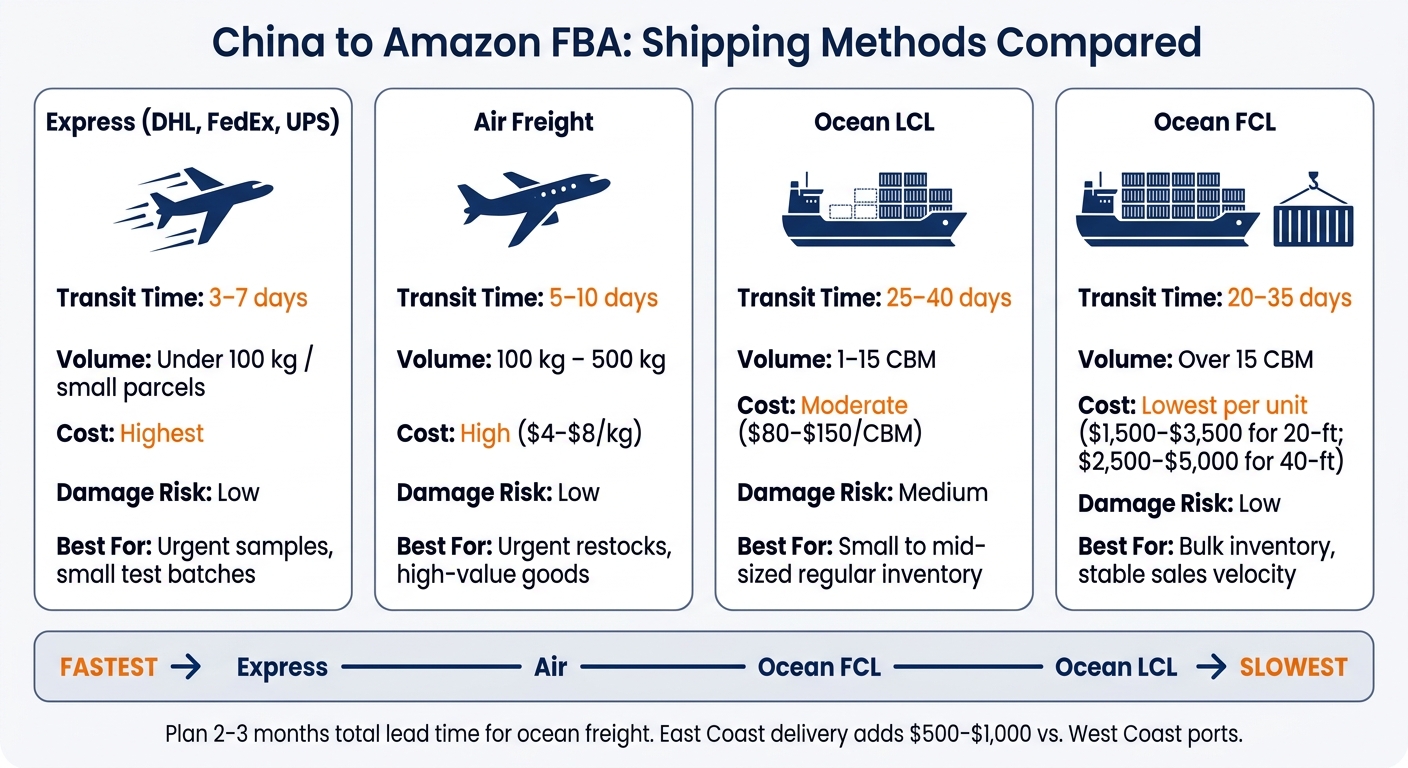
China to Amazon FBA: Shipping Methods Compared
How to Create an Amazon FBA Shipping Plan From China or USA – Prepare, Package and Ship Products FBA
sbb-itb-f9a91f9
1. Prepare the Shipment at the Supplier Stage
Set supplier duties, timing, and FBA prep before you book freight. Once the goods are labeled, counted, and backed by the right paperwork, you can pick the shipping method with a lot less guesswork.
Set Incoterms, Production Dates, and Shipping Responsibility
Choose Incoterms before production wraps up. FOB is a common setup: the supplier handles the goods until they’re loaded at the origin port, and then your forwarder takes it from there.
You’ll also want to confirm the Cargo Ready Date. That’s the day production is done and the shipment is ready for pickup. Start with your target Amazon in-stock date, then work backward to leave enough time for transit, customs clearance, prep work, and Amazon’s receiving window.
A pre-shipment inspection in China is worth doing before anything leaves the factory. It helps catch quality defects, label mistakes, wrong carton counts, and packing issues while there’s still time to fix them.
Make Products Amazon-Ready Before They Leave China
Meet FBA rules in China. Fixes after arrival usually cost more and slow everything down.
Each unit needs the right FNSKU label. For protection, use approved materials like air pillows, bubble wrap, or sheet foam. Loose-fill options such as packing peanuts or shredded paper aren’t allowed. If the product has an expiration date, the marking must match Amazon’s format and font-size rules. Items with less than 90 days of shelf life left may be destroyed by Amazon.
Each carton also has to meet Amazon’s size and weight rules. No side can be more than 25 inches. Cartons that weigh 50 lbs to 100 lbs need a "Team Lift" label. Anything above 100 lbs needs a "Mech Lift" label.
Get the following details from your supplier. These are the exact inputs you’ll need for booking, labeling, and customs paperwork:
| Data Category | What You Need |
|---|---|
| Carton Level | Total carton count, carton dimensions (L × W × H, in inches), carton weight (lb), total CBM |
| Product Level | Total units per SKU, FNSKU accuracy, HS Code, country of origin |
| Documentation | Commercial Invoice (unit price, total value), Packing List |
Use inches and pounds so the data flows into Seller Central without format issues.
With the cargo ready, the next step is building the Amazon shipment.
2. Choose the Right Shipping Method From China to the USA
Pick your shipping method based on four things: volume, timeline, landed cost, and stock risk.
Compare Express, Air, Ocean LCL, and Ocean FCL
| Shipping Method | Transit Time | Volume Range | Cost Profile | Damage Risk | Best Use Case |
|---|---|---|---|---|---|
| Express (DHL, FedEx, UPS) | 3–7 days | Under 100 kg / small parcels | Highest | Low | Urgent samples, small test batches |
| Air Freight | 5–10 days | 100 kg–500 kg | High ($4–$8/kg) | Low | Urgent restocks, high-value goods |
| Ocean LCL | 25–40 days | 1–15 CBM | Moderate ($80–$150/CBM) | Medium | Small to mid-sized regular inventory |
| Ocean FCL | 20–35 days | Over 15 CBM | Lowest per unit ($1,500–$3,500 for 20-ft; $2,500–$5,000 for 40-ft) | Low | Bulk inventory, stable sales velocity |
LCL involves more touchpoints than FCL, so the chance of damage is higher.
Match the Shipping Method to Budget, Timeline, and Volume
Start with your total CBM. If you’re under 15 CBM, LCL is usually the better fit because you pay only for the space you use.
Once your shipment gets into the 15–25 CBM range, a 20-foot FCL container will often cost less than LCL and give your goods more protection in transit. A standard 20-foot container holds up to 33 CBM, and a 40-foot container holds up to 67 CBM.
For air freight, don’t assume the per-kilogram rate tells the whole story. Carriers charge based on whichever is higher: actual weight or dimensional weight, using this formula: (L × W × H) ÷ 6,000.
Shipping to the U.S. East Coast usually costs more than shipping to West Coast ports. In many cases, that means adding $500–$1,000 on top of normal ocean container rates.
Timing matters too. During peak seasons, ocean transit can stretch past 40 days, so sea freight needs a longer runway. A good rule is to build in 2–3 months of lead time.
A simple way to handle this is to use ocean freight for your base inventory and air freight for replenishment or product launches.
Once the shipping method is set, build your Amazon shipment around that mode’s weight, carton, and timing limits.
3. Create the Amazon Shipment and Meet FBA Prep Rules
Once your inventory is packed, set up the inbound shipment in Seller Central and make sure every unit, carton, and pallet lines up with Amazon’s inbound rules.
Build the Shipment in Seller Central
In Seller Central, create the inbound shipment, choose the SKUs and quantities you’re sending, and pick the packing setup that matches how the products are packed.
Use Individual Units for mixed-SKU cartons. Use Case-Packed when each carton holds identical units. If you’re shipping mixed boxes, keep them to 5 ASINs or fewer.
Apply FNSKU Labels, Carton Labels, and Pallet Requirements
Every unit needs a scannable FNSKU or ASIN barcode. Print each label at 1.25 x 2.75 inches on durable, scannable paper.
Place the carton label flat on the outside of each box. For standard cartons, stay under 25 inches per side and under 50 lbs. Hazmat cartons are capped at 30 lbs.
If a box weighs 50 to 100 lbs, mark all sides with "Team Lift". If it weighs more than 100 lbs, mark all sides with "Mech Lift".
For pallets, use 48 x 40-inch, 4-way access wood pallets. Wrap them in clear stretch film, and keep each load under 72 inches tall and under 1,500 lbs. Double-stacked pallets are allowed only when the total height stays under 100 inches.
Once the shipment is built and labeled, the next step is export filing and U.S. customs clearance.
4. Clear Customs and Deliver to the Amazon Fulfillment Center
Once your shipment is packed and the Amazon inbound plan is done, customs is the last big checkpoint before delivery.
Handle Export Documents, Customs Entry, Duties, and ISF
Before the shipment can enter the U.S., your paperwork needs to be in order. The main documents are the commercial invoice, packing list, and bill of lading (BOL).
Your commercial invoice should include the product description, country of origin, and declared value. From there, your broker or forwarder can move ahead with customs entry.
Use the right HTS code. It determines the duty rate and helps you avoid customs delays. It’s smart to confirm the code with your forwarder or customs broker before the goods leave China.
As the seller, you act as the Importer of Record (IOR). That means you’re responsible for customs entry, duties, and Section 301 tariffs. You also need a customs bond in place before your first commercial shipment can clear U.S. Customs.
For ocean freight, the Importer Security Filing (ISF, or 10+2) must be filed at least 24 hours before the vessel departs China. Miss that window, and problems can pile up fast. The safer move is to work with a forwarder that files the ISF automatically during booking, so the deadline doesn’t slip.
Coordinate Final Delivery, Appointment Scheduling, and Receiving Time
After the shipment clears customs, it moves into the last leg. FCL shipments usually go by drayage, while LCL and air shipments are usually moved by truck to Amazon or to a prep warehouse first.
If the shipment is going LTL, the carrier must book an appointment through Amazon’s Carrier Central. No appointment, no delivery. Amazon can turn the truck away.
After delivery, Amazon usually checks in inventory within 3 to 7 business days. Once that happens, the units show up as available for sale in Seller Central.
If the shipment doesn’t meet Amazon’s rules, it may need repacking or relabeling before it can be sent back for delivery. That adds cost, and it can slow everything down.
Once the goods are delivered and checked in, the process is complete.
Conclusion: Follow the Process and Avoid Common FBA Shipping Mistakes
Shipping from China to Amazon FBA goes much more smoothly when every step lines up, from supplier prep to final delivery. The simplest way to avoid trouble is to check the common failure points before pickup.
Most delays and added costs come from mistakes that can be avoided. Missing or incorrect FNSKU labels can lead to shipment rejection or manual processing fees. Cartons that weigh between 50 and 100 lbs must have Team Lift labels, and cartons over 100 lbs must have Mech Lift labels. The wrong HTS code can lead to duty overpayment or customs penalties. And if you guess too low on ocean transit time, stockouts can hit fast.
Here’s where sellers usually slip:
| Common Mistake | Consequence | How to Prevent It |
|---|---|---|
| Missing or wrong FNSKU labels | Shipment rejection or manual processing fees | Verify labels against Seller Central before dispatch |
| Missing ISF filing | $5,000 fine and customs holds | File ISF at least 24 hours before vessel departure from China |
| Incorrect HTS code | Duty overpayment or customs penalties | Confirm classification with a broker during quoting |
| Unrealistic timelines | Stockouts | Use air freight for urgent gaps and plan 20 to 35 days for ocean freight |
| Poor palletization | Damage or rejection at the fulfillment center | Use 48 x 40-inch 4-way wood pallets, wrapped in clear stretch film, under 72 inches tall and 1,500 lbs |
This is where good coordination pays off. When the supplier, forwarder, broker, and shipment plan all match up, you cut down on delays and avoid extra cost.
FAQs
Who should be the importer of record?
The Importer of Record is the person or company that makes sure imported goods meet the destination country’s laws and rules.
That party is still responsible for the legal entry of the products, including customs requirements and import compliance as a whole. If you use Amazon Global Logistics, you need an approved Importer of Record profile.
When should I use a prep warehouse?
Use a prep warehouse when your inventory needs extra work before it can go to Amazon. That usually means tasks like FNSKU labeling, poly bagging, bubble wrapping, or palletizing to match Amazon’s receiving rules.
It also makes sense when a shipment needs to be checked for damage, relabeled, or bundled before it moves out. A prep warehouse can help you stay in line with Amazon’s rules and cut the risk of delays, added storage fees, or fulfillment center rejections.
How do I estimate total landed cost?
Estimate total landed cost by adding up every expense from your supplier’s factory to the Amazon fulfillment center. Start with the shipment basics: carton count, dimensions, gross weight, total volume (CBM), and the destination warehouse.
Then layer in each cost piece:
- International freight
- Customs duties and taxes
- Customs brokerage
- FBA prep costs, such as labeling and palletizing
- Inbound placement fees
- Final delivery
Use current quotes, not old estimates. And if you’re booking through Amazon’s systems, check the full cost breakdown before you confirm anything.
发表回复