Carton Shipping Mark Requirements For Amazon FBA
If one carton label is wrong, Amazon can slow or stop receiving for the whole shipment. This is especially critical when shipping to high-volume centers like ONT8, ABE1, or BFI1.
I’d boil this article down to four points: use the right Amazon labels, print the right carton marks, place labels where scanners can read them, and remove old barcodes before pickup. For many sellers, the biggest risks are duplicate Box IDs, missing country-of-origin marks, bad label placement, and cartons that do not match the shipment plan.
Before freight leaves China, when using Amazon FBA shipping from China, I’d check these items on every master carton:
- 1 FBA Box ID per carton from Seller Central
- FNSKU on each unit
- Ship-from and ship-to details
- PO number, SKU, carton count, weights, and dimensions
- “Made in China” on each carton for U.S. customs
- Expiration date in large print if the product is date-sensitive
- “Team Lift” for 50 lb to 100 lb cartons
- “Mech Lift” for cartons over 100 lb
- No old labels or old barcodes showing
- Labels on a flat side, not on seams, edges, or corners
A simple mistake can turn into relabeling fees, storage charges, or redelivery costs. So if I want fewer receiving problems, I’d treat carton marking as a final pre-shipment check, not a last-minute task.
That’s the full picture in plain English: the carton needs freight marks, Amazon box labels, clean placement, and a final inspection before it ships.
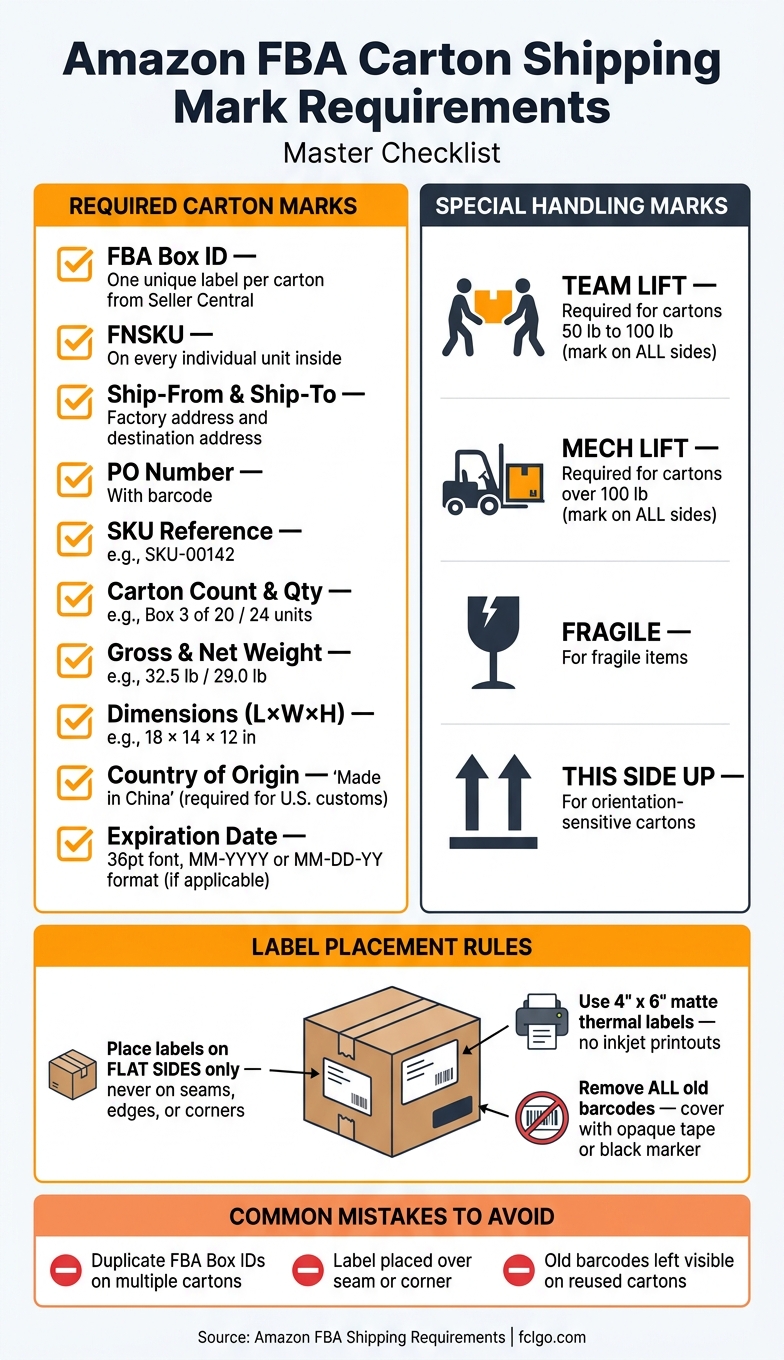
Amazon FBA Carton Shipping Mark Requirements Checklist
How To Prepare Your Carton Labelling For Amazon FBA for Imported Goods from China to USA UK CA AU
sbb-itb-f9a91f9
What to Put on Each Master Carton for Amazon FBA
Every master carton needs two things: the FBA Box ID and the shipping marks used by Amazon, carriers, and customs as part of the shipping process to Amazon FBA.
Amazon-Required Carton Identifiers
Print one unique FBA Box ID label on every carton from Seller Central. That label needs to match the shipment plan exactly.
Standard Carton Shipping Mark Fields
Once the Box ID is handled, add the carton details that Amazon, carriers, and customs look for.
| Field | Example |
|---|---|
| Case packed marking, if applicable | Case Packed |
| Ship-from / ship-to addresses and consignee | Factory address / Destination address / ACME Brands |
| PO number (with barcode) | PO 123456 |
| SKU reference | SKU-00142 |
| Carton number / total cartons and quantity per carton | Box 3 of 20 / 24 units |
| Gross weight / Net weight | 32.5 lb / 29.0 lb |
| Dimensions (L × W × H) | 18 × 14 × 12 in |
| Country of origin | Made in China |
For U.S. customs, mark each carton "Made in China". If the products have expiration dates, print the expiration date on every master carton in 36-point type or larger using MM-YYYY or MM-DD-YY format.
Handling and Compliance Marks for Special Cartons
If a carton weighs 50 lb to 100 lb, mark it "Team Lift" on all sides. If it weighs more than 100 lb, mark it "Mech Lift" on all sides. For cartons that need extra care, add "Fragile" and "This Side Up".
After you print the required marks, place them where they stay easy to see and easy to scan.
Where and How to Place Carton Marks and Labels
Once the carton data is printed, label placement and Amazon FBA prep services decide whether Amazon can scan the box at receiving.
Where to Place FBA Box ID and Carrier Labels
Put every label on a flat side of the carton. Don’t place it over a seam, edge, or corner.
For SPD shipments, place the carrier label and FBA Box ID on the same flat face, side by side, with no overlap.
For floor-loaded shipments, place labels on the side or top of each carton so they stay visible during unloading.
Palletized freight follows that same visibility rule. But pallet labels do not take the place of carton labels.
Pallet Labels and Carton Labels Are Not Interchangeable
A pallet label identifies the pallet itself. It does not replace the carton labels on the boxes under the wrap.
Apply four pallet labels to the outside of the stretch wrap, one on each side. At the same time, make sure every carton’s Box ID label stays visible.
Print Quality and Label Material Rules That Prevent Scan Failures
Use 4" x 6" matte thermal labels, not inkjet printouts. Matte, smudge-resistant label stock helps cut glare and makes barcodes easier to scan.
Don’t place clear tape over a barcode. The shine can reflect light and stop the scanner from reading it.
If you’re using reused cartons, remove or fully cover old labels, barcodes, and markings with opaque tape or a black marker.
These rules help avoid scan failures that slow down receiving.
Common Carton Marking Mistakes That Delay Amazon Receiving
These are the carton-marking errors that most often lead to Amazon receiving delays. Even when the required marks are in place, small labeling slip-ups can still stop cartons from scanning at check-in.
Wrong, Duplicate, or Missing Box Labels
One of the most common mistakes is reusing the same FBA Box ID on more than one carton. Each carton needs its own FBA Box ID. If the wrong label ends up on the wrong carton, Amazon can treat it as a shipment mismatch and move it into manual receiving.
Missing labels cause the same kind of slowdown. So do labels that are faded, torn, or hard to read. In practice, one bad label can hold up the entire shipment.
Content Mismatches and Wrong Carton Data
A label can be printed correctly and still cause trouble if the carton contents don’t match it. If the unit count shown on the carton is different from what’s actually inside, Amazon may flag the shipment during check-in.
Dated products need extra care. Print the date clearly, and make sure the stock falls within Amazon’s shelf-life rules. If the date is hard to read or the product is outside the allowed window, receiving can stall fast.
Bad Label Placement, Damaged Labels, and Old Barcodes Left on Cartons
Good data doesn’t help if the scanner can’t read the label. Labels placed on seams, corners, or crushed sides often fail to scan cleanly.
Reused cartons can create another problem: old barcodes and old markings. If those are still visible, Amazon may scan the wrong code at receiving. Remove them or fully cover them before you add the new label.
A Carton Marking Workflow to Follow Before Freight Leaves China
Catch labeling mistakes before pickup in China so you don’t run into receiving delays in the U.S. This is the last carton check to run before freight leaves the factory.
Pre-Shipment Carton Marking Checklist
Make sure every unit has an FNSKU label and every carton has its own FBA Box ID from Seller Central. The carton count, weight, and dimensions should match the shipment plan and bill of lading. If the freight is palletized, place four pallet labels on each pallet and use clear stretch wrap. Also, remove or fully cover any old barcodes and labels before pickup.
If your factory handles prep in China, have one person own this step and sign off before pickup. That simple handoff can help stop last-minute mix-ups.
How FCLGO Can Help With Carton Compliance for FBA Shipments
FCLGO can handle FBA prep, carton labeling, palletizing, inspection, customs clearance, and direct delivery to Amazon. That support helps keep cartons compliant before they reach the carrier.
Key Carton Marking Points Sellers Should Not Miss
Before pickup, confirm that each carton has a unique Box ID, correct carton data, a visible origin mark, and no exposed old barcodes. When these details are checked before departure, you’re far less likely to deal with receiving delays.
FAQs
Do inner cartons need FBA Box ID labels?
No. Inner cartons do not need their own FBA Box ID labels.
If you pack multiple case packs inside one master carton, place the unique FBA Box ID label only on the outside of the master carton.
That said, any box handled as its own shipment unit still needs its own unique label, even if it’s stacked on a pallet.
What happens if a carton label is unreadable?
A hard-to-read carton label can slow down receiving or even get a shipment turned away at an Amazon fulfillment center.
Amazon needs each carton’s FBA shipment label to be clear and easy to scan so staff can confirm what’s inside and where it needs to go.
If a label is damaged, covered up, or missing, Amazon may not be able to process the inventory without manual work.
Can Amazon reject cartons with missing origin marks?
Yes. Amazon may reject shipments that don’t meet its labeling and documentation rules.
Amazon mainly checks the FBA Box ID label on each carton. But sellers also need to enter the correct country of origin in Seller Central. If that origin info is missing or wrong, Amazon can reject the shipment, charge storage fees, and delay processing.
发表回复