Air Cargo Volume Weight for FBA: 2026 Guide
Your air freight bill is based on chargeable weight – not just the rate per kg. If you ship light but bulky FBA cartons, the carrier may bill you by size instead of scale weight. That one rule can shift a shipment from a rough $4.00/kg idea to a much higher total once dimensions are measured.
Here’s the short version:
- Actual weight = what your packed cartons weigh on a scale
- Volumetric weight = space used in the plane
- Chargeable weight = the higher of the two
- Standard air freight usually uses cm ÷ 6,000
- Express couriers like DHL, FedEx, and UPS often use cm ÷ 5,000
- Carriers may round up dimensions and billable weight
- Many quotes also include extra costs like fuel, customs, pickup, and delivery
A fast example: a 50 × 40 × 30 cm carton has a volume weight of 10 kg under standard air freight, but 12 kg under express rules. If the box only weighs 8 kg, you still pay based on 10 kg or 12 kg.
If I were checking a quote before booking, I’d focus on just 3 things: <u>final carton size</u>, <u>volume weight</u>, and <u>chargeable weight</u>. That’s where most FBA air cargo cost mistakes start.
| Item | What I’d check |
|---|---|
| Packed size | Measure the sealed carton, not the product |
| Formula | Use ÷ 6,000 for standard air, ÷ 5,000 for express |
| Billing weight | Use the higher of actual vs. volume weight |
| Extra fees | Check fuel, customs, prep, and final delivery |
| Planning rate | Roughly $4.00–$8.50/kg China to USA |
This guide to shipping to Amazon FBA walks through the math, the measuring rules, the rounding issues, and the main cost points so you can estimate your FBA air shipment before you book.
Air Cargo Weight Terms Every FBA Seller Should Know
Actual Weight, Volumetric Weight, and Chargeable Weight Explained
These are the three billing weights. If you want to price air freight the right way, you need to know what each one means.
Actual weight is the gross scale weight of your packed cartons or pallets, including packaging. Volumetric weight is a calculated figure based on the space a shipment occupies. Carriers use it for cargo that takes up a lot of room but doesn’t weigh much. Chargeable weight is the invoice weight, which means the higher of actual weight or volumetric weight.
The standard air cargo density rule is about 167 kg per cubic meter. That matches a divisor of 6,000 cm³ per kg.
2026 Air Freight Formulas in Metric and Imperial Units
Use the formula that matches your unit system:
| Unit System | Formula | Output |
|---|---|---|
| Metric (standard air) | L × W × H (cm) ÷ 6,000 | Volumetric weight in kg |
| Metric via CBM | Total CBM × 167 | Volumetric weight in kg |
| Imperial (to lb) | L × W × H (in) ÷ 166 | Volumetric weight in lb |
| Imperial (to kg) | L × W × H (in) ÷ 366 | Volumetric weight in kg |
| Express courier (DHL/FedEx/UPS) | L × W × H (cm) ÷ 5,000 | Volumetric weight in kg |
One small detail can make a big difference here: express couriers often use 5,000 instead of 6,000. That means the same box can be billed at a higher volumetric weight when you ship with DHL, FedEx, or UPS.
Rounding Rules That Change the Final Bill
Rounding can change the final invoice more than many sellers expect. Carriers often round each dimension up to the next whole centimeter or inch. They also tend to round chargeable weight up to the next 0.5 kg or 1 kg, depending on the tariff.
So if one side of a carton measures 40.2 cm, it will usually be billed as 41 cm.
Once you know the billing weight, the next step is measuring the carton correctly.
sbb-itb-f9a91f9
Stop Overpaying! How to Calculate Air Freight Volume & Chargeable Weight 🔥
How To Measure FBA Cartons and Pallets Correctly
Use the billing rules above to measure the shipment the same way the carrier will.
Always Measure the Final Sealed Carton, Not the Product
Measure the final sealed carton after packing and taping.
A box that measures 40 cm when flat can easily end up at 42 cm once it’s packed and sealed. That extra 2 cm might not sound like much, but it can be enough for automated dimension scanners to log a higher billable size.
Record the longest side as length, the next longest as width, and the shortest side as height. Include everything that sticks out: tape bulges, poly bag knots, straps, handles, and any overhang. Carriers charge based on the largest point on each side, not the average.
These dimensions help decide whether actual weight or volumetric weight becomes the billable figure.
Per-Carton vs. Per-Pallet Calculation
For SPD (small parcel) shipments, volumetric weight is worked out for each carton on its own and then added across all boxes. Each carton is measured and billed separately, so box sizing matters a lot.
For pallets, the carrier bills the full footprint plus the total stack height, not each carton by itself. That pallet height should include the pallet base too, which is about 6 in. (15 cm). Empty gaps on the pallet still count as billed space.
If any carton sticks out past the pallet edge, the carrier uses that outermost point as the pallet dimension.
| Feature | Per-Carton (SPD) | Per-Pallet |
|---|---|---|
| Measurement basis | Individual box dimensions | Full pallet footprint + total stack height |
| Unused space billed? | Only internal box air | Includes gaps between boxes and pallet base |
Those measurements feed the chargeable-weight calculation next.
When Volume Weight Replaces Actual Weight
Use your carton or pallet measurements to work out the billable weight. Carriers charge whichever is higher: the actual weight or the volumetric weight.
The Higher-of-Two Rule for Air Freight Billing
Air freight pricing follows a simple rule: carriers bill the higher of actual weight or volumetric weight. If the volumetric weight comes out higher, that number replaces the actual weight on the invoice.
This usually affects products that are light but take up a lot of space. Common examples include pillows, bedding, plush toys, apparel, and plastic storage bins. If you are shipping oversized items, professional FBA prep services can help optimize packaging to reduce volume. Heavier, denser goods like ceramic mugs, metal tools, or machine parts usually bill by actual weight because the scale weight is higher than the volumetric weight.
Density Thresholds for Low-Density Cargo
Next, compare those dimensions with the shipment’s actual weight. Once volumetric weight is higher than actual weight, volume-based billing takes over.
Express couriers such as DHL, FedEx, and UPS use a stricter divisor of 5,000 cm³/kg instead of the standard air freight divisor of 6,000 cm³/kg. That means the same box can bill at a higher weight even when the dimensions stay the same. For example, a 50 × 40 × 30 cm carton that weighs 8 kg bills at 10 kg under standard air freight and 12 kg with an express courier.
| Shipping Method | Metric Divisor | Billed By |
|---|---|---|
| Standard Air Freight | 6,000 cm³/kg | Higher of actual or volumetric |
| Express Courier (DHL/FedEx/UPS) | 5,000 cm³/kg | Higher of actual or volumetric |
Before booking, compare the volumetric weight with the actual weight. The higher figure becomes the chargeable weight, and that’s the number to use when estimating freight costs ahead of booking.
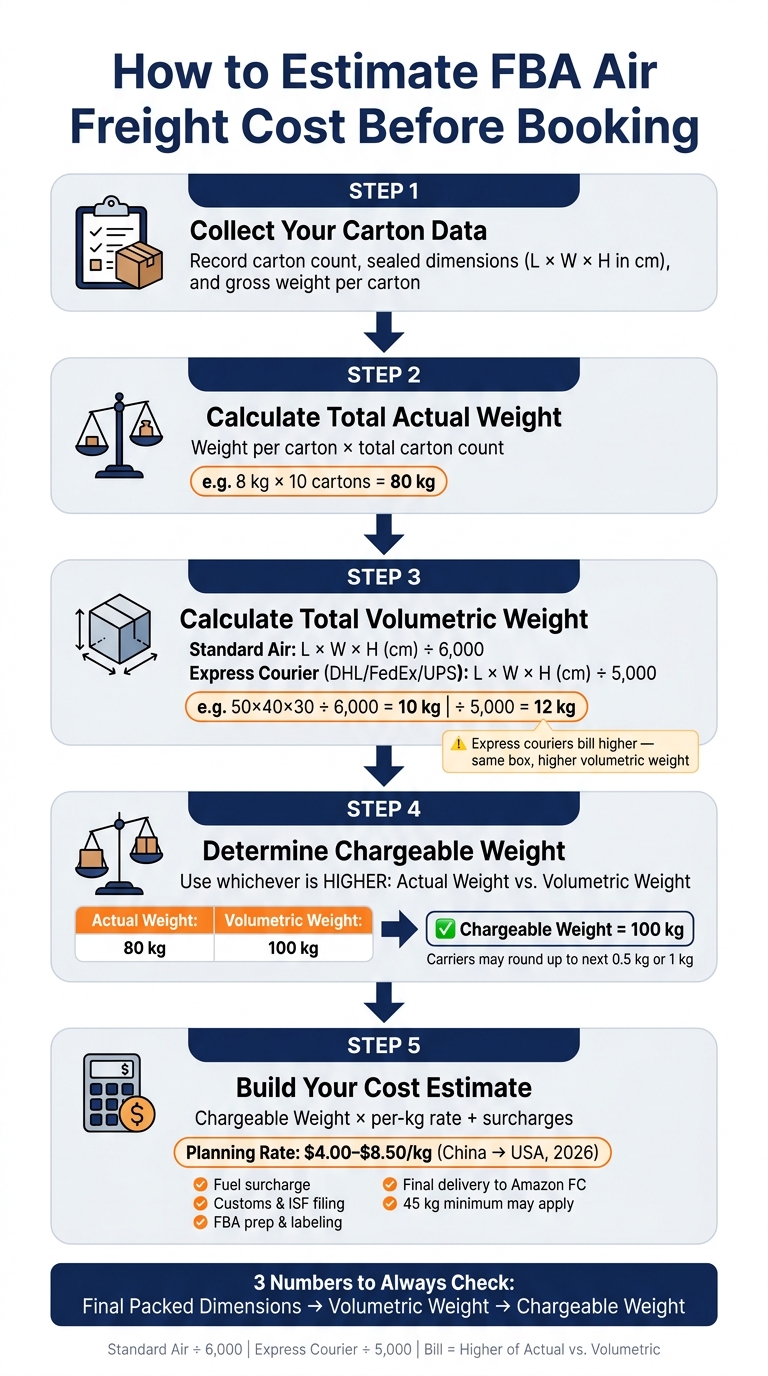
How To Estimate FBA Air Freight Cost Before Booking
Air Cargo Chargeable Weight: How FBA Air Freight Is Billed
Once you have the chargeable weight from the last step, you can put together a rough cost estimate before you book. It won’t be your final invoice, but it gives you a solid planning number.
Step-by-Step Cost Estimate Using Chargeable Weight
- Collect your carton data. Write down the carton count, sealed-carton dimensions (L × W × H in cm), and gross weight for each carton.
- Calculate total actual weight. Multiply the weight per carton by the total carton count.
- Calculate total volumetric weight. Use L × W × H ÷ 6,000 for standard air freight, or ÷ 5,000 for express couriers, then multiply by the carton count.
- Determine chargeable weight. Use whichever total is higher.
- Build your cost estimate. Multiply the chargeable weight by the per-kg rate, then add fuel and other surcharges. Many carriers also apply a 45 kg minimum.
For DDP or door-to-door quotes, make sure pickup, export clearance, customs, ISF filing, duties and taxes, FBA prep, and final delivery are all included.
If you’re reviewing a door-to-door or DDP quote, check each line item instead of assuming it’s covered:
| Cost Category | What to Confirm Is Included |
|---|---|
| Origin | Factory pickup, export clearance, documentation |
| Freight surcharges | Fuel, oversized carton fees, minimum weight |
| Customs | ISF filing, brokerage, import duties, bond |
| FBA prep | FNSKU labeling, carton labeling, palletizing |
| Destination | Airport handling, warehousing, trucking to Amazon FC |
2026 China-to-USA Air Freight Rate Ranges for Planning
For planning, expect $4.00 to $8.50 per kg for standard China-to-USA air freight, based on urgency and volume. Rates often drop once shipments hit 100 kg+, 300 kg+, and 500 kg+. Items like batteries or magnets can push routing costs higher. These numbers are planning figures only. Your actual rate depends on the quote tied to your shipment.
Using FCLGO To Check Your Pre-Booking Estimate

After you build your rough estimate, compare it against an itemized quote. Send your carton count, dimensions, gross weights, and destination fulfillment center details to FCLGO for an itemized quote before booking.
Conclusion: 3 Numbers To Check Before You Book
Once you have a rough quote, check these three numbers before you book. Final packed dimensions, volumetric weight, and chargeable weight drive most air freight invoices.
- Final packed dimensions – Measure the sealed carton, not the product inside. Even a small bump in size can increase chargeable weight across a large shipment.
- Volumetric weight – Use the correct divisor for your shipping mode. Standard air freight uses L × W × H (cm) ÷ 6,000. Express couriers usually use ÷ 5,000 instead of ÷ 6,000.
- Chargeable weight – This is the number used for billing. The carrier charges whichever is higher: actual weight or volumetric weight.
If these three line up with your quote, your freight estimate is probably on the right track. It’s worth checking all three before you ask for a quote, so you can price the shipment more accurately before booking.
FAQs
How do I know if my shipment will bill by volume weight?
Compare your shipment’s actual gross weight with its calculated volumetric weight.
Volumetric weight = length × width × height in cm ÷ the carrier’s divisor, which is usually 5,000 or 6,000.
If the volumetric weight is higher than the scale weight, you’ll be billed based on volume weight. Carriers charge whichever number is higher.
Should I calculate air freight by carton or pallet?
It depends on how the shipment moves through the carrier’s system.
For individual cartons, carriers usually work out volumetric weight from each box’s dimensions. For palletized cargo, some carriers look at the pallet’s full footprint and stack height instead.
Because carriers charge whichever is higher – actual weight or volumetric weight – it’s smart to share both carton and pallet dimensions if you want the most accurate estimate.
What fees are usually missing from air freight quotes?
Many air freight quotes leave out costs beyond the base shipping rate. So before you book, check whether export and destination handling, customs clearance, duties, and final delivery to Amazon fulfillment centers are part of the price.
Some fees slip through the cracks all the time. Common examples include:
- Airport security and X-ray scanning
- Air Waybill documentation
- Terminal handling
- Destination local charges for cargo release
- Remote delivery surcharges
If those items aren’t included upfront, your total landed cost can end up much higher than the original quote.
发表回复