Amazon FBA Freight Formulas: Dim and Chargeable Weight
If you get freight weight wrong, your shipping quote can jump fast. In most cases, the carrier bills your shipment by the higher of its scale weight or its space-based weight.
Here’s the short version:
- Gross weight = what the shipment weighs on a scale
- Volumetric or DIM weight = what the shipment weighs based on size
- Chargeable weight = the number the carrier uses to bill you
- Air freight often uses cm ÷ 6,000
- Express courier often uses cm ÷ 5,000
- Parcel often uses inches ÷ 139 or 166
- LCL ocean often uses CBM vs. metric tons under the 1 CBM = 1,000 kg rule
That means two cartons with the same actual weight can have very different freight costs if one takes up more space. For example, a 500 kg shipment at $8.50/kg costs $4,250. If it holds 1,000 units, freight adds $4.25 per unit.
What Is Chargeable Weight? | How to Calculate Dimensional Weight in Shipping | SFL Worldwide
sbb-itb-f9a91f9
Quick comparison
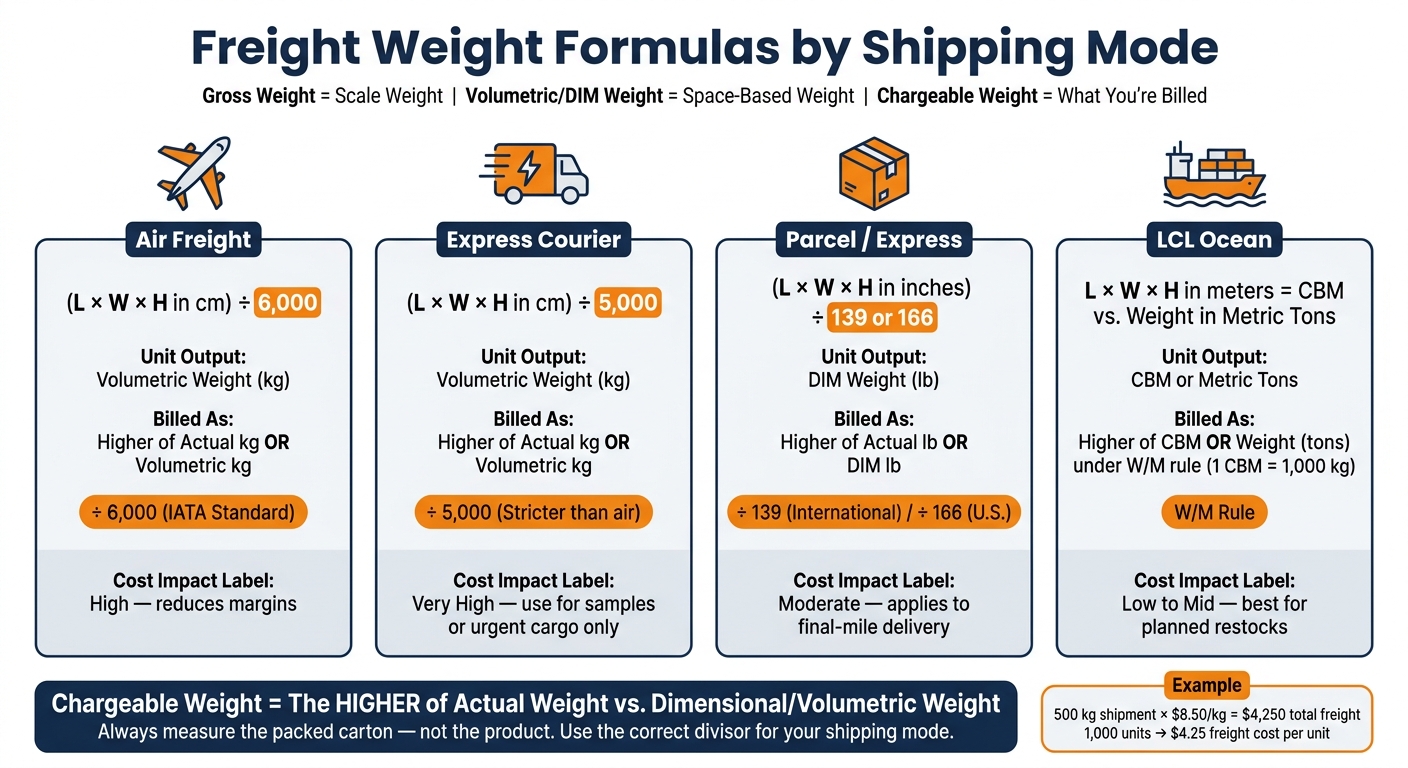
Freight Weight Formulas by Shipping Mode: Air, Ocean & Parcel
| Shipping mode | Main formula | What gets billed |
|---|---|---|
| Air freight | (L × W × H in cm) ÷ 6,000 |
Higher of actual kg or volumetric kg |
| Express courier | (L × W × H in cm) ÷ 5,000 |
Higher of actual kg or volumetric kg |
| Parcel | (L × W × H in in) ÷ 139 or 166 |
Higher of actual lb or DIM lb |
| LCL ocean | CBM vs. weight in metric tons |
Higher under W/M billing |
I’d keep one rule in mind: measure the packed carton, use the right divisor, and check the billed weight before booking. That one step can help you avoid bad quotes, margin mistakes, and invoice surprises.
The main freight weight formulas
Gross weight, volumetric weight, dimensional weight, and chargeable weight defined
Gross weight is the shipment’s actual scale weight, including packaging.
Volumetric weight, also called DIM weight, is the billable weight based on how much space the shipment takes up.
Chargeable weight is the weight used to price the shipment. It’s the number that shapes your freight quote and landed cost.
Put simply: carriers charge based on whichever is greater – the space your shipment uses or its scale weight.
Formulas for air, LCL, and parcel shipments
Different shipping modes use different formulas, which is where things can get a little tricky.
Air freight uses the IATA standard divisor of 6,000:
Volumetric weight (kg) = (L × W × H in cm) ÷ 6,000
Express couriers often use a stricter divisor of 5,000. That leads to a higher chargeable weight:
Volumetric weight (kg) = (L × W × H in cm) ÷ 5,000
LCL ocean freight is billed on the greater of actual weight or cubic meters (CBM) × 1,000 kg:
Volume (CBM) = L × W × H in meters
Parcel and express shipments billed in pounds use a DIM divisor based on cubic inches. Use the carrier’s DIM divisor. Common values are 139 for international parcels and 166 for U.S. parcels:
DIM weight (lb) = (L × W × H in inches) ÷ 139 or 166
One small detail can change the whole quote: the divisor. That’s why it’s smart to confirm the exact one with your carrier before quoting, especially if your account uses custom factors.
Metric and imperial conversion shortcuts
If you want to compare quotes cleanly, get everything into the same unit first. Otherwise, you’re comparing apples to oranges.
| To Convert | To | Multiply By |
|---|---|---|
| Inches (in) | Centimeters (cm) | 2.54 |
| Centimeters (cm) | Inches (in) | 0.3937 |
| Pounds (lb) | Kilograms (kg) | 0.4536 |
| Kilograms (kg) | Pounds (lb) | 2.2046 |
| Cubic Meters (CBM) | Cubic Feet (ft³) | 35.3147 |
Carriers also round dimensions and weight up to the next billing increment.
Once the units match, the next move is to calculate chargeable weight for each shipment.
How to calculate chargeable weight, step by step
Now let’s put the formulas to work for each shipment type, one carton at a time.
Air freight: compare actual kg vs. volumetric kg
Start with the packed dimensions and the actual scale weight for each carton. Use the finished shipping box, not the product’s own dimensions.
For each carton, multiply length × width × height in centimeters, then divide by 6,000 to get volumetric weight in kilograms. Work out each carton, add them up for the full shipment, and then compare that number with the total gross weight. The higher total is your chargeable weight.
Carriers may round dimensions and weight up to billing increments, so even small gaps can change the quote.
LCL ocean freight: calculate CBM and check shipment volume-to-weight balance
For ocean LCL, the focus shifts from carton weight to the shipment’s total volume.
LCL is billed by the billable ton under the W/M rule: either 1 CBM or 1,000 kg, whichever is greater.
To find total CBM, multiply length × width × height in centimeters, then divide by 1,000,000 to get CBM for each carton. Then multiply that figure by the carton count. After that, convert total gross weight into metric tons by dividing by 1,000. Compare the total CBM with the total weight in metric tons. Whichever number is higher controls billing.
Parcel and express: use inches, pounds, and the DIM divisor
For parcel and express shipments, use the sealed carton’s outside dimensions in inches, including any bulges. Multiply length × width × height, then divide by your carrier’s DIM divisor to get dimensional weight in pounds.
Then compare the dimensional weight with the actual scale weight in pounds. The higher number becomes your chargeable weight.
Measure the sealed carton, not a loose estimate. Scanners can pick up bulges or uneven sides that manual measuring can miss.
Applying freight formulas to landed cost planning
Convert chargeable weight into freight cost per unit
Once you know the chargeable weight, the math is simple: multiply it by the rate, then divide by the number of sellable units in the shipment to get freight cost per unit.
Here’s the dollar version. A 500 kg shipment at $8.50/kg costs $4,250. If that shipment contains 1,000 units, freight adds $4.25 per unit. That’s the number that tells you if the shipment still works with your margin.
Same formula, different shipping mode, very different outcome. That’s where many sellers get tripped up.
Comparison table: air freight, LCL, and parcel shipments
| Shipping Mode | Input Units | Chargeable Basis | Landed Cost Effect |
|---|---|---|---|
| Air Freight | cm / kg | Higher of actual vs. volumetric | High; reduces margins |
| Express Parcel | cm / kg | Higher of actual vs. volumetric | Very high; use for samples or urgent cargo |
| LCL Ocean | m / CBM | Higher of CBM vs. weight tons | Low to mid; best for planned restocks |
| Parcel | inches / lbs | Higher of actual vs. DIM weight | Moderate; applies to final-mile delivery |
Common mistakes that lead to billing surprises
Even the right formula falls apart when the inputs are off.
A common problem is mixing metric and imperial units. That can turn a normal quote into junk fast. Another big one is using product dimensions instead of packed carton dimensions. Freight carriers bill the shipment you send, not the item sitting by itself. The box, padding, and void fill all add volume. So a carton that looked fine in a spreadsheet can end up billed by DIM weight once the packed dimensions are used.
Rounding adds another layer. Carriers round up dimensions and weight, which means small changes can bump up billable weight fast. In some cases, a slightly larger master carton is enough to push a shipment from actual-weight pricing into DIM pricing without any obvious warning.
When to have a freight forwarder check your numbers
Some shipments are worth a second set of eyes before you book.
Have a freight forwarder review mixed-carton, palletized, or first-time LCL shipments before booking. FCLGO works with Amazon FBA sellers shipping from China to the USA and can review carton dimensions, actual and volumetric weights, and ocean or air routing options before you commit to a booking.
Conclusion: Get the weight formula right before you ship
In practice, freight quotes come down to three numbers: gross weight, dimensional/volumetric weight (the space a shipment uses, turned into billable weight), and chargeable weight. The carrier charges you based on the highest of the three.
The simplest way to avoid quote mistakes is to measure packed carton dimensions, not product dimensions, use the right divisor for your shipping mode, and keep your unit conversions consistent. If chargeable weight is off, landed cost is off too. And for volume-based cargo, looking at actual weight by itself can make landed cost look lower than it is.
Small mistakes add up fast. A carrier’s rounding rule, the wrong divisor, or a carton that’s just a bit too large can move a shipment into dimensional-weight pricing with no clear warning. The fix is pretty simple: use the right formula for the right mode, enter packed dimensions, and check chargeable weight before booking.
FCLGO can review your carton dimensions, gross weight, and shipment details before booking.
FAQs
When does DIM weight matter most?
DIM weight matters most for bulky, low-density cargo that takes up a lot of room compared with what it actually weighs.
Here’s the part that trips people up: shipping carriers charge based on the higher of the actual weight or the DIM weight. So if the DIM number comes out higher, your shipping cost goes up with it.
That’s why sellers often get blindsided when they estimate freight costs using only product weight. A shipment can feel light on paper but still cost more because of the space it takes up.
Do carriers round up dimensions and weight?
Yes. Carriers often round up measurements when they calculate billable weight.
In many cases, fractional dimensions get rounded up to the nearest inch before dimensional weight is worked out. Then the final billable weight is often rounded up again to the nearest pound.
That might sound minor. But across an entire shipment, those small bumps can stack up fast. That’s why accurate carton dimensions and gross weights matter when you request a freight quote.
How do I estimate freight cost per unit?
First, figure out your shipment’s chargeable weight or volume.
That means you need to calculate both:
- the actual weight
- the volumetric (dimensional) weight
Then use whichever number is higher.
For LCL ocean freight, the rule is a little different. Compare CBM with weight in metric tons under the W/M system.
Once you have the total shipping quote, divide that amount by the total number of units. That gives you the per-unit freight cost.
发表回复