Amazon Pallet Labels And Stretch Wrap Guide
If Amazon can’t scan your pallet fast, your shipment can get held up. The short version is simple: put FNSKU labels on each unit, Box ID labels on each carton, and 4 pallet labels on the outside of the clear stretch wrap – one on each side.
Here’s what I’d check before a pallet leaves:
- 3 label levels: unit, carton, and pallet
- 4 pallet labels: one per side
- Clear wrap only: no tinted or opaque film
- Upper half placement: pallet labels should sit high enough to scan
- Flat labels only: no corners, folds, seams, or wrinkles
- Re-label after rewrapping: if the outer wrap changes, print and apply new pallet labels
A few details matter a lot here. Amazon wants labels printed in black on white at 300 dpi or higher, with at least 0.25 inches of space from edges. The pallet label goes on after wrapping, while FNSKU and carton labels go on before palletizing. And if one side is missing a pallet label, or the barcode sits under bad wrap glare, receiving can slow down.
I’d sum it up like this: label units first, cartons next, wrap the pallet, then add 4 pallet labels to the outside film and scan-check all 3 levels before pickup.
Send to Amazon Step 5: Print Pallet Labels | Seller University

sbb-itb-f9a91f9
Amazon pallet label and stretch wrap rules
Getting pallet labels right comes down to placement and wrapping. If either one is off, Amazon fulfillment center teams may have trouble scanning the load when it arrives.
Place pallet labels on all 4 sides, outside the wrap
Once the label types are set, the next job is making sure the pallet label stays readable after the pallet is wrapped. Carton and FNSKU labels remain on the boxes and units. Pallet labels belong on the finished load.
Place four pallet labels on the pallet, with one label on each side, squarely on the outside of the stretch wrap so forklift operators can see them and scan them at a glance. Don’t fold a label over a corner or edge, and keep it at least 0.25 inches away from any edge. It also helps to avoid spots with straps, seams, or crushed and uneven surfaces, since those can make labels harder to scan.
Use clear stretch film and position labels on the upper half
Label placement only works if the wrap itself doesn’t get in the way. Amazon requires clear, transparent stretch film. Tinted or opaque wrap can block barcode scans.
Wrap the pallet first, then place the pallet labels on the outermost layer of the wrap. Put each label on the upper half of the load, high enough for teams to scan it without pulling or lifting the wrap.
How to wrap and label a pallet, step by step
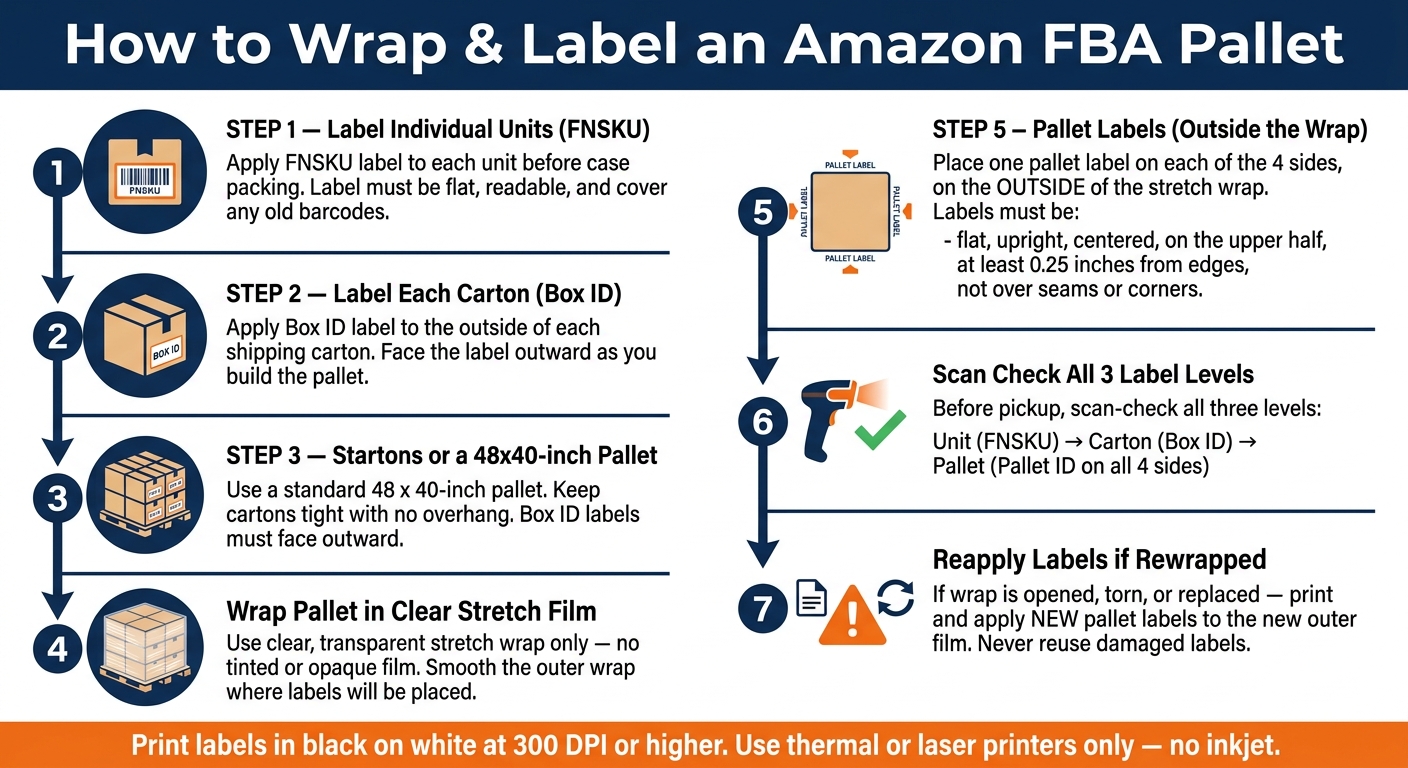
Amazon FBA Pallet Labeling & Stretch Wrap: Step-by-Step Checklist
Stack cartons so Box ID labels face outward
Once you’ve set label placement, stack the cartons in a way that keeps every barcode easy to see. Use a 48 x 40-inch pallet. Keep cartons tight, with no overhang. The FNSKU stays on each unit, and the Box ID label stays on each carton.
As you build the pallet, turn each carton so its Box ID label faces outward. That way, the label is still visible after the pallet is wrapped.
Wrap the pallet first, then apply pallet labels
Secure the load with clear plastic stretch wrap. Before you add labels, smooth the outer wrap anywhere a label will go. If the wrap is bunched up or creased, barcode scanners can struggle to read it.
Then place one pallet label on each of the four sides. Each label should go on the outside of the stretch wrap, laid flat, kept upright, and centered on the side. This makes life easier for warehouse staff who need to scan the pallet fast.
Reapply labels after damage, inspection, or rewrapping
If the outer wrap gets opened, torn, or replaced, add new pallet labels to the new outside layer. Don’t reuse a damaged label.
After rewrapping, do a quick scan check before shipment.
How to keep FNSKU, carton, and pallet labels scannable
Once the pallet is wrapped, do one last scan check at every label level. If a label won’t scan, receiving slows down. Most scan issues come from three things: weak print quality, poor placement, or barcodes getting covered.
Avoid glare, wrinkles, and corner placement
Use black ink on white, non-reflective labels at 300 dpi or higher. Stick with thermal or laser printers. Inkjet printers can smudge or fade, and Amazon does not allow them for FBA labels.
When you print label PDFs, set printer scaling to "None" or "100%". If the file gets scaled, the barcode can warp and fail to scan.
Amazon rejects labels that are smudged, reflective, curved, or wrapped around a corner. Keep each label on a flat, smooth area. Don’t place labels over seams, folds, corners, or edges. You also need enough empty space around the barcode: at least 0.25 inches of quiet zone on the left and right, and 0.125 inches on the top and bottom.
Check every label level before the shipment leaves
Before the shipment goes out, check all three label levels. Start at the unit, then the carton, then the pallet.
| Label Level | What to Check | When to Check |
|---|---|---|
| Unit (FNSKU) | Readable, flat, no old barcodes showing | Before case packing |
| Carton (Box ID) | Facing outward, not over a seam | After palletizing |
| Pallet (Pallet ID) | Scannable on all 4 sides, outside the wrap | After stretch wrapping |
Full pallet prep workflow for China-to-USA FBA shipments
Once label placement is set, the next step is the full prep flow from unit to pallet. For China-to-USA FBA shipments, apply labels in this order: unit labels first, carton labels next, pallet labels last. That order helps you avoid rework after the load is wrapped.
Where each label type is applied in the workflow
Apply FNSKU labels to individual units, Box ID labels to cartons, and pallet labels only after stacking and stretch wrapping are done. If carton labels are missing once the pallet is sealed, you’ll need to break down the load and fix it.
| Label Type | Applied At |
|---|---|
| FNSKU | Individual unit |
| Carton (Box ID) | Outside of each shipping box |
| Pallet ID | All 4 sides, outside stretch wrap |
This sequence matters even more on China-to-USA shipments, where every handoff needs clear, visible labels.
How FCLGO can support compliant pallet prep and delivery
For shipments moving from China to Amazon fulfillment centers, using one prep process helps keep labeling consistent all the way through delivery. FCLGO can handle:
- FNSKU labeling
- Carton labeling
- Palletizing
- Clear stretch wrapping
- Final Amazon-bound delivery from China to the U.S.
It also supports customs clearance, U.S. warehousing, trucking, and direct delivery to Amazon fulfillment centers.
Conclusion: Key rules to prevent scan and receiving problems
Before pickup, do one last check. Keep each carton labeled, wrap the pallet in clear stretch film, and place four pallet labels on the outside of the wrap. Each label should be centered on the upper half of a different side. Then make sure every label is flat, easy to see, and scannable.
If the pallet gets inspected, damaged, or rewrapped, add new pallet labels to the new outer film. Don’t reuse damaged labels. Print new pallet labels instead.
Receiving problems usually happen for a few simple reasons: labels are covered by wrap, a label is missing from one side, or one pallet has mixed shipment IDs.
FAQs
Can pallet labels go under stretch wrap?
Pallet labels must go outside the clear stretch wrap so Amazon fulfillment center teams can scan them without trouble.
Place FBA pallet labels on all four sides of the pallet, in the top center of each side. You should also add a clear note such as "Do Not Break Down" or "Do Not Break Stretch Wrap".
What happens if I rewrap the pallet?
If you rewrap a pallet, apply four new FBA pallet labels to the outside of the new stretch wrap. Don’t reuse or photocopy old labels, because each pallet label is linked to a specific shipment.
Place the new labels at the top center on all four sides of the pallet. Make sure each one stays easy to see and easy to scan.
Do FNSKU and Box ID labels still need to show after wrapping?
Yes. Apply FNSKU and Box ID labels before you stack cartons and stretch-wrap the pallet.
Why? Amazon checks in inbound freight with box-level scanning. Once the pallet is sealed, you can’t add those labels afterward.
A couple of things matter here:
- Keep carton labels visible on the outside of each carton.
- Place pallet labels on the outside of the final stretch wrap on all four sides so Amazon can scan them.
发表回复