I’d keep reserve stock at a US 3PL so you can refill FBA without waiting for another shipment from China. For example, selling 20 units a day means a 15-day reserve needs 300 usable units – not counting damaged or held stock.
I’d use two separate triggers: one to reorder from China and another to send 3PL stock to Amazon. Here’s what I’d track:
- Stock coverage: Set reserve levels using sales, seasonal demand, and shipping delays.
- Ready inventory: Separate ready, reserve, and held units; check labels and packaging before release.
- Freight timing: Choose FCL, LCL, or air based on shipment size and when the reserve needs refilling.
- FBA transfers: Allow time for prep, trucking, and Amazon receiving. <u>Delivered does not mean sellable.</u>
My rule: review stock weekly, assign an owner to each step, and release batches before FBA runs low. A US buffer can cover freight delays, but it cannot remove Amazon receiving delays.
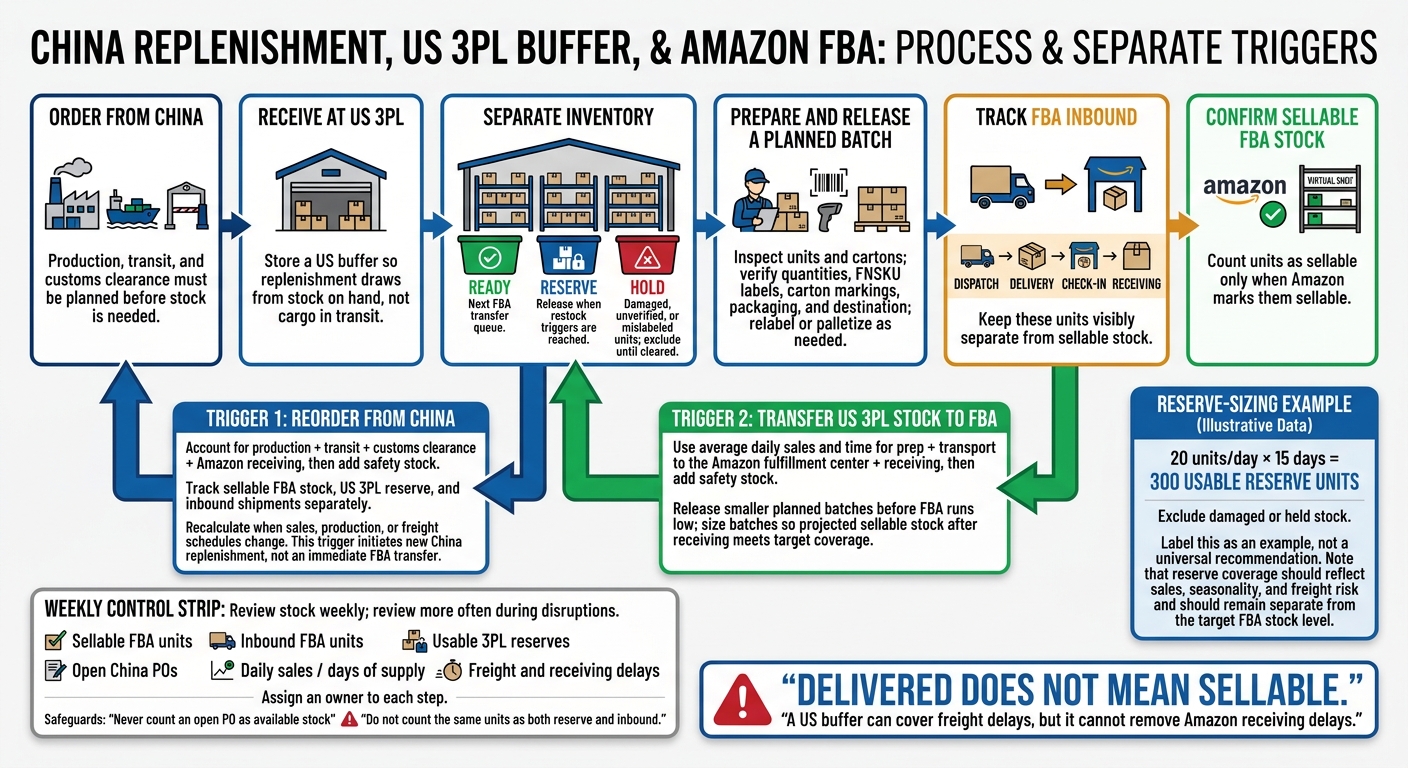
How a US 3PL Buffer Prevents FBA Stockouts
Amazon 3PL Logistics- Complete Guide – Third Party Logistics For Amazon FBA Sellers 2023
sbb-itb-f9a91f9
1. Set Buffer Levels and Restock Triggers
Set each SKU’s US reserve in days of cover, then convert that coverage to units. Base it on average daily sales, seasonality, and freight risk. Hold more reserve for seasonal SKUs or those with unpredictable demand.
Keep this reserve separate from your target FBA stock level. Once you’ve set the buffer, divide the reserve into ready and held stock at the 3PL.
Calculate When to Reorder From China
Keep the China reorder clock separate from the 3PL-to-FBA transfer clock. For China orders, account for the full lead time: production, transit, customs clearance, and Amazon receiving. Add safety stock to cover demand increases and delays beyond that lead time.
Track sellable FBA stock, US 3PL reserve, and inbound shipments separately. That keeps you from counting the same units as both reserve and inbound stock. Recalculate reorder timing whenever sales increase, production slips, or freight schedules change.
Set the US-to-FBA Transfer Trigger
Set a second trigger for moving stock from the 3PL to Amazon. Use average daily sales and the time needed for prep, transport to the Amazon fulfillment center, and receiving. Then add safety stock.
Treat deliveries to Amazon as inbound stock only. The 3PL holds the reserve and releases smaller batches early enough for the units to become sellable in FBA before stock runs out. Size each batch so projected FBA stock after receiving still meets your target coverage.
Next, stage that reserve in short-term US storage for faster replenishment.
2. Build a US Buffer With Short-Term Storage
Route imports from China to a US warehouse so FBA draws from stock on hand, not cargo still in transit. Split that buffer into ready, reserve, and hold stock so only usable units move toward FBA.
Separate Ready, Reserve, and Hold Inventory
Put only ready stock in the next FBA transfer queue. Release reserve stock when restock triggers are reached. Keep damaged, unverified, or mislabeled units on hold until cleared.
Before the 3PL books delivery, verify FNSKU labels, carton markings, and shipment details.
With inventory sorted, choose a freight mode based on how soon the buffer needs refilling.
Choose FCL, LCL, or Air Freight
Match freight to shipment size and reserve needs. Build customs, receiving, prep, trucking, and Amazon receiving into the schedule – not just transit time.
| Freight mode | Typical timing | Shipment fit | Buffer role |
|---|---|---|---|
| FCL | 25–40 days door-to-door | More than 15 CBM | Build a large reserve |
| LCL | 30–45 days, including consolidation | 1–15 CBM | Refill in smaller volumes |
| Air | 5–10 days | Under 200 kg (about 441 lb) or high-value goods | Emergency bridge |
Planning these steps together can help a shipment move from factory pickup to FBA with fewer delays.
Plan Freight and US Storage With FCLGO
Use FCLGO to coordinate pickup, freight, customs clearance, US warehousing, FBA prep, and delivery to Amazon. Compare total landed cost with stockout risk and FBA storage limits.
3. Send and Track FBA Restock Batches
Use the 3PL as a release buffer while ocean or air freight from China is in transit. Keep reserves in batches you can release, rather than one inventory pool. Track sellable FBA units, inbound FBA units, usable 3PL reserves, open China POs, and daily sales separately. Move stock based on its status – not the total unit count. Release only planned batches, and never count an open PO as available stock.
Schedule Batches and Respond to Delays
Calculate FBA days of supply from daily sales. Plan each release to allow time for prep, dispatch, delivery, and Amazon receiving. Adjust batch quantities as sales and arrival dates change, using reserves to cover the gap while China freight is in transit.
| Scenario | Trigger | Inventory source | Action | Owner |
|---|---|---|---|---|
| Routine restocking | FBA stock reaches about 30 days of supply | US 3PL reserve | Release the planned batch | 3PL warehouse manager |
| Late China freight | Vessel delay exceeds 7 days | US 3PL reserve | Increase the batch or shift part of the China replenishment to air freight | Freight forwarder |
| Receiving delay | Amazon check-in takes more than 10 days | FBA inbound stock | Pause new shipments until receiving clears | Amazon Seller Support |
| Demand spike | Sales run well above forecast | Ready US stock | Increase the batch for at-risk ASINs | Operations lead |
Treat these thresholds as review points. Track Amazon check-in separately from receiving; sending more shipments won’t clear a bottleneck.
Inspect, Relabel, and Ship Inventory
Have the 3PL inspect every batch’s units and cartons, correct packaging errors, and relabel or palletize stock to meet current Amazon specs. Before pickup, check quantities, labels, and destinations against the shipment plan. Track dispatch, delivery, check-in, receiving, and sellable status separately so you can spot where stock has stalled.
Assign Tasks and Review Stock Weekly
Name an owner for each task: China ordering, Amazon shipment plans, prep approval, carrier booking, and escalation. Each week, review available and inbound FBA units, usable reserves, days of supply, open POs, and freight or customs issues. Review more often when disruptions occur. Use days of supply, dispatch speed, and receiving delays to adjust batch sizes and release triggers before stock runs out.
Conclusion: Keep US Reserves and Restock Early
Build your US stock buffer before China freight faces delays.
Once inventory reaches the 3PL, exclude held units from usable reserves. Release only planned batches, leaving time for prep, delivery, and Amazon receiving. Track those units until Amazon marks them sellable.
For a freight and US storage quote, send FCLGO your supplier location, Amazon FC code, shipping mode, total weight and volume, carton count, and prep needs. With these details, FCLGO can match your China freight with US storage and FBA prep.
FAQs
How do I balance 3PL storage costs against stockout risk?
Set each SKU’s reorder point using this formula: average daily sales × total lead time + safety stock. Count production, transit, customs, FBA prep, and Amazon check-in in your lead time. Adjust safety stock to each SKU’s risk so you hold only the buffer you need.
Keep a small buffer in a U.S. warehouse, then send smaller lots to Amazon as intake or restock limits change. When timing is tight, split shipments between air and ocean rather than storing too much inventory.
What if Amazon receiving delays outlast my buffer?
Inventory isn’t ready to sell until Amazon checks it in – typically 3–7 business days after delivery. To help avoid prep-related delays, check FNSKU barcodes and carton labels before delivery.
If the schedule is slipping, use a U.S. warehouse as a buffer and release smaller batches to FBA as slots open. You can also send an air “gap” shipment to cover sales until Amazon checks in the ocean shipment, or use both options.
How can I verify my 3PL can handle urgent FBA transfers?
Ask how many FBA shipments they handle each month, which fulfillment centers they’ve worked with, how they book appointments through Carrier Central, and what happens if a truck is rejected.
Check that their FBA prep services include FNSKU labeling and palletizing that meet Amazon’s requirements. Confirm they’ll keep you updated without prompting and provide real-time tracking. Request an all-in quote that lists freight, customs clearance, and delivery fees separately, with no hidden costs.
发表回复