If a sharp edge can cut through the package, Amazon can stop the shipment. Since April 14, 2025, Amazon no longer handles prep for sharp products, so I need to make sure each unit is fully packed before it ships.
Here’s the short version:
- I treat any item with a blade, sharp edge, or pointed tip as a sharp item.
- I use a rigid cover first, not bubble wrap alone.
- I add a sealed second layer, such as a poly bag or corrugated box.
- I pack units in a strong six-sided carton with no internal shifting.
- I check labels, seams, weight, and carton condition before pickup.
A few rules matter most:
- No exposed edge or point
- No soft wrap as the main protection
- Poly bags must be at least 1.5 mil thick
- Poly bag openings of 5 in or more need a suffocation warning
- Double-wall corrugated is required for sharp products or items over 10 lb
Here’s a quick view of what passes and what often fails:
| Item | Passes Amazon check? | What I look for |
|---|---|---|
| Rigid blade cover | Yes | Stays on during shaking and pressure |
| Bubble wrap only | No | Can tear or shift in transit |
| Sealed poly bag over sheathed item | Yes | Must be sealed, clear, and 1.5 mil or thicker |
| Loose sleeve or partial cover | No | Can slide off and expose the edge |
| Double-wall corrugated carton | Yes | Needed for sharp items or units over 10 lb |
The goal is simple: keep the sharp part covered, keep the unit sealed, and keep the carton from getting pierced or crushed during transit and intake.
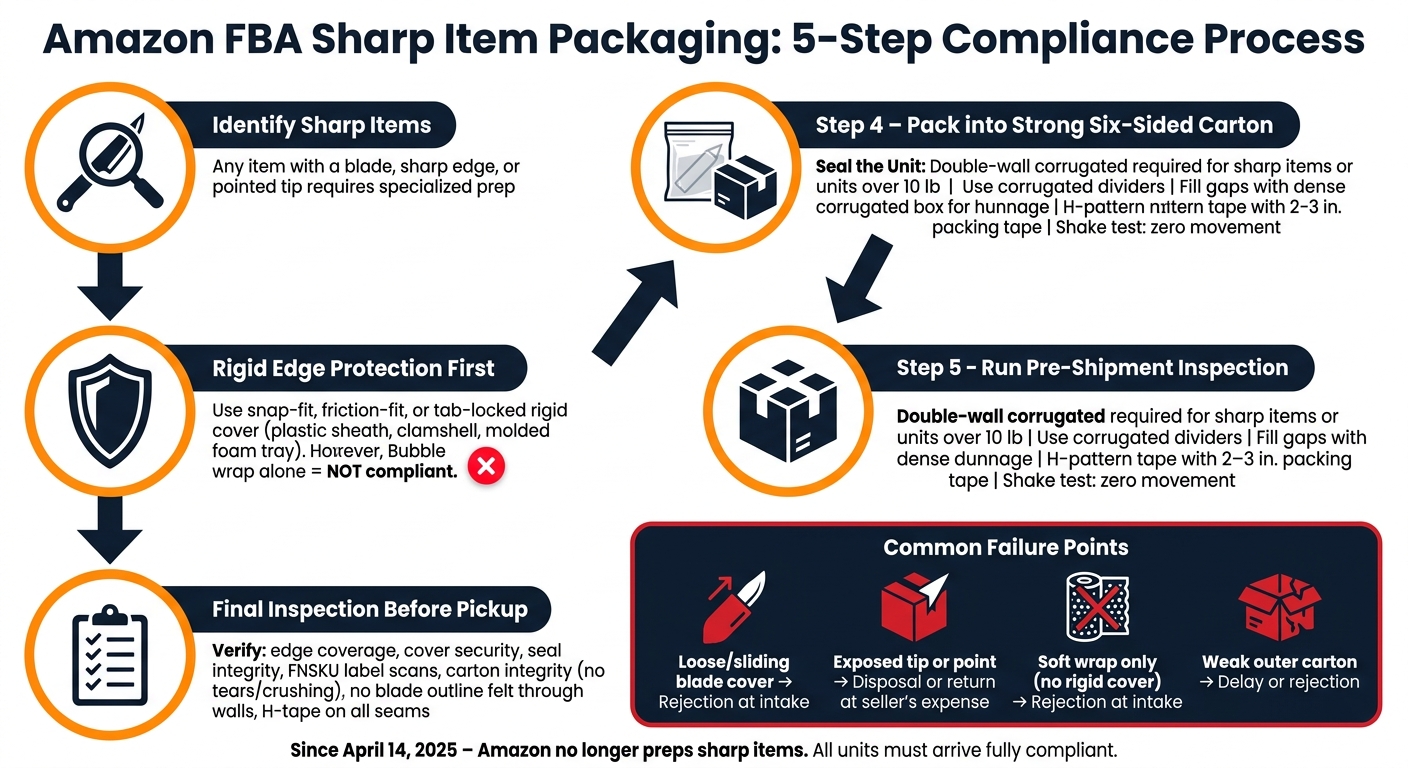
Amazon FBA Sharp Item Packaging: 5-Step Compliance Process
Amazon Policy Update for sharp products – Don’t Ignore this!
sbb-itb-f9a91f9
Amazon sharp-item packaging rules sellers must follow
Amazon’s packaging requirements for sharp items are simple: no sharp edge or point can be exposed during prep, shipping, or intake. The item must not be able to cut workers or punch through the package at any stage. Put another way, the cover has to stay in place after shipping, stacking, and vibration. If it slips, cracks, or comes loose, that’s a problem.
A mistake many sellers make is using bubble wrap as the main layer of protection. That sounds fine at first. But in transit, bubble wrap can compress, shift, tear, or get pierced when boxes are stacked or shaken around. Amazon does not accept bubble wrap or other non-corrugated packaging as the main packaging for sharp items. If you use bubble wrap, it should only be a secondary cushion around a unit that already has a rigid blade cover.
Amazon also does not re-prep sharp units that arrive out of compliance. If a shipment shows up with exposed edges, weak protection, or a cover that failed, the unit can be rejected or delayed. The seller then has to fix the issue before the shipment can move ahead.
The no-exposed-edge rule
A cover that protects only part of the blade does not meet Amazon’s standard. The same goes for a sheath that shifts when the item is shaken, stacked, or turned upside down.
The packaging has to hold up through ocean freight, drayage, and Amazon handling. That includes drops, stacking, conveyor movement, and vibration. Amazon accepts rigid plastic covers, clamshells, blister packs, foam inserts, and fully enclosed thick corrugated boxes as primary protection. For sharp products, or products over 10 lb, double-wall corrugated boxes are required.
What Amazon may reject or delay at intake
If the cover fails, Amazon treats the unit as unsafe at receiving.
| Failure Point | Amazon Result |
|---|---|
| Loose or sliding blade cover | Rejection or delay at intake |
| Exposed tip or point | Rejection, disposal, or return at seller’s expense |
| Soft wrap only (no rigid cover) | Rejection at intake |
| Weak outer carton | Delay or rejection at intake |
Any one of these issues can trigger an inbound defect and a per-unit fee, on top of the delay. And here’s the tough part: a unit may look fine when it leaves your warehouse, then still fail at intake if the packaging didn’t hold up in transit.
Steps 1 and 2: Protect the blade and seal the unit
Start with a rigid blade cover. Then add a sealed second layer.
Choose a rigid cover that stays in place
The cover needs to stay locked on during drops, stacking, and conveyor movement. A snap-fit, friction-fit, or tab-locked cover can work. What matters most is the fit, not the material. Before shipping, do a shake test. If the blade moves or the cover slips, fix the packaging before it goes out.
For knife sets or heavy tools, molded foam trays work well because they hold each blade in place. For single knives or scissors, a snap-fit hardened plastic sheath or a clamshell blister pack with molded cavities is a good option.
Once the cover is locked on, seal the unit so it can’t move during transit.
Add sealed secondary packaging after edge protection
After the rigid cover, add a sealed second layer as part of your Amazon FBA shipping process. For China-to-USA freight, that outer layer needs to hold up through stacking and vibration. It also keeps the item contained if Amazon opens the carton.
Use a sealed poly bag for small items that are already fully sheathed. Use a rigid corrugated box for heavier sets. If the item is heavier or more likely to puncture the package, skip the poly bag. Under stacking pressure during a long ocean freight trip, the blade can pierce it. In that case, a rigid box is the safer pick. Double-wall corrugated is required for sharp products or items over 10 lb.
If you use a poly bag, it must be:
- transparent
- heat-sealed or adhesive-sealed
- at least 1.5 mil thick
If the opening is 5 in or more when laid flat, the bag needs a suffocation warning label. The FNSKU barcode must scan through the bag or be placed on the outside.
After the blade is covered and the item is sealed, the next risk is carton damage and movement.
Acceptable vs. unacceptable sharp-item prep materials
| Prep Material | Compliant? | Notes |
|---|---|---|
| Sealed poly bag (≥1.5 mil) over a rigid primary cover | ✅ Yes | Transparent and fully sealed; suffocation warning needed if opening is 5 in or more; barcode must scan through or be on the outside. |
| Loose cardboard or plastic sleeve (not fixed to item) | ❌ No | Can slide off in transit; does not reliably contain the edge |
| Thin non-corrugated box or mailer | ❌ No | Sharp edges can pierce it easily |
| Open-ended or unsealed poly bag | ❌ No | Unit must be fully sealed |
| Shrink wrap alone | ❌ No | Not cut-resistant enough for sharp edges |
With the blade covered and the unit sealed, the next step is a strong six-sided carton with no movement.
Steps 3 and 4: Pack the FBA carton and run a final prep check
Pack units in strong six-sided cartons with movement control
Once the unit is sheathed and sealed, the outer carton needs to keep pressure, impact, and movement away from the blade. Use a rigid six-sided corrugated carton that fits the units well. The same rigid outer-box standard applies here: the carton needs to hold up under stacking, vibration, and edge pressure. Amazon also requires all flaps to be fully closed. No open tops, partial lids, or exposed cutouts.
Fit matters. A box that’s too big lets units slide around. One that’s too small can bulge or let edges press into the wall. Pack units in tight rows, and place corrugated dividers or partitions between them so metal parts don’t touch. Fill any extra space with dense dunnage like kraft paper, molded pulp, foam, or corrugated inserts. The goal is simple: stop movement before it starts.
After loading, shake the sealed carton. If you hear or feel anything shift, add more blocking before you seal it for shipment.
Seal each carton with 2–3 in. packing tape in an H-pattern: the center seam plus both edge seams on the top and bottom flaps. For heavier or higher-value sharp products, reinforced filament tape gives you extra hold. Make sure the tape is fully stuck down, with no lifted edges or gaps, especially at the corners. Weak taping can lead to loose flaps, and that can trigger manual inspection or re-boxing at Amazon receiving.
After the carton is sealed, check the unit, the box, and the labels as one complete package.
Pre-shipment inspection checklist for sharp items
Before any carton leaves the factory or prep center, run these checks at both the unit level and the carton level:
| Checkpoint | What to Verify |
|---|---|
| Edge coverage | Fully covered by a rigid sheath, tip guard, or molded insert |
| Cover security | Cannot slide off when shaken; snap, lock, or friction fit is firm |
| Inner packaging seal | Poly bag, clamshell, or inner box is fully closed |
| Labels and barcodes | FNSKU or shipping label is flat on a smooth surface and scans cleanly; no label crosses a seam or corner |
| Carton integrity | No tears, punctures, crushing, soft spots, or moisture damage |
| Edge pressure check | Press along all six sides – no hard ridges or blade outlines felt through the wall |
| Internal movement | Carton passes a shake test with no audible or felt shifting |
| Tape and seams | H-taped top and bottom; no lifted edges or partial seals |
| Carton weight and count | Gross weight is within safe handling limits and matches shipment documentation |
Photograph each checkpoint on a sample of cartons.
Where FCLGO can help before the shipment moves
If a carton fails inspection, fix it before freight moves. FCLGO can serve as an inspection and rework checkpoint between your factory and Amazon’s fulfillment centers. FCLGO can inspect, rework, label, and palletize sharp-item shipments before they leave China, which helps catch packaging defects before Amazon intake.
Step 5: Avoid delays during delivery and FBA intake
Common delivery issues that slow FBA receiving
Even when sharp-item shipments are packed well, things can still go wrong on the way to Amazon. And when they do, the problem usually shows up during FBA receiving.
Crushed cartons are one of the biggest trouble spots. If heavy boxes are stacked on lighter ones, or pallets are built too high, cartons can get squeezed and lose their shape. That pressure can knock blade covers loose and force sharp edges toward the carton wall. If a blade edge pushes through, Amazon may flag the unit as non-compliant.
Blade covers loosening is another common issue. Friction-fit covers can shift during ocean freight and warehouse handling because of constant vibration. This tends to happen more often in multi-unit inner packs, where units rub against each other in transit.
Labeling errors can slow receiving too. A missing FNSKU, a barcode that won’t scan, a label placed over a seam, or an old barcode left uncovered can all create delays. It’s much easier to catch those problems before the carton leaves the warehouse than to deal with them after arrival.
Packaging mismatches can cause even bigger headaches. This happens when the packaging that reaches the fulfillment center doesn’t match Amazon’s inbound rules, such as partially open poly bags, exposed edges, or missing secondary packaging. Amazon won’t fix sharp-item prep when the shipment arrives. So if there’s a mismatch, receiving can stop right there. Amazon may rework the units, charge prep fees, quarantine inventory, or mark items as unsellable. Any hold can increase the risk of a stockout.
If packaging problems are found after the shipment reaches the U.S. but before final delivery, FCLGO’s U.S. warehousing and FBA prep services can work as a last checkpoint. That can include inspecting cartons, fixing labels, and palletizing freight to Amazon’s standards before it moves to the fulfillment center.
Conclusion: Five checks that protect FBA intake
These are the final checks that help stop a compliant unit from turning into an intake issue.
- Identify sharp SKUs early so they get specialized prep and inspection instead of standard packaging treatment.
- Verify rigid edge protection on every unit. Covers need to be secure, not just present.
- Confirm sealed secondary packaging so the blade stays contained even if the cover shifts during transit.
- Inspect carton integrity and pallet condition.
- Check every carton and label before pickup. Tears, weak seams, and barcodes that won’t scan can often be fixed at origin, but they become much more expensive once the shipment reaches intake.
FAQs
What counts as a sharp item for Amazon FBA?
For Amazon FBA, sharp items are products with sharp edges or pointed parts that need extra care during prep and packing for safe storage and fulfillment.
Amazon doesn’t publish one master list. But sellers still need to package these items securely to help prevent injuries to warehouse staff, avoid damage during handling, and cut down on delays during FBA intake.
When should I use a box instead of a poly bag?
For most products, use a corrugated box so the item can handle normal shipping, storage, and stacking without getting crushed. Match the box strength to the product’s weight. For heavier items, use 32 ECT or higher.
For apparel and other soft goods, use poly bags to guard against dust, moisture, and damage during handling. The bags must be at least 1.5 mils thick. If the bag opening is over 5 inches, it also needs a suffocation warning.
What usually causes sharp-item shipments to fail intake?
Sharp-item shipments often fail Amazon FBA intake when the protective packaging isn’t good enough. And that can lead to damaged units, safety risks for warehouse staff, or items moving around in transit.
Some of the most common problems are pretty simple:
- Missing blade covers, caps, or secure seals
- Labels that can’t be read
- Overweight cartons
- Shipment-plan mismatches
- Wrong or outdated barcodes
- Old markings still visible on cartons
For sharp products, small packing mistakes can turn into big check-in problems fast. If a blade tip is exposed, a cap comes loose, or a carton still shows old labels, Amazon may reject the shipment or delay intake.
发表回复