If I need a simple answer, I use this: China to Amazon FBA usually takes 25–50 calendar days by ocean and 6–12 calendar days by air from factory pickup to Amazon check-in.
That number matters because port-to-port time is not the same as sellable inventory time. I have to count factory pickup, export work, transit, customs, U.S. delivery, Amazon appointments, and Amazon receiving. And even after delivery, Amazon may take 1–5 business days or more to receive the shipment.
Here’s the short version:
- Ocean freight: lower shipping cost, but more time and more delay points
- Air freight: much faster, but often costs 8–12x more than ocean
- West Coast FBA: usually arrives sooner than East Coast or inland FCs
- LCL: often adds 3–8 extra days vs. FCL because of consolidation and deconsolidation
- Peak season: customs, delivery appointments, and Amazon receiving can add days fast
Amazon FBA Sea Shipping Explained – Shipping To Amazon FBA From China – Lesson 3
sbb-itb-f9a91f9
Quick Comparison
| Method | Door-to-FBA Time | Cost | Best For | Main Risk |
|---|---|---|---|---|
| Ocean freight | 25–50 days | Lower | Planned restocks, heavy or bulky goods | Port, customs, drayage, Amazon delays |
| Air freight | 6–12 days | Higher | Urgent replenishment, launches, stockout prevention | Flight space, customs, final delivery delays |
My main takeaway: I should plan from the date inventory must be available for sale, not from the vessel or flight departure date.
Step-by-Step Timeline: Factory Pickup to Amazon Delivery
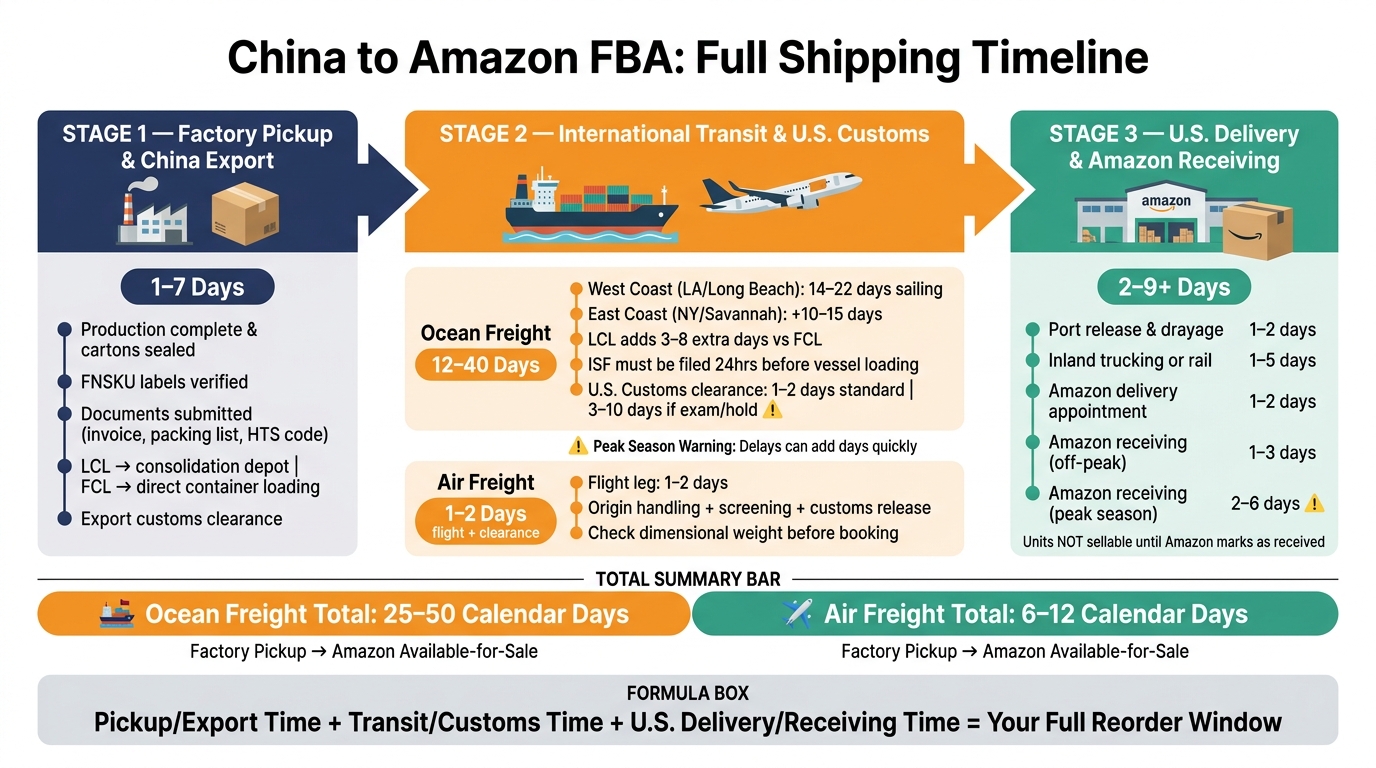
China to Amazon FBA Shipping Timeline: Full Lead Time Breakdown
Amazon FBA shipping from China usually moves through three parts: factory pickup and export, transit and customs, then U.S. delivery and receiving. Each part adds time to your total door-to-FBA lead time.
Put simply: pickup/export time + transit/customs time + U.S. delivery/receiving time = your full reorder window.
Factory Pickup and China Export Handling: 1–7 Days
This stage begins when your freight forwarder books factory pickup and ends when the cargo clears Chinese export customs and gets loaded onto a vessel or aircraft. In most cases, plan for 1–7 days.
Before pickup, make sure production is done, cartons are sealed, and carton sizes and weights are correct. You can use a CBM calculator to verify these dimensions before booking. It also helps to check carton labels and FNSKU barcodes before the truck arrives. If relabeling is needed, that can add 1–2 business days.
You’ll also want to send the commercial invoice, packing list, product details, declared value, origin, and HTS code before pickup day. If those documents show up late, the shipment can miss cutoff. And that happens more often than many sellers expect. Waiting until pickup day is one of the most common reasons cargo misses its port or airport cutoff. During peak periods, a missed cutoff can push cargo to the next sailing and add a week or more. Distance from the factory to the export gateway also affects cutoff timing.
Once the cargo is picked up, the path depends on the shipment type:
- LCL cargo goes to consolidation
- FCL cargo goes straight to container loading before cutoff
After the cargo leaves the factory, transit time becomes the main variable.
International Transit and U.S. Customs: Ocean 12–40 Days, Air 1–2 Days Plus Clearance
For ocean freight, sailing time from China to a U.S. West Coast port like Los Angeles/Long Beach usually falls in the 14–22 day range. East Coast ports like New York or Savannah often add about 10–15 more days on top of that.
Air freight cuts the flight leg to about 1–2 days, but that doesn’t mean the full trip takes only a day or two. Air shipments still go through origin handling, screening, customs, and release.
For ocean freight, make sure ISF is filed before vessel loading. Errors here can hold up departure. On the U.S. side, customs clearance can move fast when documents match and everything looks clean, often in 1–2 days. But if Customs flags an exam, asks a valuation question, or places a classification hold, several more days can disappear without much warning.
After clearance, the clock shifts to U.S. delivery and Amazon receiving.
U.S. Delivery, Amazon Appointment, and Receiving: 2–9+ Days
Once customs releases the cargo, the shipment still has one more stretch to finish. That usually includes port pickup, drayage, possible transloading or warehouse transfer, long-haul trucking if the destination is inland or on the East Coast, and then an Amazon delivery appointment.
For this final leg, plan for 2–9+ days. During peak season, limited appointment slots can push that window out even more.
Amazon receiving also takes time. Off-peak, it often takes 1–3 days. In peak season, that can stretch to 2–6 days. Until Amazon marks those units as received and available, they do not count as sellable inventory.
| U.S. Delivery Stage | Typical Duration | Main Delay Risks |
|---|---|---|
| Port release and drayage | 1–2 days | Chassis shortage, port congestion, appointment backlog |
| Inland trucking or rail | 1–5 days | Distance to destination, carrier availability |
| Amazon delivery appointment | 1–2 days | Limited slots, routing changes, delivery refusals |
| Amazon receiving (non-peak) | 1–3 days | Quantity discrepancies, labeling issues, transfer to another FC |
| Amazon receiving (peak season) | 2–6 days | Receiving backlog, high inbound volume |
These ranges make it easier to compare ocean and air when you’re planning replenishment.
Ocean vs. Air: Choosing the Right Shipping Method for Your Replenishment Plan
Once you have the full China-to-FBA timeline in view, the next move is simple: pick the shipping mode that fits your replenishment window. Compare total door-to-Amazon transit time with your sell-through rate and reorder point. If the cost of going out of stock is higher than the extra amount you’d pay for air, air is usually the better call.
The table below helps match shipping speed, cargo type, and delay risk to your next reorder. Treat these as planning ranges, not guarantees.
Comparison Table: Timeline, Cost, Shipment Fit, and Delay Risks
| Factor | Ocean Freight | Air Freight |
|---|---|---|
| Typical door-to-Amazon time | About 20–40 days; add time for LCL consolidation | About 5–10 days |
| Cost profile | Lowest per unit for larger or heavier shipments; usually quoted by container, cubic meter, or weight/volume | Higher per unit; typically based on chargeable weight |
| Best for | FCL for a full container; LCL for consolidated cargo | Small, urgent, high-value, or lightweight replenishment |
| Best fit | Planned replenishment, bulky products, and shipments with enough safety stock | Stockout prevention, product launches, small test orders, and high-margin goods |
| Main delay risks | Port congestion, vessel schedule changes, blank sailings, customs, container availability, LCL consolidation, trucking, drayage, and Amazon appointments | Limited flight capacity, cargo cutoffs, customs holds, inspections, documentation errors, weather, and trucking or Amazon receiving delays |
| Book and verify | Book early and focus on total landed cost and inventory coverage | Confirm flight space, documentation, customs readiness, and delivery appointment availability |
When FCL, LCL, and Air Freight Make Sense
FCL makes the most sense when your shipment fills most of a container, or when the cargo is expensive enough that skipping consolidation delays is worth the container cost. Since the goods move as one sealed unit, there are fewer handoffs along the way. That usually means a steadier schedule. As shipment volume grows, FCL also tends to make more financial sense.
LCL works when you need to move smaller quantities and don’t want to pay for a full container. That’s often helpful if you’re watching cash flow or testing a new product. The downside is extra handling. Your cargo gets combined with other shipments at origin, then split apart again at a U.S. deconsolidation site. That step often adds about 3–8 days compared with FCL, and it creates more chances for delays.
Air freight is the better fit when your inventory can’t wait out the full ocean timeline. Before you book, line up your lead time with your daily sales pace and safety stock. If ocean leaves too little room, a split plan can help: send a smaller air shipment to keep inventory available while the bulk of the order travels by ocean. One more thing – check dimensional weight before booking. Bulky cartons that don’t weigh much can still make air shipping cost far more than the per-kilogram quote suggests.
FCLGO can handle FCL, LCL, and air shipments from start to finish, which gives sellers a way to compare total door-to-Amazon cost and transit time side by side.
Once the mode is set, the next step is planning around delay points and adding buffer time.
Delay Points and Buffer Planning for 2026
Where Delays Happen Most Often
Once you know the base transit range, the next step is figuring out where time starts slipping.
Factory delays push every later step back. The usual problems are production running long, failed quality checks, missing labels, and cartons that don’t meet Amazon FBA packaging requirements. Get a confirmed cargo-ready date from your supplier and leave room for rework. Your target ship date needs to cover every step after production, not just the time it takes to make the goods. For a broader look at the logistics chain, see our guide on how to ship to Amazon FBA.
Origin delays at China export often come from missed cutoffs, warehouse backlogs, and document mismatches between the commercial invoice and packing list. With LCL, cargo may sit and wait for the container to fill before departure. That can add about 3–7 days on top of the quoted ocean transit.
U.S. customs delays can turn a same-day process into a multi-day problem. This usually happens when CBP flags a classification issue, asks for extra admissibility documents, or spots a mismatch between the invoice and the entry summary. In those cases, clearance can stretch to 3–10 days. A pre-departure document audit helps a lot: check HTS codes, importer-of-record details, declared values, quantities, and product descriptions before the shipment leaves China.
U.S. inland delivery and Amazon receiving can slow down because of chassis shortages, drayage limits, trucking delays, and a lack of appointments. Amazon appointment scarcity alone can add 1–14 days, depending on FC volume.
Ocean schedules remain volatile in 2026. So even if you have a confirmed booking, that doesn’t mean the vessel will leave on time. Treat the sailing date as an estimate, not a promise.
How to Calculate Your Target Ship Date
Use those delay points to work backward from the date your inventory needs to be available for sale.
Target factory-ready date = Available-for-sale date − Amazon receiving buffer − U.S. delivery − customs clearance − international transit − origin handling
After that, subtract manufacturing time and FBA prep time to find your production start date.
Work backward from the sale date, not the port-arrival date. If you need inventory available by November 15, and you use the high end of each range – 35 days for ocean and port variability, 5 days for customs or deconsolidation, 7 days for inland delivery and appointment handling, and 6 days for Amazon receiving – your factory-ready date lands around September 23. And that’s before production time is added.
| Stage | Standard Range | Peak-Season Buffer |
|---|---|---|
| China export prep and origin handling | 2–5 days | 3–7 days |
| Ocean transit (West Coast) | 14–25 days | 20–30 days |
| U.S. customs clearance | 1–3 days | 3–10 days |
| U.S. inland delivery and drayage | 1–4 days | 2–7 days |
| Amazon receiving | 3–6 days | 5–14 days |
Use the upper end of each range when the shipment is tied to a promotion, product launch, or holiday deadline. One missed vessel cutoff or one customs hold can wipe out your whole buffer in a single step. That’s why a conservative plan isn’t pessimistic. It’s just accurate.
FCLGO tracks each milestone from factory pickup through Amazon delivery, making it easier to spot a delay before it affects your available-for-sale date.
Conclusion and Seller Checklist
The number that matters most is your total lead time from factory pickup to the moment your inventory shows as available for sale in Seller Central.
For ocean freight, plan for about 25–50 days. For air freight, plan for about 6–12 days. Those ranges assume the shipment moves without hiccups. That’s why it makes sense to build extra time into your schedule before you book anything.
Start with your stockout date and work backward. Don’t plan around vessel departure alone. A shipment can leave China on schedule and still lead to a stockout if production takes longer than expected, customs holds the entry, or Amazon’s receiving line slows things down. Use the checklist below before each shipment leaves the factory.
FCLGO can handle ocean and air freight, FBA prep, customs clearance, warehousing, trucking, drayage, and direct delivery to Amazon.
Checklist for Smoother China-to-FBA Shipments
- [ ] Production complete; units counted and packaging finalized
- [ ] Pre-shipment inspection passed; defects and shortages resolved in China
- [ ] Verify carton count, dimensions, weight, and units per carton against the packing list and shipment plan
- [ ] Match descriptions, quantities, values, and consignee details across the invoice, packing list, and bill of lading
- [ ] Confirm HTS code, importer of record, country of origin, and required permits with your customs broker
- [ ] ISF filed no later than 24 hours before vessel loading for ocean shipments
- [ ] Amazon shipment created in Seller Central before cartons are labeled
- [ ] Correct FNSKU label applied to every sellable unit; labels match the exact SKU and variation
- [ ] Unique FBA Box ID label applied to every carton – not photocopied or reused
- [ ] Apply four pallet labels, one on each side near the top center, where applicable
- [ ] Carrier confirmed and the Amazon delivery appointment scheduled and accepted
- [ ] Track customs release, drayage pickup, and Amazon receiving in real time
- [ ] Safety stock on hand to cover the full replenishment lead time plus a disruption buffer
FAQs
How much buffer should I add?
Add buffer time based on the lane, shipping mode, and time of year.
For ocean freight to the U.S. West Coast, plan at least 2–4 weeks beyond port-to-port transit. On top of that, set aside 5–10 days for customs holds or delivery appointments.
Typical buffer looks like this:
- FCL: 7–14 days for the West Coast, 10–15 days for the East Coast
- LCL: 14–21 days for the West Coast, 20–30 days for the East Coast
If you’re shipping during peak season (Aug–Nov), add 10–14 more days. Shipping plans can get tight fast during that stretch, so extra time gives you some breathing room.
When should I choose air over ocean?
Choose air instead of ocean when you need to move fast, like for an urgent Amazon FBA restock, a new product launch, or items with a high price tag or a tight timeline.
Air freight from China usually takes about 5–10 days door-to-door. After that, Amazon receiving often adds another 3–7 business days once the shipment is delivered.
Ocean freight to the U.S. West Coast usually takes 25–35 days, and that’s before customs clearance and final-mile delivery are added to the total transit time.
Why does Amazon receiving sometimes take longer?
Amazon receiving can take longer than the usual 24 to 48 hours when fulfillment centers are busy. This happens most often from August through November.
Delays can also happen when delivery appointments are missed or a shipment needs extra handling. Common reasons include damaged or unreadable FBA labels, carton weight discrepancies, or floor-loaded containers that need manual unloading.
When that happens, receiving may take an extra 24 to 72 hours.
发表回复