If I want to avoid Amazon receiving problems, I need to get five things right before inventory leaves China: bag thickness, suffocation warning, FNSKU scan, carton limits, and shipment labels.
Here’s the short version: Amazon wants poly bags at 1.5 mil or thicker, a warning on bag openings of 5 inches or more, only one scannable barcode per unit, and master cartons that stay under 50 lb and use 32 ECT corrugated boxes. If I miss any of those checks, I can end up with delays, relabeling, or rejected inventory.
What I’d confirm before export:
- Inspect each unit for damage before bagging
- Use the right bag size and keep extra material under 3 inches
- Seal bags fully with no open side
- Add the suffocation warning when the opening is 5 inches or larger
- Make sure the FNSKU scans through the bag, or place it on the outside
- Cover other barcodes to stop scan conflicts
- Pack in new corrugated cartons rated 32 ECT or higher
- Keep each carton at 50 lb max
- Apply both labels: Amazon shipment label and carrier label
- Match the shipment plan for SPD or LTL
This guide boils the process down to the main checks I’d review so my shipment is ready before it heads to Amazon.
Let’s Talk POLY BAGS for Amazon FBA
sbb-itb-f9a91f9
2. Amazon Poly Bag Rules China Prep Teams Must Follow
These are the checks China prep teams should complete before any unit is bagged or labeled.
Bag Size, Thickness, and Sealing Standards
Every poly bag must be at least 1.5 mils thick, leave no more than 3 inches of extra bag material on any side, and be sealed all the way with no open ends. Clear bags are the standard. Opaque bags are required for adult items. When you use an opaque bag, place the barcode on the outside.
Suffocation Warnings and Barcode Visibility
Any bag with an opening 5 inches or larger must display a suffocation warning. Check that the text is easy to read and sized correctly before packing.
For barcodes, each unit should show only one scannable barcode. If the bag is clear and the barcode scans through the material, leave it inside. If the bag is opaque, or the inner barcode won’t scan through the bag, place the FNSKU on the outside on a flat spot away from seams and the heat seal.
When an FNSKU is in use, cover any manufacturer barcodes – UPC, EAN, or GTIN – fully to avoid scan conflicts at the receiving dock. It also helps to scan a sample of bagged units before export, so the team can catch barcode problems early. This ensures a smooth process for Amazon FBA shipping from China to the US.
Once the bag rules are set, the prep team moves to receiving, inspection, and SKU-level bag selection.
3. China Prep Workflow: Poly Bagging and FNSKU Labels Step by Step
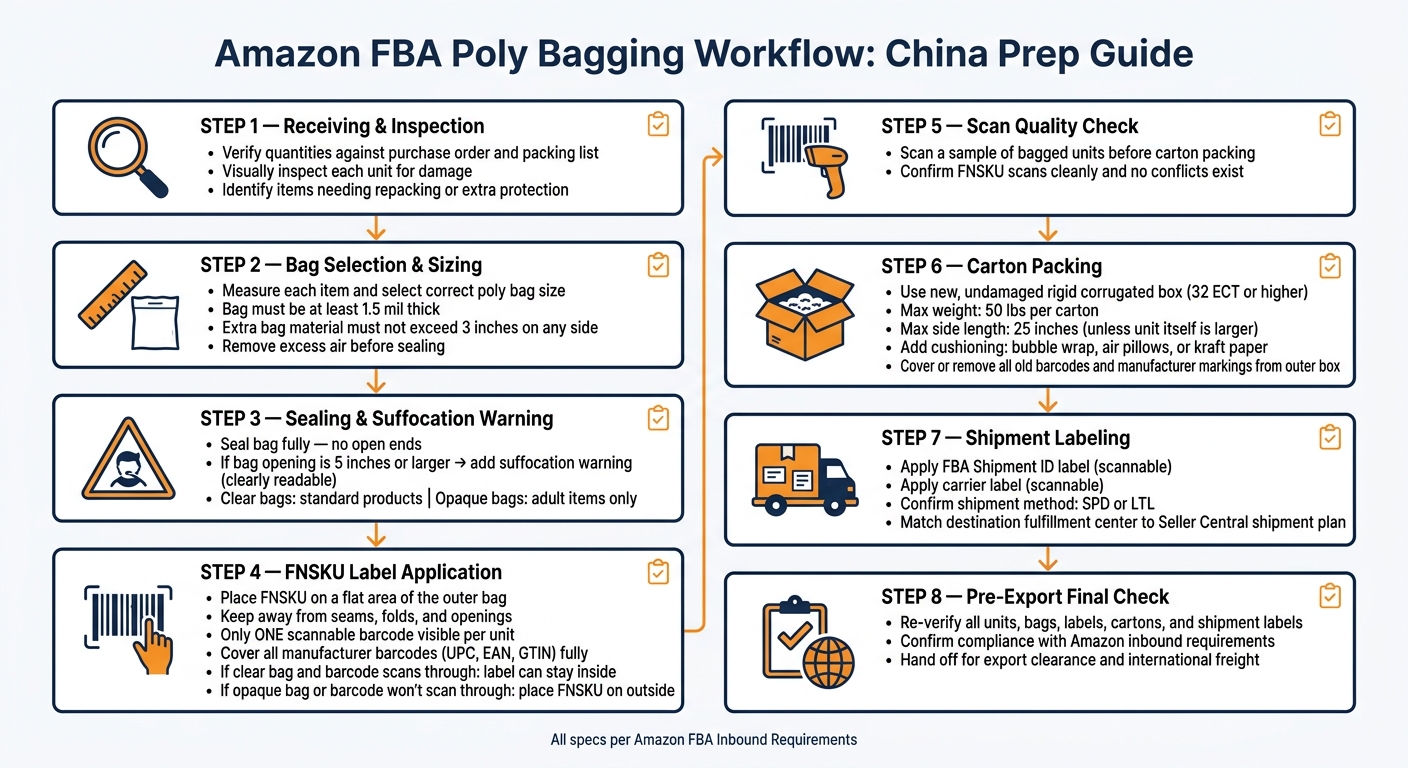
Amazon FBA Poly Bagging Prep Checklist: China to FBA Step-by-Step
Receiving, Inspection, and Bag Selection
When inventory arrives at a China prep facility, the first step is to verify quantities against the purchase order and packing list. That helps catch SKU mix-ups before bagging begins.
After that, each unit goes through a visual inspection for damage. The team also checks whether any items need repacking or extra protection.
Next, the team measures each item and picks the right poly bag. They remove excess air before sealing to cut volume and help prevent bags from bursting.
Once the bag size is confirmed, the team applies the FNSKU and checks scan quality before carton packing.
How to Apply FNSKU Labels Correctly
Place the FNSKU on a flat area of the outer bag, away from seams, folds, and openings. Make sure only one scannable FNSKU is visible.
Run a final scan check before carton packing.
After the labels pass inspection, the prep team moves to carton packing and the final shipping process to Amazon FBA.
4. Carton Packing and Shipping from China to Amazon FBA
Once the units are bagged and labeled, the team packs them into master cartons for export. This step sounds simple, but it matters a lot. If the cartons are packed or labeled the wrong way, Amazon can delay receiving the shipment or reject it.
Master Carton Rules and Shipment Labels
Amazon requires new, undamaged, rigid corrugated boxes rated at 32 ECT or higher. The outside of each carton should also be clean from a scanner’s point of view. That means no old barcodes, and no manufacturer markings that might throw off Amazon’s system.
Amazon’s carton checkpoints include the following:
| Carton Checkpoint | Amazon FBA Requirement |
|---|---|
| Box Condition | New, undamaged, rigid corrugated (32 ECT or higher) |
| Weight Limit | Max 50 lbs |
| Max Side Length | 25 inches on any side (unless the unit itself is larger) |
| Cushioning | Bubble wrap, air pillows, or kraft paper inside |
| Barcode Prep | Cover or remove all manufacturer/old barcodes on the outer box |
| Labeling | FBA Shipment ID label + carrier label; both must be scannable |
In plain English, the carton needs to be strong, clean, and easy for Amazon to scan. Inside the box, cushioning like bubble wrap, air pillows, or kraft paper helps protect the products during transit. On the outside, both the FBA Shipment ID label and the carrier label need to be clear and scannable.
Once the cartons pass these checks, the prep team hands them off for export and final delivery.
Direct Delivery to Amazon Fulfillment Centers
After carton inspection, the shipment moves through export clearance, international freight, U.S. customs, and direct delivery to the assigned Amazon fulfillment center.
FCLGO can handle pickup in China, Amazon FBA prep, freight, customs clearance, and direct delivery to Amazon fulfillment centers.
5. Conclusion: What to Confirm Before Inventory Leaves China
After carton packing, do one last pre-export check. Before inventory leaves China, make sure every unit, bag, label, carton, and shipment label follows Amazon inbound rules.
Here’s what to verify:
- Unit inspection: Check each unit for transit damage before poly bagging and labeling.
- Bag thickness and fit: The bag must be at least 1.5 mil thick, and the product should fit without putting stress on the bag.
- Suffocation warning: This is required on any bag with an opening larger than 5 inches.
- FNSKU placement: Each unit needs one scannable barcode, placed flat and left unobstructed.
- Carton standards: Use a new corrugated box, stay within the 50-lb limit, and apply the correct FBA Shipment ID label.
- Shipping method alignment: Confirm whether the shipment is SPD or LTL, and make sure the destination fulfillment center label matches your Seller Central shipment plan.
If your team wants help with that handoff, FCLGO can handle the full China-to-Amazon flow. That includes pickup in China, Amazon FBA prep, customs clearance, and direct delivery to Amazon fulfillment centers.
FAQs
What happens if my poly bags don’t meet Amazon rules?
If your poly bags don’t meet Amazon’s rules, Amazon may reject the shipment at the receiving dock or refuse to process it. And that can turn into a mess fast.
Instead of moving straight into fulfillment, the shipment may need to be rerouted to a third-party facility for manual rework. That adds delays, drives up costs, and increases the chance that you’ll go out of stock.
To stay compliant, your bags need to meet three basic requirements:
- Be at least 1.5 mil thick
- Include a suffocation warning if the opening is over 5 inches
- Be securely sealed
It’s a small detail, but one that can hold up an entire shipment.
When should the FNSKU go on the bag instead of inside it?
Place the FNSKU on the outside of the poly bag if the barcode isn’t clearly visible and scannable through the bag.
Amazon requires the label to stay scannable, whether it’s attached to the product itself or placed on the outside of the protective poly bag. That helps the item get received properly at Amazon fulfillment centers.
How do I know if my shipment should be SPD or LTL?
It mostly comes down to your shipment volume, budget, and timeline.
SPD is usually the go-to option for smaller shipments sent with carriers like UPS, FedEx, or USPS.
LTL tends to cost less for larger shipments, especially those with more than 150 units or multiple pallets. It also takes more coordination, including setting up delivery appointments through the Carrier Appointment System in Seller Central.
发表回复