One wrong invoice field can delay U.S. customs clearance, slow Amazon receiving, or add duty costs. If I had to boil this guide down to one point, it’s this: before cargo leaves China, I would check all 12 invoice items against the packing list, shipment plan, and transport documents.
Here’s the short version of what matters most:
- Match the parties: shipper, importer of record, consignee, and U.S. tax ID
- Match the invoice ID details: invoice number, date, currency, and Incoterms
- Describe each product clearly: what it is, what it’s made of, and what it’s for
- Use the right HTS code for each item
- Check all quantities: units, weight, and carton count
- Check all math: unit price, line total, and invoice total
- List country of origin on each line
- Separate goods value from freight and insurance
- Add shipment references: PO, Amazon Shipment ID, HBL/container, booking ref
- Make sure every document matches
- Sign and certify the invoice before pickup
- Never list Amazon as the buyer, seller, or importer of record
A few details can make or break the shipment. CBP can stop an entry if the EIN is missing, a vague product description can trigger a hold, and even a carton mismatch can delay release by 5 to 14 days. Also, origin errors can lead to a 10% ad valorem marking duty.
| Item | What I would check first | Common problem |
|---|---|---|
| Parties | Legal names, addresses, EIN | Wrong IOR or blank tax ID |
| Product lines | Description, HTS, origin | Vague wording or wrong code |
| Counts and values | Quantity, weight, totals | Math errors or carton mismatch |
| Charges and refs | Freight, insurance, Shipment ID | Missing reference numbers |
| Final review | Match all docs, sign invoice | Unsigned or inconsistent paperwork |
If you want a clean shipment handoff, this checklist is the last review I’d do before booking and loading.
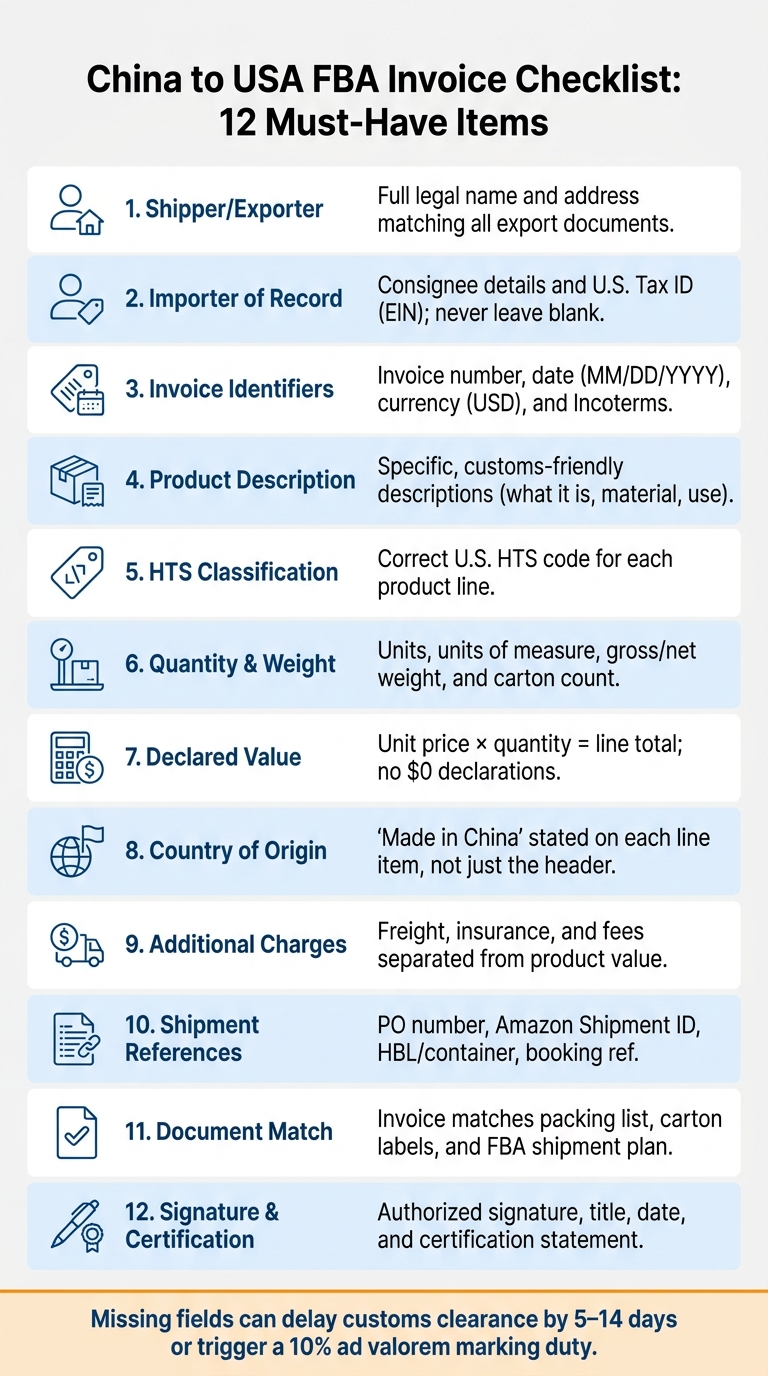
China to USA FBA Invoice Checklist: 12 Must-Have Items
Part 1: Seller, buyer, and invoice identity details
These fields are the base of a compliant commercial invoice. They need to match the packing list, bill of lading, and customs entry. If these identity details line up, you can then move on to product description, classification, and quantity.
1. Shipper or exporter legal name and address
Use the supplier’s full legal name, not a brand name or a shortened version. For example, "Shanghai ABC Trading Co., Ltd." and "ABC Trading" are not the same in customs records.
Include the complete address, country, business phone, and business email.
These details also need to match the sales contract, packing list, and freight booking. The simplest way to handle this? Keep one master record for supplier details and reuse it across all documents.
2. Importer of record, consignee, and U.S. tax ID
The importer of record, or IOR, is the U.S. entity responsible for customs entry, duties, and compliance. List the importer’s legal name, U.S. address, and EIN in EIN format, such as EIN: 12-3456789. For formal entries, CBP requires an Ultimate Consignee ID: EIN or SSN.
The consignee is the delivery party. For FBA shipments, list the Amazon fulfillment center exactly as it appears in your shipment plan. If the goods are going to a U.S. warehouse first, use that warehouse instead.
| Party | Required Details |
|---|---|
| Shipper / Exporter | Full legal name, street address, city, province, postal code, phone, email |
| Importer of Record | U.S. legal entity name, U.S. street address, EIN or SSN |
| Consignee / Ship-to | Amazon FC name and code or U.S. warehouse, full address |
3. Invoice number, issue date, currency, and Incoterms
Use one invoice number across the invoice, packing list, freight booking, and house bill of lading. It should be unique and easy to trace, like FBA-2026-08-015.
Use the U.S. date format: MM/DD/YYYY, for example 08/31/2026.
State the currency as USD and format values like this: $12,500.00.
Also include the Incoterms, named place, and version, such as FOB Shanghai, Incoterms 2020.
Next, list the product details CBP uses to classify the shipment.
sbb-itb-f9a91f9
Part 2: Product, quantity, value, and origin data
Line-item mistakes are one of the biggest reasons shipments get held up at customs. The smart move is to check the description and classification fields first, then work through quantity, value, and origin.
4. Product description
Each line item needs a plain-English description that explains what the product is, what it’s made from, and what it’s used for. Vague terms like "gift item" or "parts" don’t give Customs much to go on.
A solid description looks like stainless steel insulated water bottle, 500 ml, for reusable beverage storage. That level of detail helps CBP and your broker confirm what’s in the shipment without opening cartons.
5. HS or HTS classification
The HTS code affects the duty rate, any Section 301 China tariffs that apply, and how the entry gets reviewed. Each code should tie straight back to your internal SKU and Amazon ASIN so every record points to the same classification.
This is where small shortcuts can turn into big problems. Don’t pull a code from a similar item and assume it works. If the materials change, the tariff line can change too. A cotton T-shirt, a polyester T-shirt, and a blended T-shirt may each fall under a different tariff line based on fiber content alone.
6. Quantity, units of measure, weight, and carton count
List the quantity for each line item with a clear unit of measure, such as pieces, sets, or pairs. Then keep that same unit of measure across the invoice, packing list, and carton data. If one document says "pieces" and another says "sets", you’re asking for trouble.
Weight needs the same kind of cross-check. Net and gross weight should match the carton records. Carton counts also need to line up with the physical shipment and Amazon carton contents records. If they don’t, you can end up with receiving issues at the fulfillment center or extra customs questions.
7. Unit price, line total, and invoice value
Every SKU should show a declared unit price and a line total that equals unit price × quantity. After that, check that all line totals roll up to the right subtotal and grand total. Include other charges in the total only when customs value rules call for it.
Basic math errors are easy to avoid, but they still happen all the time. If 150 units are priced at $4.80 each, the line total must be $720.00.
The declared value also needs to match the actual commercial transaction value. A declared value of $0 is not allowed. Even free-of-charge samples must be declared at fair market value.
8. Country of origin
Country of origin has to appear on each line item, not just once at the top of the invoice. It also needs to match the physical product markings and carton labels, such as "Made in China", and reflect where the goods were actually made or substantially transformed.
This isn’t just a paperwork detail. Origin mistakes can lead to a 10% ad valorem marking duty or CBP-supervised re-marking. Before the shipment leaves, check supplier declarations and carton markings side by side.
Next, match charges and references to the shipment documents.
Part 3: Charges, references, and document matching
With origin confirmed, the next step is to check the charges and reference numbers.
9. Freight, insurance, and other charges
Keep the product value separate from freight, insurance, and any other charges. Break out the product subtotal, freight, insurance, packaging, handling, commissions or rebates, and export fees.
Freight and insurance should appear as their own line items so your broker can calculate customs value the right way. Even if those costs are rolled into the sale price, list them separately for customs valuation.
10. Payment terms, shipment mode, and reference numbers
State the payment terms, shipment mode, and all reference numbers in a clear way. CBP and your customs broker may use payment terms to review the transaction value and confirm that this is a bona fide sale for export.
Be specific about shipment mode. For example:
- Ocean freight – FCL 1 × 40′ HQ
- Ocean freight – LCL consolidation
- Air freight
This ties the invoice to the right transport document – bill of lading for ocean shipments and air waybill for air shipments – and helps your broker file the right customs entry.
Also include the PO number, Amazon Shipment ID, forwarder booking reference, and container or HBL number. Those references help your customs broker connect the commercial invoice to the entry summary and the bill of lading. They also help Amazon’s warehouse team confirm that the inbound shipment matches the shipment plan.
Once those references line up, compare the invoice against the packing list and the FBA cartons.
11. Match the invoice to the packing list, shipping labels, and FBA cartons
Do a line-by-line check before loading. Even one carton quantity mismatch between the invoice and packing list can trigger a CBP entry hold, which can delay clearance by 5 to 14 days until corrected documents are submitted.
Each SKU on the invoice should appear on the packing list with the same description, quantity, and unit of measure. Then check the total carton count on both documents against the number of cartons with Amazon FBA box labels. After that, confirm that each label points to the right destination fulfillment center. Fix every mismatch before loading.
A simple checklist helps here:
- Mark each line as Match or Mismatch
- Fix every mismatch
- Have a second person sign off before the cargo is loaded
Final review and conclusion: Sign-off before cargo leaves China
12. Signature, certification, and final compliance check
Once every line item matches, wrap up the invoice with signatures and certification. An authorized representative should sign the invoice, print their name and title, add the company name and address, and date it in MM/DD/YYYY format. A company seal (chop) is optional, but it’s commonly used on Chinese export documents.
Add this certification statement exactly as written:
"I certify that this invoice is accurate and that the goods are of the stated origin."
Before pickup, do one last check against CBP rules, Amazon FBA shipping documents, and the agreed Incoterms. One detail matters a lot here: do not list Amazon as buyer, seller, declarant, or importer of record. Fill in the importer of record field correctly. If that field is blank or wrong, customs clearance can be delayed or the entry can be stopped.
FCLGO can review export documents and FBA prep details before departure.
Checklist summary: all 12 invoice items at a glance
Use this table for the final pre-departure check. Missing fields or quantity mismatches can slow customs clearance and Amazon receiving.
Use the checklist below for the last pass before pickup.
| # | Category | What to verify |
|---|---|---|
| 1 | Shipper/Exporter | Legal name and full address matching export documents |
| 2 | Importer of Record | Consignee details and U.S. Tax ID (EIN); not left blank |
| 3 | Invoice Identifiers | Invoice number, issue date (MM/DD/YYYY), currency (USD), and Incoterms |
| 4 | Product Description | Specific, customs-friendly descriptions for each item |
| 5 | HTS Classification | Correct U.S. HTS code for each product line |
| 6 | Quantity & Weight | Units, units of measure, gross/net weight, and carton count |
| 7 | Declared Value | Unit price, line totals, and total invoice value |
| 8 | Country of Origin | Clearly stated as China for each product line |
| 9 | Additional Charges | Freight, insurance, and other fees separated from product value |
| 10 | Shipment References | Payment terms, shipment mode, PO/reference numbers, and Amazon Shipment ID |
| 11 | Document Match | Invoice matches packing list, carton labels, and shipment plan |
| 12 | Signature and certification | Authorized signature, printed name and title, company name, date, and certification statement |
Getting all 12 items right before cargo leaves China is one of the simplest ways to avoid customs delays, surprise duty bills, and Amazon receiving errors.
FAQs
Who should be listed as the importer of record for an Amazon FBA shipment?
The Importer of Record (IOR) is the person or company legally responsible for making sure a shipment follows U.S. import laws and rules.
The IOR must appear on all customs paperwork. They handle customs entry filings, pay any duties owed, and make sure the documents are accurate. FCLGO helps sellers with customs clearance and filing.
What happens if the invoice does not match the packing list or carton labels?
If your invoice doesn’t match the packing list or carton labels, your shipment can hit delays and processing problems fast. U.S. Customs may hold it for 3 to 7 days, and that can lead to extra storage fees, labor charges, or even seizure.
At an Amazon fulfillment center, mismatched unit counts or wrong labels can set off manual receiving, delays, or even shipment rejection.
How can I verify the correct HTS code and country of origin for each SKU?
Cross-check each SKU’s product specs against official trade documents and Seller Central rules. Also, verify HTS codes before filing to help avoid penalties or customs clearance delays.
For the country of origin, make sure it’s entered correctly in Seller Central and marked as Made in China on every master carton. Review these details before cargo departure to help prevent shipment rejection and storage fees.
发表回复