I plan replenishment around when stock becomes sellable – not when it leaves China. If you sell 20 units a day and replenishment takes 60 days, your reorder point is 1,200 units plus safety stock.
Here’s what I check before the next order:
- Demand: Compare 7-, 30-, and 90-day sales rates to estimate how long sellable FBA stock will last.
- Timing: Count production, freight, customs, delivery, and Amazon receiving – not just transit.
- Backup stock: Use ocean freight for core orders, with air shipments or U.S. warehouse releases only when they can cover a gap in time.
- Cost and progress: Review shipment milestones weekly, update expected sellable dates, and weigh backup costs against the expected cost of a stockout.
My rule: <u>delivery isn’t the finish line</u>. Inventory must be available for customers to buy before your current stock runs out.
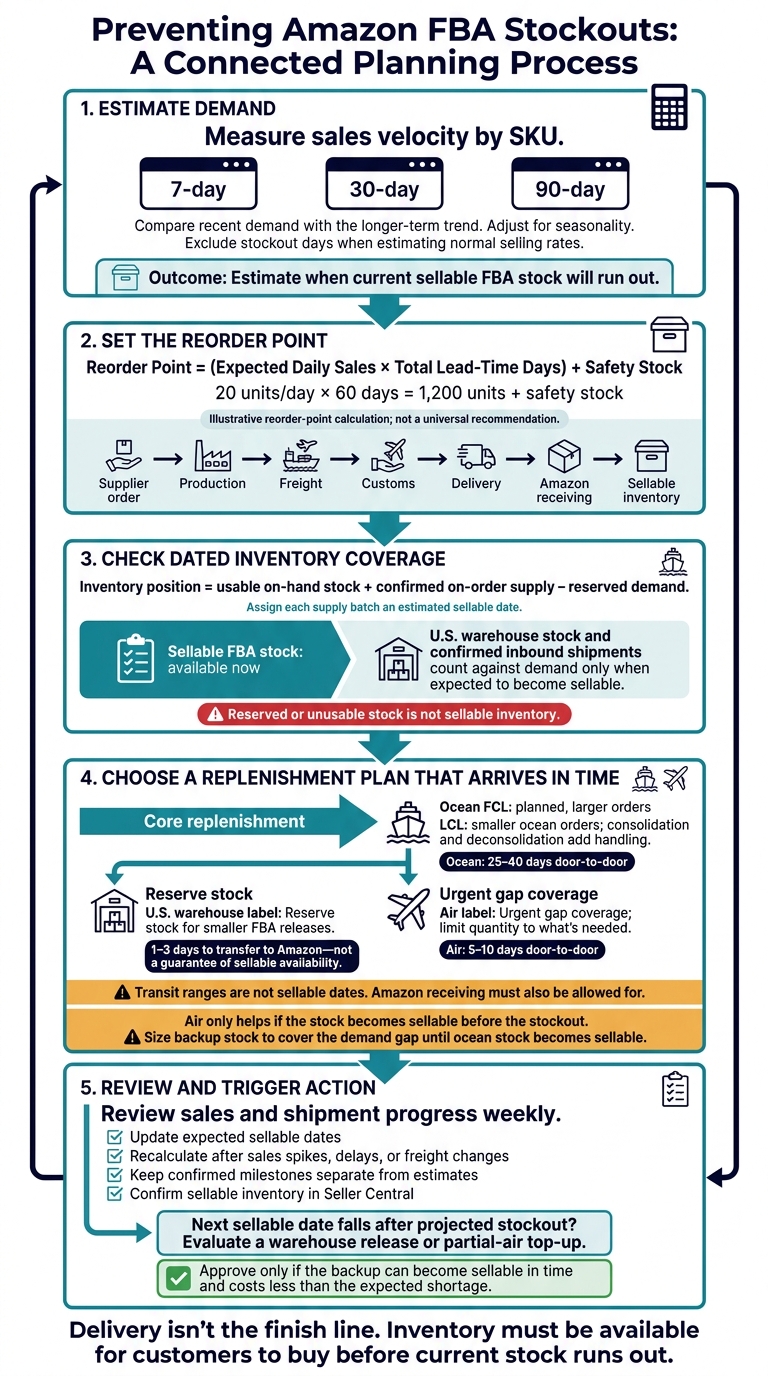
Amazon FBA Replenishment: From Sales Velocity to Sellable Stock
Use Sales Velocity to Set Reorder Dates
Calculate Daily Sales and Days of Cover
Use sales velocity to turn days of cover into a reorder date.
Track sales velocity by SKU over rolling 7-, 30-, and 90-day periods. Compare recent demand with the longer-term trend, then adjust expected daily sales for seasonality. Exclude stockout days when estimating normal selling rates: zero sales when inventory is unavailable don’t mean zero demand.
When sales increase, reorder sooner.
Calculate Total Lead Time and Safety Stock
For steady demand, use Reorder Point = (Expected Daily Sales × Total Lead-Time Days) + Safety Stock.
Count the full lead time, from placing the supplier order through Amazon FBA shipping from China and final receiving. Include safety stock to help keep inventory available until the next shipment arrives.
Check Inventory Position and Sellable Dates
Inventory position = usable on-hand stock + confirmed on-order supply − reserved demand.
Assign each supply batch an estimated sellable date. Then check whether those quantities will cover expected daily demand as they become available.
Track stock by when it can sell, not just where it sits.
| Stock category | Quantity to record | Availability date |
|---|---|---|
| Sellable FBA stock | Current sellable balance | Available now |
| U.S. warehouse stock | Verified usable balance | Estimated FBA sellable date |
| Confirmed inbound shipment | Confirmed shipment quantity | Estimated FBA sellable date |
| Reserved or unusable stock | Do not count as sellable inventory | Only after it becomes sellable |
If demand increases or replenishment falls behind schedule, move the reorder date earlier.
sbb-itb-f9a91f9
Match Freight and Warehouse Stock to Demand
Choose FCL, LCL, or Air Freight
Once you’ve set the reorder date, choose a shipment mix that makes stock sellable before the projected shortage – at the lowest workable landed cost.
Compare the full cost: freight, customs, duties, handling, prep, storage, and final delivery. Freight rates alone won’t tell you which option fits.
| Mode | Urgency and suitable volume | Handling | Inventory risk | Planning goal |
|---|---|---|---|---|
| Ocean FCL | Planned, larger orders | Full-container shipment | Lower unit cost for larger shipments | Move core replenishment efficiently |
| Ocean LCL | Smaller ocean orders | Requires consolidation and deconsolidation | Extra handling increases delay risk | Replenish smaller quantities without filling a container |
| Air freight | Urgent gaps; limit quantity to what’s needed | Requires clearance and final delivery | Higher cost leaves less room for timing errors | Cover demand until ocean stock is available |
China-to-U.S. ocean shipping may take 25 to 40 days door-to-door, while air freight may take 5 to 10 days door-to-door. These are transit ranges, not sellable dates. Ask FCLGO to separate transport time from Amazon receiving time before you choose a route.
Size an Ocean-Air Split Shipment
Use air to cover a gap, not as your default replenishment plan. Send the core quantity by ocean.
Size the air shipment to cover demand between the projected stockout and the ocean shipment’s sellable date. Calculate expected demand between the air and ocean sellable dates, then subtract usable stock remaining when air becomes sellable and any other supply available during that window. Add a justified buffer for customs and receiving uncertainty.
Air only helps if the stock becomes sellable before the stockout.
| Decision factor | Ocean-only plan | Ocean-air plan |
|---|---|---|
| Arrival dependency | Ocean stock must become sellable before existing stock runs out | Air must become sellable before the shortage; ocean must replenish before air stock runs out |
| Added cost | Avoids the air premium | Adds air freight and may add separate prep and delivery charges |
| Shortage risk | Higher when ocean timing leaves little margin | Lower only when the air quantity and timing cover the gap |
While overseas inventory is in transit, domestic stock can cover demand until Amazon receives the shipment.
Use U.S. Warehouse Stock for FBA Restocking
Keep a U.S. reserve when smaller FBA releases better match sales and Amazon receiving capacity. Schedule transfers before FBA stock runs low, leaving time for short carrier, appointment, and receiving delays.
| Stock location | Purpose | Availability | Delays it can help absorb |
|---|---|---|---|
| Amazon FBA | Active customer fulfillment | Sellable immediately | None, once sellable stock runs out |
| U.S. warehouse | FBA restocking and emergency buffer | 1–3 days to transfer to Amazon | Short carrier, appointment, and receiving delays |
| China origin | Bulk replenishment | 25–50 days | Longer production or ocean transit gaps |
Correctly do Amazon FBA Inventory Management from a 7-figure Amazon Seller 👌
Coordinate Replenishment With FCLGO
Once you’ve set your reorder date, use shipment tracking to keep it current. FCLGO connects shipment milestones to your sales-based reorder plan. Track ocean FCL/LCL, air freight, customs clearance, warehousing, prep, trucking, drayage, and direct FBA delivery against your projected sellable dates.
Review Sales and Shipment Progress Weekly
Each week, compare 7-, 30-, and 90-day sales velocity with shipment milestones. Share changes with your account contact to review freight options and U.S. warehouse releases.
Recalculate your reorder date after any major sales spike, delay, or freight change. This weekly check keeps freight choices, warehouse releases, and reorder timing in sync.
Track Customs Clearance and Amazon Receiving
After booking, watch for schedule changes between customs clearance and Amazon receiving. Track pickup, export clearance, transit, customs release, FBA prep, and final-mile delivery. Assign one person to confirm sellable inventory in Seller Central. Delivery confirmation alone doesn’t complete the restock.
Use FCLGO’s customs support to keep shipping documents and ISF filing on time for applicable ocean shipments. If delays occur, update projected sellable dates and inventory coverage. Keep confirmed milestones separate from estimates.
Set Cost Limits and Restocking Triggers
Use the latest sellable-date forecast to decide whether a backup shipment is worth the added cost. Request an itemized custom quote covering applicable freight, duties, clearance, prep, storage, trucking, drayage, and accessorial charges. Before approval, confirm what’s excluded and who pays each charge.
If the next sellable date falls after projected stockout, set a warehouse-release or partial-air top-up trigger before the replenishment window closes. Approve the extra cost only if the backup shipment can become sellable in time and costs less than the shortage.
Conclusion: Reorder Before Stock Runs Out
Once reorder timing is set, put the plan into action. Reorder based on sales velocity and total China-to-FBA lead time, rather than waiting for a low-stock alert.
Use split shipments and warehouse buffers to cover a known gap – not to make up for late ordering. Schedule them around freight, customs, and Amazon receiving milestones.
Apply that same milestone-based check to the next SKU at risk. Check your fastest-selling SKU today to confirm whether its next shipment will be sellable before days of cover reach zero. If it won’t, ask FCLGO whether a warehouse release or air shipment can close the gap.
FAQs
How much safety stock do I need for customs delays?
Set safety stock by shipping lane, method, and circumstances. Allow a buffer of 14–30 days for LCL or 7–15 days for FCL. From August through December, add another 10–14 days.
With LCL, shared-container holds can delay release by 5 days to 3 weeks. FCL carries less risk of these delays. Air shipments typically clear customs within 24 hours, though formal exams or documentation errors can add 1–5 business days.
How should I adjust reorder timing before a promotion?
Work backward from your target in-stock date, not the vessel departure date. Account for production, origin handling, customs, final delivery, and Amazon’s 3–7 business days for receiving.
Build in a buffer for drayage, appointments, and receiving delays: 14–21 days for West Coast LCL or 20–30 days for East Coast LCL. From August through December, add another 10–14 days to that buffer for peak-season volatility. FCLGO can help simplify this process.
When is backup U.S. stock cheaper than air freight?
Keeping backup stock in U.S. warehouses can cost less than running out of inventory and facing lost sales or expensive air freight. That buffer gives you time to replenish by ocean rather than air. Ocean shipping costs much less per unit, especially for shipments over 15 cubic meters (about 530 cubic feet).
发表回复