There’s no single duty rate for China-to-Amazon FBA shipments. I start with the product’s HTSUS code, country of origin, and customs value – not a flat percentage – to estimate charges before booking freight.
Here’s what I include in the budget:
- Government charges: Import duties, applicable China tariffs, and processing fees.
- Clearance costs: Brokerage, bond premiums, and any required filings.
- Shipping and FBA costs: Freight, destination handling, prep, storage, and delivery.
Shipments worth $2,500 or less may qualify for informal entry, but that doesn’t mean duty-free. I don’t assume the $800 exemption applies, either.
My final check: get an itemized, shipment-specific quote, confirm current tariff rules, and <u>identify the importer of record</u>. Shipping to Amazon doesn’t make Amazon responsible for clearing your goods.
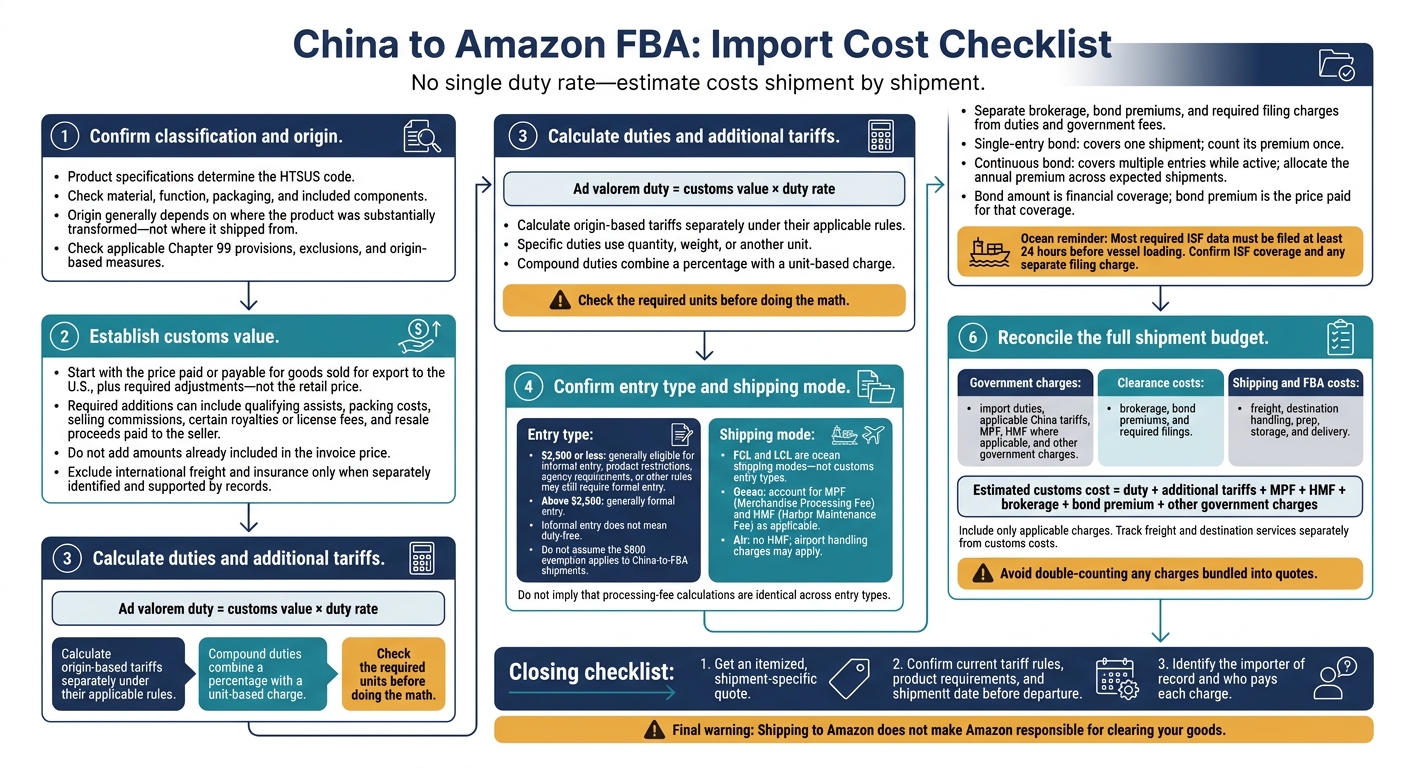
China to Amazon FBA: Import Cost Checklist
Calculating Import Duties
Ad valorem duty = customs value × duty rate. Customs value usually starts with the price paid or payable for goods sold for export to the U.S., plus required adjustments – not the retail price. Once you’ve confirmed the classification, apply its duty rate to the customs value. Calculate any origin-based tariffs separately.
Each tariff calculation must follow its own rules, including Chapter 99 provisions and exclusions. Specific duties use quantity, weight, or another unit. Compound duties combine a percentage with a unit-based charge. Check the required units before doing the math.
Product Classification and Country of Origin
Product specifications determine HTSUS classification, which sets the duty rate and helps identify extra tariffs. Find the correct provision in the USITC Harmonized Tariff Schedule, then check CBP guidance and rulings. If the classification is still uncertain, request a binding ruling.
Origin generally depends on where the product was substantially transformed – not where it shipped from. Support the origin determination with manufacturing records, bills of materials, supplier declarations, and production descriptions.
| Product information | Classification or origin consequence | Duty or compliance effect |
|---|---|---|
| Material, function, packaging, and included components | Can change classification | Different duty treatment or agency requirements |
| Manufacturing operations and country of origin | Determine applicable origin-based measures | Additional tariffs or trade remedies |
The classification determines both the duty rate and any classification-based trade measures.
Customs Value and Required Adjustments
After classification, valuation sets the dollar amount used to calculate duty under transaction-value rules.
Required additions can include qualifying buyer-provided assists, packing costs, selling commissions, certain royalties or license fees, and resale proceeds paid to the seller. Allocate assists correctly, and don’t add amounts already included in the invoice price. Exclude international freight and insurance only when those costs are separately identified and supported by records.
Keep invoices, purchase contracts, payment records, freight and insurance documents, and assist or royalty calculations consistent. Before shipment, reconcile quantities, prices, descriptions, and dutiable additions across those records. Undervaluation, false gift or sample descriptions, omitted dutiable items, and inconsistent records can lead to delays, exams, extra duties, interest, and penalties.
sbb-itb-f9a91f9
Customs Brokerage and Bond Costs
After calculating duties, account for the brokerage, bond, and filing charges needed to clear your entry. These charges add to your total landed cost, but they’re separate from duties, tariffs, and government processing fees.
A customs bond is a financial guarantee – not a replacement for duties, taxes, or fees. The importer of record remains liable even when a broker files the entry. Shipping to an Amazon fulfillment center does not make Amazon the importer of record.
Ask for an itemized quote that separates brokerage, bond premiums, duties, government fees, carrier charges, and any agency or documentation fees.
Customs Brokerage Services and Documents
A broker typically prepares and submits entry data, communicates with CBP, and coordinates release. You’ll need to provide the commercial invoice, packing list, bill of lading or air waybill, importer details, HTS codes, manufacturer or supplier information, origin and marking data, bond information, and Amazon FC delivery instructions. Include product-specific permits, certificates, or agency documents when required.
Get the brokerage fee’s scope in writing. Ask whether classification review, origin verification, agency filings and permits, entry corrections and protests, and disbursement of duties, taxes, and government fees cost extra. For ocean freight, Importer Security Filing (ISF), or “10+2,” may carry a separate charge.
Most required ISF data must be filed at least 24 hours before vessel loading for cargo bound for the United States. The importer remains responsible even if an agent files the ISF.
Single-Entry vs. Continuous Bonds
A single-entry bond covers one shipment and generally suits occasional imports. A continuous bond covers multiple entries while active and usually has an annual premium.
The bond amount and premium are different. The bond amount is the financial coverage CBP requires. The premium is what you pay the surety or broker to issue the bond.
| Bond type | Coverage | Practical use | Pricing factors |
|---|---|---|---|
| Single-entry | One shipment | Occasional or first-time FBA shipments | Merchandise value, duties, taxes, fees, entry type, commodity risk, and agency or ISF coverage |
| Continuous | Multiple entries while active | Frequent importers and recurring shipments | Import activity, duties and fees, commodity and agency risk, compliance history, and required bond amount |
Higher tariffs or exposure to antidumping and countervailing duties can require more coverage. For ocean shipments, confirm whether the bond covers ISF obligations.
These charges also vary by entry type.
Shipping Mode and Customs Entry Type
After brokerage and bond costs, shipping mode and entry type are the next factors to check.
Shipping mode affects transport costs. Entry type determines filing requirements. FCL (full container load) and LCL (less than container load) describe ocean shipping modes – not customs entry types.
| Shipping arrangement | Customs charges | Logistics charges | Documents needed |
|---|---|---|---|
| FCL ocean freight | Duties, MPF, HMF, brokerage, bond | Freight, terminal handling, drayage, final delivery | Bill of lading, entry documents, ISF |
| LCL ocean freight | Duties, MPF, HMF, brokerage, bond | Freight, consolidation, deconsolidation, destination handling, delivery | Shipment-level documents, ISF |
| Air freight | Duties, MPF, brokerage, bond where required; no HMF | Air freight, airport handling, final delivery | Air waybill, entry documents |
MPF stands for Merchandise Processing Fee; HMF stands for Harbor Maintenance Fee. When comparing quotes, check destination charges, not just freight. Pay close attention to LCL consolidation and deconsolidation fees. You can use a CBM calculator to estimate these volume-based costs. Air shipments have airport handling charges instead.
Entry type determines whether CBP processes your shipment as informal or formal.
Formal and Informal Entry Requirements
Value alone doesn’t determine entry type. Shipments valued at $2,500 or less generally qualify for informal entry, but product restrictions, agency requirements, or other rules may require formal entry below that amount.
Entry type affects government charges and bond requirements, so ask your broker to confirm eligibility before booking.
| Entry category | Eligibility | Government charges | Documents and bond |
|---|---|---|---|
| Informal entry | Generally eligible merchandise valued at $2,500 or less | Duties and MPF | Simplified entry documentation; bond often covered by the forwarder’s bond |
| Formal – value-based | Generally merchandise valued above $2,500 | Duties, MPF, and HMF for ocean imports | Formal entry documentation and a single-entry or continuous bond |
| Formal – other requirements | Lower-value goods when product-specific rules or CBP require formal entry | Duties, MPF, and HMF for ocean imports | Formal documentation, bond, and required agency filings |
The $800 De Minimis Exemption and Its Suspension
Don’t assume low-value shipments from China are duty-free. For China-to-FBA shipments, don’t base your landed-cost model on the assumption that small parcels enter duty-free.
Estimating Total Import Costs
Once classification and entry type are set, you can calculate import costs line by line using the HS code, origin, and entered value.
Estimated customs cost = duty + additional tariffs + MPF + HMF + brokerage + bond premium + other government charges. Track freight and destination services separately from customs costs.
Count a single-entry bond charge once. For a continuous bond, spread the annual premium across expected shipments rather than charging the full amount to each shipment.
Build the estimate with the same shipment details your broker needs to quote and clear the entry.
Details Needed for an Itemized Quote
Provide the commercial invoice, packing list, and bill of lading or air waybill.
FCLGO can coordinate freight, clearance, warehousing, trucking, drayage, FBA prep, and delivery. Ask for itemized charges and confirm who serves as importer of record and who pays each charge. Also check which customs and destination charges the “door-to-door” price includes.
Confirm the shipment’s duty line items before booking freight.
Pre-Shipment Customs Checks
Before goods leave the factory, have your broker verify the HTSUS code and any Chapter 99 duties. Ask for a shipment-specific estimate, not a flat landed-cost percentage. Verify the product rules and shipment date before departure.
FAQs
How can I verify my supplier’s HTS code?
Don’t rely on your supplier alone – misclassification is common. Verify your 10-digit HTSUS code in the official USITC database, then check it against the Section 301 tariff lists for goods originating in China.
Have a licensed customs broker review your invoice and packing list 48 to 72 hours before your cargo leaves China. For complex products, you can request a binding ruling from U.S. Customs and Border Protection.
When does a continuous customs bond save money?
A continuous customs bond generally costs less if you import goods into the United States more than three times a year. Instead of buying a single-entry bond for each shipment, you get coverage for all entries over a one-year period. That means fewer repeated bond costs and less paperwork, helping reduce your overall landed costs and making imports simpler to manage.
What if tariffs change before my shipment arrives?
The duty rate generally depends on when your shipment clears U.S. Customs and Border Protection. As the Importer of Record, you’re responsible for any updated tariff that takes effect before your shipment clears customs.
To avoid unexpected costs, confirm your 10-digit HTS code early and check official USITC updates. A freight forwarder like FCLGO can help you manage classification risks and work through Section 301 tariff requirements.
发表回复