How to Ship from China to Amazon FBA: Step by Step
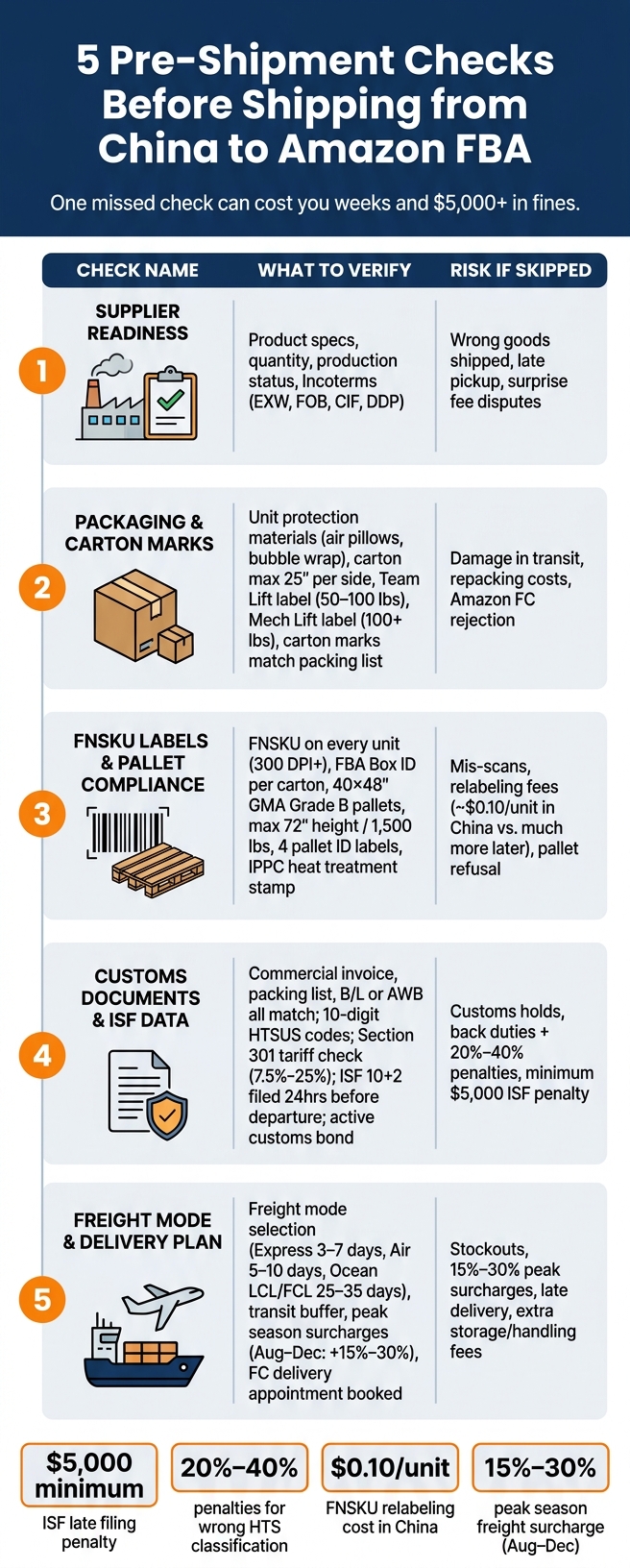
Shipping from China to Amazon FBA comes down to four jobs: prep the goods at the factory, pick the right freight method, build the Amazon shipment correctly, and clear U.S. customs without errors. If you miss a step, costs can jump fast – for example, a late ISF filing can lead to a $5,000 penalty, and ocean freight often takes 20 to 40+ days.
If I wanted the short version, I’d focus on this:
Set shipping terms early so the supplier, forwarder, and broker know who handles what
Make units and cartons FBA-ready in China to avoid relabeling and repacking after arrival
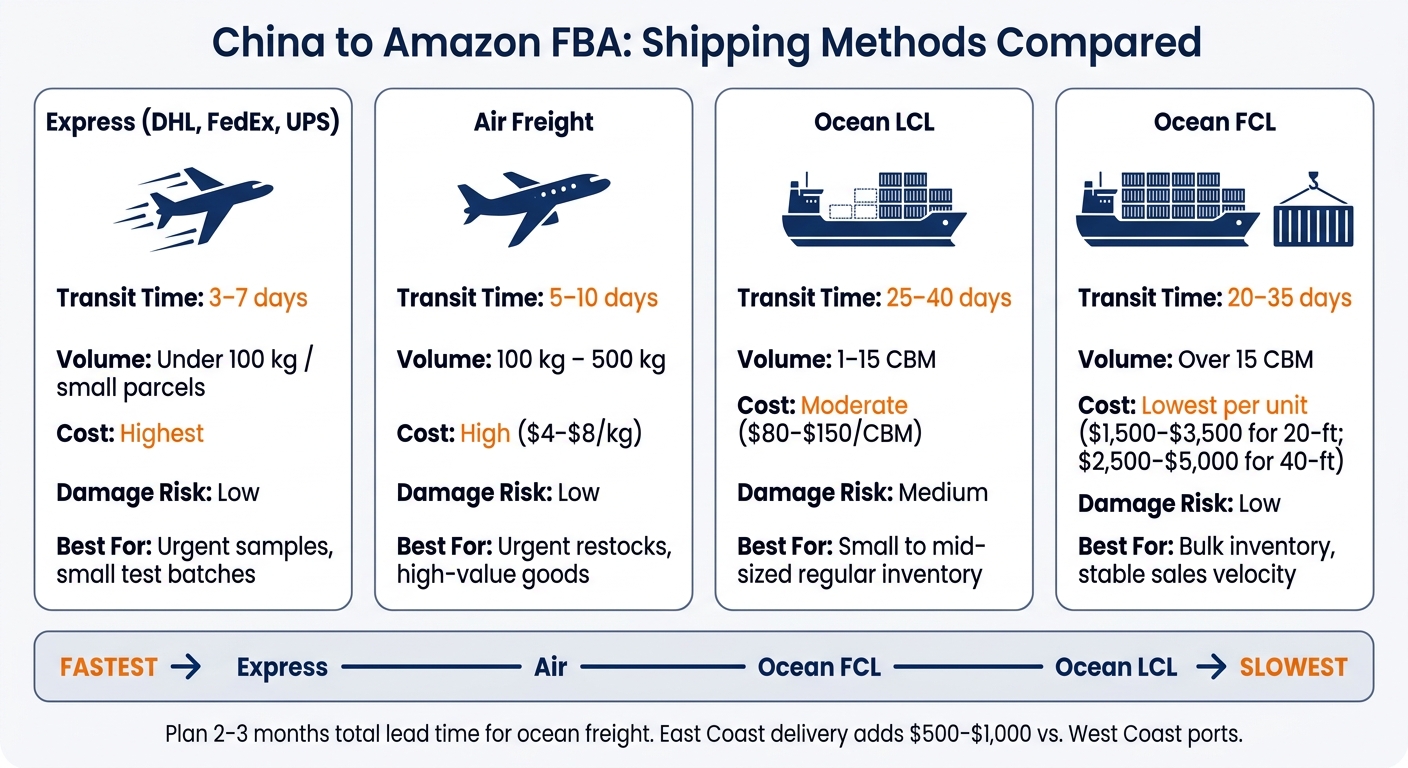
Choose freight by volume, timing, and stock risk:
Express: 3–7 days
Air: 5–10 days
Ocean LCL: 25–40 days
Ocean FCL: 20–35 days
Create the FBA shipment in Seller Central with the right unit labels, carton labels, and pallet rules
Use correct customs documents and HTS codes and file ISF on time for ocean shipments
Plan for Amazon receiving time, which is often 3 to 7 business days after delivery
A few numbers matter more than most:
Cartons should stay under 25 inches per side
Boxes from 50 to 100 lbs need Team Lift labels
Boxes over 100 lbs need Mech Lift labels
Ocean freight usually needs 2 to 3 months of planning when lead times, port delays, customs, and receiving are added together
Here’s the simple takeaway: if your labels, carton data, shipping mode, and customs paperwork are right before pickup, the rest of the move is much easier. The article below walks through that process from supplier prep to final check-in at Amazon.
China to Amazon FBA: Shipping Methods Compared
How to Create an Amazon FBA Shipping Plan From China or USA – Prepare, Package and Ship Products FBA
sbb-itb-f9a91f9
1. Prepare the Shipment at the Supplier Stage
Set supplier duties, timing, and FBA prep before you book freight. Once the goods are labeled, counted, and backed by the right paperwork, you can pick the shipping method with a lot less guesswork.
Set Incoterms, Production Dates, and Shipping Responsibility
Choose Incoterms before production wraps up. FOB is a common setup: the supplier handles the goods until they’re loaded at the origin port, and then your forwarder takes it from there.
You’ll also want to confirm the Cargo Ready Date. That’s the day production is done and the shipment is ready for pickup. Start with your target Amazon in-stock date, then work backward to leave enough time for transit, customs clearance, prep work, and Amazon’s receiving window.
A pre-shipment inspection in China is worth doing before anything leaves the factory. It helps catch quality defects, label mistakes, wrong carton counts, and packing issues while there’s still time to fix them.
Make Products Amazon-Ready Before They Leave China
Meet FBA rules in China. Fixes after arrival usually cost more and slow everything down.
Each unit needs the right FNSKU label. For protection, use approved materials like air pillows, bubble wrap, or sheet foam. Loose-fill options such as packing peanuts or shredded paper aren’t allowed. If the product has an expiration date, the marking must match Amazon’s format and font-size rules. Items with less than 90 days of shelf life left may be destroyed by Amazon.
Each carton also has to meet Amazon’s size and weight rules. No side can be more than 25 inches. Cartons that weigh 50 lbs to 100 lbs need a "Team Lift" label. Anything above 100 lbs needs a "Mech Lift" label.
Get the following details from your supplier. These are the exact inputs you’ll need for booking, labeling, and customs paperwork:
Data Category
What You Need
Carton Level
Total carton count, carton dimensions (L × W × H, in inches), carton weight (lb), total CBM
Product Level
Total units per SKU, FNSKU accuracy, HS Code, country of origin
Documentation
Commercial Invoice (unit price, total value), Packing List
Use inches and pounds so the data flows into Seller Central without format issues.
With the cargo ready, the next step is building the Amazon shipment.
2. Choose the Right Shipping Method From China to the USA
Pick your shipping method based on four things: volume, timeline, landed cost, and stock risk.
Lowest per unit ($1,500–$3,500 for 20-ft; $2,500–$5,000 for 40-ft)
Low
Bulk inventory, stable sales velocity
LCL involves more touchpoints than FCL, so the chance of damage is higher.
Match the Shipping Method to Budget, Timeline, and Volume
Start with your total CBM. If you’re under 15 CBM, LCL is usually the better fit because you pay only for the space you use.
Once your shipment gets into the 15–25 CBM range, a 20-foot FCL container will often cost less than LCL and give your goods more protection in transit. A standard 20-foot container holds up to 33 CBM, and a 40-foot container holds up to 67 CBM.
For air freight, don’t assume the per-kilogram rate tells the whole story. Carriers charge based on whichever is higher: actual weight or dimensional weight, using this formula: (L × W × H) ÷ 6,000.
Shipping to the U.S. East Coast usually costs more than shipping to West Coast ports. In many cases, that means adding $500–$1,000 on top of normal ocean container rates.
Timing matters too. During peak seasons, ocean transit can stretch past 40 days, so sea freight needs a longer runway. A good rule is to build in 2–3 months of lead time.
A simple way to handle this is to use ocean freight for your base inventory and air freight for replenishment or product launches.
Once the shipping method is set, build your Amazon shipment around that mode’s weight, carton, and timing limits.
3. Create the Amazon Shipment and Meet FBA Prep Rules
Once your inventory is packed, set up the inbound shipment in Seller Central and make sure every unit, carton, and pallet lines up with Amazon’s inbound rules.
In Seller Central, create the inbound shipment, choose the SKUs and quantities you’re sending, and pick the packing setup that matches how the products are packed.
Use Individual Units for mixed-SKU cartons. Use Case-Packed when each carton holds identical units. If you’re shipping mixed boxes, keep them to 5 ASINs or fewer.
Apply FNSKU Labels, Carton Labels, and Pallet Requirements
Every unit needs a scannable FNSKU or ASIN barcode. Print each label at 1.25 x 2.75 inches on durable, scannable paper.
Place the carton label flat on the outside of each box. For standard cartons, stay under 25 inches per side and under 50 lbs. Hazmat cartons are capped at 30 lbs.
If a box weighs 50 to 100 lbs, mark all sides with "Team Lift". If it weighs more than 100 lbs, mark all sides with "Mech Lift".
For pallets, use 48 x 40-inch, 4-way access wood pallets. Wrap them in clear stretch film, and keep each load under 72 inches tall and under 1,500 lbs. Double-stacked pallets are allowed only when the total height stays under 100 inches.
Once the shipment is built and labeled, the next step is export filing and U.S. customs clearance.
4. Clear Customs and Deliver to the Amazon Fulfillment Center
Once your shipment is packed and the Amazon inbound plan is done, customs is the last big checkpoint before delivery.
Handle Export Documents, Customs Entry, Duties, and ISF
Before the shipment can enter the U.S., your paperwork needs to be in order. The main documents are the commercial invoice, packing list, and bill of lading (BOL).
Your commercial invoice should include the product description, country of origin, and declared value. From there, your broker or forwarder can move ahead with customs entry.
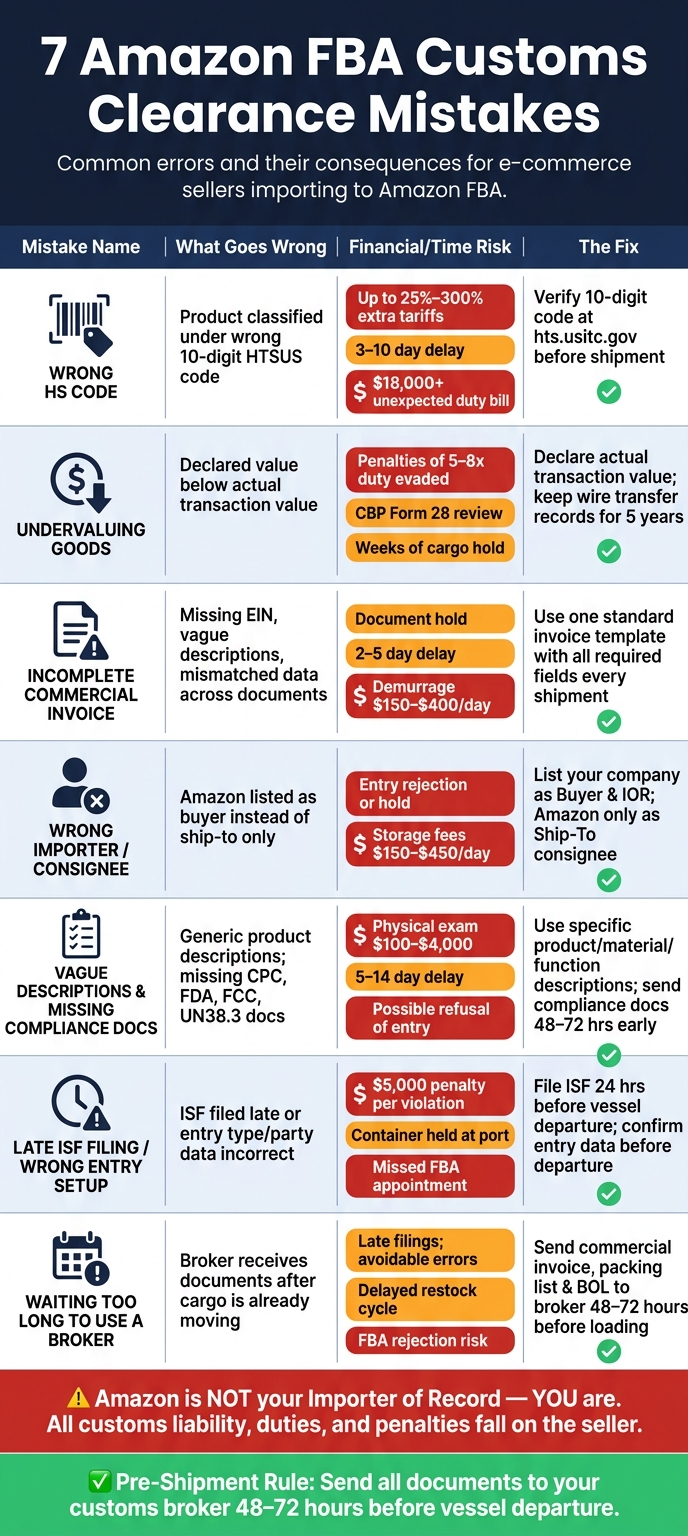
Use the right HTS code. It determines the duty rate and helps you avoid customs delays. It’s smart to confirm the code with your forwarder or customs broker before the goods leave China.
As the seller, you act as the Importer of Record (IOR). That means you’re responsible for customs entry, duties, and Section 301 tariffs. You also need a customs bond in place before your first commercial shipment can clear U.S. Customs.
For ocean freight, the Importer Security Filing (ISF, or 10+2) must be filed at least 24 hours before the vessel departs China. Miss that window, and problems can pile up fast. The safer move is to work with a forwarder that files the ISF automatically during booking, so the deadline doesn’t slip.
Coordinate Final Delivery, Appointment Scheduling, and Receiving Time
After the shipment clears customs, it moves into the last leg. FCL shipments usually go by drayage, while LCL and air shipments are usually moved by truck to Amazon or to a prep warehouse first.
If the shipment is going LTL, the carrier must book an appointment through Amazon’s Carrier Central. No appointment, no delivery. Amazon can turn the truck away.
After delivery, Amazon usually checks in inventory within 3 to 7 business days. Once that happens, the units show up as available for sale in Seller Central.
If the shipment doesn’t meet Amazon’s rules, it may need repacking or relabeling before it can be sent back for delivery. That adds cost, and it can slow everything down.
Once the goods are delivered and checked in, the process is complete.
Conclusion: Follow the Process and Avoid Common FBA Shipping Mistakes
Shipping from China to Amazon FBA goes much more smoothly when every step lines up, from supplier prep to final delivery. The simplest way to avoid trouble is to check the common failure points before pickup.
Most delays and added costs come from mistakes that can be avoided. Missing or incorrect FNSKU labels can lead to shipment rejection or manual processing fees. Cartons that weigh between 50 and 100 lbs must have Team Lift labels, and cartons over 100 lbs must have Mech Lift labels. The wrong HTS code can lead to duty overpayment or customs penalties. And if you guess too low on ocean transit time, stockouts can hit fast.
Here’s where sellers usually slip:
Common Mistake
Consequence
How to Prevent It
Missing or wrong FNSKU labels
Shipment rejection or manual processing fees
Verify labels against Seller Central before dispatch
Missing ISF filing
$5,000 fine and customs holds
File ISF at least 24 hours before vessel departure from China
Incorrect HTS code
Duty overpayment or customs penalties
Confirm classification with a broker during quoting
Unrealistic timelines
Stockouts
Use air freight for urgent gaps and plan 20 to 35 days for ocean freight
Poor palletization
Damage or rejection at the fulfillment center
Use 48 x 40-inch 4-way wood pallets, wrapped in clear stretch film, under 72 inches tall and 1,500 lbs
This is where good coordination pays off. When the supplier, forwarder, broker, and shipment plan all match up, you cut down on delays and avoid extra cost.
FAQs
Who should be the importer of record?
The Importer of Record is the person or company that makes sure imported goods meet the destination country’s laws and rules.
That party is still responsible for the legal entry of the products, including customs requirements and import compliance as a whole. If you use Amazon Global Logistics, you need an approved Importer of Record profile.
When should I use a prep warehouse?
Use a prep warehouse when your inventory needs extra work before it can go to Amazon. That usually means tasks like FNSKU labeling, poly bagging, bubble wrapping, or palletizing to match Amazon’s receiving rules.
It also makes sense when a shipment needs to be checked for damage, relabeled, or bundled before it moves out. A prep warehouse can help you stay in line with Amazon’s rules and cut the risk of delays, added storage fees, or fulfillment center rejections.
How do I estimate total landed cost?
Estimate total landed cost by adding up every expense from your supplier’s factory to the Amazon fulfillment center. Start with the shipment basics: carton count, dimensions, gross weight, total volume (CBM), and the destination warehouse.
Then layer in each cost piece:
International freight
Customs duties and taxes
Customs brokerage
FBA prep costs, such as labeling and palletizing
Inbound placement fees
Final delivery
Use current quotes, not old estimates. And if you’re booking through Amazon’s systems, check the full cost breakdown before you confirm anything.
China to USA Freight Forwarding: The Ultimate Guide
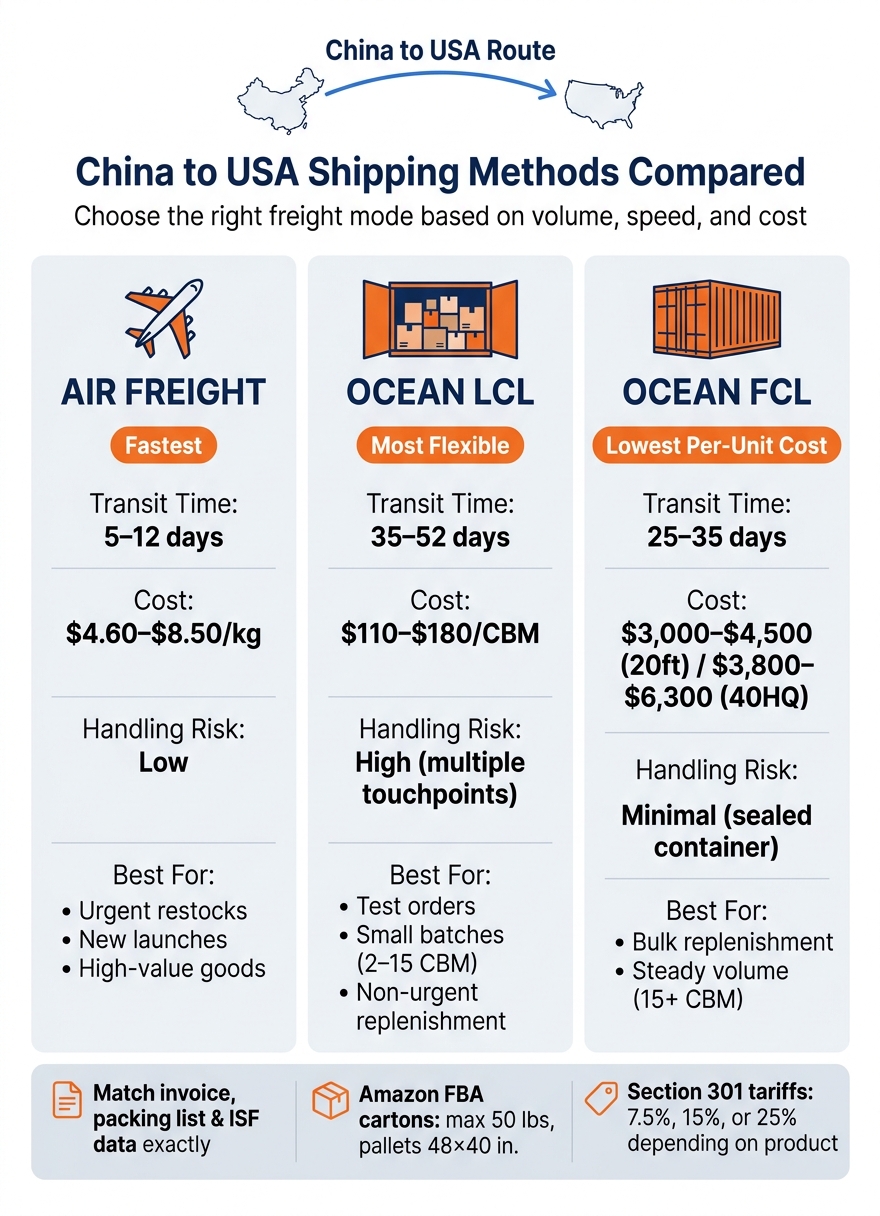
Shipping from China to the U.S. usually comes down to 3 choices: air for speed, LCL for small loads, and FCL for lower per-unit cost on bigger orders. If I want fewer delays, I need to line up the right shipping mode, file customs data on time, use the right HTSUS code, and make sure Amazon FBA labels and carton rules are correct before cargo leaves China.
Here’s the short version:
Air freight: about 5–12 days door-to-door, often $4.60–$8.50/kg
Ocean LCL: about 35–52 days, often $110–$180/CBM
Ocean FCL: about 25–35 days door-to-door, with common all-in ranges of $3,000–$4,500 for a 20-foot container and $3,800–$6,300 for a 40HQ
Section 301 tariffs on many China-made goods can be 7.5%, 15%, or 25%
Importers may also pay MPF at 0.3464% and HMF at 0.125%
For Amazon FBA, cartons usually must stay at or under 50 lbs., and pallets often need to meet 48 × 40 in. specs
What matters most is simple:
Pick the shipping method based on volume, timeline, and stock risk
Keep the invoice, packing list, and ISF data matched
Fix FNSKU, carton, and pallet issues before U.S. arrival
China to USA Freight Forwarding: Air vs LCL vs FCL Comparison
China to USA Freight Forwarders: In-Depth Comparison Guide #supplychainsecrets #amazonseller
sbb-itb-f9a91f9
Quick Comparison
Method
Best For
Door-to-Door Time
Typical Cost
Main Tradeoff
Air Freight
Urgent restocks, launches, high-value items
5–12 days
$4.60–$8.50/kg
Highest freight cost
Ocean LCL
Small orders, test shipments
35–52 days
$110–$180/CBM
More handling and more delay risk
Ocean FCL
Bigger orders, steady replenishment
25–35 days
$3,000–$6,300 depending on container
Needs more volume
If I had to sum it up in one line: good freight forwarding is less about booking space and more about getting the paperwork, customs, and final delivery steps right.
How China to USA Freight Forwarding Works
Step-by-Step: From Factory Pickup in China to U.S. Delivery
A shipment moves through seven stages. If you know where one handoff ends and the next begins, it’s much easier to avoid delays. That’s where a freight forwarder comes in. They coordinate the move from pickup all the way to final delivery.
It starts with pickup scheduling. Your freight forwarder arranges pickup from major manufacturing hubs in China. If you’re shipping to Amazon FBA, you need to create the shipment plan in Seller Central first.
Next, the goods go to a consolidation warehouse for intake, basic quality control, and export customs declaration. For ocean freight, the forwarder also arranges VGM weighing. Once export clearance is done, the cargo moves to the port or airport for the main transit leg. That could be ocean FCL, LCL, or air freight, depending on your shipment size and how fast you need it to arrive.
When the cargo reaches a U.S. gateway, a licensed customs broker files the customs entry, classifies the goods, and handles duty payment, including Section 301 tariffs. After customs release, the cargo moves to a U.S. warehouse for FBA prep, then on to Amazon or another final destination.
Each stage relies on the right documents and clear ownership of each task.
Documents and Parties Involved at Each Shipping Stage
Most of the paperwork comes down to four parties: the supplier, the freight forwarder, the importer of record (IOR), and the licensed customs broker. Who does what depends a lot on the trade term you choose.
Under FOB, the buyer takes responsibility once the goods are loaded on board at the origin port. Under DDP, the shipment includes origin fees, transport, duties, and final delivery. Under DAP, the buyer handles import clearance and duty payment after arrival. And for Amazon FBA, that’s a problem, because Amazon warehouses do not accept DAP shipments.
Document
Purpose
Primary Handler
Commercial Invoice
Product value, HTS codes, and country of origin for duty calculation
Here’s one detail that trips people up: the commercial invoice, packing list, and ISF data should match exactly. Even a small mismatch can lead to customs holds or inspections.
Those documents set the next steps for the forwarder, broker, and importer.
What a Freight Forwarder Handles Beyond Booking Cargo
A freight forwarder does a lot more than reserve space with a carrier. For Amazon sellers, the job often stretches into FBA prep and delivery appointment scheduling too.
On the China side, that usually includes factory pickup, document checks, export customs declaration, AMS filing, and VGM weighing. During transit, the forwarder tracks the shipment and works with carriers as issues come up. On the U.S. side, they handle customs entry, HTS classification, Section 301 tariff consulting, duty payment, and port drayage.
For Amazon sellers, there’s another layer. Forwarders often manage FNSKU labeling, carton checks, and palletizing to 48×40 in. After that, they schedule the delivery appointment through Amazon’s Carrier Central.
The table below shows the main jobs a forwarder usually covers:
Port drayage, LCL deconsolidation, Carrier Central scheduling, last-mile trucking
HTS code consulting matters more than many importers think. A vague product description can trigger audits and penalties.
FCL, LCL, or Air Freight: How to Choose the Right Shipping Method
Pick your shipping method based on cargo volume, speed, cost, and inventory risk.
Shipping Method
Transit Time (Door-to-Door)
Cost Profile
Handling Risk
Best-Fit Scenario
Air Freight
5–12 days
Highest (per kg)
Low
Urgent restocks, new launches, high-value goods
Ocean LCL
35–52 days
Moderate (per CBM)
High (multiple touchpoints)
Test orders, small batches, non-urgent replenishment
Ocean FCL
25–35 days
Lowest (per unit)
Minimal (sealed container)
Regular bulk replenishment, large volume moves
Start with volume first. Then look at speed and handling risk.
Ocean FCL: Best for Larger Shipments and Regular Replenishment
Full Container Load (FCL) means one shipper books the whole container. The most common setups are 20-foot containers for dense cargo and 40HQ containers for bulkier, lighter freight.
FCL starts to make sense once your shipment goes past 15 CBM. Under that point, you may be paying for space you don’t use. Over it, your per-unit cost usually drops compared with LCL. Your goods also move through fewer touchpoints because they skip consolidation and deconsolidation.
On price, a 20-foot FCL usually lands in the $3,000–$4,500 range all-in, while a 40HQ usually runs $3,800–$6,300 all-in, depending on the U.S. coast and market rates. If you replenish stock on a steady schedule, FCL is often the better fit.
Ocean LCL: Best for Smaller Volumes That Do Not Fill a Container
With Less than Container Load (LCL), your cargo shares a container with other shippers’ goods. You pay for only the space you use, which makes LCL a solid option for shipments in the 2–15 CBM range.
The downside is extra time and more touchpoints. Consolidation and deconsolidation usually add about 7–10 days to ocean transit, which pushes total door-to-door shipping time to about 35–52 days. And if one shipper’s cargo gets held or inspected, the whole container can get delayed.
LCL pricing usually runs $110–$180 per CBM all-in. For Amazon sellers, extra CFS handling time means you need more lead time. If you’re testing a new product or placing a first order, LCL is a practical way to start. But if your shipment size keeps going above 15 CBM, moving to FCL often cuts cost and lowers risk.
Air Freight: Best for Urgent Restocking, New Launches, and High-Value Cargo
Air freight moves goods from China to major U.S. cities in about 5–12 days. It’s also the most expensive option on a per-kilogram basis, usually $4.60–$8.50 per kg all-in.
Air shipments are billed by chargeable weight – either actual weight or volumetric weight, whichever is higher. That means carton size matters. Smaller cartons can lower chargeable weight and cut cost.
For Amazon sellers, air freight can make more sense than it seems at first glance. A stockout doesn’t only cost sales. It can also hurt your sales ranking. That’s why many sellers split shipments: send about 20% by air to cover near-term demand, while the other 80% goes by sea.
Use air freight for base-stock gaps, launches, and high-value goods when speed matters more than freight cost.
Next comes customs clearance, Amazon FBA prep, and delivery to the final destination.
Customs, Duties, Amazon FBA Prep, and Final Delivery
U.S. Customs Clearance, ISF Filing, Duties, and Common Compliance Risks
After booking and export, the shipment moves into the U.S. customs and delivery stage. At this point, origin logistics are mostly done, and customs clearance plus destination handling often become the main choke points.
ISF 10+2 has to be filed before the vessel departs. If the filing is late, missing, or wrong, you can run into major fines and delays. In most cases, your freight forwarder files the ISF for you, but the data still comes from you. If the shipment details are off, the risk is still yours.
Use the exact 10-digit HTSUS code for the product to cut down on holds and delays. It also helps to keep the commercial invoice, packing list, and ISF data aligned. When those documents don’t match, the odds of an X-ray inspection go up.
For Chinese-origin goods, duties may include the base tariff rate plus Section 301 tariffs of 7.5%, 15%, or 25%, based on the product category. On top of that, importers also pay the Merchandise Processing Fee (MPF) at 0.3464% of cargo value and the Harbor Maintenance Fee (HMF) at 0.125% of cargo value. A licensed customs broker usually handles entry filing and duty payment to CBP, and the broker fee is often $80 to $300 per shipment.
Here’s how the main tasks are usually split under FOB:
Step / Requirement
Responsible Party (FOB)
Key Detail
ISF 10+2 Filing
Buyer / Forwarder
Filed 24 hours before vessel departure
AMS Filing
Carrier / NVOCC
Filed 24 hours before departure
HTS Classification
Buyer / Broker
10-digit HTSUS code determines duty rate
Duties, MPF, HMF
Buyer
Base duty plus Section 301 tariffs, MPF, and HMF
Final Delivery
Buyer / Forwarder
Drayage, unloading, and final trucking to destination
One issue that trips people up: wooden pallets and crates need a visible IPPC heat-treatment stamp. If that mark is missing, CBP can require forced fumigation at the terminal, which adds cost fast.
Once the cargo clears customs, the next checkpoint is Amazon prep.
Amazon FBA Prep: FNSKU Labels, Carton Labels, and Pallet Requirements
At the unit level, each sellable unit needs a scannable FNSKU. Poly bags also need suffocation warnings when required. If the FNSKU is placed wrong or can’t be scanned, Amazon may reject the units or charge relabeling fees.
At the carton level, every box needs an Amazon Box ID label on the outside. Each carton must stay at or under 50 lbs unless the item itself weighs more. This is one of those small details that turns into a headache later. Many Chinese factories pack cartons heavier by default, so it’s smart to confirm carton weight limits with your supplier before production wraps up.
For palletized shipments, check that wooden pallets show the IPPC heat-treatment stamp. If that can’t be confirmed, plywood pallets can work instead, since they don’t need the same fumigation certifications.
The safest move is to have your freight forwarder or a prep center check FNSKU labels and carton labels against the Amazon shipment plan before cargo leaves the origin warehouse. Fixing a label issue in China is usually far cheaper than fixing it after the container lands in the U.S.
U.S. Warehousing, Drayage, Trucking, and Delivery to Amazon or Other Destinations
After release, the next steps depend on whether the shipment moved as FCL or LCL. For FCL shipments, the container is picked up from the port by drayage and moved to a warehouse for unloading. For LCL shipments, the container usually goes first to a Container Freight Station (CFS) for deconsolidation, where your cargo is separated from the rest.
Sending cargo through a U.S. warehouse before Amazon gives you more control over the process. You can inspect for damage, fix label problems, build pallets that meet Amazon rules, and send inventory into FBA in smaller batches. That can help you avoid high Amazon storage fees while still keeping stock in place.
For delivery to an Amazon fulfillment center, you need a pre-scheduled appointment through Carrier Central. After Amazon receives and checks in the inventory, it is generally ready for sale within 3 to 7 business days.
Costs, Transit Times, and How to Plan Your Shipment
What Affects Total Landed Cost and Shipping Timelines
Once customs and prep are done, the next step is figuring out total landed cost and lead time.
Quoted freight is just one piece of the bill. Total landed cost also includes origin pickup, export filing, international freight, U.S. customs duties, terminal handling, drayage, and final-mile delivery to your warehouse or Amazon fulfillment center.
A few things tend to have the biggest effect on cost. Peak season is a major one: shipping between August and November usually costs 30% to 60% more than off-peak periods because of surcharges and port congestion. If you book between March and July, you can often save 20% to 40% on the same lane.
Air freight has its own pricing rules. Carriers charge based on actual weight or volumetric weight, whichever is higher. Duties and Section 301 tariffs add to landed cost too. Route matters as well. Shipping to East Coast ports like New York or Savannah usually adds about $500 to $1,000 compared with West Coast ports like Los Angeles.
The tricky part is that these cost drivers don’t hit every shipment the same way. A small test order, a steady container program, and an urgent restock can end up with very different math.
Common Shipping Scenarios for Amazon Sellers and Importers
Three shipping situations come up again and again for Amazon sellers and importers buying from China.
Scenario 1 – Small LCL test order:
If you’re launching a new product and want to test demand before paying for a full container, LCL usually makes sense. Expect door-to-door transit of about 35 to 52 days and all-in costs of roughly $110 to $180 per CBM. It’s smart to leave room in the schedule for destination handling before final delivery.
Scenario 2 – Regular FCL replenishment (20′ or 40′ container):
If the product is already selling and you need to restock on a steady schedule, FCL is often the better fit. Port-to-port transit is usually 15 to 18 days. That said, you still need buffer time for customs, booking, and peak-season congestion. On paper, the sailing might look short. In practice, the full timeline is longer.
Scenario 3 – Urgent air shipment before a stockout:
When inventory is getting tight and your next ocean shipment is still weeks out, air freight can buy you time. Air shipments from China can reach the West Coast in 3 to 5 days in transit, while standard air for larger loads often takes 7 to 12 days. Rates usually run $3.50 to $7.00 per kg. A lot of sellers handle this by sending the urgent units by air and the rest by sea.
Conclusion: Key Steps to Ship From China to the USA With Fewer Surprises
The right forwarding plan helps keep inventory moving without extra cost or delay. The best China-to-USA shipment comes down to balancing volume, speed, compliance, and total landed cost.
FAQs
How do I choose between air, LCL, and FCL?
Choose based on your timeline, budget, and cargo volume.
FCL: Best when you can fill a 20-foot or 40-foot container. It’s often faster than LCL because the shipment goes through less handling.
LCL: A good fit for smaller shipments, usually under 12–15 CBM, when you want to cut costs.
Air: Best for urgent or high-value goods. But it costs a lot more, especially for bulky, lightweight items.
What documents do I need to import from China to the U.S.?
You’ll usually need a Commercial Invoice, Packing List, and a Bill of Lading or Air Waybill to clear customs and move the shipment.
For U.S. Customs, you’ll also need your Importer EIN/TIN, an ISF 10+2 filing before the vessel leaves port, a customs bond, and any product-specific compliance paperwork. That can include documents for FCC, CPSC, EPA, or FDA, depending on what you’re bringing in.
What can delay my shipment or customs clearance?
Delays usually come down to a few familiar problems: paperwork mistakes, missing documents, or failure to meet customs rules. One of the biggest trouble spots is mismatched details across the House Bill of Lading, commercial invoice, packing list, and Importer Security Filing (ISF).
Other common causes include:
Late ISF filing
Incorrect or unclear HTS classification
Missing certificates for regulated goods
Not having the required customs bond in place before arrival
It doesn’t take much. One wrong detail or one missing form can slow the whole shipment down.
What Is Drayage and Why It Matters for FBA Sellers
Drayage can decide whether your Amazon FBA shipment arrives on time or gets hit with extra port fees. For many sellers importing from China to the U.S., this short truck move is where delays turn into missed Amazon appointments, demurrage, detention, and stockouts.
If I had to sum it up in plain English, it’s this:
Drayage is the short truck trip from a port or rail ramp to a warehouse, prep center, or Amazon delivery point.
It matters because the clock starts fast after a container is available for pickup.
The main risks are timing gaps between customs, terminal pickup, prep work, and Amazon receiving.
Common charges can add up to hundreds or even thousands of dollars per shipment.
The fix is simple: I need one clear timeline for customs, pickup, warehouse receiving, and Amazon appointment booking, plus a 24–48 hour buffer.
A few points stand out right away:
A delayed pickup can lead to demurrage at the terminal.
A slow unload can lead to detention on the container.
A missed Amazon slot can mean re-delivery fees and later check-in.
Extra stops between port, prep warehouse, and Amazon mean more handoffs, more delay risk, and more cost.
Topic
What it means for me
Drayage
Short-haul container trucking after port or rail arrival
Main problem
Timing, not distance
Cost risk
Demurrage, detention, chassis, and wait-time charges
FBA impact
Missed appointments, later receiving, stockouts
Best move
Keep customs, drayage, prep, and Amazon delivery on one shared schedule
Bottom line: if I treat drayage like a small side task, I risk paying for it later. If I plan it early, I give my shipment a much better shot at reaching Amazon on time. For a deeper look at the entire logistics chain, see our guide on shipping to Amazon FBA.
Amazon Inbound Freight Guide: How to Stop Losing Thousands on Every FBA Shipment | AMZ Prep
sbb-itb-f9a91f9
How drayage connects to the Amazon FBA shipping flow
In FBA shipping, drayage links port or rail arrival to the next stop in the chain. The big issue here isn’t mileage. It’s timing. If this part slips, the next handoff slips too.
Common drayage routes FBA sellers use
You see that time pressure in a few common drayage moves:
Port to warehouse: After customs clearance, a drayage carrier picks up the container from the terminal and takes it to a nearby warehouse.
Port to FBA prep warehouse: The container goes straight to a prep center, where the team unloads loose cartons, checks FNSKU barcodes, and palletizes everything to spec before the last delivery leg.
Rail ramp to warehouse: For inland destinations, containers often move by rail from coastal ports like Los Angeles/Long Beach, then a drayage carrier covers the last 30–150 miles to a warehouse. This can cut truck cost, but ramp handling adds time.
Warehouse to Amazon fulfillment center: After prep is done, one last drayage move takes pallets or cartons to the assigned Amazon fulfillment center.
This is usually where delays and extra fees start piling up. One late pickup or one slow handoff can ripple through the whole shipment.
Why Amazon delivery appointments make drayage timing critical
Amazon fulfillment centers work on scheduled receiving appointments. If your container is still at the port, or stuck at the prep warehouse when that appointment window opens, you miss the slot. Then receiving gets pushed back.
Put simply, drayage timing decides whether your inventory gets to Amazon on schedule.
Drayage problems that increase FBA delays and costs
When the ocean leg ends, drayage becomes the part that decides whether your inventory keeps moving or gets stuck. At that point, the main trouble spots change. Instead of focusing on the vessel, you’re dealing with terminal access, truck supply, and appointment timing.
Demurrage, detention, chassis, and wait-time charges explained
Demurrage is the fee charged when a container stays at the terminal after free time ends. Detention is the fee charged when the container stays out too long after pickup, such as when a prep warehouse needs extra time to unload and return the empty container. Chassis fees add another charge when equipment must be pulled from a separate pool. Wait-time charges are billed by the trucking company when drivers sit idle at a terminal gate or at your prep warehouse waiting to load or unload.
These charges can stack up fast. In many cases, they add hundreds or thousands of dollars to a shipment. They can also trigger storage fees, re-delivery charges, or stockouts.
Port congestion, limited truck capacity, and customs timing gaps
Even when a shipment is cleared, it can still sit still if the truck, chassis, or terminal slot isn’t ready.
Customs clearance does not move the container. The gap before truck pickup is where demurrage starts. Port access is limited to qualified carriers with the required credentials, which shrinks the pool you can use on short notice. If the port is congested, that delay can get worse. And if no chassis is available at the terminal, the driver can’t move the container even when the cargo has already cleared.
Customs timing gaps can slow things down too. A late or incomplete filing can trigger inspection, delay clearance by days, and push your pickup date closer to the end of free time.
Extra transfers between port, prep warehouse, and Amazon
The risk goes up again when the shipment needs one more stop before Amazon.
A route from the port to a prep warehouse and then to an Amazon fulfillment center adds more handoffs and more ways for the schedule to slip. Every extra stop adds handling time and increases the odds of missing a window. The outbound leg to Amazon needs a confirmed delivery appointment, and if that window is missed, the shipment can face re-delivery charges and a later receiving date.
Put simply, each added transfer costs more and makes the timeline harder to manage.
How to reduce drayage risk through better coordination
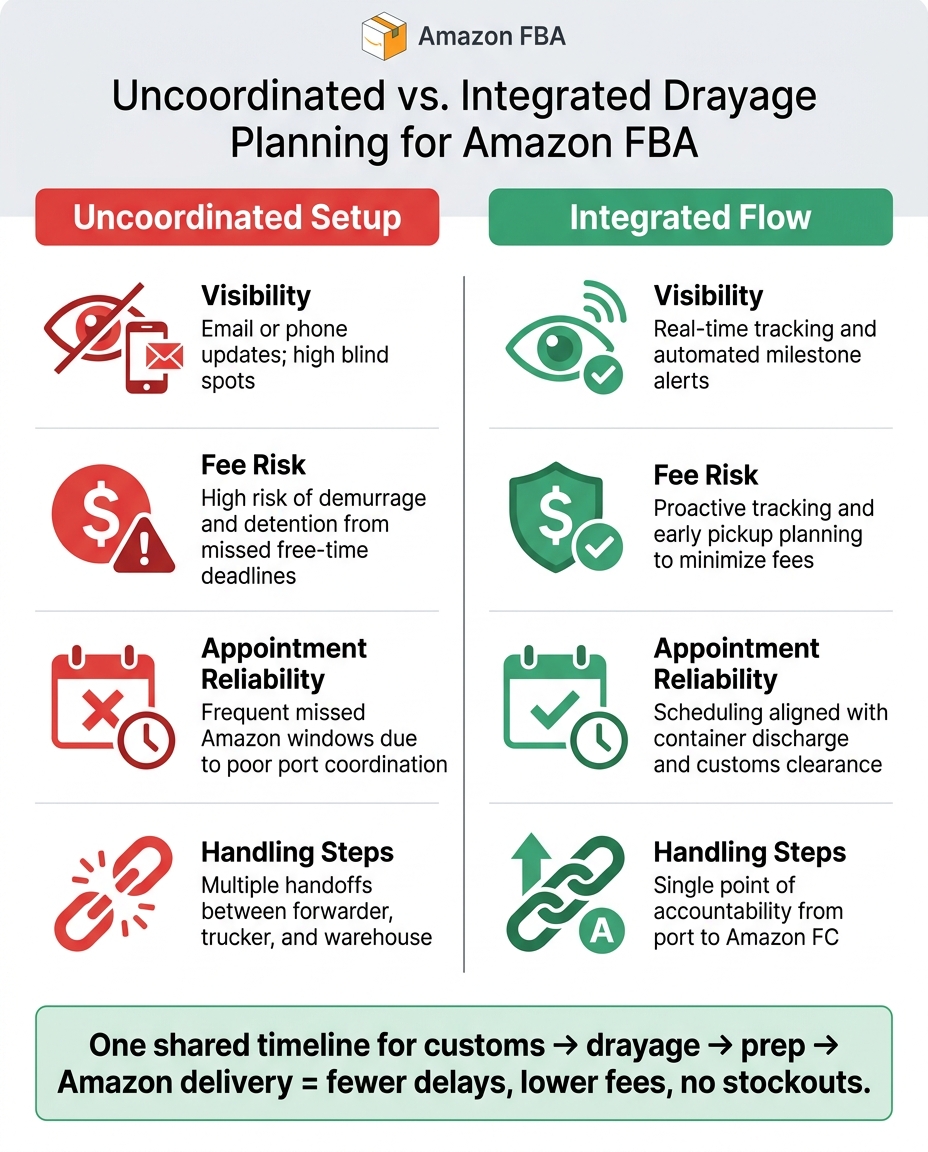
Uncoordinated vs. Integrated Drayage Planning for Amazon FBA
Once you know where delays tend to happen, the next step is simple: tighten coordination before the container leaves the terminal. A lot of drayage problems start when pickup, customs, warehouse readiness, and Amazon appointments are handled in silos instead of on one schedule.
Shipment details to confirm before container pickup
Before the container gets picked up, confirm these details with your forwarder:
Terminal info: Container number, seal number, and terminal or rail ramp location
Customs & timing: ISF 10+2 filed, U.S. Customs clearance confirmed, and the Last Free Day for both the container and chassis
Destination: Prep warehouse or direct-to-FBA, Amazon FC code (such as ONT8 or GYR3), and FBA shipment ID
Cargo specs: Total carton count and pallet count. Share gross weight and axle weight before pickup so the carrier can book the right chassis and route. Also confirm the load type: floor-loaded, palletized, or clamp unloading required
Miss one of these details, and the whole move can start to wobble. A truck may show up with the wrong chassis. A warehouse may not be ready. An Amazon appointment can slip before the container even gets moving.
How FCLGO connects drayage, prep, and Amazon delivery
The best way to cut risk is to have one party handle customs, drayage, prep, and Amazon booking together. That removes the usual gaps between teams and keeps the shipment moving on one timeline.
FCLGO coordinates drayage, customs, prep, and Amazon delivery in one flow. That means fewer handoff issues, one coordinator, and live tracking that keeps pickup, prep, and final delivery lined up.
Uncoordinated drayage vs. integrated drayage planning: a side-by-side comparison
Feature
Uncoordinated Setup
Integrated Flow (FCLGO)
Visibility
Email or phone updates; high blind spots
Real-time tracking and automated milestone alerts
Fee Risk
High risk of demurrage and detention from missed free-time deadlines
Proactive tracking and early pickup planning to minimize fees
Appointment Reliability
Frequent missed Amazon windows due to poor port coordination
Scheduling aligned with container discharge and customs clearance
Handling Steps
Multiple handoffs between forwarder, trucker, and warehouse
Single point of accountability from port to Amazon FC
That kind of coordination is what stops drayage from snowballing into a missed Amazon appointment.
Conclusion: Why drayage belongs in your FBA freight plan
Drayage links the port, the prep warehouse, and Amazon receiving. That makes it one of the main planning points in any FBA shipment. It may be the shortest leg, but it often carries the biggest timing risk. So it shouldn’t sit in the afterthought column. It belongs in the freight plan because it can decide whether your inventory moves on time.
Key takeaways for importers shipping from China
If you’re importing from China, the fix is pretty simple: plan drayage with the same urgency you give ocean freight and Amazon booking.
Treat drayage as part of the shipment, not a separate errand. Before pickup, confirm:
Last Free Day
customs clearance
warehouse receiving
Amazon appointment timing
It also helps to build in a 24–48 hour buffer for scan or check-in delays.
Miss a deadline, and costs can pile up fast. Once free time runs out, you may face fines, demurrage, detention, and daily storage charges.
The sellers who avoid delays usually keep customs, drayage, prep, and Amazon delivery on one shared timeline. When those pieces move together, delays drop, fees go down, and stockouts are less likely.
FAQs
When does drayage start?
Drayage begins once your cargo finishes its international trip and reaches a port or rail ramp. It’s the short-haul move that kicks off the domestic leg, taking the container from the terminal to a nearby warehouse, distribution center, or FBA fulfillment center.
This usually happens after the vessel is unloaded and the cargo clears U.S. customs, which allows the freight to be released for inland transport.
How much can drayage fees add up to?
Drayage costs can swing a lot. Port congestion, fuel surcharges, and equipment availability all play a part.
Most providers charge drayage as a flat rate per move. But that base price is only part of the story. Costs can climb fast once surcharges show up, including chassis splits, port fees, tolls, and terminal gate wait times.
Sellers should also keep a close eye on demurrage, detention, and mandatory customs inspection fees. These charges can hit hard and add a lot of unexpected cost to your total landed cost.
Should I send my container to a prep center first?
It depends on your cargo needs and how your shipping setup works.
If your goods arrive in cartons that don’t meet Amazon’s FNSKU, polybag, or labeling rules, you’ll need to prep them yourself or hire a prep service.
A standalone prep center adds another handoff: port to prep center to Amazon FC. That usually means higher costs and 2 to 4 extra days in transit.
If your forwarder also handles FBA prep, you can cut out some of that extra drayage, handling, and delay.
If I’m shipping less than about 13 CBM, I’d usually look at LCL. If I’m near 13 to 15 CBM or more, I’d price out FCL right away. That one choice affects my total shipping cost, transit time, cargo handling, customs risk, and how fast I can restock Amazon FBA.
Here’s the short version:
FCL = I book the whole container
LCL = I share container space and pay for the space I use
FCL is often faster and has less handling
LCL is often lower cost for small shipments
FCL often starts to make more sense at 13–15 CBM, and sometimes 10–12 CBM on some China-to-USA routes
LCL usually has more delay and damage risk because cargo is consolidated and split at warehouses
With LCL, if another shipper’s goods get flagged by customs, my shipment can be delayed too
Both modes need ISF 10+2 filed at least 24 hours before vessel departure, and missing it can mean a $5,000+ fine
If I care most about cash flow and I’m shipping a small batch, LCL often fits. If I care most about speed, fewer touchpoints, and lower risk, FCL is often the better call.
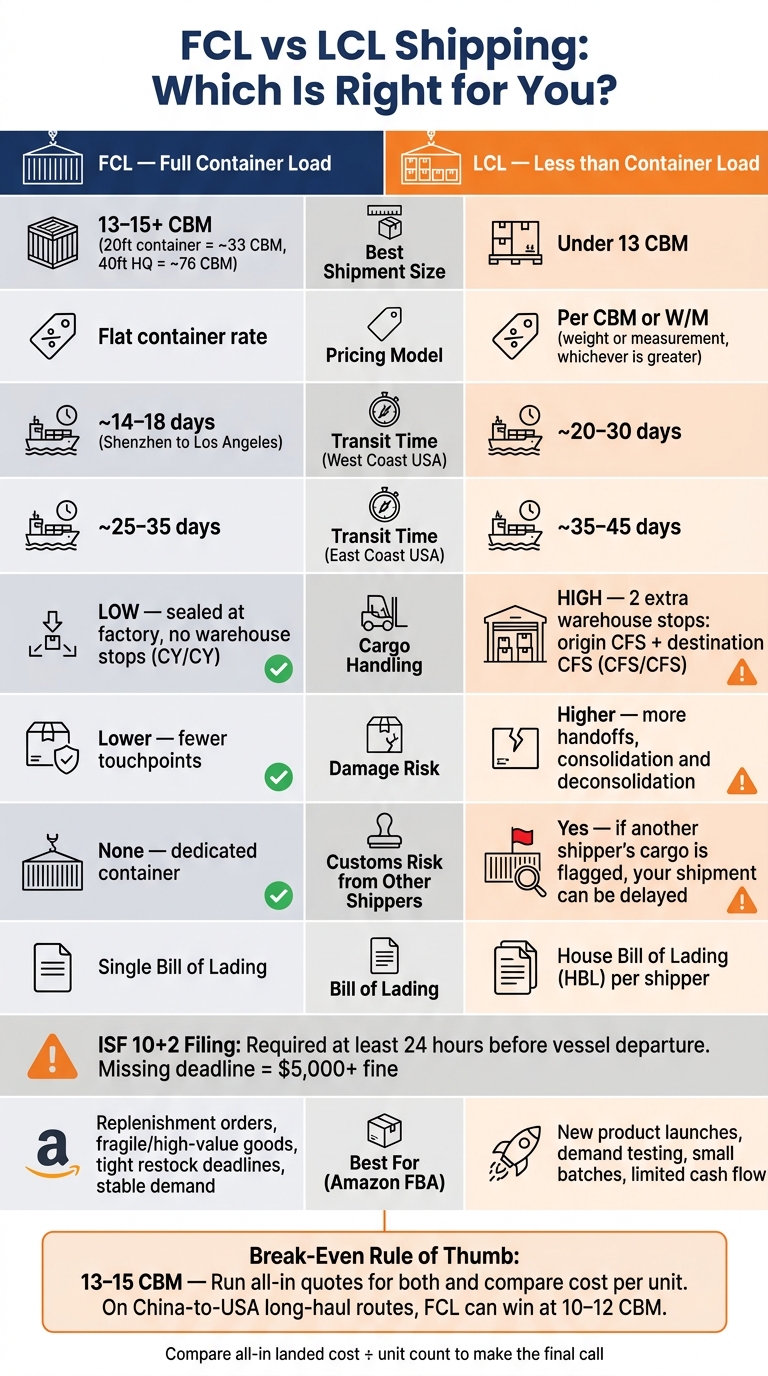
FCL vs LCL Shipping: Side-by-Side Comparison for Amazon FBA Sellers
FCL vs LCL: Which One Gets You Restocked Faster | AMZ Prep
sbb-itb-f9a91f9
Quick Comparison
Factor
FCL
LCL
Best for shipment size
Usually 13–15+ CBM
Usually under 13 CBM
Pricing
Flat container rate
Per CBM or W/M
Transit time to U.S. West Coast
About 14–18 days from Shenzhen to Los Angeles
About 20–30 days
Transit time to U.S. East Coast
About 25–35 days
About 35–45 days
Handling
Lower
Higher
Damage risk
Lower
Higher
Customs risk from other shippers
No shared container risk
Yes
Amazon FBA restocks
Better for tighter deadlines
Better for small test orders
My rule of thumb: I’d compare all-in landed cost, then use timing and risk as the tiebreaker. That usually gives the clearest answer before I book the shipment.
How FCL and LCL Work from China Pickup to Amazon FBA Delivery
How FCL Moves from Factory Pickup to Final Delivery
With FCL, the container is sealed at pickup and stays that way until final delivery. A truck brings an empty container to your supplier’s factory, the goods are loaded inside, and the container is sealed on-site. From there, it goes through export customs in China, crosses the ocean to a U.S. port like Los Angeles or Savannah, clears U.S. customs, and then moves by truck to your Amazon fulfillment center.
From Shenzhen to Los Angeles, transit usually takes 14–18 days. If the shipment is headed to New York or Savannah, it usually lands in the 25–35 day range.
LCL takes a different path because the cargo has to be combined with other shipments before it can leave by sea.
How LCL Moves Through Consolidation and Deconsolidation
LCL adds two extra warehouse stops, and those extra handoffs affect both timing and risk. Your cargo is picked up and sent to an origin consolidation warehouse, or CFS, in China, usually in Shenzhen or Shanghai. There, it’s combined with freight from other companies and loaded into one shared container.
On the U.S. side, the same process happens in reverse. The container is sent to a U.S. consolidation warehouse, opened, and split back into individual shipments. After deconsolidation, the cargo is sorted, labeled, and trucked to the assigned fulfillment center. Delivery appointments must be booked through Seller Central.
LCL shipments to the West Coast usually take 20–30 days. East Coast routes tend to take 35–45 days.
Key Differences That Affect Day-to-Day Shipping Decisions
The big day-to-day difference is simple: FCL stays sealed from start to finish, while LCL passes through shared warehouses on both ends. In shipping terms, FCL is CY/CY (Container Yard to Container Yard), while LCL is CFS/CFS (Container Freight Station to Container Freight Station).
Customs risk also changes. With FCL, one consignee controls the full container, so clearance is usually more direct. With LCL, your shipment shares space with other companies’ cargo. If one shipment in that container gets flagged for inspection, the whole container can be held, including yours.
That’s the part that shapes the tradeoff: price, transit time, and the chance of delay or damage all come back to how each shipping method moves through the system.
FCL vs LCL: Cost, Transit Time, Cargo Safety, and Customs
Shipment Size and Cost per CBM
Once your route is locked in, shipment size usually decides the first move: FCL or LCL.
LCL is priced per cubic meter. FCL, on the other hand, is a flat rate for the whole container. That means the more space you use in an FCL container, the lower your cost per CBM tends to get.
LCL pricing also comes with one catch: it’s billed on W/M. In plain English, you’re charged based on volume or 1,000 kg, whichever is greater. So if your cargo is heavy for its size, the bill may be based on weight instead of volume. And that can make the actual rate higher than the quoted per-CBM price.
Shipment Size
Best Option
Why
Under 13 CBM
LCL
Paying for a full container usually wastes money
13–15 CBM
Break-even zone
Run the numbers for both; FCL may win
15–25 CBM
20-foot FCL
Flat rate often beats per-CBM LCL pricing
25+ CBM or near-full 40HQ
40-foot FCL
More space, lower cost per CBM
When the cost difference is small, transit time and handling risk usually decide it.
Transit Time, Warehouse Handling, and Cargo Damage Risk
FCL usually wins on both speed and cargo protection.
LCL tends to move slower because consolidation and deconsolidation add extra days at both ends of the shipment. It’s not just a port-to-port move. Your cargo has to be grouped with other shipments first, then separated again after arrival.
That extra warehouse movement matters. LCL cargo goes through a consolidation warehouse in China, gets packed into a shared container, and then gets unpacked again at a U.S. Container Freight Station before final delivery. More handoffs usually mean more chances for dents, tears, or crushed cartons, especially if you’re shipping fragile products or goods with branded packaging.
If you’re shipping LCL and the items can break or scuff easily, stronger outer packaging is often money well spent. Wooden crates or film wrapping can help cut damage risk.
Customs Process and Amazon FBA Delivery Requirements
After cost and timing, customs and FBA prep often decide whether a shipment lands without trouble.
Both FCL and LCL need an ISF 10+2 filing at least 24 hours before the vessel leaves China. Miss that deadline, and you can face a minimum fine of $5,000 per shipment.
LCL has another risk that catches many importers off guard. Your goods share a container with cargo from other companies. If one shipper in that container misdeclares goods or ships something prohibited, the whole container can be held for inspection or even seized. That’s one reason some sellers move to FCL as soon as volume allows.
There are also document differences. FCL uses a single Bill of Lading, while LCL uses a House Bill of Lading (HBL) issued for each shipper.
For Amazon FBA delivery, common prep steps include FNSKU labeling and palletizing. With FCL, the shipment is loaded and sealed at the factory. With LCL, palletizing usually happens at the destination CFS after deconsolidation, right before the final leg to Amazon.
How to Choose Between FCL and LCL for Your Next Shipment
Run a Break-Even Check Before Deciding
Once you know the tradeoff on cost, speed, and handling, the next step is simple: run a landed-cost check and compare both options side by side.
Start by calculating your total shipment volume in CBM. Then ask for all-in quotes for both LCL and FCL, including origin, ocean freight, destination, customs, and final delivery.
After that, divide each total by your sellable unit count. That gives you your cost per unit. And that’s the number that matters most when you’re looking at margins.
The 13–15 CBM break-even range is a good starting point, but it doesn’t stay fixed on every route. On long-haul China-to-USA lanes, FCL can start making more financial sense at around 10–12 CBM.
Match the Shipping Mode to Your Inventory Risk and Cash Flow
If the price difference is small, let inventory risk and upfront cash flow make the call.
FCL makes more sense when you’re placing a big replenishment order, shipping fragile or high-value goods, working against a firm restock deadline, or dealing with steady demand. Your cargo stays in a sealed container with only your goods inside, which means less handling, fewer delay points, and no spillover from another shipper’s customs issue.
LCL makes more sense when you’re launching a new product, trying not to tie up too much inventory, shipping under 13 CBM, or watching cash flow closely. You pay only for the space you use, which gives you more room to test demand without going all in too early.
Situation
Recommended Mode
New product launch, under 13 CBM
LCL
Stable reorder, 15–25 CBM
20-foot FCL
High-value or fragile cargo
FCL
Tight restock deadline
FCL
Demand test, limited budget
LCL
25–60 CBM
40-foot FCL
Moving from LCL to FCL as Your Order Volume Grows
As your order volume gets more predictable, the decision tends to shift. Early on, flexibility often matters more. But once you regularly ship 13 CBM or more, FCL usually comes out ahead on unit cost and handling risk.
Conclusion: How to Pick Between FCL and LCL
Neither option wins every time. The right pick depends on three things: shipment size, timing, and risk.
LCL makes sense for smaller shipments. FCL usually starts to make more sense once you hit about 13–15 CBM, and sometimes even earlier on long China-to-USA routes. Start with cost, then use transit time and handling risk as the tie-breaker.
If your cargo is fragile, high-value, or tied to a restock deadline, FCL is often the safer bet. You get a sealed container and fewer handoffs, which can lower the odds of delays or damage. LCL is a better fit when flexibility matters more than speed, especially for smaller batches or demand tests.
There’s also shared customs risk with LCL. If another shipper in the same container gets flagged, your cargo can get held up too.
The practical move is simple: compare all-in quotes for both options, divide the total by your unit count, and choose the mode that gets inventory to Amazon on time at the lowest landed cost per unit – especially when a restock deadline is on the line.
FAQs
How do I calculate CBM for my shipment?
Multiply your cargo’s length, width, and height in meters:
Length × Width × Height = CBM
If your measurements are in centimeters, divide each one by 100 first.
It’s also smart to check the shipment weight. Many carriers charge by weight or volume – whichever comes out higher. A common rule looks like this:
1 CBM = 200 kg
When should I switch from LCL to FCL?
Consider switching when your shipment regularly hits 15 CBM or more. At that level, LCL charges for consolidation, documentation, and terminal handling can push landed costs up by 18% to 34%.
FCL gives you a fixed container rate, and at that volume it’s often 30% to 45% cheaper. It can also cut handling risk and move things along faster since you avoid deconsolidation.
What extra fees should I include in landed cost?
Include more than the base ocean freight rate.
Look at the full landed cost, including:
Origin charges like THC, ORC, documentation fees, and fuel surcharges
Destination costs such as customs clearance, entry filing, brokerage, and import tariffs
U.S. fees like Harbor Maintenance Fee, Merchandise Processing Fee, inland trucking, LCL deconsolidation, and optional marine insurance
If you skip these line items, the final bill can jump fast. The ocean rate may get the most attention, but it’s only one piece of what you’ll pay to move cargo into the United States.
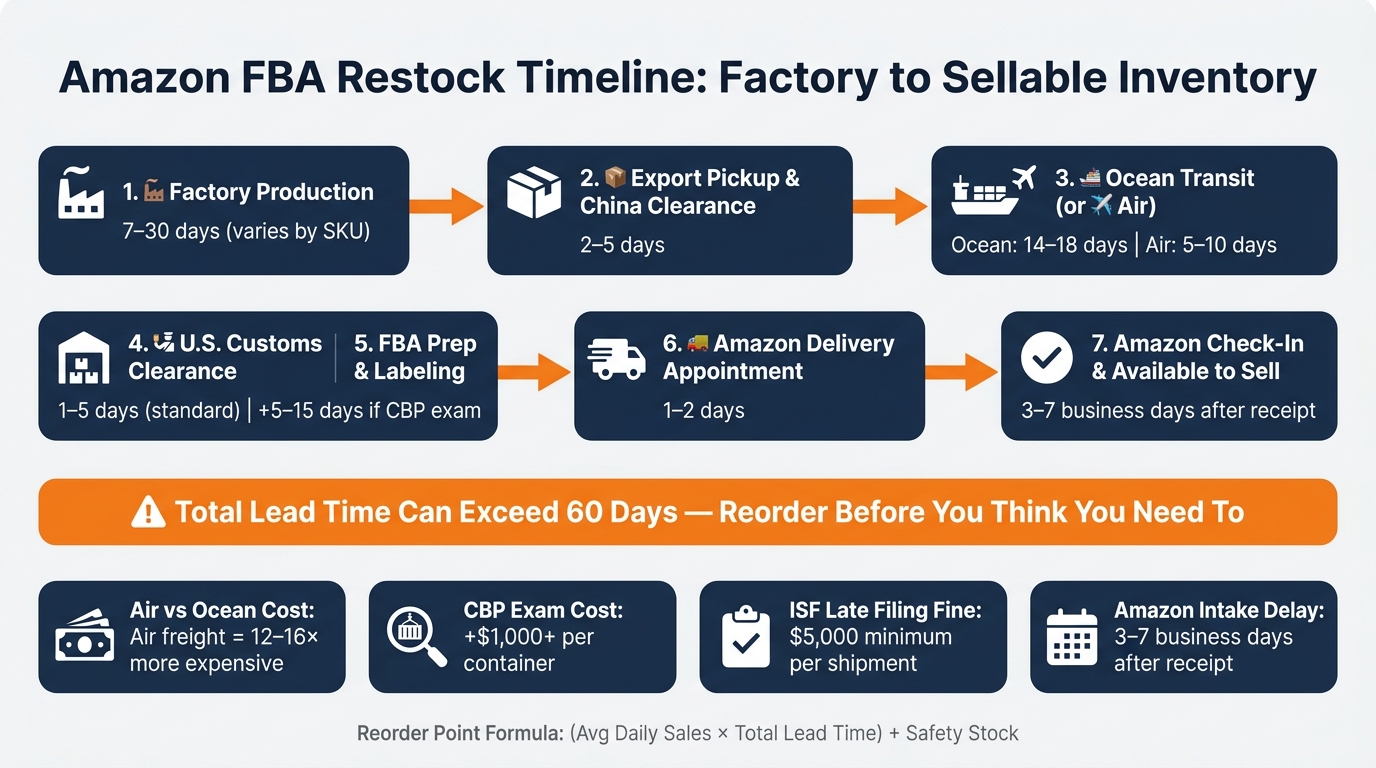
Stockouts usually happen because sellers reorder off factory time, not sellable time. I’d fix that by planning each SKU around the full timeline: production, freight, customs, prep, FBA delivery, and Amazon check-in.
Here’s the short version:
I calculate reorder points with daily sales × total lead time + safety stock
I use shipment history, not supplier estimates, to time reorders
I use air only for the gap when ocean freight will arrive too late
I keep a small U.S. warehouse buffer when restock limits or Amazon intake get messy
I check customs docs and FBA prep before cargo moves, because a shipment is not ready to sell just because it landed
A few numbers make the risk plain:
Air freight can cost 12 to 16 times more than ocean
A CBP exam can add 5 to 15 days and $1,000+ per container
Amazon inventory may take 3 to 7 business days to become available after receipt
Missing ISF can trigger a $5,000 minimum fine per shipment
If I had to boil the whole process down, it would be this: reorder earlier, hold buffer stock where it helps, and match shipping speed to the number of sales days I need to protect.
This article walks through the same framework in simple terms so you can keep units in stock without burning margin on last-minute freight.
Amazon FBA Restock Timeline: Factory to Sellable Inventory
Step 1: Calculate Your Real Reorder Timeline for Each SKU
Map Every Stage from PO to FBA Availability
Total reorder time = production + export pickup + transit + customs + prep + FBA delivery + check-in.
Treat the full trip like a chain. If one link slips, the whole shipment slips with it. That means you need to map each stage in plain terms: factory production, pickup and export clearance in China, ocean or air transit, U.S. customs, FBA prep and labeling, Amazon delivery appointment, and check-in.
And here’s the part many sellers miss: once inventory is received at an Amazon fulfillment center, it typically becomes available for sale within 3 to 7 business days. So "arrived at Amazon" does not mean "ready to sell today."
Build this timeline from your shipment history, not from factory guesses. Use actual dates from your tracking system and log each milestone:
PO date
ready-to-ship date
pickup
export release
departure
arrival
customs release
Amazon check-in
Track those dates for every shipment. After a few cycles, you’ll stop working off hope and start working off patterns.
Add Buffers for Seasonal Disruptions
Once you know the normal timeline, add extra time for shutdown periods. Chinese New Year and Golden Week can shut down factories and ports, which means reorder dates need to move up.
For Q4 holiday inventory, orders should ideally be placed by July, or no later than mid-September, to absorb those delays. If those shutdown periods land inside your lead time, don’t lean on average transit numbers. Build the delay into your plan from the start.
A Timeline Example for a U.S. Seller
A single shipping lane can give you a good test case. For a shipment moving from Shenzhen to Los Angeles/Long Beach:
Ocean transit: 14–18 days.
If CBP inspects it, clearance can stretch an additional 5 to 15 days.
After Amazon receives the inventory, it typically becomes available for sale within 3 to 7 business days.
This is why port arrival isn’t the finish line. A SKU is not reorder-safe just because the container hit the port. Review ocean-freight SKUs at least 60 days before stockout. Use that 60-day review point to trigger the next reorder decision.
Step 2: Set Reorder Points, Safety Stock, and Demand Forecasts
Calculate Reorder Points Using Daily Sales and Lead Time
Reorder Point (ROP) = (Average Daily Sales × Total Lead Time in Days) + Safety Stock
Use clean 30-, 60-, or 90-day sales data. Strip out stockout days and one-off spikes, then recalculate when demand changes.
Set Safety Stock by SKU Risk Level
Set safety stock by SKU risk, not by your catalog average.
SKU Risk Level
Safety Stock Range
Example Scenario
Stable, lower-risk
7–10 days
Slow-moving item
Single-source from China or high-margin
14–30+ days
Single-source SKU from China
Higher-inspection categories
Add 7–10 days on top
Electronics, toys, or textiles through U.S. customs
Higher-risk SKUs need more buffer because customs and transit delays stack up fast, while sales don’t slow down to wait. If a SKU sits in a higher-inspection category like electronics, toys, or textiles, add another 7–10 days for the chance of a CBP intensive exam. That kind of exam can add 5–15 days and cost more than $1,000 each time.
Forecast Demand Before Promotions and Peak Periods
Average demand helps during normal periods. It does not help much when a promotion is about to hit or peak season is around the corner.
Forecast demand before any campaign that could drain stock faster than ocean freight can replace it.
Review your days of cover (inventory on hand ÷ average daily sales) every week. If a promotion is scheduled or Q4 is getting close, increase your forecast before placing the next purchase order. U.S. e-commerce sales are expected to grow by 11.3% during the Q4 holiday season, reaching about $206.88 billion.
The goal is simple: bring in enough inventory for peak demand, not a pile of leftover units in January.
With reorder points set, the next step is choosing a shipping mix that keeps those dates protected.
Step 3: Build a Shipping Plan That Protects In-Stock Levels
Once you’ve set your reorder points, the next move is figuring out how inventory will travel so it lands before you run out. This part matters more than it seems. Your freight choice has a direct effect on stockout risk, so the goal is simple: use the fastest shipping lane only for the units that protect your reorder window.
Use Split Shipments When Ocean Timing Is Too Risky
Ocean freight is the cheapest option, but it can be too slow when your replenishment window is tight. Air moves much faster, but the cost climbs fast. That’s why it makes sense to use air only for the gap that ocean can’t cover in time.
A split shipment does exactly that. You send a small, urgent batch by air to cover sales while the larger ocean shipment is still on the water. Put plainly, the air portion keeps the SKU alive until the ocean inventory shows up.
Air units needed = daily sales × days between air arrival and ocean arrival.
So the shipping mix should match the number of selling days you need to cover. No more, no less.
Shipping Method
Transit Time
Cost Level
Stockout Risk
Best For
All-Ocean
20–40 days
Low
High
Planned bulk restocks
All-Air
5–10 days
High
Very Low
Urgent restocks, high-value items
Split (Air + Ocean)
Mixed
Medium
Low
Protecting sales while bulk is in transit
Before you book air freight, check one thing first: carriers bill based on chargeable weight: whichever is higher, actual or volumetric weight. That means a carton can be light in pounds but still expensive if it takes up a lot of space.
Keep Reserve Inventory in a U.S. Warehouse When Needed
A U.S. warehouse buffer works like insurance when Amazon intake slows down or restock limits change with little warning. Keeping inventory at a U.S. 3PL gives you room to react without scrambling.
That buffer can help you:
release stock into FBA in smaller lots
absorb restock-limit changes
finish labeling, poly-bagging, and palletizing before delivery
And if one factory still leaves you exposed, it’s time to reduce that risk at the source.
Use Backup Suppliers for Critical SKUs
For your most at-risk SKUs, backup supply often matters more than speed by itself. A second supplier gives you a fallback so one factory delay doesn’t shut down replenishment. The job of that backup supplier is simple: keep the SKU live if the main factory misses the window.
Before making a switch, verify quality, packaging, labeling, HTS code, and bond status. If the main factory slips, send the urgent quantity by air and move the rest by sea.
Step 4: Coordinate Customs, FBA Prep, and Delivery So Units Become Sellable on Time
Shipping is only part of the job. A shipment can arrive on schedule and still miss sales if customs or prep holds it up. Put simply: inventory is not sellable until customs is cleared and prep is done.
Prevent Customs and Documentation Delays
Handle customs like a pre-ship checkpoint. Before cargo leaves China, the Commercial Invoice, Packing List, and Bill of Lading (BOL) need to be accurate, with carton counts, dimensions, weight, and product descriptions matching the physical shipment.
For ocean freight, the Importer Security Filing (ISF) must be submitted before vessel departure. Miss that deadline, and you risk a minimum fine of $5,000 per shipment. Tariff classification also needs to be correct from the start so clearance doesn’t get stuck in compliance review.
If the paperwork is off by even a little, things can snowball fast. And once the documents are clean, the next trouble spot is Amazon receiving delays tied to prep mistakes.
Get FBA Labeling and Prep Right Before Delivery
Amazon check-in slows down when prep is done wrong. The mistakes that most often delay receiving include:
unreadable or missing FNSKU barcodes
incorrect carton labels
mixed SKUs in one carton
poly bags without suffocation warnings
The best time to catch these issues is before final delivery, either at the factory or at a U.S. prep warehouse. Fixing them early helps keep the shipment moving and avoids extra back-and-forth once it reaches Amazon.
How FCLGO Connects Freight, Prep, and Amazon Delivery
Most stockout delays happen during handoffs. When freight, customs, prep, and delivery are split across different parties, the gaps between those steps can slow down when inventory becomes sellable.
FCLGO can coordinate pickup, freight, customs, prep, and delivery in one sequence. That cuts handoff risk and helps units move into available inventory with less delay.
Conclusion: A Simple Framework to Stay in Stock
The safest path is pretty simple: plan all the way from the factory to sellable inventory. To avoid stockouts, set SKU-level reorder points based on daily sales, lead time, and safety stock. That gives you a clear trigger to reorder before inventory gets too close to the edge.
Plan early for peak season and holiday shutdowns, because delays tend to stack up fast during busy periods. If timing gets tight, send urgent units by air and move the rest by ocean.
Keep customs and FBA prep clean so inventory becomes sellable on time. File ISF on time and keep customs documents clean to avoid holds. Then run that same cycle for every SKU and reorder before risk turns into a stockout.
FAQs
How do I calculate lead time accurately?
Use this formula: Production Time + Shipping Time + Check-in Time.
Production time: manufacturing and packaging
Shipping time: transit time, such as ocean freight (25–35 days to the U.S. West Coast) or air freight (5–10 days)
Check-in time: Amazon receiving and processing, usually 24–48 hours, though it can take longer during peak seasons
When should I use air instead of ocean?
Use air freight when you need urgent replenishment to avoid a stockout, especially if you have fewer than 10 days of inventory left.
It also works well for high-value goods, new product launches, and smaller shipments when speed matters more than cost.
A lot of sellers also split shipments: they send a small portion by air to keep inventory moving, while the rest goes by ocean.
How much safety stock should each SKU have?
Keep 4 to 6 weeks of baseline demand on hand as safety stock for each SKU. That extra cushion helps protect you if production runs late, freight takes longer than planned, or Amazon takes extra time to check inventory into its fulfillment centers.
For seasonal items, build up enough inventory to cover 10 to 12 weeks of demand before each peak season. This gives you more room to avoid stockouts when traffic and sales start to climb.
Amazon FBA Prep Requirements: A Complete Checklist
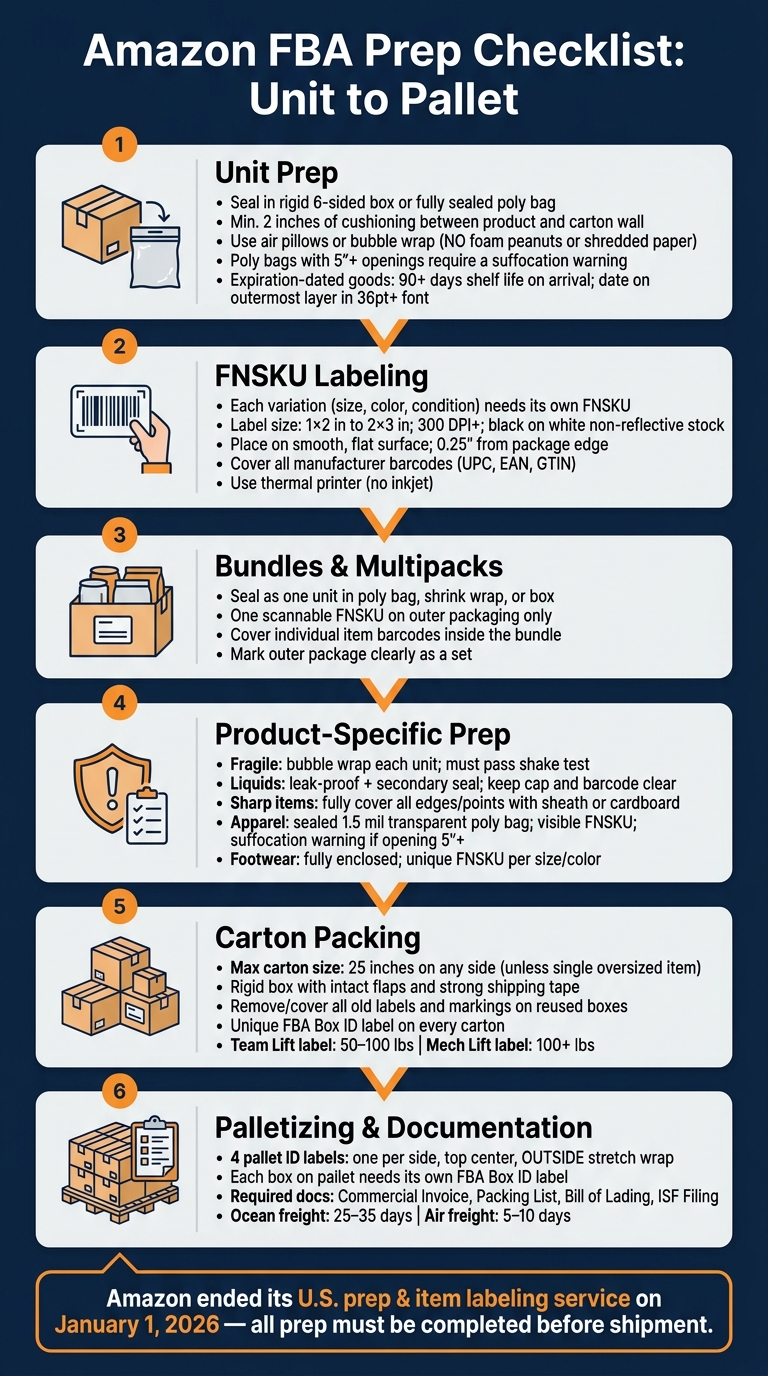
If I get Amazon FBA prep wrong, my shipment can be delayed, rejected, or hit with extra fees. And since Amazon ended its U.S. prep and item labeling service on January 1, 2026, I now need to make sure every unit, carton, and pallet is ready before it ships.
Here’s the article in plain English:
I start with the unit, not the pallet
I pack each item in a sealed box or poly bag
I check bubble wrap, dunnage, and 2-inch cushioning
I add suffocation warnings on poly bags with openings of 5 inches or more
I make sure expiration-dated goods arrive with at least 90 days left
I label each sellable item with the right FNSKU
I cover old or extra scannable barcodes like UPC or EAN
I seal bundles and multipacks as one sellable unit
I follow carton rules like 25-inch max side length unless it’s one oversized item
I add Team Lift labels for 50–100 lbs and Mech Lift labels for 100+ lbs
I place 4 pallet ID labels on each pallet and keep them outside the stretch wrap
I check special prep for fragile, liquid, sharp, apparel, footwear, and bundle products
I confirm shipping docs like the commercial invoice, packing list, bill of lading, and ISF
A few numbers stand out. Ocean freight from China to the U.S. West Coast usually takes 25–35 days. Air freight usually takes 5–10 days. That long trip means bad prep at the item level can turn into damaged cartons, unreadable labels, or receiving problems by the time the shipment reaches Amazon.
Area
What I check first
Unit prep
Sealed packaging, cushioning, poly bag warning, expiration date
Labeling
FNSKU, barcode placement, extra barcode coverage
Cartons
Box condition, dunnage, size, weight labels, old mark removal
This article is a step-by-step checklist that helps me catch problems before inventory leaves China and reaches a U.S. fulfillment center.
Amazon FBA Prep Checklist: Unit to Pallet Step-by-Step
How to PREP, PACK & LABEL Your Amazon FBA Shipments | Packaging, Labeling and Barcode Requirements
If you prefer to outsource these tasks, professional Amazon FBA prep services can handle the entire process for you.
sbb-itb-f9a91f9
Unit prep checklist: Packaging, poly bags, bubble wrap, and expiration labels
Start with the unit itself. Carton prep only works if each item is packed the right way first. Small prep errors at the unit level can turn into carton rejections later.
Secure packaging and drop-test basics
Each sellable unit must follow Amazon FBA packaging requirements and be sealed in a rigid six-sided box or a fully sealed poly bag. If an item has multiple parts, don’t ship those parts loose. Pack the item fully assembled and secured as one sellable unit. If it comes with loose sleeves or pouches, bag them or secure them with a non-adhesive band or removable tape.
Once the unit is packed, do a drop test. The item inside shouldn’t shift around. If it does, add more cushioning. You also need at least 2 inches of cushioning material between the product and the carton wall.
Poly bagging, suffocation warnings, and bubble wrap
If the unit can still move after packing, add dunnage to hold it in place. Use bubble wrap or air pillows to stop movement. Don’t use loose-fill materials like foam peanuts or shredded paper.
Any poly bag with an opening of 5 inches or more must have a suffocation warning printed on the bag itself in a legible font. This is one of those small details that’s easy to miss, and it can cause problems fast.
Expiration date format and outermost-layer labeling
Expiration-dated goods need extra control. Ship these products with at least 90 days of shelf life left when they arrive. If the inventory shows up late, it’s destroyed at the seller’s expense.
Print the expiration date on the outermost visible layer. Don’t place it only on the inner unit pack. For outer carton labels, use a font size of 36 pt or larger. For barcode tracking on expiration-dated products, an Amazon FNSKU label is required.
Requirement
Specification
Unit packaging
Rigid six-sided box or fully sealed poly bag
Cushioning buffer
At least 2 inches between the product and the carton wall
Acceptable dunnage
Air pillows or bubble wrap
Prohibited loose-fill
Foam peanuts, shredded paper
Poly bag suffocation warning
Required on any poly bag with an opening of 5 inches or larger
Expiration-dated inventory
Must arrive with at least 90 days of remaining shelf life
Expiration date placement
Printed on the outermost visible layer
Barcode tracking for expiration-dated products
Amazon FNSKU label required
Master carton expiration date font
36 pt or larger
Labeling checklist: FNSKU, bundles, and carton marks
After unit prep, label every sellable unit, bundle, and carton before you send the shipment.
FNSKU labeling and barcode placement
Once each unit is packed, add the right labels before you place anything into cartons. Every sellable variation – such as size, color, or condition – must have its own FNSKU. So if you sell a black T-shirt in size large and the same shirt in size medium, those two units need different FNSKUs.
Use black print on white, non-reflective label stock with removable adhesive at 300 DPI or higher. Label size should be between 1 x 2 inches and 2 x 3 inches. Leave the required white margins, and keep the label at least 0.25 inch from the edge of the package.
Each label needs to show:
The FNSKU or ASIN
The product name
The item condition
Put the label on a smooth, flat area. Skip seams, corners, and curved spots so the barcode stays easy to scan. Amazon recommends thermal printers for FBA labels, and says inkjet printers should not be used.
Before shipping, remove, cover, or make unreadable any manufacturer barcode, such as a UPC, EAN, or GTIN. Transparency authentication codes and serial number barcodes do not need to be covered.
Multipacks, bundles, and case-packed cartons
For grouped items, the label has to work at the set level, not just the item level. Multipacks and bundles must be sealed as one unit in a poly bag, shrink wrap, or box so the items stay together during handling. The outer packaging must show only one scannable barcode and a clear set label. Any barcodes on the individual items inside the bundle must be covered or made unreadable.
Case-packed cartons have their own rule set. Each carton must contain identical units with the same SKU and condition, and every carton must hold the same quantity.
Carton labels, box content accuracy, and used-box cleanup
The quantities in Ship to Amazon need to match what is actually inside each carton. If you reuse shipping boxes, clear away the old stuff first. Remove or fully cover all old shipping labels, barcodes, and markings before you place the new carton label.
Carton Requirement
Specification
Max carton dimension
25 inches on any side, unless the carton contains a single oversized item
Team Lift label
Required for cartons 50–100 lbs
Mech Lift label
Required for cartons over 100 lbs
Label edge clearance
At least 0.25 inch from the edge of the box
Reused box cleanup
Remove or cover all old labels, barcodes, and markings
Special prep checklist by product type
Different products need different prep before they go inbound to Amazon. Once unit labeling is done, check these product-specific rules for higher-risk items before you move to carton packing.
Fragile, sharp, and liquid products
Fragile items need to be wrapped one by one and cushioned so they can’t shift inside the box. Bubble wrap or padded inserts help keep everything in place. If the box rattles when you shake it, that’s a problem. A properly packed box should pass the shake test.
Liquids need leak-proof packaging with a secure lid plus a second seal, like shrink wrap or a tamper-evident seal. Also, keep the cap and barcode area clear.
Sharp items, such as knives or scissors, must have every exposed edge or point fully covered with a protective sheath or thick cardboard wrap.
Apparel, textiles, and soft goods and garments
Apparel, linens, and other soft goods must ship in sealed transparent poly bags that are at least 1.5 mil thick. The FNSKU needs to stay visible through the bag. And if the bag opening is over 5 inches, it must include a suffocation warning.
Footwear must be fully enclosed, with no part of the product exposed. Each size or color variation also needs its own FNSKU.
Bundles and promotional sets
Bundles must arrive as one sealed, sellable unit. Amazon does not assemble sets at receiving. The outer package needs one scannable FNSKU. Any manufacturer barcodes on the individual items inside should be covered, and the package must be marked as a set.
Use the table below as a quick compliance check.
Product Type
Compliant
Non-Compliant
Fragile (glass jar)
Bubble-wrapped, contents do not shift in a shake test
Loose jar in a thin retail box with no internal cushioning
Liquids
Leak-proof, double-sealed; cap and barcode area unobstructed
Single-capped bottle with no secondary seal
Sharp items
Blade or tips fully covered with a sheath or cardboard wrap
Scissors or knives with exposed tips or edges
Apparel
Sealed 1.5 mil transparent poly bag, visible FNSKU, suffocation warning
Loose garment in a thin bag with an obscured barcode
Bundles
One sealed unit, one scannable FNSKU, marked as a set
Items taped together with multiple visible manufacturer barcodes
Carton, pallet, and China-to-Amazon shipping checklist
Carton packing standards for FBA shipments
After unit prep, the next step is building cartons that can make it from China to the U.S. without falling apart halfway there. Use rigid boxes with intact flaps and strong shipping tape. For dunnage, stick to air pillows or bubble wrap. Do not use loose-fill materials like packing peanuts or shredded paper.
Here’s a simple gut check: once the carton is packed, give it a gentle shake. If anything shifts, fix it before sealing the box.
Labeling matters here too. Add Team Lift labels to cartons that weigh 50–100 lbs. Use Mech Lift labels for cartons over 100 lbs. And if you’re reusing boxes, remove or fully cover all old marks before adding new labels.
Palletizing standards and pallet label placement
Once cartons pass inspection, stack them on compliant pallets for U.S. delivery. Each pallet needs four pallet ID labels. Place one on the top center of each side, and make sure they sit outside the stretch wrap so workers can scan them without breaking the seal.
Each individual box on the pallet also needs its own unique FBA Box ID label. That part trips people up more often than you’d think. The pallet label doesn’t replace the box label. You need both.
Use this final pre-shipment check to catch mistakes before the shipment leaves China.
Checklist Category
What to Verify
Unit Prep
FNSKU on every unit; poly bags sealed with suffocation warning if needed
Carton Prep
Approved dunnage only; old labels removed or blacked out; unique FBA Box ID label on each box
Pallet Prep
4 pallet ID labels (one per side, top center, outside stretch wrap); each box has its own box ID label
Documentation
Commercial invoice, packing list, bill of lading, and ISF filing completed
FCLGO can handle the full prep and delivery flow. Finish the documentation, then release the shipment.
FAQs
What happens if my FBA prep is wrong?
If your FBA prep is off, Amazon can refuse your inventory, send it back, or repackage it at your cost. It can also lead to unplanned per-unit service fees.
When a shipment doesn’t meet Amazon’s rules, it may be rejected. That can slow things down and add extra costs for storage, rework, and re-delivery. To avoid that mess, make sure each product is labeled, cushioned, and packed securely before it ships to Amazon.
Do I need an FNSKU on every item?
Yes. Each individual unit needs a scannable barcode for Amazon to accept it.
An FNSKU is required for items that:
aren’t new
don’t have a scannable standard barcode
are restricted
have expiration dates
are sold as bundles
In practice, many sellers use an FNSKU on all FBA inventory. It keeps things simple and helps avoid mix-ups.
Also, label each unit on its own, even when several units are packed inside the same shipping carton.
When do poly bags need a suffocation warning?
A suffocation warning is required on any poly bag with an opening of 5 inches or larger, measured flat.
You can print the warning directly on the bag or apply it as a label.
If the opening is under 5 inches, no warning is required.
5 Things to Check Before Shipping Goods from China
One missed check before pickup can cost you weeks and more than $5,000 in fines or added fees. If I’m sending goods from China for Amazon FBA, I want to confirm five things before cargo leaves the factory: supplier readiness, packaging, Amazon labels and pallets, customs paperwork, and the freight plan.
Here’s the short version:
Check the supplier and order details so the goods, counts, and terms match the PO
Invoice, packing list, B/L or AWB, HTS, origin, importer data
Customs holds, duty errors, penalties
Freight and delivery
Air vs. ocean, transit buffer, final route, FC appointment
Stockouts, added storage or handling charges, late delivery
If I handle these five checks before pickup, I cut down the most common shipping problems while fixes are still cheaper and easier to make.
1. Verify Supplier Readiness, Product Specs, and Shipping Terms
Don’t book pickup until you know the supplier is actually ready. “It’s done” can mean a lot of things. It does not always mean the cartons are counted, sealed, and sitting there ready to load.
Confirm the Goods Match the Final Order
Start by checking the basics against your original purchase order: model, size, color, materials, and quantity. If you’re dealing with regulated goods, make sure the item also meets the required U.S. certifications or agency rules.
Then compare the commercial invoice and packing list with what’s physically at the factory. The descriptions and quantities need to match. If they don’t, customs issues can show up later, and that’s where small mistakes turn into expensive delays.
Once the order lines up, check that packing and labels are done and ready for export.
Check Production Status, Quality, and Pickup Readiness
Do the inspection when production is almost finished, but before final payment or pickup. That gives you time to fix defects or packing mistakes while the goods are still in China.
Hold the final balance until you have inspection photos and a report that confirms the order is complete, packed, and ready to load on the agreed date. After that, you can authorize pickup with a lot more confidence.
Confirm Incoterms and Responsibility Split
Before pickup, make sure everyone is clear on who pays for what. Check whether the shipment is under EXW, FOB, CIF, or DDP, and confirm who covers pickup, export clearance, freight, duties, and final delivery.
For Amazon FBA shipments, DDP is a common option. In that setup, the freight forwarder handles supplier pickup, export clearance, duties, and final delivery to the U.S. fulfillment center.
This part matters more than people think. If the supplier, your forwarder, and your team each assume someone else is covering a charge, you can end up with surprise fees or a stalled shipment. Get that split confirmed before anything moves.
After that, you’re ready to move on to packaging, carton marks, and Amazon prep.
2. Confirm Packaging, Carton Marks, and Master Carton Details
Check packaging, carton marks, and master carton details before pickup. It’s a simple step, but it can save you from repacking, shipping delays, and FC rejections.
Each unit should arrive in good shape and be ready for FBA intake. That means the item needs enough protection to make it through handling and transit without damage.
Use materials like:
Air pillows
Bubble wrap
Kraft paper
Do not use styrofoam peanuts or shredded paper.
Review Carton Weight, Dimensions, and Handling Labels
Look at carton size, weight, and labels before the shipment moves. For standard-size units, no side of the box should be more than 25 inches.
Weight labels matter too. If a master carton weighs 50 to 100 lbs, add a "Team Lift" label. If it weighs more than 100 lbs, add a "Mech Lift" label.
Also, check that each master carton’s unit count matches the packing list. If the count is off, problems tend to show up later – usually when it’s harder and more expensive to fix.
Match Carton Marks to the Shipment Plan
Carton marks need to match the shipment plan and packing list exactly. No guesswork here. The details should line up item for item, including carton number, units per carton, gross weight, country-of-origin mark, and "Case Packed" where required .
Once the cartons are set, move on to FNSKU labels, box IDs, and pallet compliance.
3. Check FNSKU Labels, Box Labels, and Pallet Compliance
Before pickup, go through every Amazon label and pallet rule one more time. If something is off, it’s much cheaper to fix it in China than after the shipment hits the FBA center.
Verify Item-Level FNSKU and Barcode Placement
Every sellable unit needs an Amazon FNSKU label. That’s Amazon’s seller-specific ID.
Print labels with a thermal or laser printer at 300 DPI or higher. Skip inkjet printers because the ink can smear. Place each label on a flat area, not near edges, seams, or corners. If you’re using reused boxes, cover old barcodes with opaque tape so they don’t trigger mis-scans. It also helps to test each barcode before shipping, just to make sure it scans the way it should.
Confirm Carton Labels and Box IDs Are Correct
Each box needs its own FBA Box ID label from Seller Central. Make sure every box ID matches the shipment plan and the packing list. This sounds small, but it can save you from a messy check-in problem later.
Review Pallet Size, Height, Weight, and Label Placement
Use 40 x 48-inch, 4-way access wood pallets, GMA Grade B or higher. Keep pallets at a maximum of 72 inches high and 1,500 lbs. Each pallet also needs four pallet ID labels – one on each side, placed at the top center .
Wood pallets must have a visible IPPC heat treatment stamp. Without it, the pallet may need fumigation or get rejected.
Once labels and pallets are confirmed, check the commercial invoice, packing list, and customs data.
4. Validate Shipping Documents and US Customs Details
Once your packaging and labels are done, make sure the paperwork matches the shipment itself. If the invoice, packing list, bill of lading, and ISF data don’t line up, customs can put the shipment on hold or send it to inspection.
Audit the Commercial Invoice, Packing List, and Bill of Lading or Air Waybill
These documents need to match across the board. Seller and buyer names, product descriptions, carton counts, weights, dimensions, unit prices, and Incoterms should be identical on each one.
The commercial invoice should include 10-digit HTS codes, country of origin, and the total shipment value. The packing list should break out each SKU by carton, along with per-carton weights and dimensions. The bill of lading or air waybill should show the same piece count, weight, and shipment description as the other documents.
Then double-check the customs data before anything gets filed.
Confirm HS Codes, Country of Origin, and Importer Details
Use the full 10-digit HTSUS code for each product line. Skip vague terms like "parts" or "accessories". If the shipment includes different product types, list each one on its own line with its own HTS code.
Chinese-origin goods may face Section 301 tariffs – from 7.5% to 25% on top of the standard duty rate. A wrong classification can come back to bite you with back duties and penalties. The country of origin should match on both labels and documents. Also check that your importer of record details, including your US EIN or TIN, are correct everywhere.
If your product type needs extra documents, get them ready before the cargo leaves:
Before the vessel departs China, confirm that the ISF data, HTS codes, and bond status are ready to file. For ocean freight, file ISF 10+2 at least 24 hours before vessel departure. Check all 10 required data points, including the manufacturer, buyer/consignee, ship-to address, and HTS code. Also make sure your customs bond is active before the shipment moves.
5. Review Freight Mode, Transit Timing, and Final Delivery to Amazon
Your freight plan should line up with two things: how soon Amazon needs the inventory and what you can afford to spend. The mode you pick changes cost per unit, transit time, and the odds of running out of stock before the shipment lands.
Choose the Right Freight Mode for Cost and Urgency
The best option comes down to shipment size, urgency, and how much inventory you still have on hand.
Urgent restocks, new launches, or high-value goods
Ocean LCL
25–35 days
Small shipments under 15 CBM
Ocean FCL
25–35 days
Large, regular replenishment cycles
A simple rule works well here: use air freight when you need inventory fast, and use ocean freight for normal restocks.
Check Transit Buffers, Destination Charges, and Delivery Appointments
After you choose the freight mode, build in extra time for the parts that tend to slow things down. Ocean freight from China to the US West Coast usually takes 25–35 days, but that is only part of the trip. You still need to account for customs clearance, drayage, and Amazon appointment booking. During peak season, from August through December, surcharges can jump by 15%–30%, and delays are common.
Landed cost can also go beyond the base freight rate. It may include:
customs brokerage fees
ISF filing fees
drayage
prep warehouse handling in the US if the factory missed Amazon labeling or pallet rules
Before the shipment moves, confirm the final route. Is it going straight to an Amazon fulfillment center, or does it need to stop at a prep warehouse first? Also make sure the delivery appointment is booked ahead of time. That one step can save a lot of last-minute scrambling.
Conclusion: The 5 Checks to Complete Before Cargo Leaves China
Running through these five checks before cargo leaves China may take only a few hours, but it can prevent weeks of delays and hundreds – or thousands – of dollars in avoidable fees. The checklist is simple: verify supplier readiness and product specs, confirm packaging and carton marks, validate FNSKU labels and pallet compliance, audit your shipping documents and customs data, and review your freight mode, transit timing, and final delivery plan. These five checks help catch the errors that show up most often before cargo leaves China.
FAQs
When should I do these checks before pickup?
Do these checks when production is 80% to 100% complete and the goods are fully finished and packed.
Handle them before the supplier releases the cargo to the freight forwarder and before you send final payment. While the goods are still at the supplier’s facility, you still have time to fix labeling, packaging, or paperwork issues before the shipment leaves China.
What should I fix first if something is wrong?
Fix any issue before the forwarder picks up your cargo.
Start by matching your packing list to the actual carton count. If the quantities are off or incomplete, delays are common.
Then check that FNSKU labels, carton markings, packaging, and documents match your instructions and Amazon requirements. If anything is wrong, tell the supplier to rework, replace, or relabel the goods before final release.
Also, don’t send the final payment until those fixes are checked and confirmed.
Do I need a prep warehouse before Amazon delivery?
Not always. But your products do need to meet Amazon FBA packaging, labeling, and FNSKU rules before they arrive at the fulfillment center. If they don’t, Amazon may reject the shipment or charge extra fees.
You’ve got a few ways to handle this. Your supplier can take care of prep, inspection, and labeling in China. You can also hire a third-party service to do it. Or, if you’d rather have Amazon handle part of the work, you can use Amazon’s FBA Prep Service when you create your shipment plan in Seller Central.
7 Common Customs Clearance Mistakes Amazon Sellers Make
One customs mistake can turn a normal FBA shipment into extra duty, a $5,000 ISF penalty, port fees of $100 to $500 per day, and weeks of delay.
If I were shipping Amazon FBA inventory from China to the U.S., I’d focus on seven things first: the HTS code, declared value, commercial invoice, importer and consignee details, product description and compliance files, entry setup, and broker timing.
Here’s the short version:
Wrong HTS code can lead to more duty, Section 301 tariffs, and CBP review
Low declared value can trigger Form 28 requests, exams, and steep penalties
Bad invoices can cause document holds before cargo clears
Wrong buyer or importer details can stall or reject the entry
Vague descriptions or missing certificates can lead to exams or detention
Bad entry setup or late ISF can mean a $5,000 penalty per violation
Late broker involvement leaves no time to fix errors before the vessel sails
The main point is simple: Amazon is not your importer of record – you are. That means the cost of bad paperwork lands on you, not Amazon.
Product details are too broad or files are missing
Exam, detention, release delay
Send clear descriptions and compliance files early
Wrong entry setup / late ISF
Filing type or party data is wrong
Hold, rejection, $5,000 penalty
Confirm entry data before departure
Waiting too long to use a broker
Review starts after cargo is moving
Filing errors and schedule slips
Send documents 48 to 72 hours early
If I wanted to avoid customs trouble, I’d treat this as a pre-shipment checklist, not a last-minute fix.
sbb-itb-f9a91f9
Why Customs Errors Cost Amazon Sellers More Than Just Time
A customs hold can eat into your margin fast and push delivery back for weeks. Once CBP holds cargo, demurrage kicks in after free time runs out, often within 4 to 7 days, and costs can hit $100 to $500 per container per day. On top of that, a missed Amazon inbound appointment can tack on weeks more to your timeline. In many cases, the biggest losses start with simple paperwork mistakes that could have been avoided.
A wrong HS code can lead to a major duty reassessment. And a late or incorrect ISF can bring a $5,000 penalty per violation. At that point, the problem stops being “just paperwork” and starts turning into extra fees, delayed inventory, and lost momentum.
The bigger hit often comes later: stockouts. If a customs delay wipes out your FBA inventory, you don’t just lose sales in the moment. Your product’s Best Seller Rank (BSR) can take a hit that lingers for months.
Take a misclassified yoga mat shipment. That one error can snowball into reclassification, extra duty, demurrage, and a missed launch window. One small code issue, and suddenly the whole shipment is off track.
And here’s the part many sellers learn the hard way: the seller, not Amazon, is the Importer of Record. That means you’re legally on the hook for customs compliance, duties, and penalties. The seven mistakes below are where those costs often begin.
1. Using the Wrong HS Code for Your FBA Products
For FBA imports from China, the HS code shapes almost everything at the border: duty, tariff treatment, and how closely CBP looks at the shipment. Every product entering the U.S. needs a 10-digit HTS code (Harmonized Tariff Schedule). A lot of sellers just copy the supplier’s code or go with Amazon’s auto-generated suggestion. That’s where trouble starts.
If the product is misclassified, you can end up with the wrong duty rate, extra tariff exposure, or a shipment that gets flagged for review.
Clearance Delay Risk
A wrong HTS code can trigger a CBP exam. Once that happens, the shipment gets held for review, and that hold adds time before release.
For an FBA seller, that delay isn’t just annoying. It can throw off the whole inbound schedule and push your delivery window off track.
The money at stake can be steep. In March 2026, a Texas-based Amazon seller imported yoga mats classified under HTS 9506.91, which carried a 4.6% duty. CBP reclassified them under HTS 4016.99, which triggered a 25% Section 301 tariff plus a 2.5% regular duty. The result was an unexpected $18,000 duty bill and a three-week delivery delay.
"Using supplier-provided HTS codes without verification is the most frequent error. Your overseas supplier is not an expert in U.S. tariff classification." – Peacock Tariff Consulting
A CBP hold can wreck your launch window. Reclassification can add duty you didn’t plan for, slow down port release, and cause you to miss your Amazon inbound appointment.
And once that appointment is missed, delivery can slide back by weeks. A shipment that looked profitable on paper can turn into a loss fast.
Preventive Action Before Departure
Before the goods leave China, check the 10-digit HTS code in the official USITC database at hts.usitc.gov. Then compare that code against the Section 301 tariff lists for China-origin goods.
For repeat imports or products that sit in a gray area, it helps to:
Request a CBP binding ruling
Ask a licensed customs broker to review your invoice and packing list before departure
If classification is wrong, the next mistake – undervaluing the shipment – can make things even worse.
2. Undervaluing Goods to Lower Duties
Customs undervaluation means declaring a value that’s lower than what you actually paid the supplier. Some sellers do this to cut duty costs. On paper, it may look like an easy win. In practice, it can turn into a mess.
CBP can flag values that fall below normal market ranges and ask for proof of payment through a Form 28. And if a supplier or broker told you to use the lower number, that doesn’t shift the risk off your plate. You still hold the liability. A small tweak in declared value can lead to review, extra charges, and missed inbound windows.
Clearance Delay Risk
If your invoice, packing list, and manifest don’t match, CBP may place the shipment on a document review hold until the records are checked and cleared. That kind of hold can snowball fast. Demurrage, chassis, and inspection fees can start piling up while the shipment sits.
CBP Penalty or Exam Exposure
The downside here isn’t minor. Penalties for undervaluation can reach 5 to 8 times the duty evaded – or even the full domestic value of the goods.
An exam can also add time and cost. In some cases, that means a few hours and a few hundred dollars for an X-ray scan. In others, it can mean several days and thousands of dollars for a full intensive exam.
The safest move is simple: declare the true transaction value from the start.
Preventive Action Before Departure
Use the actual price you paid the supplier, usually on an FOB or EXW basis. If a supplier offers to issue a second invoice with a lower value, pass on it. That’s the kind of shortcut that can come back to bite you.
Keep your records in order, including:
Proof of payment
Wire transfer records
Commercial invoices
Hold onto those records for at least five years so you can reply fast if CBP sends a Form 28 request.
Even when the value is right, a shipment can still get stuck if the commercial invoice is incomplete or doesn’t line up with the rest of the paperwork.
3. Submitting Incomplete or Inaccurate Commercial Invoices
The commercial invoice is the document that drives customs clearance. And when that invoice is incomplete or doesn’t line up with the rest of the paperwork, delays are common.
This often starts before the shipment even leaves China. A lot of suppliers fill out invoices without knowing Amazon FBA entry rules.
One point trips people up all the time: do not list Amazon as the buyer. Amazon should appear only as the ship-to party. After the buyer and ship-to fields are set up the right way, the next issue is data that doesn’t match across documents.
Clearance Delay Risk
Vague product descriptions and mismatched values can trigger a document hold when the invoice, packing list, and bill of lading don’t match. If quantities, weights, or party names differ from one document to another, the shipment may be placed on hold, and supplementary documents may not be accepted after the hold is issued.
CBP Penalty or Exam Exposure
Incomplete invoices can trigger exams, which can add hundreds or thousands of dollars in extra fees. For textile shipments, leaving out fiber content percentages can also lead to detention under 19 CFR 141.89.
Impact on Amazon FBA Delivery Timelines
Paperwork mistakes can delay sea freight by 5 to 14 days. If the cargo gets held at the port, demurrage and detention charges usually run $150 to $400 per day. That’s more than a minor hiccup. It can put your Amazon FBA delivery window in danger fast.
Preventive Action Before Departure
The safest move is to use one standard invoice template. It should include:
Seller/exporter
Buyer
Ship-to address
Importer of record number
10-digit HTSUS code
Clear product description
Country of origin
Quantity
Unit price
Total USD value
Incoterms
Send the invoice and packing list to your customs broker 48 to 72 hours before the cargo leaves China so mistakes can be caught early.
Even if the invoice itself looks fine, the shipment can still run into trouble if the importer or consignee details are wrong.
4. Missing or Incorrect Importer and Consignee Details
Wrong importer and consignee details are one of the most common reasons FBA shipments get held up. Amazon is not the importer of record, which means the seller is still on the hook for entry, duties, and compliance until customs clears the cargo. Once those party details are wrong, every document that follows gets harder to sort out.
If Amazon is listed as the buyer, CBP may assume Amazon is supposed to pay the duties. That can slow the release process or stop the entry from moving.
Clearance Delay Risk
CBP can flag mismatches across the invoice, packing list, and ISF. If the company name, EIN, or address doesn’t match, that can trigger a CBP document hold. First-time importers can also run into a hold on their first entry if they haven’t submitted CBP Form 5106.
CBP Penalty or Exam Exposure
For ocean freight, the ISF must be filed at least 24 hours before vessel departure. If the filing is late or inaccurate, CBP can issue a $5,000 penalty per violation. And it doesn’t stop there. One filing problem can snowball into storage charges and missed Amazon receiving windows.
Impact on Amazon FBA Delivery Timelines
A hold can add demurrage and storage fees fast, often $150 to $450 per day, while also delaying FBA delivery.
Preventive Action Before Departure
Before cargo leaves China, check these fields carefully so the entry lines up from the start:
Document Field
Correct Entity
Common Mistake
Buyer
Your legal company name
Listing Amazon.com
Ship To / Consignee
Amazon Fulfillment Center, with the FC code and full address
Using your home or office address
Importer of Record
Your company, with a U.S. EIN or CBP-assigned number
Assuming Amazon handles the entry
EIN
Your U.S. EIN or CBP-assigned ID
Leaving it blank or using the factory’s ID
Match the importer, consignee, and EIN before departure. If you import often, use a continuous bond.
Even when the party details are correct, the shipment can still get stuck if the product description and compliance files aren’t strong enough.
5. Vague Product Descriptions and Missing Compliance Documents
Even if the importer details are correct, CBP can still stop a shipment when the product description is too broad or the compliance paperwork isn’t there.
A commercial invoice that says only "electronics" or "apparel" doesn’t give CBP enough to work with. Be specific. Use product, function, material, and key spec. For example:
"ABS plastic storage case for batteries"
"80% polyester / 20% cotton women’s knit sweater"
That level of detail helps CBP figure out what the goods are. The other half of the puzzle is the paperwork that shows the goods are allowed in. If those files are missing, CBP may hold the shipment until the right agency documents are submitted.
Different products need different documents before CBP will release them:
Product Category
Required Document
Children’s toys and clothing
Children’s Product Certificate (CPC), lab test reports
Vague descriptions or missing certifications can trigger a CBP document-review hold. And this isn’t a small issue. Around 80% of CBP document-review holds for Chinese goods lead to delays of at least 3 days.
CBP Penalty or Exam Exposure
If CBP can’t verify the goods from the documents alone, the shipment may be sent to an exam. That gets expensive fast.
A VACIS X-ray exam can cost $100–$200, while an intensive manual exam can cost $800–$4,000, based on whether the freight has to be fully unloaded. Goods regulated by FDA, CPSC, or FCC may also take longer to clear because CBP has to coordinate with that agency before release.
Impact on Amazon FBA Delivery Timelines
While the shipment sits on hold, storage and demurrage can add up to $100–$500 per day. On top of that, restock shipments can get pushed back by 7–14 days, which can leave your Amazon FBA inventory running thin.
Preventive Action Before Departure
The best move is to get ahead of the problem. Send the invoice, packing list, and compliance certificates to your customs broker 48–72 hours before arrival.
Then double-check the details:
Make sure FDA registrations, FCC IDs, and CPCs match the manufacturer listed on the invoice
For textiles, list the exact fiber percentages
Mark each product or inner package with a permanent "Made in China" label
Small paperwork gaps can turn into expensive delays. In this part of the process, being precise saves time and money.
6. Using the Wrong Customs Entry Setup for Amazon Shipments
Once the paperwork is in order, the next place things go wrong is the customs entry setup. DDP is common, but it doesn’t fix bad entry data. You still need the right buyer, consignee, and Importer of Record listed on the filing.
One mistake shows up all the time: assuming low-value shipments still qualify for Section 321. If the entry type is wrong, you can end up with a formal entry, added filings, and a delayed release.
Another problem is using the wrong buyer and importer fields for an Amazon shipment. If the buyer or consignee is formatted the wrong way, the entry can get rejected before the shipment clears.
The setup itself is pretty simple: list your legal entity as the buyer, Amazon as the consignee, and your company as the Importer of Record. If a licensed customs broker is filing for you, that broker should also be named the right way in the entry.
Clearance Delay Risk
A bad entry setup can trigger a CBP hold or rejection. When that happens, delays from setup errors often run 7–14 days, and demurrage fees can hit $100–$500 per day.
CBP Penalty or Exam Exposure
A missing or late Importer Security Filing (ISF) can trigger an automatic $5,000 penalty per violation. And here’s the part many sellers miss: if a DDP provider uses fake or recycled IOR numbers, under-declares value, or misclassifies goods to cut costs, CBP can still go after the seller.
"Sellers are responsible for ensuring that their products are lawfully imported into the destination country and comply with all applicable import and customs laws." – Amazon Official Policy
Impact on Amazon FBA Delivery Timelines
A rejected or held entry can throw off your whole restock cycle. That kind of delay doesn’t stay in customs. It spills into inventory planning, stock levels, and sales. In fact, 34% of Amazon shipments originating from China face costly delays tied to outdated shipping strategies or prep non-compliance. A bad entry setup is one of the fastest ways to fall behind.
Preventive Action Before Departure
Before cargo leaves China, check the entry type, filer, and consignee. Your company should be listed as the buyer. The consignee should be formatted as Amazon.com Services, Inc. [FC Code]. The IOR should be your legal entity.
A few extra checks can save a lot of trouble:
If the entry is low-value, confirm the needed product, origin, and filing data before departure.
If you import more than two or three times a year, a continuous customs bond is usually cheaper than buying a single-entry bond each time.
If you’re using a DDP provider, ask for CBP Form 7501 (Entry Summary). If they won’t share it, that’s a red flag.
7. Waiting Too Long to Work with Freight Forwarders and Customs Brokers
A lot of sellers loop in their freight forwarder or customs broker at the last minute. That’s where trouble starts.
The ISF must be filed 24 hours before vessel departure, so your commercial invoice, packing list, and importer details should be sent 48–72 hours before loading. That short window is often where avoidable holds begin.
If you’re importing for the first time, finish Form 5106 before departure. If that step isn’t done, CBP can put an immediate hold on the shipment when it arrives.
Clearance Delay Risk
When you wait until the cargo is already on the water, your broker has to review everything under pressure. And rushed review means less time to catch and fix mistakes before filing.
If the shipment is selected for inspection, the delay can add 5–14 business days to your timeline. Once the filing falls behind, penalty risk climbs fast.
CBP Penalty or Exam Exposure
A late or inaccurate ISF can trigger a $5,000 penalty per violation.
That’s the direct cost. The bigger problem is what happens next: your inbound plan gets pushed back, and one customs issue can ripple through the rest of your schedule.
Impact on Amazon FBA Delivery Timelines
A customs delay can throw off your Amazon receiving appointment and your restock plan.
If the shipment details don’t match Amazon’s inbound booking, the delivery can be refused. At that point, fixing the issue gets harder, more expensive, and far more stressful than it needed to be. The best move is to get everything lined up before the shipment leaves China.
Preventive Action Before Departure
Bring your broker in as soon as the purchase order is placed. Early review gives you time to sort out paperwork before the shipment is locked in.
Try to gather these details as early as you can:
Manufacturer’s name
Manufacturer’s address
10-digit HTSUS code
Then send the commercial invoice, packing list, and Bill of Lading for review 48–72 hours before loading.
If you import more than three times per year, a continuous customs bond is usually a better deal than buying single-entry bonds for each shipment.
All 7 Mistakes at a Glance
Use this table as a pre-shipment check before cargo leaves China.
Mistake
Error
Customs Result
Delivery Impact
Fix
Wrong HS Code
Wrong 10-digit HTSUS code, often copied from a supplier or pulled from a system suggestion
Additional tariffs of 25%–300% or manual review
Delays of 3–10 days or longer, with stockouts possible during peak sales windows
Verify the 10-digit HTSUS code on your own using official databases
Undervaluing Goods
Declared value is below the actual transaction value
CBP Form 28 and penalties of 5–8x the duty evaded
Cargo may be held for weeks
Declare the actual transaction value and keep wire transfer receipts as proof
Incomplete Commercial Invoice
Missing EIN, vague descriptions, or mismatched currency
Document hold
Documentation gaps can delay clearance for 2–5 days and create demurrage charges
Use a standard invoice template that includes the buyer, IOR, HTS code, material description, and Incoterms
Wrong Importer or Consignee
Amazon is listed as the buyer instead of only the ship-to consignee
CBP may hold or reject the entry
Entry rejection delays FBA delivery until IOR details are corrected
List your company as the Sold To party and Amazon only as the Ship To consignee
Vague Descriptions and Missing Compliance Docs
Generic descriptions and missing compliance documents
Physical exam or refusal of entry
Expect a 5–14 day delay for a mandatory exam, plus possible FBA rejection
Use detailed product descriptions and verify required compliance certificates before departure
Late ISF Filing
ISF is filed late or not confirmed before vessel departure
Up to a $5,000 penalty per violation
Missed delivery appointments and a container held at port
File the ISF at least 24 hours before vessel departure
Waiting Too Long to Work with a Broker
Your broker gets the documents after cargo is already moving
Late filings and avoidable document errors
More FBA rejection risk and a delayed restock cycle
Give your broker the documents early enough to catch errors before filing, ideally 48–72 hours before the shipment leaves China
If even one line in this table is off, fix it before booking pickup.
Documents to Check Before Your Cargo Leaves China
Use this checklist before you hand cargo to your broker or forwarder. It helps you catch invoice, importer, and compliance mistakes that can slow FBA deliveries from China. Do these checks before the vessel leaves. If CBP flags the entry later, fixes usually take more time and cost more.
Buyer, ship-to, and importer details need to match exactly across every document. Even small mismatches can cause problems.
Commercial invoice: legal buyer, Amazon fulfillment center as ship-to, importer number, 10-digit HTSUS, USD unit values, and country of origin
Packing list: carton dimensions, net and gross weight, and SKU counts that match the invoice and bill of lading exactly
The ISF filing must be submitted at least 24 hours before vessel departure. Miss that deadline, and you could face a $5,000 penalty per violation. So your broker needs the manufacturer name and address, loading location, and HTS code before that 24-hour cutoff.
Then review the compliance documents tied to your product category:
Document
Required For
Risk
CPC
Toys and children’s products
Refusal of entry or seizure
FDA Prior Notice
Food, supplements, cosmetics
Port hold
MSDS / UN38.3
Lithium batteries, power banks
Inspection or violation
FCC Authorization
RF electronics
Detention
Fumigation Certificate
Wood packaging
Quarantine hold
Also check origin marks and FNSKU labels before departure.
After that, verify every line against your broker’s draft entry before loading.
How to Avoid Clearance Problems on Future FBA Shipments
The best way to avoid clearance trouble is to turn these seven mistakes into a simple process your team uses on every FBA shipment.
Start early, when the PO is placed. At that stage, collect the manufacturer name and address, HTS code, and country of origin. That gives your broker what they need to file the ISF on time. Once you have that data, make sure it stays consistent across every document used in clearance.
Ask your Chinese suppliers to use the same invoice template every time. A standard format cuts down on missing fields, mismatched details, and last-minute back-and-forth. Then send the documents to your broker 48–72 hours before arrival so they have time to review everything and file on schedule.
If you ship more than three times a year, use a continuous bond. It’s usually the simpler way to handle repeat imports.
After that, put the final stretch in the hands of a freight team that knows Amazon FBA. An FBA-focused freight forwarder can help cut clearance mistakes before they turn into fees or delays. FCLGO coordinates factory pickup, customs clearance, ISF filing, and FBA delivery appointments to keep shipments on schedule. That helps lower demurrage risk and keeps delivery appointments from slipping.
Conclusion
These seven mistakes all point to the same issue: customs data that is incomplete or doesn’t line up.
The fix is pretty simple, but it takes discipline on every shipment. Keep your data clean. Make sure your documents match. Get your customs broker to review things early, before the goods move.
That means checking the 10-digit HTS code before you place the purchase order, using the actual transaction value, and making sure every party name matches before the shipment leaves China. Amazon will not clear the shipment for you. Your paperwork will.
Use the same checklist for every shipment from China to help keep FBA deliveries on schedule.
FAQs
Who is the importer of record for Amazon FBA shipments?
You, the Amazon seller, are the importer of record for Amazon FBA shipments. Amazon does not serve in that role, and Amazon is not responsible for customs clearance.
So the legal responsibility sits with you. That includes compliance, customs entries, duties and taxes, and correct product classification, even if a customs broker or freight forwarder files the paperwork for you.
When should I send shipping documents to my customs broker?
Send your shipping documents to your customs broker 48 to 72 hours before your cargo reaches the U.S. port. That window gives your broker time to review everything and file it electronically, which can help spot problems before they turn into customs holds.
The main documents usually include:
Commercial invoice
Packing list
Bill of Lading or Air Waybill
Country of origin information
For ocean shipments, there’s one more deadline to watch: the Importer Security Filing must be submitted at least 24 hours before the vessel leaves the foreign port.
What documents do I need before shipping to Amazon FBA?
Before you ship to Amazon FBA, send your customs broker and freight forwarder the key documents they’ll need:
Commercial invoice
Packing list
Bill of Lading or Air Waybill
If your shipment moves by ocean, file the ISF at least 24 hours before the vessel departs.
You may also need product-specific compliance documents, such as CPC, FDA, or FCC paperwork.
For 2026, shipments under $800 also need Section 321 Enhanced Entry filing.
Choosing between Fulfillment by Amazon (FBA) and Fulfillment by Merchant (FBM) is one of the most critical decisions Amazon sellers face. This choice impacts your costs, customer service, time investment, and ultimately your profit margins. Understanding the key differences between these two fulfillment methods will help you make an informed decision for your business.
What is FBA?
Fulfillment by Amazon (FBA) is a service where sellers send their inventory to Amazon’s fulfillment centers. Amazon then handles storage, packing, shipping, customer service, and returns. Sellers pay for storage space and fulfillment fees, but gain access to Amazon’s vast logistics network and Prime eligibility.
When you use FBA, your products become eligible for Prime shipping, which significantly increases visibility and conversion rates. Amazon stores your inventory across multiple fulfillment centers, ensuring fast delivery times. The company also handles customer service inquiries, returns, and refunds, freeing you to focus on sourcing new products and growing your business.
FBA sellers benefit from Amazon’s trusted customer service reputation. When customers see the “Fulfilled by Amazon” badge, they often feel more confident making a purchase, knowing Amazon stands behind the delivery experience. This trust factor can translate into higher conversion rates and more positive reviews.
What is FBM?
Fulfillment by Merchant (FBM) means you handle all aspects of fulfillment yourself. You store inventory, pack orders, ship directly to customers, and manage customer service. This approach gives you complete control over the entire process but requires more time and infrastructure.
With FBM, you’re responsible for finding storage space, purchasing packing materials, printing labels, and coordinating with carriers like USPS, UPS, or FedEx. You also handle returns and customer complaints directly. While this means more hands-on work, it often results in lower per-order costs for certain products and gives you flexibility in how you fulfill orders.
Many experienced sellers prefer FBM because it allows complete control over packaging, branding, and the unboxing experience. You can include custom inserts, promotional materials, and branded packaging that Amazon’s plain boxes cannot provide. This personal touch can differentiate your brand in a crowded marketplace.
Cost Comparison
FBA involves multiple fee structures that can add up quickly. Fulfillment fees typically range from $3 to $10 per order, depending on product size and weight. Monthly storage fees vary based on inventory volume and time of year, with holiday seasons typically costing more. Long-term storage fees apply to inventory remaining in warehouses for more than 365 days.
FBM eliminates these Amazon-centric fees but introduces other costs. You’ll need to budget for warehouse space (whether a spare room or rented facility), packing materials, shipping supplies, and potentially shipping software or carrier accounts. However, many sellers find that FBM’s variable costs scale more favorably with growth.
Calculating your break-even point between FBA and FBM is essential. For lightweight items or those with high sales velocity, FBA often makes more sense despite higher per-order fees. For heavy, bulky items or those with irregular sales patterns, FBM frequently proves more cost-effective.
Time and Resource Investment
FBA dramatically reduces your time commitment. Once inventory reaches Amazon’s warehouses, the operational burden shifts entirely to them. This frees significant time for sourcing new products, optimizing listings, and scaling your business. Many successful FBA sellers manage multiple stores with minimal daily operational involvement.
FBM demands substantial time for order processing, shipping, and customer service. Each order requires manual attention—from printing labels to scheduling carrier pickups. As order volume grows, FBM sellers often need to hire staff or invest in warehouse management systems, adding complexity to operations.
For entrepreneurs valuing time freedom or those managing multiple business ventures, FBA’s hands-off approach often proves worthwhile. The ability to scale without proportional time investment is a significant advantage that many successful Amazon sellers leverage.
Customer Service and Prime Benefits
FBA provides access to Amazon’s world-class customer service infrastructure. Prime customers expect free two-day shipping and excellent support, which FBA automatically delivers. This dramatically boosts conversion rates, as Amazon’s algorithm favors Prime-eligible items in search results.
When customers have issues with FBA orders, Amazon’s customer service team handles inquiries professionally, often at no additional cost to the seller. This protection against difficult customers or fraudulent return requests provides significant peace of mind.
FBM sellers must handle customer service independently, which can be challenging when managing order volume. However, this direct customer relationship allows you to build lasting relationships and gather valuable feedback that FBA sellers never see.
Which is Right for You?
FBA typically wins for new sellers, those scaling quickly, or anyone prioritizing time freedom over margin optimization. If you want to minimize operational complexity and access Prime’s powerful benefits, FBA is the clear choice. The automatic access to millions of Prime shoppers represents significant marketing value that would cost thousands in advertising through other channels.
FBM suits experienced merchants with established logistics capabilities, high-margin products, or those wanting full control over packaging and branding. If you have existing warehouse infrastructure or preferential carrier rates, FBM can significantly improve margins.
Many successful Amazon sellers actually combine both—using FBA for bestsellers while fulfilling specialty items themselves. This hybrid approach maximizes the advantages of each method while minimizing their respective drawbacks.
The right choice depends on your specific circumstances, product category, and business goals. Start with the approach that aligns with your current priorities, and don’t hesitate to adjust as your business evolves.
Ready to Optimize Your Amazon FBA Business?
At FCLGO, we specialize in helping Amazon sellers streamline their logistics and maximize profits. Whether you’re just starting with FBA or looking to optimize your existing operations, our team can provide personalized solutions tailored to your needs.
Selling on Amazon through Fulfillment by Amazon (FBA) offers incredible convenience, but understanding packaging requirements is essential to avoid costly errors and delays. Amazon has specific packaging standards that every seller must follow to ensure products reach customers safely and efficiently.
Why Amazon FBA Packaging Matters
Proper packaging serves multiple critical purposes. First, it protects your products during storage and transit through Amazon’s vast distribution network. Second, it ensures compliance with Amazon’s strict guidelines, preventing shipment rejections that can delay your inventory and cost you money. Third, well-packaged products lead to better customer reviews and reduced returns.
Amazon processes millions of packages daily, and their automated systems rely on consistent packaging to handle your inventory efficiently. Failure to meet these standards can result in your products being flagged, returned, or disposed of at your expense. Additionally, improper packaging can trigger long-term storage fees as your inventory sits waiting for resolution.
Understanding these requirements from the start saves both time and money. Many new sellers underestimate the complexity of Amazon’s packaging rules, leading to rejected shipments and delayed cash flow. Taking the time to learn these requirements before sending your first shipment will pay dividends throughout your Amazon business journey.
General Packaging Requirements
All products sent to Amazon fulfillment centers must meet basic packaging standards. Each unit must have a scannable barcode label that identifies the product. The label must be printed clearly and applied to a smooth, flat surface without wrapping or covering other important product information.
Packaging must be new and undamaged. Used boxes, torn packaging, or worn containers are not acceptable. Each product needs individual packaging unless it consists of multiple identical units that customers typically purchase together. This individual packaging requirement applies even to products shipped in cases or multi-packs.
The packaging itself must be able to withstand normal handling and storage conditions. This means using materials appropriate for your product’s weight and fragility. Amazon recommends using corrugated boxes for most items, with appropriate cushioning materials inside. The box strength should match the weight of the contents, typically rated at 32 ECT (Edge Crush Test) or higher for heavier items.
Each shipment must include proper case-pack labels if you’re sending multiple units of the same product. These labels help Amazon’s systems quickly identify and process your inventory. Without proper case labels, your shipment may be manually processed, leading to longer receiving times.
Product-Specific Requirements
Different product categories have additional requirements that sellers must follow. For liquids, gels, and creams, each unit needs leak-proof packaging with secure lids. These products require additional sealing to prevent spillage during handling. The packaging must include a two-inch clearance around the lid or cap for scanning purposes. Amazon recommends using shrink wrap or similar tamper-evident seals for these products.
Biological substances, hazardous materials, and restricted items have specialized packaging requirements mandated by federal regulations. These categories require specific certifications and packaging that complies with DOT, IATA, and other regulatory bodies. Selling these items through FBA requires additional approvals and compliance measures. Sellers must complete Amazon’s dangerous goods review process before listing these products.
Consumer products like electronics, toys, and household items need packaging that prevents damage from static electricity, moisture, and physical impact. Button batteries, small parts, and items with sharp edges require special handling and child-resistant packaging where applicable. Electronics require anti-static packaging to prevent damage from electrostatic discharge.
Apparel and soft goods need to be packaged in poly bags to protect against dust, moisture, and handling damage. These bags must be at least 1.5 mils thick and must display a suffocation warning if the bag opening exceeds five inches. The barcode must remain scannable through the poly bag material.
Labeling Requirements
Amazon requires specific labeling for all FBA inventory. Each unit needs an Amazon barcode, which can be either a manufacturer barcode (UPC, EAN, or GTIN) or an Amazon-born identity that requires Amazon barcodes for each unit. Most new sellers use Amazon barcodes to avoid complications with manufacturer codes, though using manufacturer barcodes can reduce costs for established brands.
The barcode label must be at least 1.25 inches by 2.75 inches in size. It should be printed on high-quality, weather-resistant paper to ensure readability throughout the storage and shipping process. The label must be affixed to a clean, flat surface free from wrinkles, folds, or obstructions. Avoid placing labels over seams, edges, or curved surfaces where scanning may fail.
For products that require expiration dates, these must be clearly visible on the packaging. Certain categories like cosmetics, supplements, and baby items have specific date formatting requirements that sellers must follow precisely. Expiration dates must include month and year at minimum, with day required for some categories.
Dangerous goods labeling follows additional requirements specified by regulatory bodies. These include specific hazard symbols, UN numbers, and handling instructions that must be visible on the outer packaging. Failure to properly label hazardous materials can result in significant fines and shipment rejections.
Prep and Packaging Materials
Amazon requires specific preparation for different product types. Poly bags used for packaging must be at least 1.5 mils thick and must have a suffocation warning if the opening is larger than five inches. The barcode must be visible through the bag or applied to the outside. Amazon provides specific requirements for bag closure, typically requiring heat sealing or adhesive tape that prevents easy reopening.
Bubble wrap, kraft paper, and air pillows serve as acceptable cushioning materials. Paper filler materials work well for non-fragile items. For fragile products, additional cushioning with foam peanuts, bubble wrap, or padded inserts provides necessary protection. The goal is to prevent any movement within the package during handling.
Certain products require “sticky” labeling where the barcode is affixed directly to the product rather than the packaging. This applies to products sold in multi-packs, unsealed containers, and items where external labeling is impractical. Products like candles, cosmetics, and consumables often require this approach.
Poly bag recycling symbols and other environmental markings must not interfere with barcode scanning. Place these markings on portions of the packaging that won’t be scanned. This may require custom packaging or careful label placement during the preparation process.
Common Mistakes to Avoid
New FBA sellers frequently encounter problems by overlooking basic requirements. Using box sizes that are too large creates unnecessary shipping costs and can result in damage during transit as products shift within the box. Boxes that are too small may not accommodate required labels and barcodes, leading to scanning failures and manual processing fees.
Applying multiple barcodes to the same product causes scanning errors and inventory confusion. Remove or cover manufacturer barcodes if using Amazon’s system, or ensure only one barcode is visible and scannable. This is one of the most common reasons for shipment rejection and inventory receiving delays.
Failing to include proper cushioning leads to damaged products and negative reviews. Amazon’s distribution centers handle millions of units daily, and your package will be sorted, stacked, and transported multiple times. Adequate protection is essential. Consider the worst-case scenarios during handling and package accordingly.
Not checking Amazon’s packaging requirements for your specific product category before shipping can result in costly returns. Each category may have unique requirements that aren’t obvious from general guidelines. Reviewing category-specific requirements before your first shipment prevents most common problems.
Conclusion
Understanding and implementing Amazon’s FBA packaging requirements protects your inventory investment and ensures smooth operations throughout your Amazon selling journey. Taking time to properly prepare your products before shipping to Amazon’s fulfillment centers prevents costly delays and maintains positive customer experiences.
By following these guidelines, you can minimize rejections, reduce storage fees associated with problematic inventory, and build a reputation for reliable service that keeps customers coming back. Invest in proper packaging materials and preparation time upfront, and you’ll avoid the much higher costs of fixing problems after your inventory reaches Amazon’s warehouses.
Remember that Amazon’s requirements may change, and staying current with updates through Seller Central notifications ensures continued compliance. Regularly review your packaging processes and make improvements based on any rejected shipments or customer feedback about packaging condition.