If your product origin mark is missing, wrong, or covered, your Amazon FBA shipment can get delayed, re-labeled, or hit with a 10% marking duty plus other customs costs.
When I check a shipment before it leaves China, I focus on five things:
- Product and retail packaging marks say the right country in English, such as “Made in China”
- Supplier proof confirms origin at the SKU level
- Invoice and packing list match the product line by line
- FNSKU, carton, and prep labels do not hide the origin mark
- ISF and customs entry data match the same origin, HTS line, importer, and Amazon delivery details
In short: check the product, check the paperwork, check the labels, and check the filing data before pickup. That is the easiest way to cut the risk of cargo holds, rework, storage fees, and $5,000 ISF penalty exposure.
Here’s the full checklist in plain English.
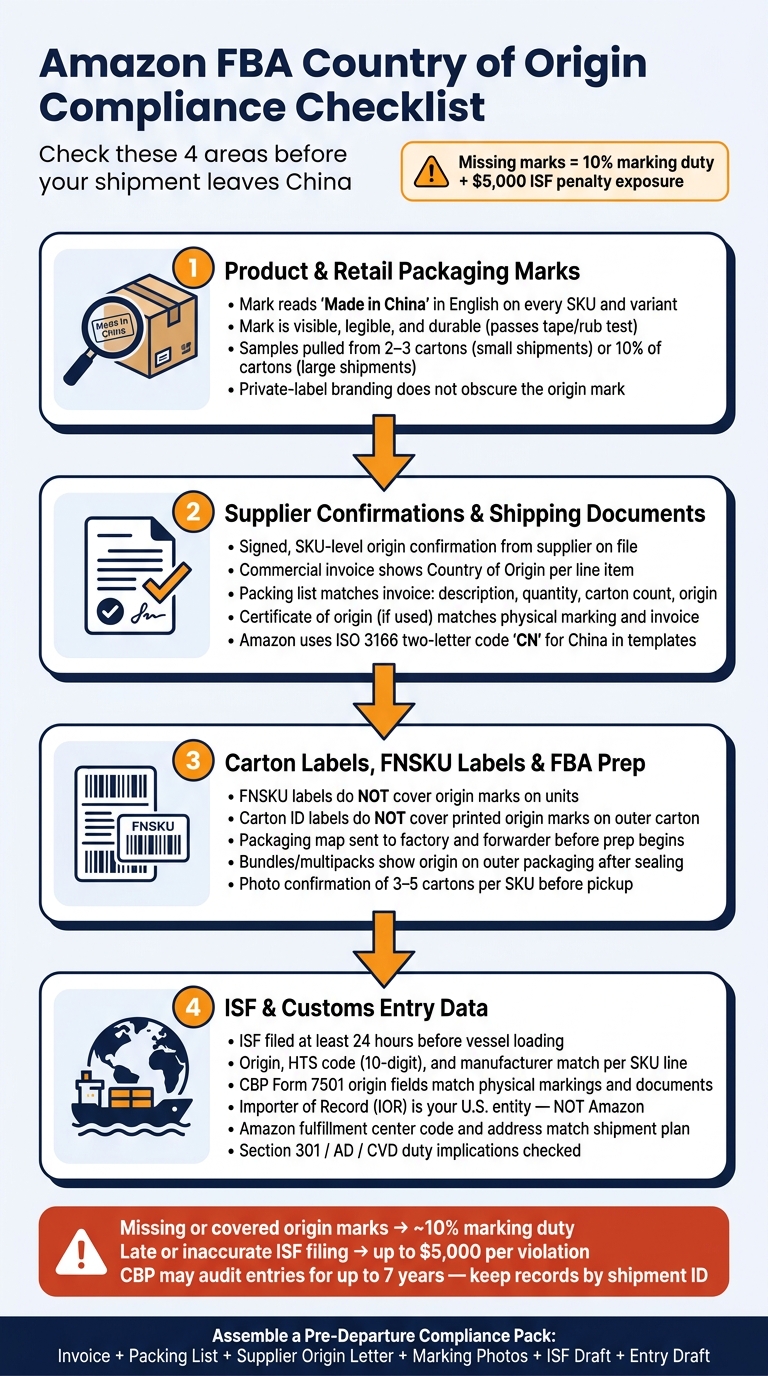
Amazon FBA Country of Origin Compliance Checklist
Amazon News: Avoid cross-border restrictions – Provide Country of Origin information
sbb-itb-f9a91f9
Checklist 1: Check Origin Marking on Products and Retail Packaging
Start with the product and packaging. If the origin mark is wrong, it can turn into a customs issue later. Check every product and every retail package before pickup. The mark needs to be correct, easy to see, and able to stay on through normal handling.
Confirm the Right Origin Statement for Each SKU
If the country of origin is China, use the exact origin mark required for that SKU, usually Made in China. In some cases, P.R. China may also be allowed; PRC by itself is misleading. Check each SKU and each variant on its own, including every color, size, and bundle setup.
For private-label products, don’t let U.S.-based branding cover up or distract from a clear Made in China mark. The manufacturing country should appear near the branding and in at least the same size.
A simple way to stay organized is to build a SKU master list with:
- Product title
- Variation details like size and color
- Amazon ASIN/FNSKU
- Exact origin wording required
Use that list during the factory check so no variant slips through the cracks.
Check That Marks Are Visible, Readable, and Lasting
A mark that technically exists but can’t be found or read won’t meet the standard. CBP says origin marks must be conspicuous and legible. In plain English, that means people should be able to spot them during normal handling and read them without strain.
Placement matters more than many sellers think. On a retail box, the origin statement should be on an outer panel that’s visible when the box sits on a shelf, not hidden under a flap or printed inside. On a polybag, it should be printed or labeled on the outside in a font that can be read at arm’s length. For apparel, a woven or printed neck label is a safer bet than a paper hangtag that can fall off in transit.
Durability matters too. A quick factory check can save a headache later. Lightly rub the mark with a damp cloth, or place clear tape over it and remove it. That test helps show whether the print will make it through the trip to an Amazon fulfillment center. If it smears or peels, fix it before pickup.
Inspect Samples From Multiple Cartons Before Pickup
Don’t rely on one carton. One box can hide old packaging or uneven labeling. For shipments up to about 10 cartons, pull samples from at least 2–3 cartons from different pallet spots. For larger shipments, check at least 10% of cartons, with at least one carton from each production lot or date code.
If it’s a replenishment order, or if the packaging artwork was changed recently, target cartons from both before and after the change. That’s the best way to make sure old, non-compliant packaging isn’t still in the mix. Mixed cartons need extra attention too. If several SKUs share one carton, check every SKU inside, not just the main one.
Use the table below as your on-site checklist. Your inspector, factory QC contact, or freight forwarder’s prep team should complete it before cargo is loaded. Add carton numbers or lot codes in the notes so you can trace an issue later if one comes up.
| Item | Requirement | Verified By | Date (MM/DD/YYYY) |
|---|---|---|---|
| Each SKU, color, and size variant | Verify every variation separately for origin mark | ||
| Bundles/multipacks | Outer packaging clearly shows origin for the full set | ||
| Polybags | Origin mark visible on exterior; suffocation warning if opening > 5 inches | ||
| Durability check | Mark does not smear or peel with light rubbing or tape test | ||
| Multi-carton sample | Units pulled from at least 2–3 cartons on small shipments, or 10% of cartons on larger shipments, per SKU |
Save the completed checklist under the shipment ID and keep it with your purchase order records. If you spot a problem – for example, one color variant is missing the mark – fix it at the factory before pickup. Alternatively, you can use US-based FBA prep services to correct labeling issues after arrival. Don’t wait and hope it sorts itself out.
Once the product and packaging pass, match the supplier’s written origin confirmation to the invoice and packing list.
Checklist 2: Match Supplier Confirmations With Shipping Documents
Once the physical marks check out, the next step is simple: make sure the paperwork says the same thing before you book the shipment. Use the SKU list from Checklist 1 to compare the factory’s stated origin against the shipping documents.
Get Written Origin Confirmation From the Supplier
Get a signed, SKU-level origin confirmation before booking. Put it on the pro forma invoice or commercial invoice as a line-item field, not as a vague note at the bottom. If more than one factory is involved, list the factory address and origin for each SKU.
A signed declaration on supplier letterhead also works well for shipments tied to more than one factory. It should list each SKU, the PO number, the invoice number, and the factory address. This becomes part of your compliance file and gives your freight forwarder the data they need for ISF and customs entry details.
Check the Invoice, Packing List, and Origin Statements Line by Line
Review the commercial invoice and packing list line by line. Every SKU line should show the same description, quantity, carton count, and country of origin. If you’re using a certificate of origin or a separate origin statement, that document also needs to match the invoice and the physical marking on the product.
Here’s what to check in each core document:
| Document | Origin Field Name | Where Used | Key Verification Points |
|---|---|---|---|
| Pro forma invoice | Country of Origin / Origin | Quotation, PO confirmation | Origin per SKU; factory location; no mixed-origin SKUs under one line |
| Commercial invoice | Country of Origin | Customs entry, ISF filing | Each line item matches product marking; descriptions and HTS codes align |
| Packing list | Origin (if shown) / Notes | Carton checks, warehouse receiving | Carton counts, SKU-to-carton mapping, origin notes vs. physical carton marks |
| Certificate of origin | Country of Origin, Exporter | Customs clearance, compliance audits | Origin matches product marking and invoice; exporter and consignee data correct |
| Origin declaration letter | Origin per SKU | Internal compliance file, forwarder use | Every SKU listed; PO and invoice numbers cross-checked; signed and dated |
Amazon’s own invoice and packing list templates require a country of origin field for each line item. They often use ISO 3166 two-letter country codes, such as "CN" for China. If your templates don’t use that format yet, update them now.
Fix Any Mismatch Before Cargo Leaves China
Handle any mismatch before pickup. That may mean correcting the origin, relabeling the goods, and reissuing the invoice, packing list, and origin declaration.
Once the documents are clean and match the physical marks, send the final versions to your freight forwarder so they can update ISF filings and customs entry data before departure. Next, check carton and FNSKU labels to make sure they don’t cover the origin mark.
Checklist 3: Match Carton Labels, FNSKU Labels, and Amazon FBA Prep
Labels added during FBA prep can cover origin marks after you’ve already checked them. And once the mark is covered, customs can treat it the same way they would a missing mark. This happens a lot with FNSKU labels, which often get placed wherever there’s open space, including right over the country-of-origin text. Polybag suffocation warnings can cause the same issue. Even simple box-sealing tape can block the mark if the factory printed it along a carton seam. The point of this step is simple: protect the origin mark through every labeling, packing, and repacking stage.
Make Sure Amazon Labels Do Not Cover Origin Marks
The easiest fix is to use a packaging map for each SKU. That can be a photo or a simple diagram showing exactly where the origin mark appears and which areas are approved for labels. Send that map to both the factory and your forwarder before prep starts. Then require photo confirmation of sample units before cargo is picked up.
Check Outer Cartons, Bundles, and Multipacks
Use the same origin wording you’ve already cleared on the invoice and packing list. Then check both the individual unit and the outer carton. A shipment can fail if the mark is wrong – or hidden – at either level.
| Level | Consistency Check | Common Errors |
|---|---|---|
| Unit-level | Wording matches the commercial invoice and customs entry; consistent across all units in the shipment | FNSKU placed over origin text; origin printed only on an inner flap or manual; low-contrast or undersized font |
| Carton-level | Carton origin matches the unit origin and customs entry data; origin visible on at least one external face | Carton ID label placed over the printed origin mark; mixed-origin SKUs in one carton marked with a single origin; reused cartons with old labels or markings |
For bundles and multipacks, the final sellable unit still needs to show the correct origin on the outside. If shrink wrap, a polybag, or a sleeve covers the mark on the units inside, then the bundle packaging itself needs its own origin statement. Check this after sealing, not before.
Add Origin Checks to Your FBA Prep Process
Every prep step can hide an origin mark. That includes relabeling, repacking, polybagging, and palletizing. So build a fast visual check into each stage. Before sealing a carton, make sure the unit’s origin text is still readable. Before placing a pallet label, make sure the carton’s origin mark is visible on a different face.
If FCLGO handles your FBA prep in China, send them the packaging map and ask for photo checks of 3–5 cartons per SKU before pickup. Once carton labels are cleared, match the ISF and entry data before departure.
Checklist 4: Check ISF and Customs Entry Data Before Departure
After your carton labels and prep photos are approved, use that same origin data in your ISF and customs entry filings. Don’t treat this as a separate task. The SKU list and origin details you already checked on the product and commercial invoice should carry straight through.
Match Origin Data Across ISF, HTS Lines, and Entry Records
The Importer Security Filing (ISF) must be filed at least 24 hours before vessel loading, and the manufacturer, origin, and HTS must match each line item. If you’re shipping multiple SKUs from different countries, each SKU needs its own correct origin entry. Don’t group mixed-origin SKUs under one origin code. Use a master SKU list that shows the confirmed origin for every item before anything gets filed.
This matters because CBP looks at origin data at the line level when it checks duty exposure and trade remedies. That includes Section 301 tariffs, antidumping duties, and countervailing duties when they apply.
| Step | Origin-Related Data | Responsible Party | Check Completed |
|---|---|---|---|
| ISF Filing | Country of origin, HTS code (at least 6 digits), manufacturer info per SKU | Broker prepares, Seller reviews | [ ] |
| HTS Classification | 10-digit HTS confirmed; Section 301/AD/CVD implications checked | Customs broker | [ ] |
| Entry Draft Review | CBP Form 7501 origin fields match physical markings and documents | Broker prepares, Seller reviews | [ ] |
| Final Sign-Off | Pre-departure compliance pack assembled and shared | Seller | [ ] |
Once the filing data lines up, check the parties and delivery details tied to the entry.
Confirm Importer, Consignee, and Amazon Delivery Details
Before departure, three identity blocks need to match across all documents: your importer of record (IOR), your consignee, and the Amazon fulfillment center address from your shipment plan.
Amazon will not act as importer of record for FBA inventory. Your U.S. entity or IOR service needs to appear on the customs entry. Amazon can be listed as the ultimate consignee in care of FBA, but the legal name, address, and tax ID should match what your broker has on file and what appears on your CBP bond setup. Even a small spelling mistake or tax ID mismatch can slow release.
Also check that the Amazon fulfillment center code and address in your shipment plan match the forwarder’s delivery instructions. If the shipment plan changes after booking, send the update to your forwarder and broker in writing before the vessel departs.
Put Together a Pre-Departure Compliance Pack
Keep one shipment folder with all origin-supporting documents in one place. Think of it as your proof file. It should show that the product markings, supplier records, and filing data all say the same thing.
Include:
- The origin-verified invoice
- The matching packing list
- Supplier origin letters
- Marking photos
- Draft ISF data
- Draft entry data
Ask your broker for draft ISF and entry summaries before filing so you can catch mistakes early. If FCLGO is handling your ocean freight, FBA prep, customs clearance, and final delivery to Amazon fulfillment centers, share the compliance pack with them too. That helps keep origin data aligned from pickup through Amazon check-in. CBP may review entries for up to seven years, so it’s smart to keep records sorted by shipment ID and date long after delivery.
Conclusion: Final Sign-Off Before Your Amazon FBA Shipment Leaves China
Once the compliance pack and ISF draft match, do one last sign-off before loading. This last review ties together product marks, paperwork, labels, and entry data.
Missing origin marks, or marks hidden by labels or packaging, can lead to about 10% marking duty. Late or inaccurate ISF filings can also lead to cargo holds and $5,000 per violation in liquidated damages.
Final Sign-Off Checks for Every Shipment
Use this sign-off for every shipment.
| Check | What to Confirm |
|---|---|
| Origin marking | Each SKU and retail package shows "Made in China" or the correct country of origin in English, in a clear and permanent way |
| Supplier declaration | Written origin confirmation for each SKU is on file and matches your customs documents |
| Document consistency | The invoice, packing list, HTS codes, quantities, and origin fields match line by line |
| Label placement | FNSKU and Amazon box labels do not cover origin marks on units or master cartons |
| Customs data | ISF and entry records show the correct origin, HTS, importer of record, consignee, and Amazon fulfillment center details |
If FCLGO is handling the shipment, send the completed compliance pack before loading.
No shipment should leave China without a finished sign-off that is dated and filed under the shipment ID.
FAQs
Who is responsible for country of origin compliance for Amazon FBA shipments?
The Amazon seller is mainly responsible for country of origin compliance. You need to state the country of origin correctly on master carton labels and in Amazon Seller Central.
If that information is missing or wrong, Amazon may reject your shipment, delay it, or charge storage fees. FCLGO can help with compliance through labeling, inspection, and customs documentation.
What if my shipment includes products from more than one country?
You need to track where each item was made with care. If the country of origin is wrong or missing, your shipment can be rejected, hit with extra storage fees, or delayed during processing.
In Seller Central, enter the correct country of origin for every product.
Each master carton also needs a clear country-of-origin mark, such as "Made in China," to meet U.S. customs rules. If your supply chain has a lot of moving parts, FCLGO can help with the paperwork and labeling for Amazon FBA shipments.
How long should I keep origin marking and customs records?
The search results don’t say how long you should keep origin marking or customs records.
To stay compliant, check with your customs broker or review official U.S. Customs and Border Protection (CBP) record-keeping rules for importers.
发表回复