If I had to boil this down to one point, it’s this: the lowest freight rate depends on how your shipment is billed. FCL is priced per container, LCL is priced per CBM or 1,000 kg, and air freight is priced per chargeable kg. So the same cargo can look cheap in one mode and expensive in another.
Here’s the short version:
- FCL usually fits larger shipments, often when volume gets close to 13–15 CBM or more
- LCL usually fits smaller ocean shipments, often around 1–15 CBM
- Air freight usually fits urgent or small shipments, often under 200 kg
- Base freight is only the main transport charge
- It does not include items like duties, taxes, customs clearance, drayage, destination handling, storage, insurance, or Amazon FBA shipping prep
If I’m comparing quotes, I’d check:
- packed CBM
- gross weight
- carton dimensions
- origin and destination
- what fees are included
- whether the quote is port-to-port or door-to-door
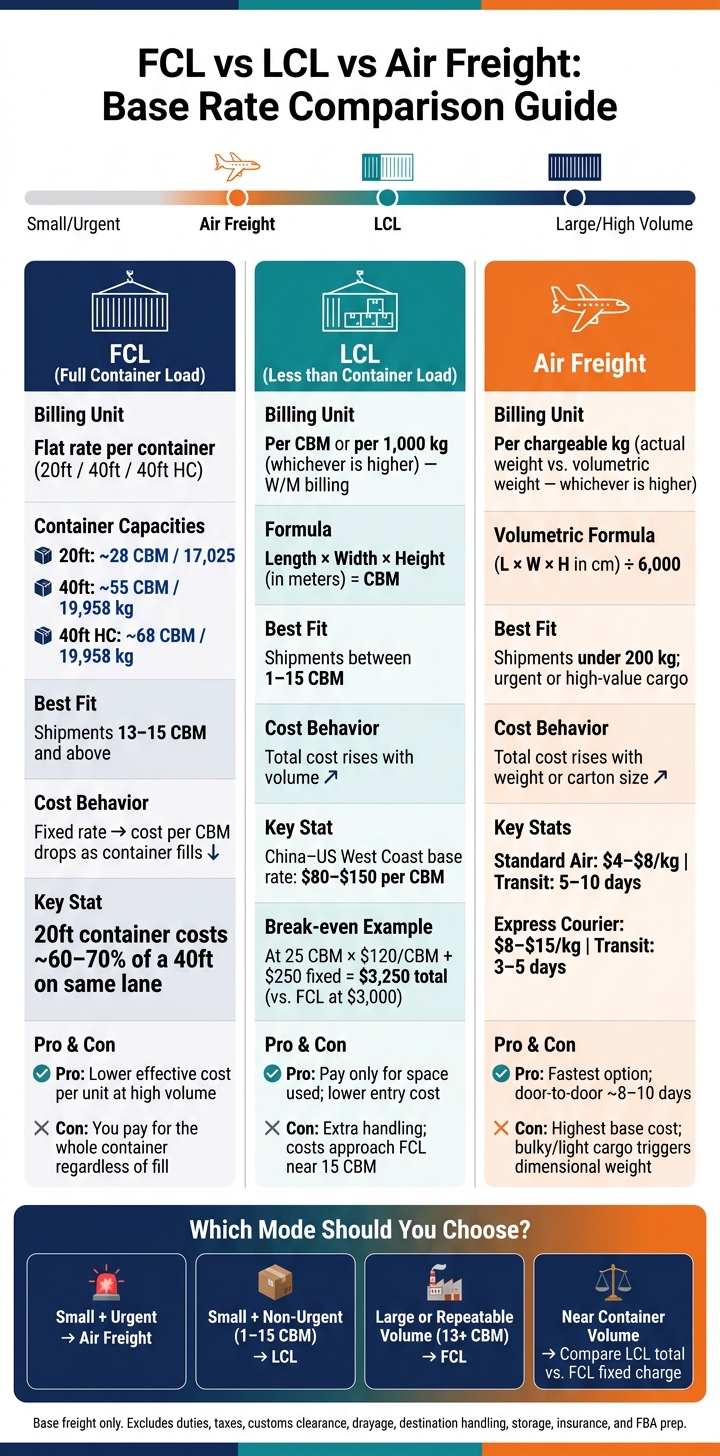
FCL vs LCL vs Air Freight: Base Rate Comparison Guide
FCL vs LCL Shipping: When to Switch (Break-Even Point Explained)
To determine your shipment’s volume and identify this break-even point, you can use a CBM calculator to compare ocean and air freight dimensions.
sbb-itb-f9a91f9
Quick Comparison
| Mode | How it’s billed | Common fit | Base rate pattern | Main tradeoff |
|---|---|---|---|---|
| FCL | Flat rate per container | Larger loads | Cost per CBM drops as container use goes up | You pay for the whole container |
| LCL | Per CBM or per 1,000 kg, whichever is higher | Small-to-mid ocean loads | Total cost rises with volume | More handling and break-even can get close to FCL |
| Air Freight | Per chargeable kg | Small or urgent loads | Total cost rises with weight or carton size | Highest cost, but fastest transit |
A simple example shows why this matters: if LCL is $120 per CBM + $250 fixed, then 25 CBM = $3,250. If a 20-foot container shipping quote is $3,000, FCL is already the lower-cost pick at that size.
So when I read this article, the main takeaway is clear: don’t compare freight modes by headline price alone – compare the billing method, shipment size, and full quote scope side by side.
1. FCL Ocean Freight
Charging Unit
FCL is priced per container – usually a 20-foot, 40-foot, or 40-foot high-cube unit. That means the base ocean freight rate stays the same whether the container is packed tight or only partly loaded.
So the big pricing lever is simple: how much of that container you use.
Shipment Size Fit
A 20-foot container holds about 28 CBM and 17,025 kg. A standard 40-foot container holds about 55 CBM and 19,958 kg. A 40-foot high-cube holds about 68 CBM and 19,958 kg.
In practice, you may not get all of that space. Carton dimensions, pallets, product limits, and carrier rules often cut into usable volume.
Most industry sources put the FCL decision point at around 13–15 CBM, which is about half of a 20-foot container. Below that, LCL often costs less. Above that, FCL often becomes the lower-cost and simpler option to run.
That said, this is a comparison trigger, not a hard cutoff. The break-even point can move based on the route, destination charges, and accessorial fees. And the more container space you use, the lower your base cost per CBM tends to be. Once you know your usable volume, the next step is figuring out how that fixed rate spreads across it.
Cost Behavior
Because FCL uses a fixed container rate, your cost per CBM drops as you load more cargo.
Here’s where it gets interesting: a 20-foot container often costs about 60%–70% of a 40-foot container on the same lane, while a 40-foot container gives you about twice the volume. That setup can lower your unit cost. But it only works if you can use the extra space without creating too much stock or storage pressure at Amazon.
Amazon FBA Use Case
FCL works well for high-volume, repeatable shipments with steady demand. If you’re shipping a near-full 40-foot container of standard-size, nonhazardous goods, that’s usually a strong fit for FCL.
Amazon fulfillment centers can receive FCL ocean shipments when the load is easy to unload and set up to avoid product damage in transit. Still, FCL doesn’t replace Amazon’s shipment plan, carton and pallet rules, labeling, or delivery appointment steps. You still need to follow the Amazon FBA shipping process.
If you use FCLGO, it can handle customs clearance, drayage, and delivery to your assigned Amazon fulfillment center.
When shipment volume falls below this range, LCL is the next option to compare.
2. LCL Ocean Freight
Charging Unit
LCL usually uses W/M billing. That means you’re charged by whichever is higher:
- 1 CBM
- 1,000 kg
CBM is worked out by multiplying length × width × height in meters. That number becomes your billable volume.
Shipment Size Fit
Unlike FCL, which comes with a fixed container price, LCL scales with volume. So the more space your cargo takes up, the more you pay.
LCL makes sense when a shipment is below the FCL break-even point. In plain English, it’s often the right fit when the shipment is too big for air freight but too small to fill a full container.
Here’s how it works: your cargo shares container space with other shipments. It’s consolidated at origin and then broken out at destination. That shared setup is useful, but it also adds extra handling steps.
Cost Behavior
Base LCL freight from China to the U.S. West Coast usually lands in the $80 to $150 per CBM range.
Because pricing is tied to CBM, the base freight cost goes up as shipment size grows. Once you get close to 15 CBM, it’s smart to compare LCL with a 20-foot FCL. At that point, the price gap can get a lot tighter.
That’s why LCL often sits in the middle: not as expensive as air for this size range, but more flexible than booking a full container.
Amazon FBA Use Case
For Amazon FBA, LCL is a solid option for non-urgent restocks or new product launches when volume falls between 1 and 15 CBM. It’s often used to move goods from Chinese factories to U.S. Amazon fulfillment centers such as ONT8, SCK4, and LAX9.
In many cases, LCL cargo arrives as loose cartons. Before Amazon will accept it, the shipment often needs palletizing and FNSKU labeling. FCLGO can take care of that prep before the last trucking leg to the fulfillment center.
Air freight follows a different base-rate formula, so once you switch modes, the size and cost math changes too.
3. Air Freight
Charging Unit
Air freight is billed by chargeable weight. That means you pay based on whichever is higher: the actual (gross) weight or the volumetric (dimensional) weight.
Volumetric weight is worked out with this formula: (Length × Width × Height in cm) ÷ 6,000.
So if a shipment is light but takes up a lot of space, the size of the cartons can drive the price more than the scale does.
Shipment Size Fit
Air freight tends to make the most sense for shipments under 200 kg. There’s also no minimum weight, which makes it a solid option for very small shipments.
That’s the catch with air: pricing is tied to weight, so costs can climb fast as the shipment gets bigger.
Cost Behavior
Standard air freight from China to the U.S. usually costs $4–$8 per kg. Express courier air is higher, at $8–$15 per kg.
| Service Type | Cost per kg | Transit Time |
|---|---|---|
| Standard Air Freight | $4–$8 | 5–10 days |
| Express Air Courier | $8–$15 | 3–5 days |
Air freight doesn’t behave like LCL. LCL costs move with volume, but air freight costs are driven mostly by weight. As shipment size increases, the price gap between air and ocean shipping gets much larger.
For Amazon sellers, that makes air freight a speed-first choice, not the best pick for moving a lot of inventory at once.
Amazon FBA Use Case
Air freight is the right fit when speed matters more than price. Common use cases include:
- urgent inventory restocks to avoid going out of stock
- small test orders for new product launches
- high-value or fragile products, such as electronics
Typical door-to-door air transit is about 8–10 days. FCLGO also handles air freight, including customs clearance and delivery to Amazon fulfillment centers.
How Shipment Size Affects the Base Rate
Unit pricing only shows part of the picture. Your total base freight cost shifts as shipment size grows because each shipping mode scales in its own way. The practical question is simple: at what point does one option stop being the lowest-cost choice?
| Shipment Condition | Rate Structure to Prioritize | Reason |
|---|---|---|
| Small and urgent | Air freight by chargeable weight | Speed may justify the premium, and smaller cartons lower dimensional weight. |
| Small and non-urgent | LCL by chargeable CBM | Pay for the ocean space you use instead of reserving a full container. |
| Large shipment | FCL per container | A fixed container charge is spread across more inventory, lowering the effective cost per CBM. |
| Near-container volume | Compare LCL total cost vs. FCL fixed charge | LCL may approach or exceed FCL, and FCL can also reduce handling complexity. |
| Bulky or lightweight | Compare air chargeable weight vs. LCL CBM pricing | Large, light cartons can trigger high dimensional weight in air freight, while ocean pricing is based on space. |
When you’re close to container volume, do a quick FCL vs. LCL break-even check. Here’s a simple example: if LCL costs $120 per CBM plus $250 fixed, the total hits $3,250 at 25 CBM. If an FCL quote is $3,000, FCL is already the lower-cost move at that volume.
Of course, pricing doesn’t happen in a vacuum. Actual results will vary by lane, season, container availability, and what each quote includes. That’s why apples-to-apples quoting matters.
Ask for quotes using the same shipment details:
- packed CBM
- gross weight
- carton dimensions
- origin
- destination
- fee split
That way, the base rate comparison is clean. FCLGO can quote ocean freight, air freight, customs clearance, and delivery under the same quote scope.
Those break-even points are what shape the tradeoffs between modes.
Pros and Cons by Freight Mode
Each freight mode comes with its own pricing logic. The right pick usually comes down to three things: shipment size, delivery speed, and how much cost your margins can handle. The big difference is how you’re charged – fixed container, shared CBM space, or chargeable kilogram.
| Freight Mode | Pros | Cons | Best-Fit Scenario |
|---|---|---|---|
| FCL | Lower effective cost per unit at higher volume; fewer consolidation and handling steps; simpler logistics | Higher upfront cost; inefficient if the container is only partly filled | Predictable replenishment with high container utilization |
| LCL | Pay only for the space or weight used; lower entry cost for smaller shipments | Billed by chargeable volume or weight, so handling charges can add up as volume rises | Shipments under about 15 CBM; new product launches with uncertain demand; irregular replenishment cycles |
| Air Freight | Fastest option – best for urgent restocking | Highest base cost per kilogram; bulky but light cargo can be priced by dimensional weight | Stockout prevention, launches, high-value goods, and small bridge shipments |
The table gives you the short version. What matters in practice is how each mode changes as shipment size grows.
FCL tends to look better as you fill more of the container. Since the rate is fixed, the cost per unit drops as utilization goes up. That makes it a strong fit for steady replenishment and larger-volume moves.
LCL usually starts out cheaper for smaller shipments. You only pay for the space or weight you use, which keeps the entry cost lower. But there’s a catch: as volume climbs, consolidation and handling charges can start eating into the savings. At some point, the gap between LCL and FCL gets a lot smaller.
Air freight is the speed play. It’s the fastest option by far, but also the most expensive on a per-kilogram basis. And if your cargo is light but bulky, dimensional weight can push the rate up fast. That’s why air tends to make sense when timing matters more than cost – like avoiding a stockout, supporting a launch, or moving a small bridge shipment.
A common move is to send the main replenishment by FCL or LCL, then use air for a smaller top-up shipment while the ocean freight is still on the water. It’s not fancy, but it works.
If you’re comparing quotes, FCLGO can help line up FCL, LCL, and air freight alongside customs clearance, U.S. warehousing, trucking, drayage, FBA prep, and direct delivery to Amazon fulfillment centers.
For sellers, the day-to-day question is simple: which pricing model lines up with the shipment’s size and timing?
Conclusion
After looking at all three billing models, the main takeaway is simple: choose the shipping mode that fits your shipment size, timeline, and the way that mode charges for freight. Use FCL when your cargo is close to filling a container, LCL for smaller ocean shipments, and air freight when time matters most.
Before you make a call, compare quotes using the same scope. That means checking line by line for:
- consolidation
- destination handling
- drayage
- customs clearance
- FBA prep
- delivery
Price is only one part of the decision. If a top-selling ASIN is getting close to a stockout, the lost sales can cost more than what you save with ocean freight. In that case, air freight isn’t just faster. It can be the better inventory move.
FCLGO handles China-to-U.S. ocean freight, air freight, customs clearance, FBA prep, U.S. warehousing, trucking, drayage, and delivery to Amazon fulfillment centers.
FAQs
What’s included in a base freight quote?
A base freight quote usually covers the main cost of moving your goods from origin to destination. But that number is often just one piece of your total landed cost.
For FCLGO, the quote may include pickup, export customs clearance, ocean or air transit, U.S. customs clearance, destination handling, and final trucking to your warehouse or Amazon fulfillment center.
That said, don’t assume every charge is already baked in. It’s smart to confirm whether the quote includes:
- Fuel surcharges
- Documentation
- Terminal handling
- Duties
- Taxes
- FBA prep
A quote can look low at first glance, then grow once these line items show up. That’s why it helps to check exactly what’s included before you book.
How do I find the break-even point between LCL and FCL?
Calculate the total cost for each option based on your shipment’s volume and weight. LCL is usually priced per cubic meter (CBM) or per 2,204.6 lbs. (1,000 kg), while FCL comes with a fixed rate for the entire container.
As a rule of thumb, LCL tends to cost less for shipments under 15 CBM. Once you get above 15 CBM, FCL often starts to make more sense on price. To make the comparison easier, divide each total quote by your number of units.
Why can air freight cost more for lightweight cargo?
Air freight charges are based on whichever is higher: actual weight or volumetric weight.
Volumetric weight reflects how much space your cargo takes up, and it’s calculated like this:
(Length × Width × Height in cm) ÷ 6,000
Here’s the idea in plain English: a shipment might not weigh much, but if it takes up a lot of room, the airline still has to give that space over to your cargo.
So if your shipment is light but bulky, its volumetric weight can end up higher than its actual weight. When that happens, you’re charged for the space it uses, not just the pounds or kilos on the scale.
发表回复