If your pallet misses Amazon’s rules, your shipment can be refused, delayed, or reworked at your cost. I’d check 5 things first: 40 x 48-inch wooden pallet, four-way entry, no box overhang, correct height/weight, and labels on every pallet side plus every box.
Here’s the short version in plain English:
- I use a 40 x 48-inch wood pallet for most U.S. Amazon FBA LTL, FTL, and intermodal shipments.
- I make sure it has four-way forklift access and is GMA Grade B or better.
- I keep all cartons fully inside the pallet edges. No overhang.
- I measure the loaded pallet, not just the boxes.
- I keep stackable pallets at 50 inches max and 750 lb max.
- I keep non-stackable pallets at 72 inches max and 1,500 lb max.
- I use clear stretch wrap only and place 4 pallet labels, one on each side.
- I check that every carton has its own FBA Box ID label.
- I inspect for broken boards, nails, mold, water damage, or contamination.
- If the pallet comes from Amazon FBA shipping from China and uses wood, I confirm the ISPM 15 mark on at least 2 opposite sides.
- I match the physical load to the paperwork: BOL, Shipment ID, FC code, pallet count, box count, and tracking/PRO details.
A few numbers matter most here. Amazon’s pallet footprint is 40 x 48 inches. Stackable loads top out at 50 inches / 750 lb. Non-stackable loads top out at 72 inches / 1,500 lb. And if one packed unit is over 100 lb, over 80 inches long, or over 30 inches wide, I put it on its own pallet.
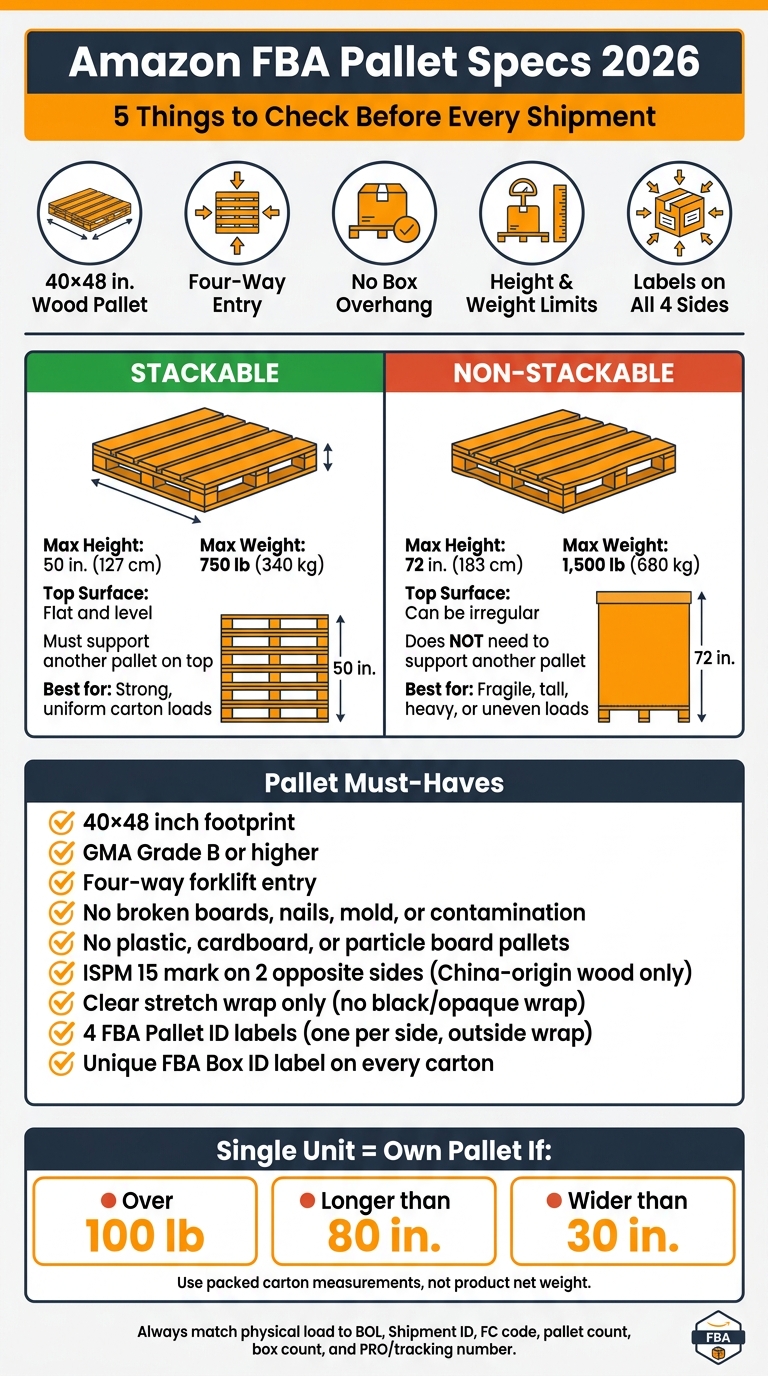
Amazon FBA Pallet Specs: Stackable vs Non-Stackable at a Glance
Pallet LTL Shipping Tips with Amazon FBA – How to Avoid Common Mistakes
sbb-itb-f9a91f9
Quick comparison
| Item | Stackable | Non-stackable |
|---|---|---|
| Max total height | 50 in. | 72 in. |
| Max total weight | 750 lb | 1,500 lb |
| Top surface | Flat and level | Can be irregular |
| Strength | Must hold another pallet on top | Does not need to support another pallet |
| Best use | Even, strong carton loads | Fragile, tall, heavy, or uneven loads |
In other words: this guide is about passing Amazon receiving the first time. I’d use it as a last-check list before pickup and again before delivery. For a broader look at the logistics process, see our guide to shipping to Amazon FBA.
Amazon pallet specs: size, material, condition, and access
Amazon’s standard pallet for U.S. fulfillment center shipments is a 40 × 48-inch, four-way-entry wooden pallet rated GMA Standard Grade B or higher. That means forks from a forklift or pallet jack can go in from all four sides. It also means the load has to stay neat: cartons must sit fully inside the 40 × 48-inch footprint, with no overhang. If one oversized unit can’t fit that footprint, use a pallet size that fits the unit.
Once the pallet type is set, the next step is simple: check the footprint, the pallet’s build, and any export marks before pickup.
Approved pallet construction and condition
Grade B pallets need six or seven top boards, at least four bottom boards, intact stringers, four-way entry, and no block repairs. Amazon also does not allow plastic, cardboard, and particle board pallets for these shipments.
Before you wrap anything, inspect the pallet closely. Look for broken or missing boards, protruding nails, damaged stringers, warping, mold, or signs of chemical or water contamination. Amazon says broken or damaged pallets may be rejected at the seller’s expense.
If you’re using China-origin wood pallets, check for a clear ISPM 15 mark on at least two opposite sides. The mark should include the IPPC symbol, country code, producer code, and treatment code. USDA APHIS says regulated wood packaging material entering the United States must be treated and certified under ISPM 15.
Specification table: Amazon rules, planning targets, and Seller Central checks
Use the table below to separate Amazon requirements from planning targets and Seller Central checks.
| Item | Amazon requirement | Planning target | Seller Central check |
|---|---|---|---|
| Footprint | 40 × 48 inches | No carton overhang; load flush within the deck | Confirm whether an oversized unit or special program changes the requirement |
| Material | Wooden pallet; no plastic, cardboard, or particle board | Use a durable, export-grade wooden pallet | Check for any carrier or fulfillment center-specific instructions |
| Access | Four-way entry | Keep all fork-entry openings clear and unobstructed | Review partnered-carrier and appointment instructions |
| Grade | GMA Standard Grade B or higher | Use Grade A or heavy-duty equivalent where available | Verify whether the carrier has stricter pallet standards |
| Condition | No broken or damaged pallets | Reject pallets with mold, contamination, protruding nails, or unstable repairs | Document the inspection before pickup |
| Export treatment | ISPM 15 treatment and marking for regulated wood packaging | Inspect marks before container loading | Retain supplier or treatment records |
Next, measure total pallet height, weight, and stackability before release.
How to calculate pallet height, weight, and stackability
Once you’ve confirmed the pallet type, measure the loaded pallet – not just the cartons.
Height and weight limits to measure before pickup
Measure height from the floor to the top of the load. Weight should include everything: the pallet, cartons, stretch wrap, corner boards, and any other packaging materials.
Amazon’s limits change based on whether the pallet is stackable. A stackable pallet must stay at or below 50 inches in total height and 750 lb in total weight. In Amazon’s planning example, that 50-inch limit is split into about 45 inches of cartons on top of a 5-inch pallet. A non-stackable pallet can go up to 72 inches in total height and 1,500 lb in total weight.
Both limits have to pass. If one is over, the pallet doesn’t qualify. That’s why it’s smart to measure again after wrapping. Stretch wrap and other materials can add just enough height to put a load over the line.
When a product needs its own pallet
A single unit or set should go on its own pallet if it is:
- Over 100 lb
- Longer than 80 inches
- Wider than 30 inches
Use the packed carton measurements, not the product inside.
Before pickup, check the pallet step by step. Record the carton count, each carton’s packed dimensions, each carton’s gross weight, and the pallet’s tare weight. Then use these formulas:
- Total pallet weight = (carton count × carton weight) + pallet tare + packaging materials
- Total loaded height = pallet height + height of the carton stack
Use actual packed weights, not product net weights.
Stackable vs. non-stackable pallets
A pallet is stackable only if it meets both the size limits and the load-strength rule. That means the load needs to be level, evenly spread, and built from cartons strong enough to hold another pallet on top.
Mark a pallet non-stackable if the cartons are weak, wet, or visibly compressed; if the top surface is uneven or irregular; if the product is fragile or easy to crush; or if the total goes over 50 inches or 750 lb. Don’t label a pallet stackable unless it clears every part of the rule.
Amazon treats stackable pallets as the preferred setup because they use trailer space more efficiently.
| Factor | Stackable pallet | Non-stackable pallet |
|---|---|---|
| Total height | Up to 50 in. (127 cm), including pallet | Up to 72 in. (183 cm), including pallet |
| Total weight | Up to 750 lb (340 kg), including pallet | Up to 1,500 lb (680 kg), including pallet |
| Load stability | Must safely support another pallet; level, uniform, compression-resistant | Must stay stable during transit without carrying another pallet |
| Trailer-space impact | More efficient; carrier may place another pallet above it | Less efficient; vertical space above the load is unused |
| When it applies | Strong, uniform cartons; even load shape; within 50 in./750 lb limits | Fragile, irregular, heavy, or tall loads that cannot safely support another pallet |
If the pallet clears these limits, you’re ready to build, wrap, and label it next.
How to build, wrap, and label an FBA pallet
Once the pallet clears height, weight, and stackability checks, it’s time to get it ready for handling and receiving.
Build a stable load with no box overhang
Start with a pallet that isn’t damaged. Put the heaviest and most rigid cartons on first, then stack lighter cartons on top. Keep the weight centered so the load doesn’t tilt or lean. Every carton should sit flush within the pallet footprint. Don’t build it into a pyramid shape – the top layer should stay flat and level. Also, keep forklift and pallet jack entry points fully open.
Use clear stretch wrap and place labels on all four sides
Wrap the load with clear stretch wrap only. Begin at the pallet base and work your way up, overlapping each pass so the wrap helps secure the cartons to the pallet. Don’t use black or opaque wrap. It hides the condition of the cartons and can block labels from view. Add this carrier instruction where it can be seen: Do not break stretch wrap.[3]
Each pallet needs four FBA pallet labels. Place one at the top center of each side, on the outside of the stretch wrap. Every carton on the pallet must also have its own unique FBA Box ID label. Don’t photocopy labels or reuse them.
Prep steps before release
Use this checklist before pickup:
- Inspect the pallet condition and carton labels.
- Build a centered load with all carton edges inside the pallet footprint.
- Measure the finished height and gross weight.
- Wrap the pallet in clear stretch wrap.
- Apply four pallet labels and confirm all carton Box IDs.
- Take photos of all four sides, the top, and all labels, then save the shipment records.
- Hold the pallet if labels are missing, the wrap is loose, overhang is present, or the measurements don’t match.
Next, verify carrier and Amazon delivery rules before release. This includes checking the specific requirements for your assigned Amazon fulfillment centers.
Final pre-delivery checks for China-to-USA FBA shipments
Carrier and fulfillment center checks before delivery
Once the pallet is built and labeled, you’re at the last gate before dispatch: making sure the physical load matches the booking and the delivery paperwork.
Before the truck shows up, confirm the finished pallet still matches Amazon’s approved spec and that the shipment documents line up with the load. A pallet can meet the physical rules and still get turned away if the BOL, shipment ID, or FC code doesn’t match the booked shipment.
Check the load itself first. Make sure the total loaded height is correct, the gross weight is within the allowed limit, the pallet labels are in place, and forklift access is open on all four sides. Also look at the wrap from every angle. The stretch wrap should be clear, secure, and not block entry points.
Then review the paperwork. The carrier needs an accurate bill of lading, the correct FBA Shipment ID, exact pallet and box counts, and the exact fulfillment center code and address. Confirm box and pallet counts before the delivery appointment, and list the Amazon reference IDs, shipment ID, and PRO/tracking number on the BOL. Verify the fulfillment center code on every document before dispatch.
Conclusion: release-or-hold checklist for Amazon pallet compliance
Use this final dispatch check before the truck leaves.
| Check | Pass standard | If it fails |
|---|---|---|
| Pallet size | 40 × 48 in., four-way access, GMA Standard Grade B or higher | Re-palletize |
| Pallet condition | No broken boards, protruding nails, contamination, or water damage | Replace pallet |
| Total height | 72 in. or under, including the pallet | Re-stack or split load |
| Gross weight | Within the shipment-specific Seller Central limit | Re-palletize or split load |
| Overhang | Zero – all cartons flush within the pallet footprint | Re-stack |
| Stretch wrap | Clear, fully secured, load cannot shift | Rewrap |
| Pallet labels | Four FBA Pallet ID labels, one per side, outside the wrap | Relabel |
| Carton labels | Every box has a unique, visible FBA Box ID label | Relabel affected cartons |
| Forklift access | All four entry points unobstructed | Reposition wrap or straps |
| BOL and shipment ID | Accurate counts, correct FBA Shipment ID, Amazon reference IDs, and PRO/tracking number | Update documents before departure |
| Fulfillment center address | Exact FC code and address matches Seller Central | Correct all documents |
| Delivery appointment | Confirmed through the required process | Reschedule before dispatch |
FAQs
How do I know if my pallet is truly stackable?
A pallet is stackable only when the load is stable, flat, and even enough to carry extra weight without shifting or collapsing.
That means cartons should be stacked tight with no overhang, the top should stay level, the pallet base should be in good shape, and clear stretch wrap should keep the whole load locked together.
What happens if my pallet is slightly over Amazon’s limits?
If your pallet goes over Amazon’s limits, Amazon may reject it, delay the shipment, or charge extra manual handling fees.
There’s another catch: if any cargo hangs over the pallet edge, carriers may measure from that farthest point. That can bump up your shipping costs.
To avoid problems, check that your pallet meets Amazon’s rules for size, weight, stacking, labeling, and stretch wrap before delivery.
Do all boxes need labels even if the pallet is labeled?
No. Even if the pallet has labels, each box still needs its own Box ID label, and each unit still needs its FNSKU.
Pallet labels identify the pallet only. They don’t replace box labels. So keep carton labels visible on each box, and place pallet labels on all four sides outside the final stretch wrap.
发表回复