7 Common Customs Clearance Mistakes Amazon Sellers Make
One customs mistake can turn a normal FBA shipment into extra duty, a $5,000 ISF penalty, port fees of $100 to $500 per day, and weeks of delay.
If I were shipping Amazon FBA inventory from China to the U.S., I’d focus on seven things first: the HTS code, declared value, commercial invoice, importer and consignee details, product description and compliance files, entry setup, and broker timing.
Here’s the short version:
- Wrong HTS code can lead to more duty, Section 301 tariffs, and CBP review
- Low declared value can trigger Form 28 requests, exams, and steep penalties
- Bad invoices can cause document holds before cargo clears
- Wrong buyer or importer details can stall or reject the entry
- Vague descriptions or missing certificates can lead to exams or detention
- Bad entry setup or late ISF can mean a $5,000 penalty per violation
- Late broker involvement leaves no time to fix errors before the vessel sails
The main point is simple: Amazon is not your importer of record – you are. That means the cost of bad paperwork lands on you, not Amazon.
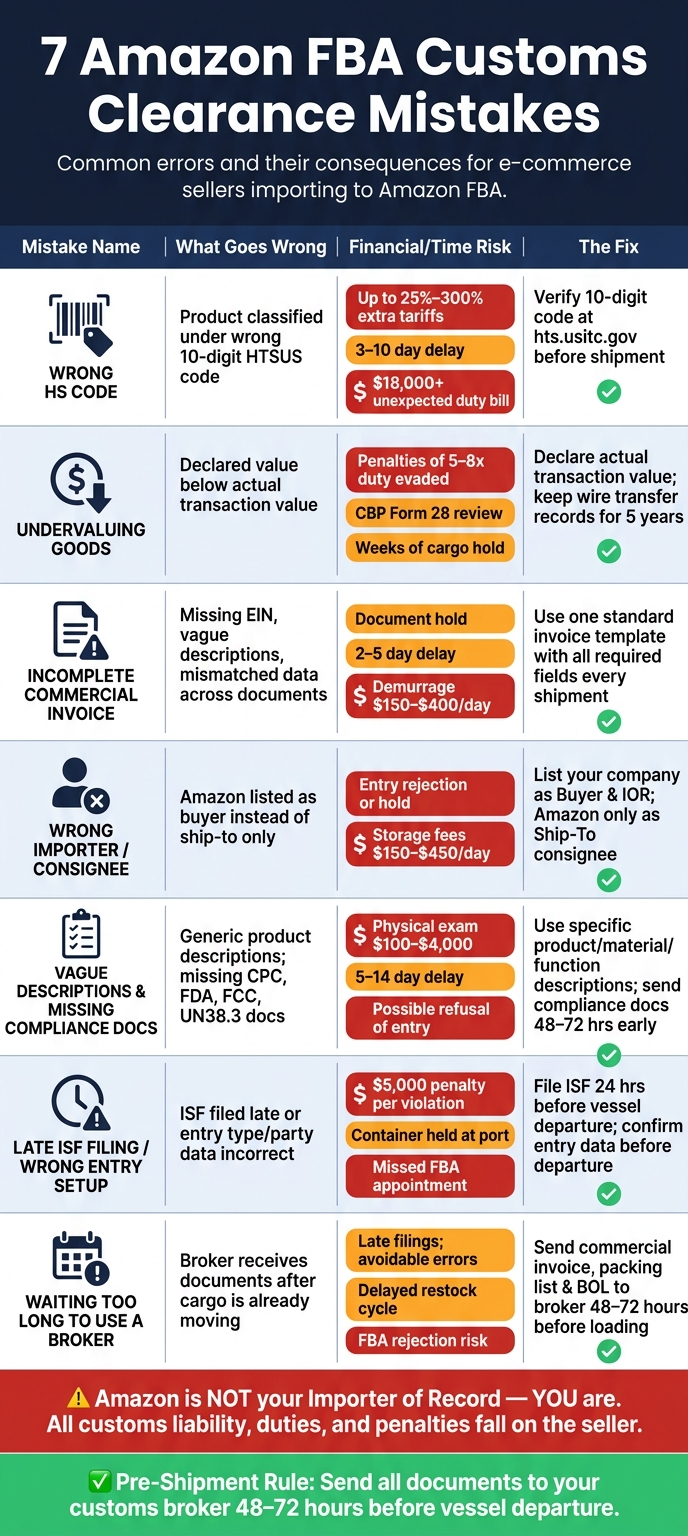
7 Amazon FBA Customs Mistakes: Costs, Risks & Fixes
Quick Comparison
| Mistake | What goes wrong | Likely result | What I’d do |
|---|---|---|---|
| Wrong HTS code | Product is classified under the wrong tariff code | Duty change, tariff hit, CBP hold | Check the 10-digit HTSUS code before shipment |
| Low declared value | Invoice value is below what was paid | Form 28, penalties, exam | Use the actual transaction value |
| Incomplete invoice | Missing or mismatched shipment data | Document hold | Use one invoice template for every shipment |
| Wrong importer/consignee | Amazon listed in the wrong role | Entry delay or rejection | List my company as buyer and IOR |
| Vague description / missing docs | Product details are too broad or files are missing | Exam, detention, release delay | Send clear descriptions and compliance files early |
| Wrong entry setup / late ISF | Filing type or party data is wrong | Hold, rejection, $5,000 penalty | Confirm entry data before departure |
| Waiting too long to use a broker | Review starts after cargo is moving | Filing errors and schedule slips | Send documents 48 to 72 hours early |
If I wanted to avoid customs trouble, I’d treat this as a pre-shipment checklist, not a last-minute fix.
sbb-itb-f9a91f9
Why Customs Errors Cost Amazon Sellers More Than Just Time
A customs hold can eat into your margin fast and push delivery back for weeks. Once CBP holds cargo, demurrage kicks in after free time runs out, often within 4 to 7 days, and costs can hit $100 to $500 per container per day. On top of that, a missed Amazon inbound appointment can tack on weeks more to your timeline. In many cases, the biggest losses start with simple paperwork mistakes that could have been avoided.
A wrong HS code can lead to a major duty reassessment. And a late or incorrect ISF can bring a $5,000 penalty per violation. At that point, the problem stops being “just paperwork” and starts turning into extra fees, delayed inventory, and lost momentum.
The bigger hit often comes later: stockouts. If a customs delay wipes out your FBA inventory, you don’t just lose sales in the moment. Your product’s Best Seller Rank (BSR) can take a hit that lingers for months.
Take a misclassified yoga mat shipment. That one error can snowball into reclassification, extra duty, demurrage, and a missed launch window. One small code issue, and suddenly the whole shipment is off track.
And here’s the part many sellers learn the hard way: the seller, not Amazon, is the Importer of Record. That means you’re legally on the hook for customs compliance, duties, and penalties. The seven mistakes below are where those costs often begin.
1. Using the Wrong HS Code for Your FBA Products
For FBA imports from China, the HS code shapes almost everything at the border: duty, tariff treatment, and how closely CBP looks at the shipment. Every product entering the U.S. needs a 10-digit HTS code (Harmonized Tariff Schedule). A lot of sellers just copy the supplier’s code or go with Amazon’s auto-generated suggestion. That’s where trouble starts.
If the product is misclassified, you can end up with the wrong duty rate, extra tariff exposure, or a shipment that gets flagged for review.
Clearance Delay Risk
A wrong HTS code can trigger a CBP exam. Once that happens, the shipment gets held for review, and that hold adds time before release.
For an FBA seller, that delay isn’t just annoying. It can throw off the whole inbound schedule and push your delivery window off track.
CBP Penalty or Exam Exposure
The money at stake can be steep. In March 2026, a Texas-based Amazon seller imported yoga mats classified under HTS 9506.91, which carried a 4.6% duty. CBP reclassified them under HTS 4016.99, which triggered a 25% Section 301 tariff plus a 2.5% regular duty. The result was an unexpected $18,000 duty bill and a three-week delivery delay.
"Using supplier-provided HTS codes without verification is the most frequent error. Your overseas supplier is not an expert in U.S. tariff classification." – Peacock Tariff Consulting
Impact on Amazon FBA Delivery Timelines
A CBP hold can wreck your launch window. Reclassification can add duty you didn’t plan for, slow down port release, and cause you to miss your Amazon inbound appointment.
And once that appointment is missed, delivery can slide back by weeks. A shipment that looked profitable on paper can turn into a loss fast.
Preventive Action Before Departure
Before the goods leave China, check the 10-digit HTS code in the official USITC database at hts.usitc.gov. Then compare that code against the Section 301 tariff lists for China-origin goods.
For repeat imports or products that sit in a gray area, it helps to:
- Request a CBP binding ruling
- Ask a licensed customs broker to review your invoice and packing list before departure
If classification is wrong, the next mistake – undervaluing the shipment – can make things even worse.
2. Undervaluing Goods to Lower Duties
Customs undervaluation means declaring a value that’s lower than what you actually paid the supplier. Some sellers do this to cut duty costs. On paper, it may look like an easy win. In practice, it can turn into a mess.
CBP can flag values that fall below normal market ranges and ask for proof of payment through a Form 28. And if a supplier or broker told you to use the lower number, that doesn’t shift the risk off your plate. You still hold the liability. A small tweak in declared value can lead to review, extra charges, and missed inbound windows.
Clearance Delay Risk
If your invoice, packing list, and manifest don’t match, CBP may place the shipment on a document review hold until the records are checked and cleared. That kind of hold can snowball fast. Demurrage, chassis, and inspection fees can start piling up while the shipment sits.
CBP Penalty or Exam Exposure
The downside here isn’t minor. Penalties for undervaluation can reach 5 to 8 times the duty evaded – or even the full domestic value of the goods.
An exam can also add time and cost. In some cases, that means a few hours and a few hundred dollars for an X-ray scan. In others, it can mean several days and thousands of dollars for a full intensive exam.
The safest move is simple: declare the true transaction value from the start.
Preventive Action Before Departure
Use the actual price you paid the supplier, usually on an FOB or EXW basis. If a supplier offers to issue a second invoice with a lower value, pass on it. That’s the kind of shortcut that can come back to bite you.
Keep your records in order, including:
- Proof of payment
- Wire transfer records
- Commercial invoices
Hold onto those records for at least five years so you can reply fast if CBP sends a Form 28 request.
Even when the value is right, a shipment can still get stuck if the commercial invoice is incomplete or doesn’t line up with the rest of the paperwork.
3. Submitting Incomplete or Inaccurate Commercial Invoices
The commercial invoice is the document that drives customs clearance. And when that invoice is incomplete or doesn’t line up with the rest of the paperwork, delays are common.
This often starts before the shipment even leaves China. A lot of suppliers fill out invoices without knowing Amazon FBA entry rules.
One point trips people up all the time: do not list Amazon as the buyer. Amazon should appear only as the ship-to party. After the buyer and ship-to fields are set up the right way, the next issue is data that doesn’t match across documents.
Clearance Delay Risk
Vague product descriptions and mismatched values can trigger a document hold when the invoice, packing list, and bill of lading don’t match. If quantities, weights, or party names differ from one document to another, the shipment may be placed on hold, and supplementary documents may not be accepted after the hold is issued.
CBP Penalty or Exam Exposure
Incomplete invoices can trigger exams, which can add hundreds or thousands of dollars in extra fees. For textile shipments, leaving out fiber content percentages can also lead to detention under 19 CFR 141.89.
Impact on Amazon FBA Delivery Timelines
Paperwork mistakes can delay sea freight by 5 to 14 days. If the cargo gets held at the port, demurrage and detention charges usually run $150 to $400 per day. That’s more than a minor hiccup. It can put your Amazon FBA delivery window in danger fast.
Preventive Action Before Departure
The safest move is to use one standard invoice template. It should include:
- Seller/exporter
- Buyer
- Ship-to address
- Importer of record number
- 10-digit HTSUS code
- Clear product description
- Country of origin
- Quantity
- Unit price
- Total USD value
- Incoterms
Send the invoice and packing list to your customs broker 48 to 72 hours before the cargo leaves China so mistakes can be caught early.
Even if the invoice itself looks fine, the shipment can still run into trouble if the importer or consignee details are wrong.
4. Missing or Incorrect Importer and Consignee Details
Wrong importer and consignee details are one of the most common reasons FBA shipments get held up. Amazon is not the importer of record, which means the seller is still on the hook for entry, duties, and compliance until customs clears the cargo. Once those party details are wrong, every document that follows gets harder to sort out.
If Amazon is listed as the buyer, CBP may assume Amazon is supposed to pay the duties. That can slow the release process or stop the entry from moving.
Clearance Delay Risk
CBP can flag mismatches across the invoice, packing list, and ISF. If the company name, EIN, or address doesn’t match, that can trigger a CBP document hold. First-time importers can also run into a hold on their first entry if they haven’t submitted CBP Form 5106.
CBP Penalty or Exam Exposure
For ocean freight, the ISF must be filed at least 24 hours before vessel departure. If the filing is late or inaccurate, CBP can issue a $5,000 penalty per violation. And it doesn’t stop there. One filing problem can snowball into storage charges and missed Amazon receiving windows.
Impact on Amazon FBA Delivery Timelines
A hold can add demurrage and storage fees fast, often $150 to $450 per day, while also delaying FBA delivery.
Preventive Action Before Departure
Before cargo leaves China, check these fields carefully so the entry lines up from the start:
| Document Field | Correct Entity | Common Mistake |
|---|---|---|
| Buyer | Your legal company name | Listing Amazon.com |
| Ship To / Consignee | Amazon Fulfillment Center, with the FC code and full address | Using your home or office address |
| Importer of Record | Your company, with a U.S. EIN or CBP-assigned number | Assuming Amazon handles the entry |
| EIN | Your U.S. EIN or CBP-assigned ID | Leaving it blank or using the factory’s ID |
Match the importer, consignee, and EIN before departure. If you import often, use a continuous bond.
Even when the party details are correct, the shipment can still get stuck if the product description and compliance files aren’t strong enough.
5. Vague Product Descriptions and Missing Compliance Documents
Even if the importer details are correct, CBP can still stop a shipment when the product description is too broad or the compliance paperwork isn’t there.
A commercial invoice that says only "electronics" or "apparel" doesn’t give CBP enough to work with. Be specific. Use product, function, material, and key spec. For example:
- "ABS plastic storage case for batteries"
- "80% polyester / 20% cotton women’s knit sweater"
That level of detail helps CBP figure out what the goods are. The other half of the puzzle is the paperwork that shows the goods are allowed in. If those files are missing, CBP may hold the shipment until the right agency documents are submitted.
Different products need different documents before CBP will release them:
| Product Category | Required Document |
|---|---|
| Children’s toys and clothing | Children’s Product Certificate (CPC), lab test reports |
| Food, supplements, cosmetics | FDA facility registration, Prior Notice |
| Wireless electronics (Bluetooth/Wi-Fi) | FCC ID, equipment authorization |
| Products with lithium batteries | UN38.3 test summary, MSDS |
| Wooden pallets or crates | IPPC fumigation certificate (ISPM 15) |
Clearance Delay Risk
Vague descriptions or missing certifications can trigger a CBP document-review hold. And this isn’t a small issue. Around 80% of CBP document-review holds for Chinese goods lead to delays of at least 3 days.
CBP Penalty or Exam Exposure
If CBP can’t verify the goods from the documents alone, the shipment may be sent to an exam. That gets expensive fast.
A VACIS X-ray exam can cost $100–$200, while an intensive manual exam can cost $800–$4,000, based on whether the freight has to be fully unloaded. Goods regulated by FDA, CPSC, or FCC may also take longer to clear because CBP has to coordinate with that agency before release.
Impact on Amazon FBA Delivery Timelines
While the shipment sits on hold, storage and demurrage can add up to $100–$500 per day. On top of that, restock shipments can get pushed back by 7–14 days, which can leave your Amazon FBA inventory running thin.
Preventive Action Before Departure
The best move is to get ahead of the problem. Send the invoice, packing list, and compliance certificates to your customs broker 48–72 hours before arrival.
Then double-check the details:
- Make sure FDA registrations, FCC IDs, and CPCs match the manufacturer listed on the invoice
- For textiles, list the exact fiber percentages
- Mark each product or inner package with a permanent "Made in China" label
Small paperwork gaps can turn into expensive delays. In this part of the process, being precise saves time and money.
6. Using the Wrong Customs Entry Setup for Amazon Shipments
Once the paperwork is in order, the next place things go wrong is the customs entry setup. DDP is common, but it doesn’t fix bad entry data. You still need the right buyer, consignee, and Importer of Record listed on the filing.
One mistake shows up all the time: assuming low-value shipments still qualify for Section 321. If the entry type is wrong, you can end up with a formal entry, added filings, and a delayed release.
Another problem is using the wrong buyer and importer fields for an Amazon shipment. If the buyer or consignee is formatted the wrong way, the entry can get rejected before the shipment clears.
The setup itself is pretty simple: list your legal entity as the buyer, Amazon as the consignee, and your company as the Importer of Record. If a licensed customs broker is filing for you, that broker should also be named the right way in the entry.
Clearance Delay Risk
A bad entry setup can trigger a CBP hold or rejection. When that happens, delays from setup errors often run 7–14 days, and demurrage fees can hit $100–$500 per day.
CBP Penalty or Exam Exposure
A missing or late Importer Security Filing (ISF) can trigger an automatic $5,000 penalty per violation. And here’s the part many sellers miss: if a DDP provider uses fake or recycled IOR numbers, under-declares value, or misclassifies goods to cut costs, CBP can still go after the seller.
"Sellers are responsible for ensuring that their products are lawfully imported into the destination country and comply with all applicable import and customs laws." – Amazon Official Policy
Impact on Amazon FBA Delivery Timelines
A rejected or held entry can throw off your whole restock cycle. That kind of delay doesn’t stay in customs. It spills into inventory planning, stock levels, and sales. In fact, 34% of Amazon shipments originating from China face costly delays tied to outdated shipping strategies or prep non-compliance. A bad entry setup is one of the fastest ways to fall behind.
Preventive Action Before Departure
Before cargo leaves China, check the entry type, filer, and consignee. Your company should be listed as the buyer. The consignee should be formatted as Amazon.com Services, Inc. [FC Code]. The IOR should be your legal entity.
A few extra checks can save a lot of trouble:
- If the entry is low-value, confirm the needed product, origin, and filing data before departure.
- If you import more than two or three times a year, a continuous customs bond is usually cheaper than buying a single-entry bond each time.
- If you’re using a DDP provider, ask for CBP Form 7501 (Entry Summary). If they won’t share it, that’s a red flag.
7. Waiting Too Long to Work with Freight Forwarders and Customs Brokers
A lot of sellers loop in their freight forwarder or customs broker at the last minute. That’s where trouble starts.
The ISF must be filed 24 hours before vessel departure, so your commercial invoice, packing list, and importer details should be sent 48–72 hours before loading. That short window is often where avoidable holds begin.
If you’re importing for the first time, finish Form 5106 before departure. If that step isn’t done, CBP can put an immediate hold on the shipment when it arrives.
Clearance Delay Risk
When you wait until the cargo is already on the water, your broker has to review everything under pressure. And rushed review means less time to catch and fix mistakes before filing.
If the shipment is selected for inspection, the delay can add 5–14 business days to your timeline. Once the filing falls behind, penalty risk climbs fast.
CBP Penalty or Exam Exposure
A late or inaccurate ISF can trigger a $5,000 penalty per violation.
That’s the direct cost. The bigger problem is what happens next: your inbound plan gets pushed back, and one customs issue can ripple through the rest of your schedule.
Impact on Amazon FBA Delivery Timelines
A customs delay can throw off your Amazon receiving appointment and your restock plan.
If the shipment details don’t match Amazon’s inbound booking, the delivery can be refused. At that point, fixing the issue gets harder, more expensive, and far more stressful than it needed to be. The best move is to get everything lined up before the shipment leaves China.
Preventive Action Before Departure
Bring your broker in as soon as the purchase order is placed. Early review gives you time to sort out paperwork before the shipment is locked in.
Try to gather these details as early as you can:
- Manufacturer’s name
- Manufacturer’s address
- 10-digit HTSUS code
Then send the commercial invoice, packing list, and Bill of Lading for review 48–72 hours before loading.
If you import more than three times per year, a continuous customs bond is usually a better deal than buying single-entry bonds for each shipment.
All 7 Mistakes at a Glance
Use this table as a pre-shipment check before cargo leaves China.
| Mistake | Error | Customs Result | Delivery Impact | Fix |
|---|---|---|---|---|
| Wrong HS Code | Wrong 10-digit HTSUS code, often copied from a supplier or pulled from a system suggestion | Additional tariffs of 25%–300% or manual review | Delays of 3–10 days or longer, with stockouts possible during peak sales windows | Verify the 10-digit HTSUS code on your own using official databases |
| Undervaluing Goods | Declared value is below the actual transaction value | CBP Form 28 and penalties of 5–8x the duty evaded | Cargo may be held for weeks | Declare the actual transaction value and keep wire transfer receipts as proof |
| Incomplete Commercial Invoice | Missing EIN, vague descriptions, or mismatched currency | Document hold | Documentation gaps can delay clearance for 2–5 days and create demurrage charges | Use a standard invoice template that includes the buyer, IOR, HTS code, material description, and Incoterms |
| Wrong Importer or Consignee | Amazon is listed as the buyer instead of only the ship-to consignee | CBP may hold or reject the entry | Entry rejection delays FBA delivery until IOR details are corrected | List your company as the Sold To party and Amazon only as the Ship To consignee |
| Vague Descriptions and Missing Compliance Docs | Generic descriptions and missing compliance documents | Physical exam or refusal of entry | Expect a 5–14 day delay for a mandatory exam, plus possible FBA rejection | Use detailed product descriptions and verify required compliance certificates before departure |
| Late ISF Filing | ISF is filed late or not confirmed before vessel departure | Up to a $5,000 penalty per violation | Missed delivery appointments and a container held at port | File the ISF at least 24 hours before vessel departure |
| Waiting Too Long to Work with a Broker | Your broker gets the documents after cargo is already moving | Late filings and avoidable document errors | More FBA rejection risk and a delayed restock cycle | Give your broker the documents early enough to catch errors before filing, ideally 48–72 hours before the shipment leaves China |
If even one line in this table is off, fix it before booking pickup.
Documents to Check Before Your Cargo Leaves China
Use this checklist before you hand cargo to your broker or forwarder. It helps you catch invoice, importer, and compliance mistakes that can slow FBA deliveries from China. Do these checks before the vessel leaves. If CBP flags the entry later, fixes usually take more time and cost more.
Buyer, ship-to, and importer details need to match exactly across every document. Even small mismatches can cause problems.
- Commercial invoice: legal buyer, Amazon fulfillment center as ship-to, importer number, 10-digit HTSUS, USD unit values, and country of origin
- Packing list: carton dimensions, net and gross weight, and SKU counts that match the invoice and bill of lading exactly
The ISF filing must be submitted at least 24 hours before vessel departure. Miss that deadline, and you could face a $5,000 penalty per violation. So your broker needs the manufacturer name and address, loading location, and HTS code before that 24-hour cutoff.
Then review the compliance documents tied to your product category:
| Document | Required For | Risk |
|---|---|---|
| CPC | Toys and children’s products | Refusal of entry or seizure |
| FDA Prior Notice | Food, supplements, cosmetics | Port hold |
| MSDS / UN38.3 | Lithium batteries, power banks | Inspection or violation |
| FCC Authorization | RF electronics | Detention |
| Fumigation Certificate | Wood packaging | Quarantine hold |
Also check origin marks and FNSKU labels before departure.
After that, verify every line against your broker’s draft entry before loading.
How to Avoid Clearance Problems on Future FBA Shipments
The best way to avoid clearance trouble is to turn these seven mistakes into a simple process your team uses on every FBA shipment.
Start early, when the PO is placed. At that stage, collect the manufacturer name and address, HTS code, and country of origin. That gives your broker what they need to file the ISF on time. Once you have that data, make sure it stays consistent across every document used in clearance.
Ask your Chinese suppliers to use the same invoice template every time. A standard format cuts down on missing fields, mismatched details, and last-minute back-and-forth. Then send the documents to your broker 48–72 hours before arrival so they have time to review everything and file on schedule.
If you ship more than three times a year, use a continuous bond. It’s usually the simpler way to handle repeat imports.
After that, put the final stretch in the hands of a freight team that knows Amazon FBA. An FBA-focused freight forwarder can help cut clearance mistakes before they turn into fees or delays. FCLGO coordinates factory pickup, customs clearance, ISF filing, and FBA delivery appointments to keep shipments on schedule. That helps lower demurrage risk and keeps delivery appointments from slipping.
Conclusion
These seven mistakes all point to the same issue: customs data that is incomplete or doesn’t line up.
The fix is pretty simple, but it takes discipline on every shipment. Keep your data clean. Make sure your documents match. Get your customs broker to review things early, before the goods move.
That means checking the 10-digit HTS code before you place the purchase order, using the actual transaction value, and making sure every party name matches before the shipment leaves China. Amazon will not clear the shipment for you. Your paperwork will.
Use the same checklist for every shipment from China to help keep FBA deliveries on schedule.
FAQs
Who is the importer of record for Amazon FBA shipments?
You, the Amazon seller, are the importer of record for Amazon FBA shipments. Amazon does not serve in that role, and Amazon is not responsible for customs clearance.
So the legal responsibility sits with you. That includes compliance, customs entries, duties and taxes, and correct product classification, even if a customs broker or freight forwarder files the paperwork for you.
When should I send shipping documents to my customs broker?
Send your shipping documents to your customs broker 48 to 72 hours before your cargo reaches the U.S. port. That window gives your broker time to review everything and file it electronically, which can help spot problems before they turn into customs holds.
The main documents usually include:
- Commercial invoice
- Packing list
- Bill of Lading or Air Waybill
- Country of origin information
For ocean shipments, there’s one more deadline to watch: the Importer Security Filing must be submitted at least 24 hours before the vessel leaves the foreign port.
What documents do I need before shipping to Amazon FBA?
Before you ship to Amazon FBA, send your customs broker and freight forwarder the key documents they’ll need:
- Commercial invoice
- Packing list
- Bill of Lading or Air Waybill
If your shipment moves by ocean, file the ISF at least 24 hours before the vessel departs.
You may also need product-specific compliance documents, such as CPC, FDA, or FCC paperwork.
For 2026, shipments under $800 also need Section 321 Enhanced Entry filing.
发表回复