5 Things to Check Before Shipping Goods from China
One missed check before pickup can cost you weeks and more than $5,000 in fines or added fees. If I’m sending goods from China for Amazon FBA, I want to confirm five things before cargo leaves the factory: supplier readiness, packaging, Amazon labels and pallets, customs paperwork, and the freight plan.
Here’s the short version:
- Check the supplier and order details so the goods, counts, and terms match the PO
- Review Amazon FBA packaging requirements and carton marks to avoid damage, relabeling, or FC refusal
- Confirm FNSKU, box IDs, and pallet rules so Amazon can receive the shipment without extra work
- Validate customs documents and ISF data to cut the risk of holds, duty problems, or a $5,000 ISF penalty
- Pick the right freight mode and timing so inventory arrives before stock runs out
A few numbers stand out:
- Late ISF 10+2 filing can trigger a minimum $5,000 CBP penalty
- Wrong HTS classification can lead to back duties plus 20% to 40% penalties
- Fixing FNSKU labels in China can start at about $0.10 per unit
- Peak season surcharges from August to December can add 15% to 30%
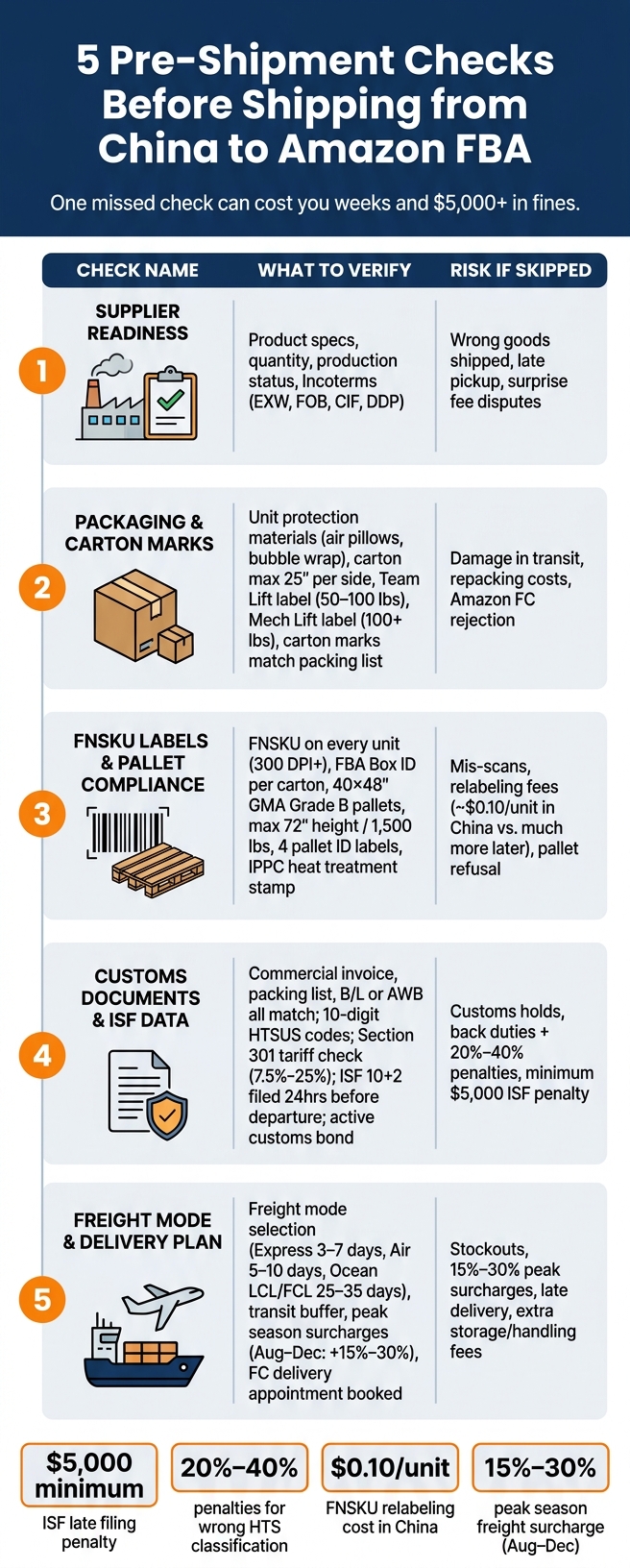
5 Pre-Shipment Checks for Amazon FBA from China: What to Verify & What’s at Risk
How To Ship From China/Alibaba To Amazon FBA – The Ultimate Guide
sbb-itb-f9a91f9
Quick Comparison
| Check | What I verify | What can go wrong if I skip it |
|---|---|---|
| Supplier readiness | Product specs, quantity, production status, Incoterms | Wrong goods, late pickup, fee disputes |
| Packaging | Unit protection, carton size/weight, carton marks | Damage, repacking, Amazon intake issues |
| Amazon labels and pallets | FNSKU, Box ID, pallet size, pallet labels, IPPC stamp | Mis-scans, relabeling, pallet refusal |
| Customs paperwork | Invoice, packing list, B/L or AWB, HTS, origin, importer data | Customs holds, duty errors, penalties |
| Freight and delivery | Air vs. ocean, transit buffer, final route, FC appointment | Stockouts, added storage or handling charges, late delivery |
If I handle these five checks before pickup, I cut down the most common shipping problems while fixes are still cheaper and easier to make.
1. Verify Supplier Readiness, Product Specs, and Shipping Terms
Don’t book pickup until you know the supplier is actually ready. “It’s done” can mean a lot of things. It does not always mean the cartons are counted, sealed, and sitting there ready to load.
Confirm the Goods Match the Final Order
Start by checking the basics against your original purchase order: model, size, color, materials, and quantity. If you’re dealing with regulated goods, make sure the item also meets the required U.S. certifications or agency rules.
Then compare the commercial invoice and packing list with what’s physically at the factory. The descriptions and quantities need to match. If they don’t, customs issues can show up later, and that’s where small mistakes turn into expensive delays.
Once the order lines up, check that packing and labels are done and ready for export.
Check Production Status, Quality, and Pickup Readiness
Do the inspection when production is almost finished, but before final payment or pickup. That gives you time to fix defects or packing mistakes while the goods are still in China.
Hold the final balance until you have inspection photos and a report that confirms the order is complete, packed, and ready to load on the agreed date. After that, you can authorize pickup with a lot more confidence.
Confirm Incoterms and Responsibility Split
Before pickup, make sure everyone is clear on who pays for what. Check whether the shipment is under EXW, FOB, CIF, or DDP, and confirm who covers pickup, export clearance, freight, duties, and final delivery.
For Amazon FBA shipments, DDP is a common option. In that setup, the freight forwarder handles supplier pickup, export clearance, duties, and final delivery to the U.S. fulfillment center.
This part matters more than people think. If the supplier, your forwarder, and your team each assume someone else is covering a charge, you can end up with surprise fees or a stalled shipment. Get that split confirmed before anything moves.
After that, you’re ready to move on to packaging, carton marks, and Amazon prep.
2. Confirm Packaging, Carton Marks, and Master Carton Details
Check packaging, carton marks, and master carton details before pickup. It’s a simple step, but it can save you from repacking, shipping delays, and FC rejections.
Check Unit Packaging for Protection and FBA Prep
Each unit should arrive in good shape and be ready for FBA intake. That means the item needs enough protection to make it through handling and transit without damage.
Use materials like:
- Air pillows
- Bubble wrap
- Kraft paper
Do not use styrofoam peanuts or shredded paper.
Review Carton Weight, Dimensions, and Handling Labels
Look at carton size, weight, and labels before the shipment moves. For standard-size units, no side of the box should be more than 25 inches.
Weight labels matter too. If a master carton weighs 50 to 100 lbs, add a "Team Lift" label. If it weighs more than 100 lbs, add a "Mech Lift" label.
Also, check that each master carton’s unit count matches the packing list. If the count is off, problems tend to show up later – usually when it’s harder and more expensive to fix.
Match Carton Marks to the Shipment Plan
Carton marks need to match the shipment plan and packing list exactly. No guesswork here. The details should line up item for item, including carton number, units per carton, gross weight, country-of-origin mark, and "Case Packed" where required .
Once the cartons are set, move on to FNSKU labels, box IDs, and pallet compliance.
3. Check FNSKU Labels, Box Labels, and Pallet Compliance
Before pickup, go through every Amazon label and pallet rule one more time. If something is off, it’s much cheaper to fix it in China than after the shipment hits the FBA center.
Verify Item-Level FNSKU and Barcode Placement
Every sellable unit needs an Amazon FNSKU label. That’s Amazon’s seller-specific ID.
Print labels with a thermal or laser printer at 300 DPI or higher. Skip inkjet printers because the ink can smear. Place each label on a flat area, not near edges, seams, or corners. If you’re using reused boxes, cover old barcodes with opaque tape so they don’t trigger mis-scans. It also helps to test each barcode before shipping, just to make sure it scans the way it should.
Confirm Carton Labels and Box IDs Are Correct
Each box needs its own FBA Box ID label from Seller Central. Make sure every box ID matches the shipment plan and the packing list. This sounds small, but it can save you from a messy check-in problem later.
Review Pallet Size, Height, Weight, and Label Placement
Use 40 x 48-inch, 4-way access wood pallets, GMA Grade B or higher. Keep pallets at a maximum of 72 inches high and 1,500 lbs. Each pallet also needs four pallet ID labels – one on each side, placed at the top center .
Wood pallets must have a visible IPPC heat treatment stamp. Without it, the pallet may need fumigation or get rejected.
Once labels and pallets are confirmed, check the commercial invoice, packing list, and customs data.
4. Validate Shipping Documents and US Customs Details
Once your packaging and labels are done, make sure the paperwork matches the shipment itself. If the invoice, packing list, bill of lading, and ISF data don’t line up, customs can put the shipment on hold or send it to inspection.
Audit the Commercial Invoice, Packing List, and Bill of Lading or Air Waybill
These documents need to match across the board. Seller and buyer names, product descriptions, carton counts, weights, dimensions, unit prices, and Incoterms should be identical on each one.
The commercial invoice should include 10-digit HTS codes, country of origin, and the total shipment value. The packing list should break out each SKU by carton, along with per-carton weights and dimensions. The bill of lading or air waybill should show the same piece count, weight, and shipment description as the other documents.
Then double-check the customs data before anything gets filed.
Confirm HS Codes, Country of Origin, and Importer Details
Use the full 10-digit HTSUS code for each product line. Skip vague terms like "parts" or "accessories". If the shipment includes different product types, list each one on its own line with its own HTS code.
Chinese-origin goods may face Section 301 tariffs – from 7.5% to 25% on top of the standard duty rate. A wrong classification can come back to bite you with back duties and penalties. The country of origin should match on both labels and documents. Also check that your importer of record details, including your US EIN or TIN, are correct everywhere.
If your product type needs extra documents, get them ready before the cargo leaves:
- FCC for electronics
- CPSC/CPC for children’s products
- EPA for machinery
- UN38.3/MSDS for lithium batteries
Make Sure ISF and Customs Filing Data Are Ready
Before the vessel departs China, confirm that the ISF data, HTS codes, and bond status are ready to file. For ocean freight, file ISF 10+2 at least 24 hours before vessel departure. Check all 10 required data points, including the manufacturer, buyer/consignee, ship-to address, and HTS code. Also make sure your customs bond is active before the shipment moves.
5. Review Freight Mode, Transit Timing, and Final Delivery to Amazon
Your freight plan should line up with two things: how soon Amazon needs the inventory and what you can afford to spend. The mode you pick changes cost per unit, transit time, and the odds of running out of stock before the shipment lands.
Choose the Right Freight Mode for Cost and Urgency
The best option comes down to shipment size, urgency, and how much inventory you still have on hand.
| Freight Mode | Speed | Best Use for Amazon FBA |
|---|---|---|
| Express Courier (DHL, FedEx) | 3–7 days | Critical stockouts; very small shipments (<45 kg) |
| Air Freight | 5–10 days | Urgent restocks, new launches, or high-value goods |
| Ocean LCL | 25–35 days | Small shipments under 15 CBM |
| Ocean FCL | 25–35 days | Large, regular replenishment cycles |
A simple rule works well here: use air freight when you need inventory fast, and use ocean freight for normal restocks.
Check Transit Buffers, Destination Charges, and Delivery Appointments
After you choose the freight mode, build in extra time for the parts that tend to slow things down. Ocean freight from China to the US West Coast usually takes 25–35 days, but that is only part of the trip. You still need to account for customs clearance, drayage, and Amazon appointment booking. During peak season, from August through December, surcharges can jump by 15%–30%, and delays are common.
Landed cost can also go beyond the base freight rate. It may include:
- customs brokerage fees
- ISF filing fees
- drayage
- prep warehouse handling in the US if the factory missed Amazon labeling or pallet rules
Before the shipment moves, confirm the final route. Is it going straight to an Amazon fulfillment center, or does it need to stop at a prep warehouse first? Also make sure the delivery appointment is booked ahead of time. That one step can save a lot of last-minute scrambling.
Conclusion: The 5 Checks to Complete Before Cargo Leaves China
Running through these five checks before cargo leaves China may take only a few hours, but it can prevent weeks of delays and hundreds – or thousands – of dollars in avoidable fees. The checklist is simple: verify supplier readiness and product specs, confirm packaging and carton marks, validate FNSKU labels and pallet compliance, audit your shipping documents and customs data, and review your freight mode, transit timing, and final delivery plan. These five checks help catch the errors that show up most often before cargo leaves China.
FAQs
When should I do these checks before pickup?
Do these checks when production is 80% to 100% complete and the goods are fully finished and packed.
Handle them before the supplier releases the cargo to the freight forwarder and before you send final payment. While the goods are still at the supplier’s facility, you still have time to fix labeling, packaging, or paperwork issues before the shipment leaves China.
What should I fix first if something is wrong?
Fix any issue before the forwarder picks up your cargo.
Start by matching your packing list to the actual carton count. If the quantities are off or incomplete, delays are common.
Then check that FNSKU labels, carton markings, packaging, and documents match your instructions and Amazon requirements. If anything is wrong, tell the supplier to rework, replace, or relabel the goods before final release.
Also, don’t send the final payment until those fixes are checked and confirmed.
Do I need a prep warehouse before Amazon delivery?
Not always. But your products do need to meet Amazon FBA packaging, labeling, and FNSKU rules before they arrive at the fulfillment center. If they don’t, Amazon may reject the shipment or charge extra fees.
You’ve got a few ways to handle this. Your supplier can take care of prep, inspection, and labeling in China. You can also hire a third-party service to do it. Or, if you’d rather have Amazon handle part of the work, you can use Amazon’s FBA Prep Service when you create your shipment plan in Seller Central.
发表回复