Amazon FBA Prep Requirements: A Complete Checklist
If I get Amazon FBA prep wrong, my shipment can be delayed, rejected, or hit with extra fees. And since Amazon ended its U.S. prep and item labeling service on January 1, 2026, I now need to make sure every unit, carton, and pallet is ready before it ships.
Here’s the article in plain English:
- I start with the unit, not the pallet
- I pack each item in a sealed box or poly bag
- I check bubble wrap, dunnage, and 2-inch cushioning
- I add suffocation warnings on poly bags with openings of 5 inches or more
- I make sure expiration-dated goods arrive with at least 90 days left
- I label each sellable item with the right FNSKU
- I cover old or extra scannable barcodes like UPC or EAN
- I seal bundles and multipacks as one sellable unit
- I follow carton rules like 25-inch max side length unless it’s one oversized item
- I add Team Lift labels for 50–100 lbs and Mech Lift labels for 100+ lbs
- I place 4 pallet ID labels on each pallet and keep them outside the stretch wrap
- I check special prep for fragile, liquid, sharp, apparel, footwear, and bundle products
- I confirm shipping docs like the commercial invoice, packing list, bill of lading, and ISF
A few numbers stand out. Ocean freight from China to the U.S. West Coast usually takes 25–35 days. Air freight usually takes 5–10 days. That long trip means bad prep at the item level can turn into damaged cartons, unreadable labels, or receiving problems by the time the shipment reaches Amazon.
| Area | What I check first |
|---|---|
| Unit prep | Sealed packaging, cushioning, poly bag warning, expiration date |
| Labeling | FNSKU, barcode placement, extra barcode coverage |
| Cartons | Box condition, dunnage, size, weight labels, old mark removal |
| Product-specific prep | Fragile, liquids, sharp items, apparel, footwear, bundles |
| Pallets | 4 pallet labels, box ID labels, label placement |
| Documents | Invoice, packing list, bill of lading, ISF |
This article is a step-by-step checklist that helps me catch problems before inventory leaves China and reaches a U.S. fulfillment center.
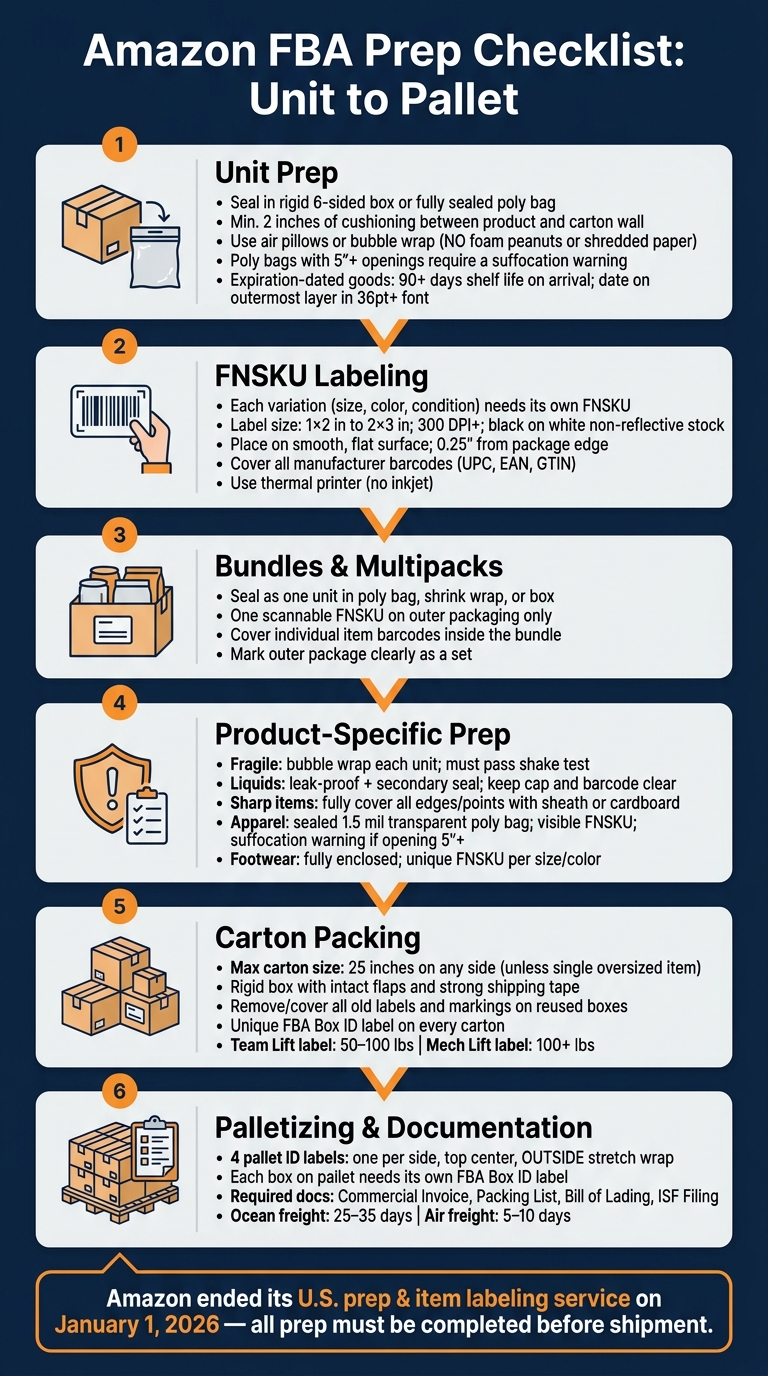
Amazon FBA Prep Checklist: Unit to Pallet Step-by-Step
How to PREP, PACK & LABEL Your Amazon FBA Shipments | Packaging, Labeling and Barcode Requirements
If you prefer to outsource these tasks, professional Amazon FBA prep services can handle the entire process for you.
sbb-itb-f9a91f9
Unit prep checklist: Packaging, poly bags, bubble wrap, and expiration labels
Start with the unit itself. Carton prep only works if each item is packed the right way first. Small prep errors at the unit level can turn into carton rejections later.
Secure packaging and drop-test basics
Each sellable unit must follow Amazon FBA packaging requirements and be sealed in a rigid six-sided box or a fully sealed poly bag. If an item has multiple parts, don’t ship those parts loose. Pack the item fully assembled and secured as one sellable unit. If it comes with loose sleeves or pouches, bag them or secure them with a non-adhesive band or removable tape.
Once the unit is packed, do a drop test. The item inside shouldn’t shift around. If it does, add more cushioning. You also need at least 2 inches of cushioning material between the product and the carton wall.
Poly bagging, suffocation warnings, and bubble wrap
If the unit can still move after packing, add dunnage to hold it in place. Use bubble wrap or air pillows to stop movement. Don’t use loose-fill materials like foam peanuts or shredded paper.
Any poly bag with an opening of 5 inches or more must have a suffocation warning printed on the bag itself in a legible font. This is one of those small details that’s easy to miss, and it can cause problems fast.
Expiration date format and outermost-layer labeling
Expiration-dated goods need extra control. Ship these products with at least 90 days of shelf life left when they arrive. If the inventory shows up late, it’s destroyed at the seller’s expense.
Print the expiration date on the outermost visible layer. Don’t place it only on the inner unit pack. For outer carton labels, use a font size of 36 pt or larger. For barcode tracking on expiration-dated products, an Amazon FNSKU label is required.
| Requirement | Specification |
|---|---|
| Unit packaging | Rigid six-sided box or fully sealed poly bag |
| Cushioning buffer | At least 2 inches between the product and the carton wall |
| Acceptable dunnage | Air pillows or bubble wrap |
| Prohibited loose-fill | Foam peanuts, shredded paper |
| Poly bag suffocation warning | Required on any poly bag with an opening of 5 inches or larger |
| Expiration-dated inventory | Must arrive with at least 90 days of remaining shelf life |
| Expiration date placement | Printed on the outermost visible layer |
| Barcode tracking for expiration-dated products | Amazon FNSKU label required |
| Master carton expiration date font | 36 pt or larger |
Labeling checklist: FNSKU, bundles, and carton marks
After unit prep, label every sellable unit, bundle, and carton before you send the shipment.
FNSKU labeling and barcode placement
Once each unit is packed, add the right labels before you place anything into cartons. Every sellable variation – such as size, color, or condition – must have its own FNSKU. So if you sell a black T-shirt in size large and the same shirt in size medium, those two units need different FNSKUs.
Use black print on white, non-reflective label stock with removable adhesive at 300 DPI or higher. Label size should be between 1 x 2 inches and 2 x 3 inches. Leave the required white margins, and keep the label at least 0.25 inch from the edge of the package.
Each label needs to show:
- The FNSKU or ASIN
- The product name
- The item condition
Put the label on a smooth, flat area. Skip seams, corners, and curved spots so the barcode stays easy to scan. Amazon recommends thermal printers for FBA labels, and says inkjet printers should not be used.
Before shipping, remove, cover, or make unreadable any manufacturer barcode, such as a UPC, EAN, or GTIN. Transparency authentication codes and serial number barcodes do not need to be covered.
Multipacks, bundles, and case-packed cartons
For grouped items, the label has to work at the set level, not just the item level. Multipacks and bundles must be sealed as one unit in a poly bag, shrink wrap, or box so the items stay together during handling. The outer packaging must show only one scannable barcode and a clear set label. Any barcodes on the individual items inside the bundle must be covered or made unreadable.
Case-packed cartons have their own rule set. Each carton must contain identical units with the same SKU and condition, and every carton must hold the same quantity.
Carton labels, box content accuracy, and used-box cleanup
The quantities in Ship to Amazon need to match what is actually inside each carton. If you reuse shipping boxes, clear away the old stuff first. Remove or fully cover all old shipping labels, barcodes, and markings before you place the new carton label.
| Carton Requirement | Specification |
|---|---|
| Max carton dimension | 25 inches on any side, unless the carton contains a single oversized item |
| Team Lift label | Required for cartons 50–100 lbs |
| Mech Lift label | Required for cartons over 100 lbs |
| Label edge clearance | At least 0.25 inch from the edge of the box |
| Reused box cleanup | Remove or cover all old labels, barcodes, and markings |
Special prep checklist by product type
Different products need different prep before they go inbound to Amazon. Once unit labeling is done, check these product-specific rules for higher-risk items before you move to carton packing.
Fragile, sharp, and liquid products
Fragile items need to be wrapped one by one and cushioned so they can’t shift inside the box. Bubble wrap or padded inserts help keep everything in place. If the box rattles when you shake it, that’s a problem. A properly packed box should pass the shake test.
Liquids need leak-proof packaging with a secure lid plus a second seal, like shrink wrap or a tamper-evident seal. Also, keep the cap and barcode area clear.
Sharp items, such as knives or scissors, must have every exposed edge or point fully covered with a protective sheath or thick cardboard wrap.
Apparel, textiles, and soft goods and garments
Apparel, linens, and other soft goods must ship in sealed transparent poly bags that are at least 1.5 mil thick. The FNSKU needs to stay visible through the bag. And if the bag opening is over 5 inches, it must include a suffocation warning.
Footwear must be fully enclosed, with no part of the product exposed. Each size or color variation also needs its own FNSKU.
Bundles and promotional sets
Bundles must arrive as one sealed, sellable unit. Amazon does not assemble sets at receiving. The outer package needs one scannable FNSKU. Any manufacturer barcodes on the individual items inside should be covered, and the package must be marked as a set.
Use the table below as a quick compliance check.
| Product Type | Compliant | Non-Compliant |
|---|---|---|
| Fragile (glass jar) | Bubble-wrapped, contents do not shift in a shake test | Loose jar in a thin retail box with no internal cushioning |
| Liquids | Leak-proof, double-sealed; cap and barcode area unobstructed | Single-capped bottle with no secondary seal |
| Sharp items | Blade or tips fully covered with a sheath or cardboard wrap | Scissors or knives with exposed tips or edges |
| Apparel | Sealed 1.5 mil transparent poly bag, visible FNSKU, suffocation warning | Loose garment in a thin bag with an obscured barcode |
| Bundles | One sealed unit, one scannable FNSKU, marked as a set | Items taped together with multiple visible manufacturer barcodes |
Carton, pallet, and China-to-Amazon shipping checklist
Carton packing standards for FBA shipments
After unit prep, the next step is building cartons that can make it from China to the U.S. without falling apart halfway there. Use rigid boxes with intact flaps and strong shipping tape. For dunnage, stick to air pillows or bubble wrap. Do not use loose-fill materials like packing peanuts or shredded paper.
Here’s a simple gut check: once the carton is packed, give it a gentle shake. If anything shifts, fix it before sealing the box.
Labeling matters here too. Add Team Lift labels to cartons that weigh 50–100 lbs. Use Mech Lift labels for cartons over 100 lbs. And if you’re reusing boxes, remove or fully cover all old marks before adding new labels.
Palletizing standards and pallet label placement
Once cartons pass inspection, stack them on compliant pallets for U.S. delivery. Each pallet needs four pallet ID labels. Place one on the top center of each side, and make sure they sit outside the stretch wrap so workers can scan them without breaking the seal.
Each individual box on the pallet also needs its own unique FBA Box ID label. That part trips people up more often than you’d think. The pallet label doesn’t replace the box label. You need both.
Final pre-shipment checklist and FCLGO workflow
Use this final pre-shipment check to catch mistakes before the shipment leaves China.
| Checklist Category | What to Verify |
|---|---|
| Unit Prep | FNSKU on every unit; poly bags sealed with suffocation warning if needed |
| Carton Prep | Approved dunnage only; old labels removed or blacked out; unique FBA Box ID label on each box |
| Pallet Prep | 4 pallet ID labels (one per side, top center, outside stretch wrap); each box has its own box ID label |
| Documentation | Commercial invoice, packing list, bill of lading, and ISF filing completed |
FCLGO can handle the full prep and delivery flow. Finish the documentation, then release the shipment.
FAQs
What happens if my FBA prep is wrong?
If your FBA prep is off, Amazon can refuse your inventory, send it back, or repackage it at your cost. It can also lead to unplanned per-unit service fees.
When a shipment doesn’t meet Amazon’s rules, it may be rejected. That can slow things down and add extra costs for storage, rework, and re-delivery. To avoid that mess, make sure each product is labeled, cushioned, and packed securely before it ships to Amazon.
Do I need an FNSKU on every item?
Yes. Each individual unit needs a scannable barcode for Amazon to accept it.
An FNSKU is required for items that:
- aren’t new
- don’t have a scannable standard barcode
- are restricted
- have expiration dates
- are sold as bundles
In practice, many sellers use an FNSKU on all FBA inventory. It keeps things simple and helps avoid mix-ups.
Also, label each unit on its own, even when several units are packed inside the same shipping carton.
When do poly bags need a suffocation warning?
A suffocation warning is required on any poly bag with an opening of 5 inches or larger, measured flat.
You can print the warning directly on the bag or apply it as a label.
If the opening is under 5 inches, no warning is required.
发表回复