How to Avoid Stockouts When Importing from China
Stockouts usually happen because sellers reorder off factory time, not sellable time. I’d fix that by planning each SKU around the full timeline: production, freight, customs, prep, FBA delivery, and Amazon check-in.
Here’s the short version:
- I calculate reorder points with daily sales × total lead time + safety stock
- I use shipment history, not supplier estimates, to time reorders
- I add extra days for Chinese New Year, Golden Week, customs exams, and FBA receiving
- I use air only for the gap when ocean freight will arrive too late
- I keep a small U.S. warehouse buffer when restock limits or Amazon intake get messy
- I check customs docs and FBA prep before cargo moves, because a shipment is not ready to sell just because it landed
A few numbers make the risk plain:
- Air freight can cost 12 to 16 times more than ocean
- A CBP exam can add 5 to 15 days and $1,000+ per container
- Amazon inventory may take 3 to 7 business days to become available after receipt
- Missing ISF can trigger a $5,000 minimum fine per shipment
If I had to boil the whole process down, it would be this: reorder earlier, hold buffer stock where it helps, and match shipping speed to the number of sales days I need to protect.
This article walks through the same framework in simple terms so you can keep units in stock without burning margin on last-minute freight.
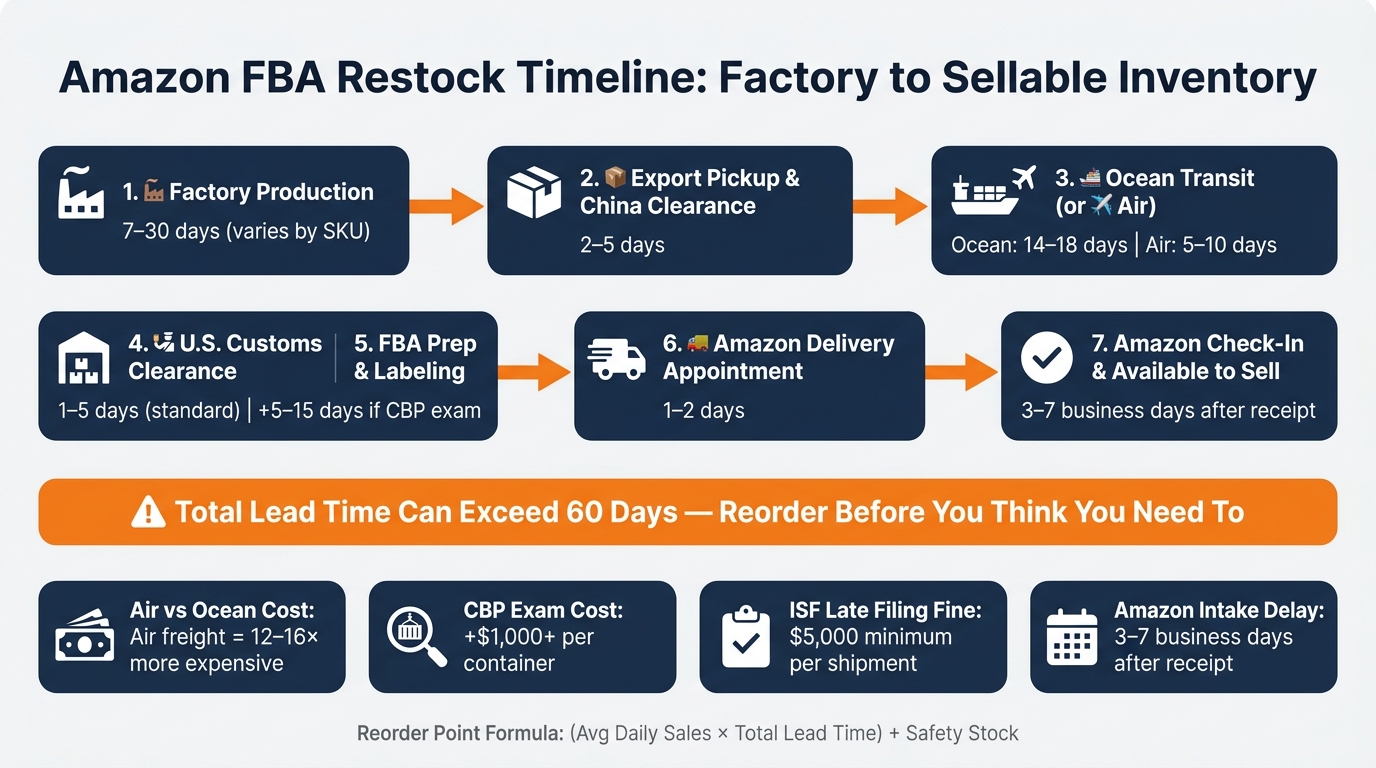
Amazon FBA Restock Timeline: Factory to Sellable Inventory
Step 1: Calculate Your Real Reorder Timeline for Each SKU
Map Every Stage from PO to FBA Availability
Total reorder time = production + export pickup + transit + customs + prep + FBA delivery + check-in.
Treat the full trip like a chain. If one link slips, the whole shipment slips with it. That means you need to map each stage in plain terms: factory production, pickup and export clearance in China, ocean or air transit, U.S. customs, FBA prep and labeling, Amazon delivery appointment, and check-in.
And here’s the part many sellers miss: once inventory is received at an Amazon fulfillment center, it typically becomes available for sale within 3 to 7 business days. So "arrived at Amazon" does not mean "ready to sell today."
Build this timeline from your shipment history, not from factory guesses. Use actual dates from your tracking system and log each milestone:
- PO date
- ready-to-ship date
- pickup
- export release
- departure
- arrival
- customs release
- Amazon check-in
Track those dates for every shipment. After a few cycles, you’ll stop working off hope and start working off patterns.
Add Buffers for Seasonal Disruptions
Once you know the normal timeline, add extra time for shutdown periods. Chinese New Year and Golden Week can shut down factories and ports, which means reorder dates need to move up.
For Q4 holiday inventory, orders should ideally be placed by July, or no later than mid-September, to absorb those delays. If those shutdown periods land inside your lead time, don’t lean on average transit numbers. Build the delay into your plan from the start.
A Timeline Example for a U.S. Seller
A single shipping lane can give you a good test case. For a shipment moving from Shenzhen to Los Angeles/Long Beach:
- Ocean transit: 14–18 days.
- If CBP inspects it, clearance can stretch an additional 5 to 15 days.
- After Amazon receives the inventory, it typically becomes available for sale within 3 to 7 business days.
This is why port arrival isn’t the finish line. A SKU is not reorder-safe just because the container hit the port. Review ocean-freight SKUs at least 60 days before stockout. Use that 60-day review point to trigger the next reorder decision.
Step 2: Set Reorder Points, Safety Stock, and Demand Forecasts
Calculate Reorder Points Using Daily Sales and Lead Time
Reorder Point (ROP) = (Average Daily Sales × Total Lead Time in Days) + Safety Stock
Use clean 30-, 60-, or 90-day sales data. Strip out stockout days and one-off spikes, then recalculate when demand changes.
Set Safety Stock by SKU Risk Level
Set safety stock by SKU risk, not by your catalog average.
| SKU Risk Level | Safety Stock Range | Example Scenario |
|---|---|---|
| Stable, lower-risk | 7–10 days | Slow-moving item |
| Single-source from China or high-margin | 14–30+ days | Single-source SKU from China |
| Higher-inspection categories | Add 7–10 days on top | Electronics, toys, or textiles through U.S. customs |
Higher-risk SKUs need more buffer because customs and transit delays stack up fast, while sales don’t slow down to wait. If a SKU sits in a higher-inspection category like electronics, toys, or textiles, add another 7–10 days for the chance of a CBP intensive exam. That kind of exam can add 5–15 days and cost more than $1,000 each time.
Forecast Demand Before Promotions and Peak Periods
Average demand helps during normal periods. It does not help much when a promotion is about to hit or peak season is around the corner.
Forecast demand before any campaign that could drain stock faster than ocean freight can replace it.
Review your days of cover (inventory on hand ÷ average daily sales) every week. If a promotion is scheduled or Q4 is getting close, increase your forecast before placing the next purchase order. U.S. e-commerce sales are expected to grow by 11.3% during the Q4 holiday season, reaching about $206.88 billion.
The goal is simple: bring in enough inventory for peak demand, not a pile of leftover units in January.
With reorder points set, the next step is choosing a shipping mix that keeps those dates protected.
How To Avoid Out Of Stock? (amazon fba inventory)
sbb-itb-f9a91f9
Step 3: Build a Shipping Plan That Protects In-Stock Levels
Once you’ve set your reorder points, the next move is figuring out how inventory will travel so it lands before you run out. This part matters more than it seems. Your freight choice has a direct effect on stockout risk, so the goal is simple: use the fastest shipping lane only for the units that protect your reorder window.
Use Split Shipments When Ocean Timing Is Too Risky
Ocean freight is the cheapest option, but it can be too slow when your replenishment window is tight. Air moves much faster, but the cost climbs fast. That’s why it makes sense to use air only for the gap that ocean can’t cover in time.
A split shipment does exactly that. You send a small, urgent batch by air to cover sales while the larger ocean shipment is still on the water. Put plainly, the air portion keeps the SKU alive until the ocean inventory shows up.
Air units needed = daily sales × days between air arrival and ocean arrival.
So the shipping mix should match the number of selling days you need to cover. No more, no less.
| Shipping Method | Transit Time | Cost Level | Stockout Risk | Best For |
|---|---|---|---|---|
| All-Ocean | 20–40 days | Low | High | Planned bulk restocks |
| All-Air | 5–10 days | High | Very Low | Urgent restocks, high-value items |
| Split (Air + Ocean) | Mixed | Medium | Low | Protecting sales while bulk is in transit |
Before you book air freight, check one thing first: carriers bill based on chargeable weight: whichever is higher, actual or volumetric weight. That means a carton can be light in pounds but still expensive if it takes up a lot of space.
Keep Reserve Inventory in a U.S. Warehouse When Needed
A U.S. warehouse buffer works like insurance when Amazon intake slows down or restock limits change with little warning. Keeping inventory at a U.S. 3PL gives you room to react without scrambling.
That buffer can help you:
- release stock into FBA in smaller lots
- absorb restock-limit changes
- finish labeling, poly-bagging, and palletizing before delivery
And if one factory still leaves you exposed, it’s time to reduce that risk at the source.
Use Backup Suppliers for Critical SKUs
For your most at-risk SKUs, backup supply often matters more than speed by itself. A second supplier gives you a fallback so one factory delay doesn’t shut down replenishment. The job of that backup supplier is simple: keep the SKU live if the main factory misses the window.
Before making a switch, verify quality, packaging, labeling, HTS code, and bond status. If the main factory slips, send the urgent quantity by air and move the rest by sea.
Step 4: Coordinate Customs, FBA Prep, and Delivery So Units Become Sellable on Time
Shipping is only part of the job. A shipment can arrive on schedule and still miss sales if customs or prep holds it up. Put simply: inventory is not sellable until customs is cleared and prep is done.
Prevent Customs and Documentation Delays
Handle customs like a pre-ship checkpoint. Before cargo leaves China, the Commercial Invoice, Packing List, and Bill of Lading (BOL) need to be accurate, with carton counts, dimensions, weight, and product descriptions matching the physical shipment.
For ocean freight, the Importer Security Filing (ISF) must be submitted before vessel departure. Miss that deadline, and you risk a minimum fine of $5,000 per shipment. Tariff classification also needs to be correct from the start so clearance doesn’t get stuck in compliance review.
If the paperwork is off by even a little, things can snowball fast. And once the documents are clean, the next trouble spot is Amazon receiving delays tied to prep mistakes.
Get FBA Labeling and Prep Right Before Delivery
Amazon check-in slows down when prep is done wrong. The mistakes that most often delay receiving include:
- unreadable or missing FNSKU barcodes
- incorrect carton labels
- mixed SKUs in one carton
- poly bags without suffocation warnings
The best time to catch these issues is before final delivery, either at the factory or at a U.S. prep warehouse. Fixing them early helps keep the shipment moving and avoids extra back-and-forth once it reaches Amazon.
How FCLGO Connects Freight, Prep, and Amazon Delivery
Most stockout delays happen during handoffs. When freight, customs, prep, and delivery are split across different parties, the gaps between those steps can slow down when inventory becomes sellable.
FCLGO can coordinate pickup, freight, customs, prep, and delivery in one sequence. That cuts handoff risk and helps units move into available inventory with less delay.
Conclusion: A Simple Framework to Stay in Stock
The safest path is pretty simple: plan all the way from the factory to sellable inventory. To avoid stockouts, set SKU-level reorder points based on daily sales, lead time, and safety stock. That gives you a clear trigger to reorder before inventory gets too close to the edge.
Plan early for peak season and holiday shutdowns, because delays tend to stack up fast during busy periods. If timing gets tight, send urgent units by air and move the rest by ocean.
Keep customs and FBA prep clean so inventory becomes sellable on time. File ISF on time and keep customs documents clean to avoid holds. Then run that same cycle for every SKU and reorder before risk turns into a stockout.
FAQs
How do I calculate lead time accurately?
Use this formula: Production Time + Shipping Time + Check-in Time.
- Production time: manufacturing and packaging
- Shipping time: transit time, such as ocean freight (25–35 days to the U.S. West Coast) or air freight (5–10 days)
- Check-in time: Amazon receiving and processing, usually 24–48 hours, though it can take longer during peak seasons
When should I use air instead of ocean?
Use air freight when you need urgent replenishment to avoid a stockout, especially if you have fewer than 10 days of inventory left.
It also works well for high-value goods, new product launches, and smaller shipments when speed matters more than cost.
A lot of sellers also split shipments: they send a small portion by air to keep inventory moving, while the rest goes by ocean.
How much safety stock should each SKU have?
Keep 4 to 6 weeks of baseline demand on hand as safety stock for each SKU. That extra cushion helps protect you if production runs late, freight takes longer than planned, or Amazon takes extra time to check inventory into its fulfillment centers.
For seasonal items, build up enough inventory to cover 10 to 12 weeks of demand before each peak season. This gives you more room to avoid stockouts when traffic and sales start to climb.
发表回复