How Long Does Ocean Freight from China to USA Take?
If I plan ocean freight from China to the U.S., I don’t use the carrier’s sailing time alone. I use the full door-to-door range: about 24–45 days for FCL and 40–70 days for LCL, with East Coast shipments (such as ABE1 in Pennsylvania) often taking 10–15 more days than West Coast moves — common West Coast destinations include ONT8 (Ontario, CA) and LAX9 (Los Angeles).
Here’s the short version:
- Port-to-port is not the full timeline
- FCL usually arrives sooner than LCL
- West Coast routes usually take less time than East Coast routes
- Customs, port release, drayage, and Amazon FBA appointments can add days or weeks
- I should add a 5–10 day buffer for planning, and more during August–November and before Chinese New Year
How long does it take to ship from China to the US?
sbb-itb-f9a91f9
Quick Comparison
| Shipment Type | West Coast Door-to-Door | East Coast Door-to-Door | Main Reason It Takes Longer |
|---|---|---|---|
| FCL | 18–35 days | 28–45 days | Port handling, customs, inland delivery |
| LCL | 25–40 days | 40–55 days | CFS consolidation and deconsolidation |
A few numbers matter most:
- Origin handling in China: 3–7 days
- Ocean transit to West Coast: 12–22 days
- Ocean transit to East Coast: 25–35+ days
- U.S. customs and port release: 1–3 days, or 5–7 days if examined
- Final delivery: 1–5 days
- Peak season delays: often +7 days to +2 weeks
So if I’m restocking inventory or sending goods to Amazon FBA, I should plan from the in-stock date backward, not from vessel departure. That keeps the schedule grounded in what happens in the full shipping chain, not just on the water.
Shipping Time by Route and Shipment Type
FCL Transit Times From Major China Ports to US West and East Coast Ports
Once you know the overall shipping range, the next step is figuring out which route gets there faster.
That mostly comes down to the lane you choose. Shipments from China to West Coast ports usually arrive sooner. If you’re shipping to East Coast ports like New York/New Jersey, expect more time because the ocean leg is longer.
Use the table below as a benchmark for common lanes. These are total timelines, not just time spent at sea.
For Amazon FBA, a good planning range is about 20–30 days to West Coast centers and 35–45 days to East Coast centers.
LCL Transit Times and Why LCL Usually Takes Longer
LCL uses the same ocean routes as FCL, but the total timeline is longer. The reason is simple: there are more stops and more handoffs.
At origin, LCL cargo goes to a Container Freight Station (CFS), where it waits to be grouped with other shipments before the container is sealed and sent to the port. After arrival in the U.S., that same container is moved to another CFS, unpacked, sorted, and then sent out for final delivery.
There’s also a timing gap at cut-off. LCL cargo usually needs to reach the CFS 2–4 days before the vessel’s estimated departure. FCL cut-offs are often just 1–2 days before departure. So if you miss the weekly LCL consolidation window, you may have to wait for the next vessel.
And because LCL is shared space, one company’s paperwork problem can hold up the whole container.
That’s why LCL usually takes longer than FCL even when both move on the same route.
FCL vs. LCL by Common China–USA Routes: Comparison Table
The table below shows how transit ranges shift across common China–US lanes.
| Route | FCL Port-to-Port | FCL Door-to-Door | LCL Port-to-Port | LCL Door-to-Door | Extra Days (LCL) |
|---|---|---|---|---|---|
| Shanghai to Los Angeles | 14–18 days | 20–35 days | 15–21 days | 28–38 days | 3–10 days |
| Shenzhen to Los Angeles | 14–18 days | 20–30 days | 17–25 days | 28–38 days | 3–10 days |
| Ningbo to Seattle | 15–20 days | 25–35 days | 18–24 days | 30–40 days | 5–7 days |
| Shanghai to New York/New Jersey | 25–35 days | 35–50 days | 32–42 days | 45–60 days | 5–10 days |
| Shenzhen to Savannah | 25–35 days | 35–50 days | 32–42 days | 45–60 days | 5–10 days |
Door-to-door times include origin handling, U.S. customs clearance, and final delivery.
If your shipment is over 15 CBM, it’s smart to compare 20-foot FCL pricing with LCL. At that size, FCL often arrives faster and can come in at a similar or even lower total cost.
Step-by-Step Timeline From Supplier Pickup to Final Delivery
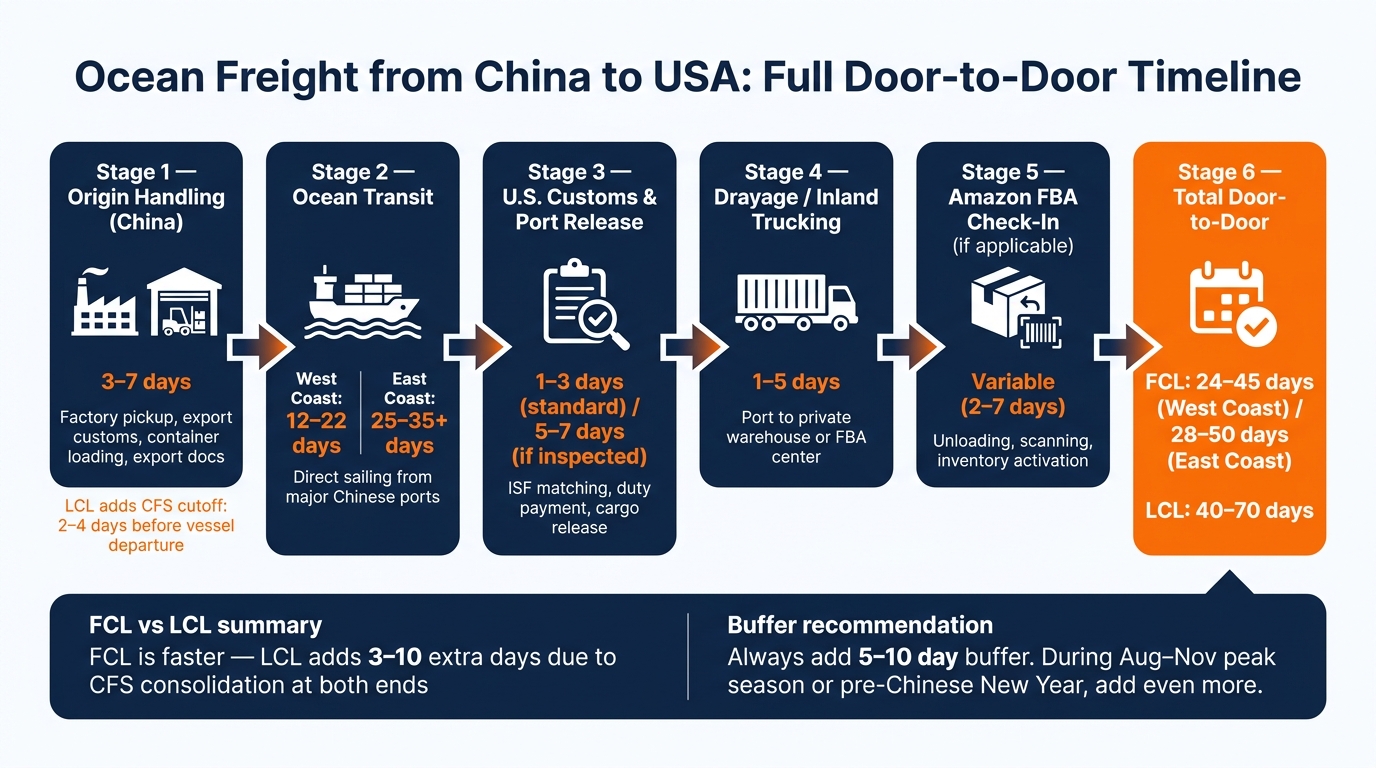
Ocean Freight from China to USA: Full Door-to-Door Timeline
The ranges above are total door-to-door estimates. This breakdown shows where the time actually goes.
Origin Handling in China
Origin handling in China usually adds 3–7 days before the vessel sails. That includes supplier pickup, container loading for FCL or delivery to a Container Freight Station for LCL, export paperwork, and Chinese customs clearance.
For LCL, one timing issue matters a lot: the CFS cutoff. It’s usually 2–4 days before vessel departure. Miss that cutoff, and your cargo may wait for the next sailing.
File the Importer Security Filing (ISF 10+2) early. It must be submitted to U.S. Customs at least 24 hours before the vessel departs China. If you miss that deadline, you can face $5,000+ in penalties and slower cargo release.
Ocean Sailing, U.S. Customs, and Port Release
Ocean transit usually takes 12–22 days to the West Coast and 25–35+ days to the East Coast.
After the vessel arrives, U.S. Customs clearance and port release often take 1–3 days if your commercial invoice, packing list, bill of lading, and ISF filing are all in order. If CBP selects the shipment for an X-ray or physical exam, that can push the timeline to 5–7 days. And yes, that often means extra storage and labor charges too.
Final Delivery to a Warehouse or Amazon FBA Center
Once the shipment clears the port, drayage and inland trucking to a private warehouse usually add 1–5 days.
Amazon FBA adds one more step. Delivery to a fulfillment center needs a pre-scheduled appointment, and Amazon’s receiving and check-in process can add several more days before your inventory shows as available.
Here’s how the full timeline stacks up:
| Shipping Stage | Typical Duration | What Happens |
|---|---|---|
| Origin Handling | 3–7 days | Factory pickup, export customs, loading, export documentation |
| Ocean Transit (West Coast) | 12–22 days | Direct sailing from major Chinese ports |
| Ocean Transit (East Coast) | 25–35+ days | Sailing to East Coast ports |
| U.S. Customs & Port Release | 1–3 days (up to 5–7 days with exam) | ISF matching, duty payment, cargo release |
| Final Delivery / Drayage | 1–5 days | Trucking to warehouse or Amazon FBA center |
| Amazon FBA Appointment and Check-In | Variable | Unloading, scanning, and inventory activation |
Add those stages together, and FCL door-to-door usually takes 20–50 days. LCL usually takes 30–70 days because of consolidation and deconsolidation at both origin and destination.
These stages give you the baseline. The next part is what slows things down.
What Speeds Up or Delays an Ocean Freight Shipment
Route, Port, and Seasonal Factors
Once you know the baseline transit time, the next thing to watch is what pushes that timing up or down. One of the biggest factors is which U.S. coast your shipment is heading to. West Coast ports usually land in the 12–20 day range, while East Coast ports are more like 25–35 days.
Routing matters too. If your cargo goes on a transshipment route instead of a direct sailing, that can tack on 5–10 extra days. It’s the shipping version of taking a connecting flight instead of flying nonstop.
Season timing can also throw things off fast. Peak season runs from August through November, and the period before Chinese New Year – usually January and February – often brings vessel congestion, blank sailings, and equipment shortages. In those windows, 7+ day delays are common. Booking 2–4 weeks in advance can help lower the odds of missing your planned sailing.
Documentation, Customs, and Delivery Appointment Issues
A lot of delays don’t happen on the water. They happen on paper.
If your commercial invoice, packing list, and bill of lading don’t match, or your HTS codes are wrong, customs may hold the shipment. That can add 3–7 days, and in some cases it can even lead to seizure.
And even after the cargo clears the port, the last leg can still slow you down. Busy Amazon fulfillment centers often need pre-scheduled delivery appointments, and a missed appointment window can add several more days.
Common Delay Factors and Their Typical Time Impact: Comparison Table
Use the table below to see how each delay affects transit time.
| Delay Factor | Where It Occurs | Typical Time Added | What to Do |
|---|---|---|---|
| Peak Season / Chinese New Year | Entire route | +1–2 weeks | Book 2–4 weeks in advance |
| Blank Sailings | Origin port | +7 days or more | Build extra buffer time into your plan |
| Direct vs. Transshipment Routing | Ocean transit | +5–10 days | Choose direct service when lead time is tight |
| Customs Inspection or HS Code Error | US port / customs entry | +3–10 days | Verify HTS codes and ensure all documents match exactly |
| Missed Consolidation Cutoff | Origin | +7–10 days | Use FCL for shipments over 15 CBM |
| Port Congestion | US port | +2–5 days | Build in extra buffer time |
| Amazon FBA Appointment | Final mile | +2–7 days | Confirm warehouse appointments early |
| Missing Required Certificates | Destination port | Multi-week delay at port | Check FCC, CPSC, or EPA requirements before shipping |
These buffer days matter when you’re planning restocks and setting delivery dates. A shipment can look on time on paper, then slip by a week because of one missed cutoff or one customs issue.
How to Plan Ocean Freight for Inventory Restocking and FBA Replenishment
How to Work Backward From Your Target In-Stock Date
The best way to build a shipping schedule is simple: start with the date your inventory needs to be available at your warehouse or Amazon FBA fulfillment center, then work backward from there.
That means you don’t plan from the day the factory says it’s done. You plan from the day the stock must be live, then subtract each part of the trip.
Use these stages to map out your shipment calendar:
| Phase | FCL Time | LCL Time |
|---|---|---|
| Origin handling (China) | 3–7 days | 7–14 days |
| Ocean transit (West Coast) | 14–18 days | 20–30 days |
| Ocean transit (East Coast) | 25–35 days | 32–45 days |
| US customs & port release | 5–7 days | 7–10 days |
| Final delivery to FBA | 2–5 days | 3–7 days |
| Total door-to-door | 24–45 days | 40–70 days |
You’ll also need to subtract production lead time before transit and delivery. And don’t skip the buffer. Add 5–10 days for customs holds, appointment changes, or carrier schedule shifts. During peak season, add even more.
How FCLGO Reduces Handoffs and Timeline Risk
Every handoff in the shipping process creates one more place where things can slow down. Factory to trucker. Trucker to port. Port to customs broker. Customs broker to drayage carrier. It adds up fast.
More handoffs usually means more room for delay, missed updates, or simple confusion.
Once your schedule is in place, one of the biggest problems is avoidable handoff delay. FCLGO can handle pickup, booking, customs, drayage, and FBA prep in one workflow. That cuts down on handoff delays and helps keep shipments on schedule. With one coordinator managing the flow, it’s easier to avoid missed deadlines.
Conclusion: The Transit Time Numbers Importers Should Use for Planning
FCL door-to-door from China to the US West Coast typically runs 24–45 days; LCL runs 40–70 days. If you’re routing to the East Coast, plan for about 10–15 extra days compared with the West Coast.
For day-to-day planning, the takeaway is pretty clear:
- FCL is faster and more predictable than LCL
- West Coast ports are quicker than East Coast ports
- A carrier’s quoted transit time is not your full door-to-door timeline
So if you’re planning a restock or an FBA replenishment, use the full lead time, not just the time on the water. That means production, origin handling, ocean transit, customs, and final delivery all need to be in the calendar. Then add a 5–10 day buffer so one delay doesn’t turn into a stockout or a missed launch window.
FAQs
How early should I book ocean freight from China?
Book ocean freight as early as you can, especially when you’re working toward a hard deadline. Once your cargo details are set, lock in the booking. That gives you a better shot at securing space, since rates and carrier availability can shift.
It also helps to plan for the entire move, not just the time on the water. That includes export operations, ocean transit, customs clearance, and inland delivery. With total door-to-door transit times often landing between 20 and 70 days, it’s smart to begin the booking process weeks before your target replenishment or launch date.
When should I choose FCL instead of LCL?
Choose FCL (Full Container Load) when your shipment is more than 15 cubic meters. It usually makes more sense for large, regular inventory restocks because the cost per cubic meter is lower, and transit is often faster.
FCL can also cut handling risk. The container stays sealed from origin to destination, which means fewer touchpoints along the way. It also skips the extra port time that comes with LCL consolidation and deconsolidation.
What is the safest buffer to add for Amazon FBA shipments?
For Amazon FBA shipments, the safest buffer is at least two to four weeks beyond your estimated port-to-port transit time.
Ocean transit to the U.S. West Coast usually takes 25 to 35 days. But that’s only the water portion of the trip. Origin handling, customs clearance, port congestion, and final trucking to Amazon fulfillment centers can all slow things down.
发表回复