I plan Amazon FBA shipping from China backward from the date inventory must be available for sale – not the ship’s arrival. I track 3 separate milestones: U.S. arrival, Amazon delivery, and sellable inventory. Delivered doesn’t mean ready for customers.
Before booking, I check:
- Cargo readiness: Production and pickup dates, inspection, FNSKU prep, labels, and carton and pallet counts.
- Freight and customs: Shipping mode, written costs and exclusions, carrier cutoffs, importer details, and filing deadlines.
- Final delivery: Warehouse receipts, Amazon appointment ownership, and extra time for receiving and delays.
For applicable ocean shipments, I confirm the ISF deadline with my broker; required pre-loading data generally must reach CBP at least 24 hours before vessel loading.
My booking rule is simple: <u>every requirement needs an owner, a deadline, and proof</u>. If any of those are missing, I hold approval until the gap is fixed.
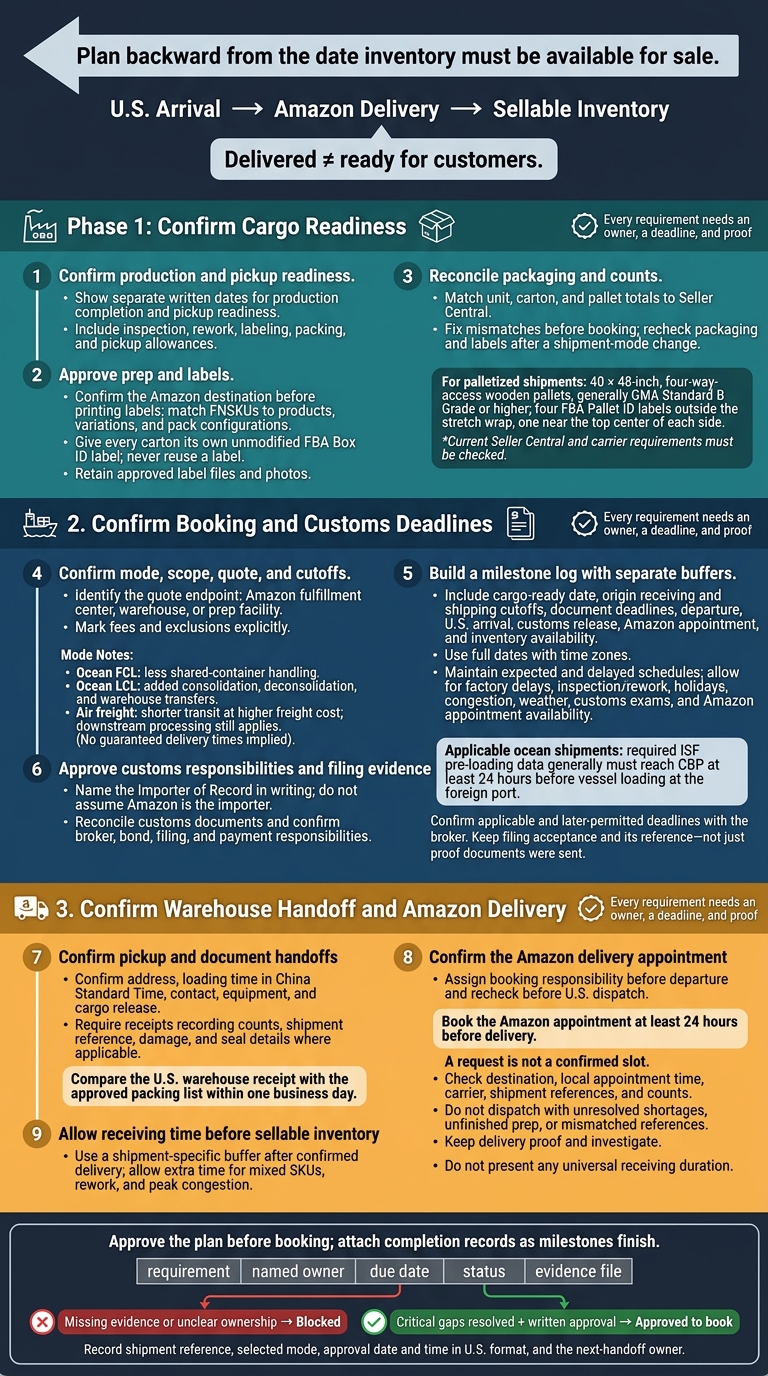
Amazon FBA China Shipping Lead Time Checklist
How to Ship from China to Amazon FBA Explained
sbb-itb-f9a91f9
1. Confirm Cargo Readiness
Give every readiness check – production, inspection, unit prep, carton labels, palletization, and pickup – one owner, one deadline, and one proof item. Track production finish → pickup-ready date → prep approval → pickup, and save proof with each signoff. Before approving packaging and labels, check current Seller Central requirements for the product, shipment type, and destination.
Confirm Production Finish and Supplier Handoff Dates
Get separate written dates for production completion and pickup readiness. Allow time for inspection, rework, labeling, packing, and pickup.
Check the supplier’s packing list and pickup contact against the invoice, inspection report, and shipment plan. Approve required test reports, battery paperwork, and origin documents before release. Once the cargo is production-ready, move to label and pallet approval.
Approve FNSKU Prep and Carton Labels
Complete the Amazon shipment workflow and confirm the destination before printing labels. This is a critical step in the Amazon FBA shipping process. Match each FNSKU to the correct product, variation, and pack configuration. Approve sample photos showing required bags, warnings, wrapping, and bundling.
Keep unit barcodes visible and scannable. Cover existing barcodes when required to prevent scanning errors.
Give every carton its own unmodified FBA Box ID label, and never reuse the same label. Place box and carrier labels on flat surfaces, away from seams, edges, and corners. Save approved label files and photos that show readable barcodes and any required country-of-origin markings.
Check Cartons, Pallets, and Shipment Counts
Check carton strength, closure, and condition. For palletized shipments, use 40 × 48-inch, four-way-access wooden pallets, generally GMA Standard B Grade or higher.
Confirm loaded height, weight, stackability, wrapping, and loading rules with the carrier. Check required wood-treatment marks. Place four FBA Pallet ID labels outside the stretch wrap, with one near the top center of each side.
Match unit, carton, and pallet totals to Seller Central, then confirm the shipment mode. Fix any mismatch before booking. A shipment-mode change requires another packaging and label check. Once packaging and counts are locked, confirm booking cutoffs and customs filing deadlines.
2. Confirm Booking and Customs Deadlines
Choose a Shipping Method and Check the Quote
Once cargo and labels are set, use the final shipment specs to confirm the route, rate, and cutoff calendar. Before requesting a quote, send the forwarder your SKU list, carton and pallet counts, dimensions, weights, and volume, cargo-ready date, pickup address, load type, and Amazon destination.
Confirm exactly where the quote ends: an Amazon fulfillment center, warehouse, or prep facility. Check that it includes the required handoff. If any shipment specs change, review both the quote and the cutoffs.
| Shipping method | Suitable shipment | Lead-time impact |
|---|---|---|
| Ocean FCL | Large shipments that justify a dedicated container | Reduces shared-container handling, but timing still depends on container availability, terminal receiving windows, and vessel cutoffs. |
| Ocean LCL | Smaller shipments that do not need a full container | Adds consolidation, deconsolidation, and warehouse transfers, so inventory takes longer to become available. |
| Air freight | Urgent replenishment or high-value, lightweight goods | Cuts transit time at a higher freight cost, but customs clearance, FBA prep, and Amazon receiving still affect availability. |
Ask for a route-specific, end-to-end estimate to check whether the shipment can meet your inventory deadline. Break it into three stages: cargo-ready to departure, departure to arrival, and arrival to FBA receiving.
Require an itemized quote in USD covering pickup, export handling, freight, consolidation or deconsolidation where applicable, customs brokerage, destination handling, FBA prep, trucking, and final delivery. Confirm the billing basis and how long the quote remains valid. Duties, taxes, storage, demurrage, detention, exams, chassis, appointment or re-delivery fees, and Amazon waiting time should each be marked included or excluded, not hidden in a bundled price.
Record Cutoffs and Add Schedule Buffers
Keep one milestone log for booking confirmation, the cargo-ready date, origin warehouse receiving cutoff, container or consolidation cutoff, shipping instructions deadline, customs document deadlines, and any applicable verified gross mass (VGM) deadlines.
Include estimated departure, U.S. arrival, customs release, the target Amazon delivery appointment, and inventory availability. Assign a named owner for booking, supplier readiness, document approval, customs filing, and delay updates. Use full dates with time zones, and confirm whether documents are due before cargo and who submits VGM.
Set internal deadlines before carrier cutoffs. Allow separate buffers for factory delays, inspection or rework, Chinese holidays, U.S. peak demand, congestion, weather, customs exams, and Amazon appointment availability.
Maintain both expected and delayed schedules. If a cutoff is missed, require the next departure date, a revised delivery estimate, added costs, and updated customs and appointment plans.
Approve Customs Documents and Filing Duties
Review and approve the commercial invoice, packing list, purchase order, Importer of Record details, product descriptions, country of origin, proposed HTSUS classifications, bill of lading instructions, and applicable product-specific compliance records together. Check that descriptions, quantities, values, currency, origin, weights, and carton totals match across documents.
Name the Importer of Record (IOR) in writing. Do not assume Amazon will act as importer. Confirm the customs bond, broker power of attorney, who files entry, how duties and taxes will be paid, and the clearance contact.
For applicable ocean shipments, set an internal Importer Security Filing (ISF) deadline that leaves time for broker review and corrections. Required pre-loading data generally must reach U.S. Customs and Border Protection at least 24 hours before vessel loading at the foreign port.
Confirm any later-permitted data deadlines with the broker, especially for LCL stuffing and consolidator details. Require filing acceptance and keep the reference; sending documents to the broker does not prove acceptance.
After filing acceptance is confirmed, arrange pickup timing, warehouse handoff, and Amazon delivery scheduling.
3. Confirm Warehouse Handoff and Amazon Delivery
Once the customs filing is accepted, confirm the final handoff steps: pickup, warehouse receipt, Amazon booking, and a buffer for receiving.
Approve Pickup Details and Warehouse Receipts
Before booking, send the forwarder one final shipment packet. Include the FBA shipment ID, SKU and unit counts, carton and pallet counts, pickup address, supplier contact, cargo-ready date, delivery destination, and special handling instructions.
Confirm pickup details in writing: the address, loading time in China Standard Time, supplier contact, truck access, loading equipment, and cargo-release approval. If the shipment passes through a U.S. warehouse, also confirm its receiving hours, inspection scope, relabeling and palletizing deadlines, storage limits, and outbound booking cutoff.
After the handoff packet is approved, require a receipt at every handoff. Each receipt should record carton and pallet counts, the shipment reference, visible damage, and the seal number and condition where applicable. Require photos of any damage or label discrepancies.
Compare the U.S. warehouse receipt against the approved packing list within one business day. Request recounts for shortages, and hold mislabeled cartons until corrections are approved.
Schedule Amazon Delivery and Allow Receiving Time
Once pickup is confirmed, start the Amazon delivery booking right away. Assign responsibility for final delivery booking before departure, then recheck the booking before U.S. dispatch.
Confirm customs, carrier, and terminal releases where applicable, along with truck or chassis availability. Give the carrier accurate FBA shipment IDs, delivery reference numbers, counts, and the bill of lading. Book the Amazon appointment at least 24 hours before delivery. A request is not a confirmed slot.
Before dispatch, check the appointment confirmation against the fulfillment-center address, delivery date, local appointment time, carrier, PRO number, trailer or container number, and every FBA shipment on the load. Reconfirm the booking after any count or destination change. Do not release cargo if shortages remain unresolved, prep is unfinished, or shipment references don’t match.
Set a shipment-specific buffer between confirmed delivery and inventory availability. Allow extra time for mixed SKUs, rework, and peak congestion. Keep proof of delivery, receipts, photos, and appointment records, and investigate missing proof or count differences immediately. Open an Amazon case if receiving remains incomplete beyond the expected buffer.
Conclusion: Complete the Pre-Booking Signoff
Use this final signoff sheet as the last checkpoint before booking. Create five columns: requirement, named owner, due date, status, and evidence file. Add one row for each booking-critical milestone.
Enter actual dates and cutoff times – not just “before shipping.” Link each approval to its supporting file: production confirmation, approved label PDFs, packing photos, a reconciled packing list, a written quote, customs instructions, or a backward-planned delivery schedule. Approve the plan before booking, then attach completion records as each milestone is finished.
Missing evidence or unclear ownership means Blocked – not approved. Name a correction owner, set a deadline, resolve critical gaps, and get written approval again. Record the final decision as Approved to book, including the shipment reference, selected mode, approval date and time in U.S. format, and the person responsible for the next handoff.
Before booking any freight, get the service scope in writing. For FCLGO shipments, confirm whether the scope includes ocean FCL/LCL or air freight, FBA prep, customs clearance, U.S. warehousing, drayage, trucking, and Amazon delivery. Also confirm all exclusions, fees, deadlines, and handoff responsibilities in writing.
FAQs
How much lead time should I allow for my first FBA shipment?
Plan for the full door-to-door timeline, not just the time your shipment spends at sea. Allow 25–40 days for ocean freight to the U.S. West Coast or 35–50 days to the East Coast. Air freight typically takes 5–10 days in transit, plus time for Amazon check-in.
Build in a safety buffer of at least 2–4 weeks, especially during peak season (August–December) or before Chinese New Year.
What if Amazon changes my destination after booking?
Update your documentation right away to reflect Amazon’s new destination. Each fulfillment center (FC) has its own requirements, so match every Shipment ID to the correct FC code before printing labels.
Amazon treats each consignment as a separate shipment – even when goods head to the same facility. Make sure your labels, Bill of Lading, and transport documents show the new destination to avoid check-in delays or inventory rejection.
When should I split inventory between air and ocean freight?
Split inventory between air and ocean freight to balance speed and cost. For a product launch or stockout recovery, use air freight to get inventory live in 5 to 10 days.
Once the product is established, switch to ocean freight for regular replenishment. You’ll pay less per unit for shipping, but you’ll need to allow 30 to 45 days for ocean transit.
发表回复