I’d plan 60–90+ days for ocean or 20–40 days for air – from production to sellable FBA inventory, not just transit. Work backward from your expected stockout, and count each stage only once.
As of October 29, 2026, the guide’s mid-October ocean window for Black Friday has passed. Air may still work for ready cargo shipped by early November, but arrival alone won’t prevent a stockout.
Here’s what I’d check before booking:
- Cargo readiness: Confirm production, inspection, labeling, and pickup dates.
- Shipping method: Compare FCL, LCL, air, and express based on shipment size, cost, and remaining time.
- U.S. handling: Allow for customs release, prep, trucking, and delivery appointments.
- Amazon receiving: Plan for 10–21 days in Q4, without counting delays already included elsewhere.
My planning rule: <u>use the sellable date – not the delivery date</u>. If your shipment is already moving, calculate from its current milestone and update your buffer whenever a date slips.
Production, Pickup, and Freight Lead Times
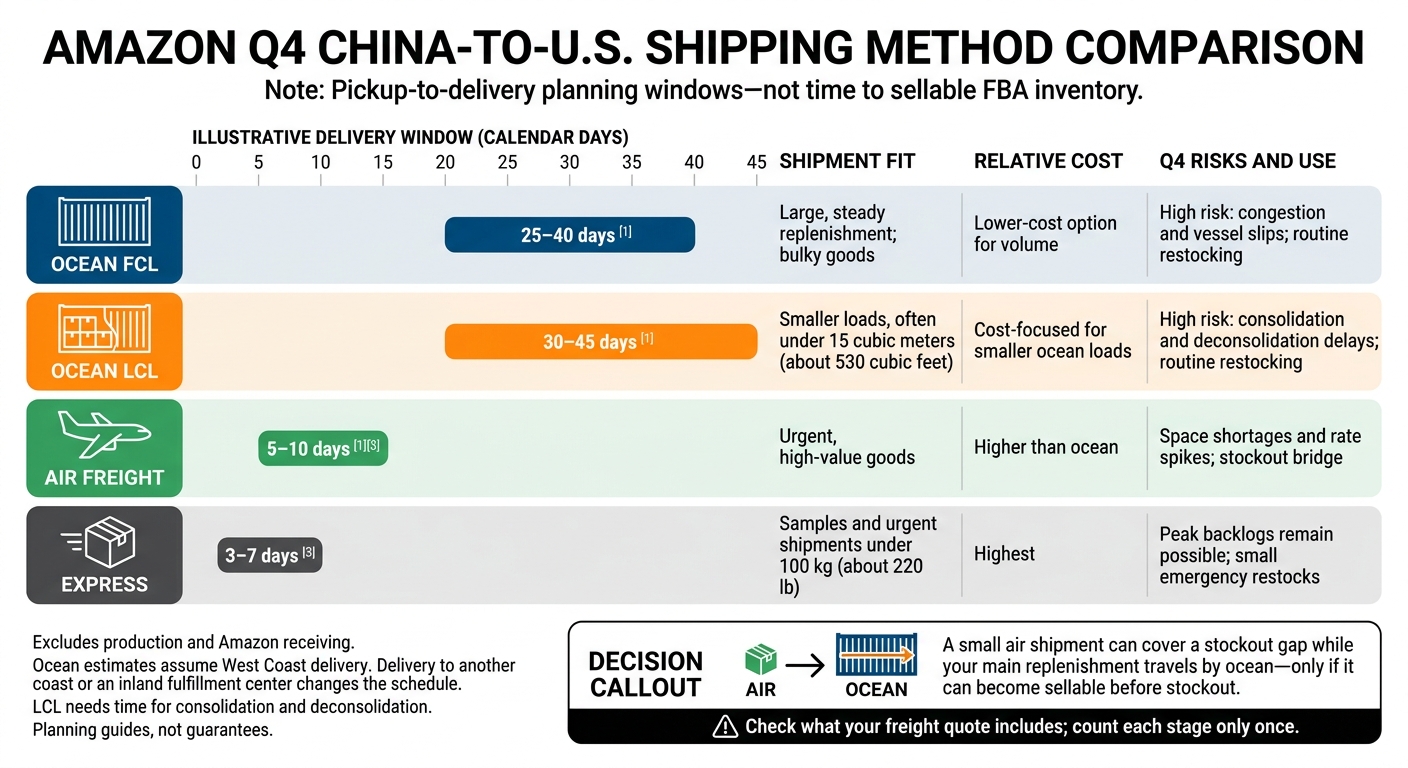
China to FBA Shipping: FCL vs. LCL vs. Air vs. Express
Treat these ranges as planning guides, not guarantees. Break the total window into stages so you can see where time is spent.
Follow the shipment from factory pickup → export clearance → ocean/air transit → customs → FBA prep → trucking → Amazon receiving → sellable inventory.
| Stage | Calendar days | What it covers | Q4 delay risks |
|---|---|---|---|
| Production | 20–60 | PO placement to factory gate. | Material shortages; factory capacity |
| Origin handling | 2–5 | Pickup to export release. | Missed cutoffs; equipment shortages |
| Customs and port release | 1–3 | Clearance and cargo release; may overlap discharge. | Holds; customs exams |
| U.S. FBA prep | 1–3 | Needed only if goods aren’t prepped in China. | Labor shortages |
| Trucking and appointment wait | 2–7 | Drayage to the fulfillment center (FC); depends on Amazon’s schedule. | Driver shortages; appointment scarcity |
| Amazon check-in to sellable status | 2–6 | Dock arrival to sellable inventory. | Receiving delays; scan errors |
| Buffer | 7–10 | Reserve 7–10 days for delays at any stage. | Delays across several stages |
Don’t add every row to a door-to-door quote. Check where the quote ends, then count each stage once. Each shipping method has its own planning window, shown below.
Confirm Production and Pickup Readiness
Track PO placement, production completion, and carrier handoff as separate milestones. Confirm the cargo-ready date before authorizing pickup.
Check Export Requirements and Vessel Cutoffs
Before scheduling factory trucking, confirm the cargo-ready date, booking status, documentation deadline, and terminal cutoff. Your origin plan should account for export clearance and FCL loading or LCL consolidation.
Missing documents, unavailable equipment, and congestion can all lead to a missed sailing. A booking or pickup confirmation doesn’t mean the vessel sailed.
With the stage-by-stage timeline mapped out, compare shipping methods by total pickup-to-delivery time.
Compare Ocean FCL, Ocean LCL, Air, and Express
The windows below exclude production and Amazon receiving. Ocean estimates assume West Coast delivery. Delivery to another coast or an inland fulfillment center changes the schedule, and LCL needs time for consolidation and deconsolidation.
If you’re facing a stockout, a small air shipment can cover the gap while your main replenishment travels by ocean.
| Method | Illustrative delivery window | Shipment fit | Relative cost | Q4 risks and use |
|---|---|---|---|---|
| Ocean FCL | 25–40 days | Large, steady replenishment; bulky goods | Lower-cost option for volume | High risk: congestion and vessel slips; routine restocking |
| Ocean LCL | 30–45 days | Smaller loads, often under 15 cubic meters (about 530 cubic feet) | Cost-focused for smaller ocean loads | High risk: consolidation and deconsolidation delays; routine restocking |
| Air freight | 5–10 days | Urgent, high-value goods | Higher than ocean | Space shortages and rate spikes; stockout bridge |
| Express | 3–7 days | Samples and urgent shipments under 100 kg (about 220 lb) | Highest | Peak backlogs remain possible; small emergency restocks |
sbb-itb-f9a91f9
U.S. Customs, FBA Prep, and Amazon Receiving
Once freight reaches the U.S., the focus shifts from transit to cargo release, FBA prep, and Amazon receiving.
Clear Customs and Release Cargo
Customs clearance doesn’t mean cargo is ready for pickup. Inspections, terminal release, and LCL deconsolidation can still add days. Schedule pickup around the cargo-available date – not the arrival date.
| Risk | Affected milestone | How to reduce delays |
|---|---|---|
| Customs exam | Customs release | Build in buffer time. |
| Terminal release delay | Cargo availability | Confirm cargo is ready for pickup before dispatching a truck. |
| LCL deconsolidation | Pickup timing | Allow extra time for deconsolidation. |
After release, move straight to prep and delivery scheduling so you don’t lose days at the dock.
Finish FBA Prep and Schedule Delivery
Before dispatch, complete any missing FBA prep at the warehouse. This includes FNSKU labeling, poly bagging, bubble wrapping, carton labeling, and palletizing to Amazon’s specifications.
Prep quality affects check-in speed, so have all labeling and palletizing finished before the shipment leaves.
Track Delivery and Sellable Inventory
Track proof of delivery (POD), Amazon check-in, and receiving separately. Inventory can become sellable before every status clears. For planning, allow 5–14 days for ordinary receiving and 10–21 days in Q4. These are buffers, not guarantees.
| Milestone | What it confirms |
|---|---|
| Proof of delivery (POD) | The carrier recorded delivery. |
| Amazon check-in | Amazon acknowledged arrival. |
| Receiving | Units are being scanned and counted. Some may move within Amazon’s network before becoming sellable. |
Use these milestones to set the Q4 buffer in the next section.
Calculate Q4 Buffers and Restock Deadlines
Use the receiving milestones above to work backward from sellable inventory in the U.S. to the last safe factory pickup date in China.
Add Lead Times Without Double-Counting
Count each stage once, in calendar days. Check what each freight quote covers so you don’t count overlapping stages twice.
Set Buffers by Shipping Method
Add Q4 buffers based on lane conditions, supplier reliability, compliance readiness, and destination handling capacity. Leave out any delay time already built into the quote.
Treat these as planning allowances, not shipping promises.
| Method | Additional Q4 contingency | What to check |
|---|---|---|
| Ocean FCL | Varies by lane | Sailing reliability, port conditions, and delivery capacity |
| Ocean LCL | Varies by lane | Origin consolidation, destination deconsolidation, and routing |
| Air | 5–10 calendar days | Cargo readiness, flight capacity, and destination handling |
| Express | 3–7 calendar days | What the service includes and destination handling |
Work Backward from Your Sellable Date
Start with the latest date your inventory must be sellable, then work backward to factory pickup. Set that sellable date before your forecast stockout, not simply on the promotion date.
Check ready stock first. Use air or express only if the inventory can still become sellable before stockout.
Conclusion: Check Milestones and Remaining Buffer
Production is not transit, and delivery is not sellable inventory. Work backward through each milestone: sellable inventory → Amazon receiving → delivery → customs → pickup → production. Follow a step-by-step guide to ship to Amazon FBA to ensure no steps are missed. Check what’s left before setting your final buffer.
Confirm that production is complete, review inspection results, and check pickup readiness, FNSKU labeling, and palletizing. Then verify customs release, the delivery appointment, and POD. Use Amazon Track Shipment to confirm delivery and check-in. Once you’ve checked those milestones, recalculate the remaining days.
Recheck your buffer whenever a milestone slips. A delay at any stage can shift your restock date. Even with a delivery appointment booked, you still need to allow time for Amazon receiving.
For a shipment-specific China-to-USA schedule, contact FCLGO.
FAQs
How do I calculate my Q4 reorder date?
Start with the date your inventory needs to be available for sale on Amazon, then work backward. Subtract shipping time, buffers, and factory production lead time to set your booking and reorder deadline.
Allow 25–40 days for West Coast ocean freight, 35–50 days for East Coast ocean freight, or 5–10 days for air freight. Add a standard buffer of 7–10 days. From August through December, add another 10–14 days for congestion, carrier shifts, and Amazon check-in delays.
How much inventory should I send by air to avoid a stockout?
For Q4, plan air freight with a 35- to 45-day buffer, rather than relying on the standard 5- to 10-day door-to-door transit time. Factory pickup, export, customs, warehouse prep, and Amazon’s 3- to 7-business-day receiving window can add up to 10–17+ days before inventory is sellable.
Work backward from your required in-stock date, leaving extra time for Q4 bottlenecks.
What should I do if Amazon receiving exceeds my buffer?
Inventory isn’t ready to sell as soon as it arrives. Amazon typically needs 3–7 business days to process, scan, and activate units.
If receiving takes longer, check your Carrier Central appointments. Contact your freight partner immediately if an appointment is missed or rejected – rescheduling can add several more days.
For urgent Q4 stockouts, consider air freight if ocean replenishment can no longer meet your timeline.
发表回复