If your stock will run out before an ocean shipment reaches Amazon, I’d use air for the gap and ocean for the rest. That’s the core decision.
Here’s the short version:
- Use ocean freight when your inventory can cover the full restock cycle to Amazon.
- Use air freight when ocean is too slow and the stockout cost is higher than the extra freight cost.
- Use a split shipment when sending everything by air would cut too deeply into margin.
I’d look at four numbers first:
- Landed cost per unit
- Total lead time to sellable FBA stock
- Days of inventory cover
- Contribution margin per unit
A simple check helps: if you have 15 days of cover but ocean takes 35 to 55+ days end to end, ocean alone will not prevent a stockout.
A few numbers from the article stand out:
- China-to-U.S. ocean freight can take about 25 to 45 days door to Amazon, and published Amazon estimates can run 45 to 55 days for FCL and 54 to 64 days for LCL
- China-to-U.S. air freight is often about 5 to 10 days for the transport leg, but customs, FBA prep, trucking, and Amazon receiving add more time
- LCL can add about 5 to 14 days versus FCL on the same lane
- Amazon receiving can take 2 to 4 weeks, and often more in Q4
Quick Comparison
| Option | Best for | Main upside | Main downside | Timing note |
|---|---|---|---|---|
| Amazon FBA shipping via ocean | Planned restocks | Lower per-unit shipping cost | More stockout risk if booked late | Often 25 to 45 days door to Amazon, sometimes more |
| Air freight | Urgent replenishment | Faster arrival | Higher landed cost, especially for bulky cartons | About 5 to 10 days for flight/transit only |
| Split restock | Gap coverage | Balances cost and timing | More planning across two shipments | Air covers the shortfall while ocean refills base stock |
One more point: don’t compare freight quotes alone. I’d compare the extra air cost against lost margin from going out of stock, plus possible ranking and Buy Box damage.
That’s the decision in plain English: ocean supports the base plan, air protects near-term availability, and a split shipment handles the middle ground.
sbb-itb-f9a91f9
Ocean Freight for Planned FBA Restocks
Use ocean freight when your inventory can cover the entire replenishment cycle. It usually brings down landed cost per unit, especially for dense shipments. Then the next call is simple: FCL or LCL, based on how much you’re shipping and how fast you need the booking to move.
For China-to-U.S. ocean freight, expect 25 to 45 days door to Amazon once you include inland handling, customs, prep, and receiving. That full time frame matters. Don’t build your reorder point around vessel sailing time alone. Amazon’s listed standard service estimates show 45 to 55 days for FCL and 54 to 64 days for LCL on China-to-U.S. West Coast routes.
When FCL and LCL Each Make Sense
Choose FCL for bigger loads and LCL for smaller ones. FCL works best when your shipment fills most of a container. LCL makes more sense when it doesn’t, since you pay only for the space your cargo uses.
The catch is timing. LCL cargo has to be consolidated at origin and deconsolidated at destination. That extra handling can add 5 to 14 days compared with a direct FCL move on the same lane. If you’re shipping around 12 to 15 CBM, get quotes for both. The break-even point can shift based on fees, weight, and what the service includes.
Cost Savings vs. Longer Lead-Time Risk
Ocean freight can save money, but it punishes late planning. Book too late, and a cheap shipment turns into a stockout problem.
Indicative FCL pricing runs about $1,500 to $4,000 per container to the U.S. West Coast. LCL is usually priced by cubic meter, and the cost per unit often gets better as shipment density goes up. On the risk side, a blank sailing can add 7 to 14 days to a transpacific shipment.
Use this tradeoff to line up the shipment method with your restock window:
| Factor | Ocean freight implication |
|---|---|
| Cost | Usually the lowest-cost option per unit for larger or denser shipments, especially when container use is high |
| Speed | Slower than air; published Amazon service estimates can run 45 to 55 days for FCL and 54 to 64 days for LCL on listed China-to-U.S. West Coast routes. |
| Shipment size | FCL fits regular, higher-volume shipments using a full container; LCL fits smaller planned shipments that do not justify a full container |
| Stockout exposure | High if demand changes after booking |
| Best use | Planned restocks for stable, predictable SKUs |
When you set your reorder point, use the full replenishment formula, not just transit time:
Required coverage = production time + ocean transit + customs, inland handling, prep, receiving, and buffer.
If that buffer starts looking too thin, switch to air freight for the recovery shipment.
Air Freight for Urgent FBA Replenishment
When your inventory won’t hold out until an ocean shipment lands, air freight can be the right move. The key is simple: use it when the money you’d lose from a stockout is higher than the extra amount you’ll pay for air. In other words, don’t look at freight cost by itself. Compare the air premium with your expected stockout loss.
Air transit from China to the U.S. is often quoted at about 5 to 10 days for the transportation leg. But that’s only the flight and core transit portion. It does not include export handling, U.S. customs clearance, domestic delivery, FBA prep, or Amazon’s receiving process. Your units aren’t sellable until Amazon receives and processes them, so total lead time is longer than the flight window. That’s why it makes more sense to plan backward from your projected stockout date, not forward from the day you book the shipment.
When Speed Outweighs Freight Cost
Air freight fits best when time is the main problem: stockout recovery, product launches, high-margin items, and short demand spikes.
Use this formula to check whether air is worth it:
Maximum justified air premium = Expected stockout loss − Cost of the ocean alternative
This should be based on total landed cost, not just the freight line item. That means adding everything tied to the shipment:
- Pickup
- Export documentation
- Air charges
- Customs-related fees
- Duties
- U.S. delivery
- Prep and labeling
A low quoted rate per kilogram can look good at first glance, but the all-in cost may tell a different story.
How Chargeable Weight Affects the Cost
Air freight is billed using chargeable weight: actual weight or dimensional weight, whichever is higher. The standard air-cargo formula for dimensional weight is:
Dimensional weight (kg) = (Length cm × Width cm × Height cm) ÷ 6,000
So if a carton measures 100 cm × 60 cm × 50 cm, its dimensional weight is 50 kg. If the actual gross weight is only 35 kg, the quote will still be based on 50 kg. That difference can hit your per-unit cost hard, especially across a larger shipment.
This is why bulky, lightweight, low-margin products usually don’t work well for air freight. Dense, compact, higher-value goods tend to handle air rates much better.
| Factor | Air freight implication |
|---|---|
| Cost | Higher than ocean in most cases; justify it against lost contribution margin and stockout exposure |
| Speed | Roughly 5–10 days for the transportation leg; customs, prep, and Amazon receiving extend total lead time |
| Shipment size | Best for smaller, time-sensitive quantities; bulky shipments become expensive due to chargeable weight |
| Stockout exposure | Reduces replenishment time and can protect sales continuity, rankings, and launch timing |
| Best use | Urgent recovery, product launches, high-value products, short-term demand spikes, and split restocks that bridge an ocean shipment |
When you ask for a quote, send exact carton dimensions and gross weights. Even a small measurement mistake can change whether the shipment is billed by actual weight or dimensional weight, and that can shift your landed cost per unit in a meaningful way. It’s also smart to ask for an all-in quote that breaks out freight, fuel surcharges, origin handling, customs clearance, U.S. delivery, and any FBA prep needs.
FCLGO can coordinate air freight along with customs clearance, FBA prep, and direct delivery to Amazon fulfillment centers. If air is only there to cover the shortfall, split the restock: use air for the gap and let ocean replenish your base inventory.
Ocean Freight vs. Air Freight: Decision Matrix for FBA Sellers
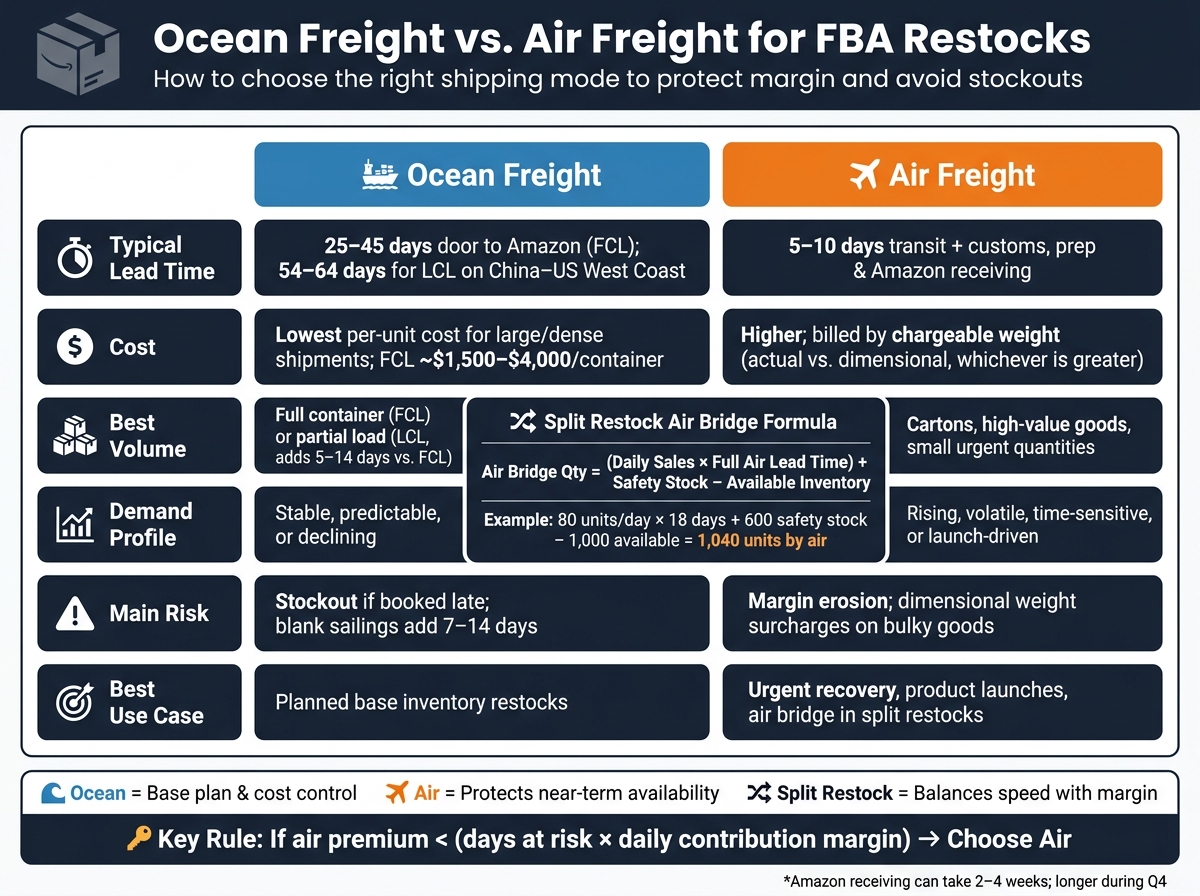
Ocean Freight vs. Air Freight for FBA Restocks: Cost, Speed & Risk
Use this matrix to pick the shipping mode that protects your margin without leaving you with too much stock.
It works best when your remaining inventory cover is getting close to your full replenishment lead time. At that point, the call usually comes down to four things: landed cost, inventory cover, demand velocity, and the cost of going out of stock.
Here’s the rule of thumb:
air premium vs. stockout loss avoided = days covered × daily contribution margin.
If the damage you avoid by staying in stock – including possible ranking and Buy Box effects – is greater than the extra cost of air, then air makes financial sense. If your inventory cover can comfortably handle the ocean lead time and demand is steady, ocean is usually the lower-cost move.
Side-by-Side Comparison: Cost, Speed, and Risk
The best mode depends on your SKU’s cost profile, how fast you need inventory, and how demand is behaving.
| Decision factor | Ocean freight | Air freight |
|---|---|---|
| Primary advantage | Lowest transportation cost for larger shipments | Fastest replenishment option |
| Typical role | Planned base inventory and routine replenishment | Emergency coverage, launch support, or a short-term inventory bridge |
| Volume fit | Best for pallets, container quantities, and larger replenishment cycles; FCL suits a full container, while LCL suits smaller shipments | Best for cartons, samples, high-value goods, and limited quantities needed quickly |
| Demand profile | Stable, predictable, or declining demand | Rising, volatile, or time-sensitive demand |
| Lead-time tolerance | Requires enough inventory to cover the full ocean cycle, often around 25–45 days door to FBA | Appropriate when available inventory may not cover the longer ocean lead time |
| Financial trade-off | Lower freight cost but more capital tied up longer and greater exposure to delays or excess inventory | Higher freight cost but potentially lower lost-sales cost and less time waiting for replenishment |
| Main risk | Stockout risk increases if the shipment is booked too late; demand may change while goods are in transit | Margin erosion, dimensional-weight surcharges, and insufficient quantity for sustained demand |
| Best stockout response | Use for the main replenishment when inventory coverage is adequate | Use for urgent recovery, an air bridge, or a split restock when waiting for ocean would create a stockout |
How to Choose When Demand Changes
When demand shifts, this stops being a simple cost question. It becomes a coverage-risk question.
Stable or declining demand: go with ocean. Your inventory covers the full cycle, and landed cost stays lower.
Rising demand: use an air bridge. Send a smaller batch by air to cover the gap, then let the larger ocean shipment do the heavy lifting.
Unexpected spikes: move to air if stock will run out before ocean can land. Then use ocean for the larger follow-up quantity once you know the spike is sticking around.
Launches and seasonal peaks: work backward from the FBA in-stock date. Send base volume by ocean, and send the gap volume by air.
Split Restocks and Final Mode Selection
When stockout risk goes up but sending the whole order by air would crush margin, split the shipment: send the shortfall by air and move the base quantity by ocean. From there, the job is simple in theory but easy to get wrong in practice: size the air bridge with precision.
Air Bridge with Ocean Base Inventory
Use this formula to size the air bridge:
Air bridge quantity = (forecast daily sales × full air lead time) + safety stock − available inventory
Use available sellable inventory only. Don’t use factory stock or units that are still in transit.
Full air lead time means the whole path from pickup to FBA-ready status. That includes supplier handling, export clearance, transit, customs, drayage, delivery, and Amazon receiving. Amazon receiving can take 2–4 weeks under normal conditions and longer during Q4.
Here’s a simple example. If you sell 80 units per day, need 18 days of coverage, keep 600 units of safety stock, and have 1,000 sellable units available, your air bridge comes to 1,040 units. Round up to the nearest full case pack or pallet when needed, using a CBM calculator to verify volume.
After you size the gap, subtract any inventory that will become sellable before the air shipment lands. That can include:
- Open POs
- Inbound units
- Reserved units
- Stranded stock
Then ship only the remaining gap by air. Let the ocean leg cover the rest.
Split restocks also mean each leg needs its own plan, paperwork, customs filing, and delivery appointment. Ask for separate all-in quotes and service assumptions for air and ocean. FCLGO can coordinate ocean freight, air freight, customs clearance, FBA prep, warehousing, trucking, and delivery to Amazon fulfillment centers across both legs.
If the math still leaves you torn, use the table below to make the final call.
Final Decision Table and Key Takeaways
Use the table below to choose the right mix based on inventory cover and demand pattern.
| Situation | Preferred method | Reason |
|---|---|---|
| Stable demand with enough inventory cover | Ocean freight | Lower cost works when current stock can cover the ocean lead time. |
| Stockout risk before ocean arrival | Air bridge + ocean balance | Air protects near-term availability while ocean controls total freight cost. |
| Large, steady shipment | FCL ocean freight | Predictable volume suits container utilization and lower unit freight cost. |
| Smaller planned shipment | LCL ocean freight | Move a partial load without waiting to fill a full container. |
| Temporary demand spike | Limited air shipment | Covers the incremental increase without moving the entire order at air rates. |
| Urgent launch or high-value SKU | Air freight, or air + ocean | Fast availability may outweigh the higher chargeable-weight cost. |
The rule of thumb is straightforward: ocean freight supports the base plan, air freight protects availability, and split restocks balance cost with speed.
FAQs
How do I calculate my air bridge quantity?
Calculate your air bridge quantity by estimating how much inventory you need to cover the gap between your current stock and when your next ocean shipment arrives.
For the air portion, compare each packed carton’s actual scale weight with its volumetric weight:
(Length × Width × Height in cm) ÷ 6,000 = kg
The higher of the two is the chargeable weight. That’s the number used to calculate your air freight cost.
What costs should I include in landed cost?
Include every cost between the factory floor and the Amazon fulfillment center. That means freight, handling, consolidation, and Amazon inbound placement fees, whether Amazon manages that part or you do.
You’ll also want to account for FNSKU labeling, palletizing, prep, customs clearance, duties, terminal handling, and inland trucking.
And here’s where many sellers get caught off guard: extra charges can show up fast if something goes wrong. A delayed or rejected shipment may lead to demurrage, per diem, or rework fees. Those costs aren’t rare edge cases – they’re part of the math.
When should I choose FCL over LCL?
Choose FCL when your shipment is over 15 CBM. For large, regular restocks, it usually gives you a lower cost per CBM and faster transit than LCL.
There’s another plus: the container stays sealed from origin to destination. That means less handling, lower risk of damage, and no extra port time for LCL consolidation and deconsolidation.
If your shipment is under 15 CBM, LCL is usually the more cost-effective option.
发表回复