FCL vs LCL Shipping: Which Is Right for You?
If I’m shipping less than about 13 CBM, I’d usually look at LCL. If I’m near 13 to 15 CBM or more, I’d price out FCL right away. That one choice affects my total shipping cost, transit time, cargo handling, customs risk, and how fast I can restock Amazon FBA.
Here’s the short version:
- FCL = I book the whole container
- LCL = I share container space and pay for the space I use
- FCL is often faster and has less handling
- LCL is often lower cost for small shipments
- FCL often starts to make more sense at 13–15 CBM, and sometimes 10–12 CBM on some China-to-USA routes
- A 20-foot container holds about 33 CBM
- A 40-foot High Cube holds about 76 CBM
- LCL usually has more delay and damage risk because cargo is consolidated and split at warehouses
- With LCL, if another shipper’s goods get flagged by customs, my shipment can be delayed too
- Both modes need ISF 10+2 filed at least 24 hours before vessel departure, and missing it can mean a $5,000+ fine
If I care most about cash flow and I’m shipping a small batch, LCL often fits. If I care most about speed, fewer touchpoints, and lower risk, FCL is often the better call.
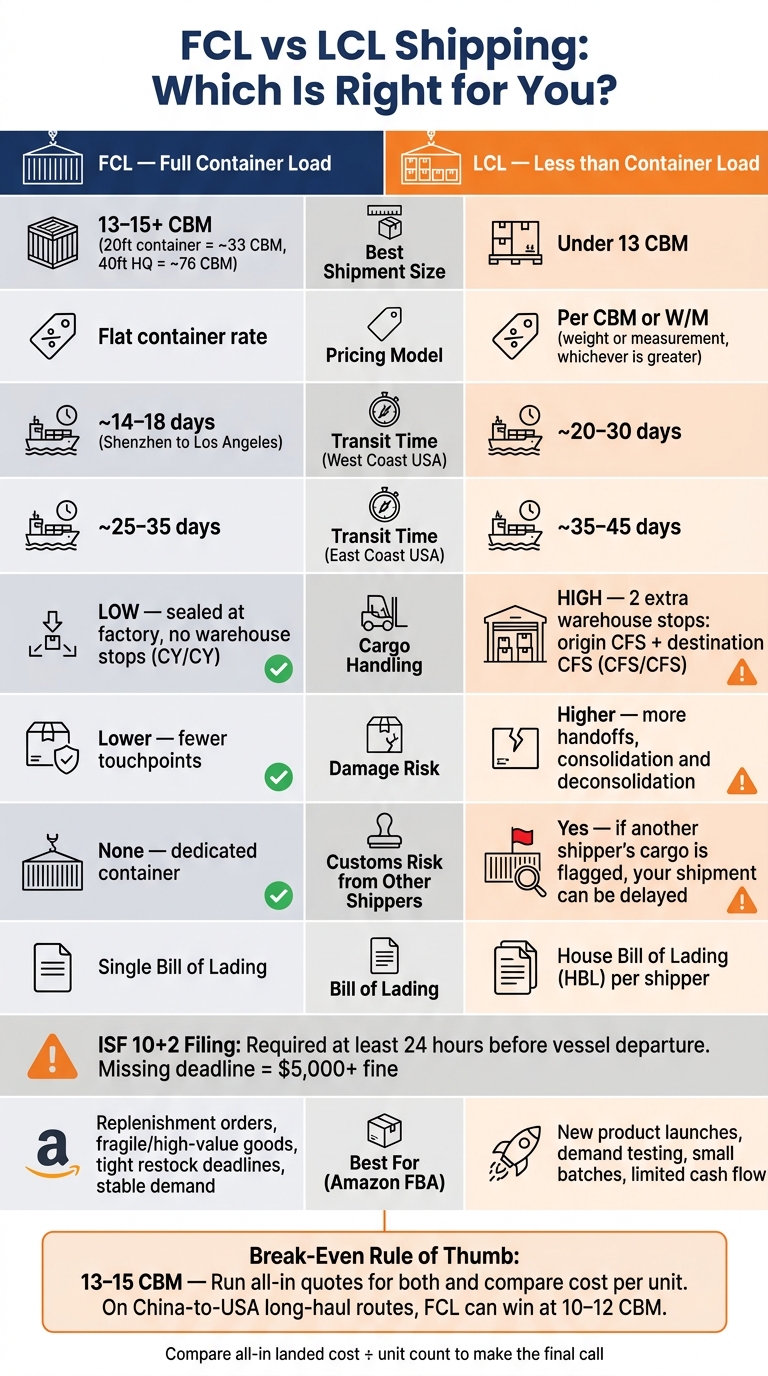
FCL vs LCL Shipping: Side-by-Side Comparison for Amazon FBA Sellers
FCL vs LCL: Which One Gets You Restocked Faster | AMZ Prep
sbb-itb-f9a91f9
Quick Comparison
| Factor | FCL | LCL |
|---|---|---|
| Best for shipment size | Usually 13–15+ CBM | Usually under 13 CBM |
| Pricing | Flat container rate | Per CBM or W/M |
| Transit time to U.S. West Coast | About 14–18 days from Shenzhen to Los Angeles | About 20–30 days |
| Transit time to U.S. East Coast | About 25–35 days | About 35–45 days |
| Handling | Lower | Higher |
| Damage risk | Lower | Higher |
| Customs risk from other shippers | No shared container risk | Yes |
| Amazon FBA restocks | Better for tighter deadlines | Better for small test orders |
My rule of thumb: I’d compare all-in landed cost, then use timing and risk as the tiebreaker. That usually gives the clearest answer before I book the shipment.
How FCL and LCL Work from China Pickup to Amazon FBA Delivery
How FCL Moves from Factory Pickup to Final Delivery
With FCL, the container is sealed at pickup and stays that way until final delivery. A truck brings an empty container to your supplier’s factory, the goods are loaded inside, and the container is sealed on-site. From there, it goes through export customs in China, crosses the ocean to a U.S. port like Los Angeles or Savannah, clears U.S. customs, and then moves by truck to your Amazon fulfillment center.
From Shenzhen to Los Angeles, transit usually takes 14–18 days. If the shipment is headed to New York or Savannah, it usually lands in the 25–35 day range.
LCL takes a different path because the cargo has to be combined with other shipments before it can leave by sea.
How LCL Moves Through Consolidation and Deconsolidation
LCL adds two extra warehouse stops, and those extra handoffs affect both timing and risk. Your cargo is picked up and sent to an origin consolidation warehouse, or CFS, in China, usually in Shenzhen or Shanghai. There, it’s combined with freight from other companies and loaded into one shared container.
On the U.S. side, the same process happens in reverse. The container is sent to a U.S. consolidation warehouse, opened, and split back into individual shipments. After deconsolidation, the cargo is sorted, labeled, and trucked to the assigned fulfillment center. Delivery appointments must be booked through Seller Central.
LCL shipments to the West Coast usually take 20–30 days. East Coast routes tend to take 35–45 days.
Key Differences That Affect Day-to-Day Shipping Decisions
The big day-to-day difference is simple: FCL stays sealed from start to finish, while LCL passes through shared warehouses on both ends. In shipping terms, FCL is CY/CY (Container Yard to Container Yard), while LCL is CFS/CFS (Container Freight Station to Container Freight Station).
Customs risk also changes. With FCL, one consignee controls the full container, so clearance is usually more direct. With LCL, your shipment shares space with other companies’ cargo. If one shipment in that container gets flagged for inspection, the whole container can be held, including yours.
That’s the part that shapes the tradeoff: price, transit time, and the chance of delay or damage all come back to how each shipping method moves through the system.
FCL vs LCL: Cost, Transit Time, Cargo Safety, and Customs
Shipment Size and Cost per CBM
Once your route is locked in, shipment size usually decides the first move: FCL or LCL.
LCL is priced per cubic meter. FCL, on the other hand, is a flat rate for the whole container. That means the more space you use in an FCL container, the lower your cost per CBM tends to get.
LCL pricing also comes with one catch: it’s billed on W/M. In plain English, you’re charged based on volume or 1,000 kg, whichever is greater. So if your cargo is heavy for its size, the bill may be based on weight instead of volume. And that can make the actual rate higher than the quoted per-CBM price.
| Shipment Size | Best Option | Why |
|---|---|---|
| Under 13 CBM | LCL | Paying for a full container usually wastes money |
| 13–15 CBM | Break-even zone | Run the numbers for both; FCL may win |
| 15–25 CBM | 20-foot FCL | Flat rate often beats per-CBM LCL pricing |
| 25+ CBM or near-full 40HQ | 40-foot FCL | More space, lower cost per CBM |
When the cost difference is small, transit time and handling risk usually decide it.
Transit Time, Warehouse Handling, and Cargo Damage Risk
FCL usually wins on both speed and cargo protection.
LCL tends to move slower because consolidation and deconsolidation add extra days at both ends of the shipment. It’s not just a port-to-port move. Your cargo has to be grouped with other shipments first, then separated again after arrival.
That extra warehouse movement matters. LCL cargo goes through a consolidation warehouse in China, gets packed into a shared container, and then gets unpacked again at a U.S. Container Freight Station before final delivery. More handoffs usually mean more chances for dents, tears, or crushed cartons, especially if you’re shipping fragile products or goods with branded packaging.
If you’re shipping LCL and the items can break or scuff easily, stronger outer packaging is often money well spent. Wooden crates or film wrapping can help cut damage risk.
Customs Process and Amazon FBA Delivery Requirements
After cost and timing, customs and FBA prep often decide whether a shipment lands without trouble.
Both FCL and LCL need an ISF 10+2 filing at least 24 hours before the vessel leaves China. Miss that deadline, and you can face a minimum fine of $5,000 per shipment.
LCL has another risk that catches many importers off guard. Your goods share a container with cargo from other companies. If one shipper in that container misdeclares goods or ships something prohibited, the whole container can be held for inspection or even seized. That’s one reason some sellers move to FCL as soon as volume allows.
There are also document differences. FCL uses a single Bill of Lading, while LCL uses a House Bill of Lading (HBL) issued for each shipper.
For Amazon FBA delivery, common prep steps include FNSKU labeling and palletizing. With FCL, the shipment is loaded and sealed at the factory. With LCL, palletizing usually happens at the destination CFS after deconsolidation, right before the final leg to Amazon.
How to Choose Between FCL and LCL for Your Next Shipment
Run a Break-Even Check Before Deciding
Once you know the tradeoff on cost, speed, and handling, the next step is simple: run a landed-cost check and compare both options side by side.
Start by calculating your total shipment volume in CBM. Then ask for all-in quotes for both LCL and FCL, including origin, ocean freight, destination, customs, and final delivery.
After that, divide each total by your sellable unit count. That gives you your cost per unit. And that’s the number that matters most when you’re looking at margins.
The 13–15 CBM break-even range is a good starting point, but it doesn’t stay fixed on every route. On long-haul China-to-USA lanes, FCL can start making more financial sense at around 10–12 CBM.
Match the Shipping Mode to Your Inventory Risk and Cash Flow
If the price difference is small, let inventory risk and upfront cash flow make the call.
FCL makes more sense when you’re placing a big replenishment order, shipping fragile or high-value goods, working against a firm restock deadline, or dealing with steady demand. Your cargo stays in a sealed container with only your goods inside, which means less handling, fewer delay points, and no spillover from another shipper’s customs issue.
LCL makes more sense when you’re launching a new product, trying not to tie up too much inventory, shipping under 13 CBM, or watching cash flow closely. You pay only for the space you use, which gives you more room to test demand without going all in too early.
| Situation | Recommended Mode |
|---|---|
| New product launch, under 13 CBM | LCL |
| Stable reorder, 15–25 CBM | 20-foot FCL |
| High-value or fragile cargo | FCL |
| Tight restock deadline | FCL |
| Demand test, limited budget | LCL |
| 25–60 CBM | 40-foot FCL |
Moving from LCL to FCL as Your Order Volume Grows
As your order volume gets more predictable, the decision tends to shift. Early on, flexibility often matters more. But once you regularly ship 13 CBM or more, FCL usually comes out ahead on unit cost and handling risk.
Conclusion: How to Pick Between FCL and LCL
Neither option wins every time. The right pick depends on three things: shipment size, timing, and risk.
LCL makes sense for smaller shipments. FCL usually starts to make more sense once you hit about 13–15 CBM, and sometimes even earlier on long China-to-USA routes. Start with cost, then use transit time and handling risk as the tie-breaker.
If your cargo is fragile, high-value, or tied to a restock deadline, FCL is often the safer bet. You get a sealed container and fewer handoffs, which can lower the odds of delays or damage. LCL is a better fit when flexibility matters more than speed, especially for smaller batches or demand tests.
There’s also shared customs risk with LCL. If another shipper in the same container gets flagged, your cargo can get held up too.
The practical move is simple: compare all-in quotes for both options, divide the total by your unit count, and choose the mode that gets inventory to Amazon on time at the lowest landed cost per unit – especially when a restock deadline is on the line.
FAQs
How do I calculate CBM for my shipment?
Multiply your cargo’s length, width, and height in meters:
Length × Width × Height = CBM
If your measurements are in centimeters, divide each one by 100 first.
It’s also smart to check the shipment weight. Many carriers charge by weight or volume – whichever comes out higher. A common rule looks like this:
1 CBM = 200 kg
When should I switch from LCL to FCL?
Consider switching when your shipment regularly hits 15 CBM or more. At that level, LCL charges for consolidation, documentation, and terminal handling can push landed costs up by 18% to 34%.
FCL gives you a fixed container rate, and at that volume it’s often 30% to 45% cheaper. It can also cut handling risk and move things along faster since you avoid deconsolidation.
What extra fees should I include in landed cost?
Include more than the base ocean freight rate.
Look at the full landed cost, including:
- Origin charges like THC, ORC, documentation fees, and fuel surcharges
- Destination costs such as customs clearance, entry filing, brokerage, and import tariffs
- U.S. fees like Harbor Maintenance Fee, Merchandise Processing Fee, inland trucking, LCL deconsolidation, and optional marine insurance
If you skip these line items, the final bill can jump fast. The ocean rate may get the most attention, but it’s only one piece of what you’ll pay to move cargo into the United States.
发表回复