China to USA Air Booking Timelines for FBA
If I need Amazon FBA stock live on time, I don’t plan around the flight. I plan around the full chain. A China-to-U.S. air shipment may fly in about 12–14 hours, but the full path usually runs 5–10 days door to door, plus 3–7 business days for Amazon to check it in.
Here’s the short version:
- Book air freight early: usually 2–5 days before cargo is ready
- Book earlier in Q4 or for battery goods: about 7 days ahead
- Factory pickup + China export: about 1.5–4 days
- Airport-to-airport transit: often 3–7 days
- U.S. customs + warehouse prep + FC delivery: about 2–7 days
- Amazon receiving after delivery: 3–7 business days
That means a “fast” air shipment can still take 10–17+ days before inventory is sellable.
A few things decide whether the shipment stays on schedule:
- Route: West Coast lanes are often faster than East Coast lanes
- Cargo type: batteries and magnets need extra screening and routing
- Documents: invoice, packing list, HTS/HS data, Tax ID, and bond must match
- Carton specs: air charges can change if carton size changes late
- Amazon prep: labeling or carton mistakes can delay receiving or trigger fees
If I had to boil it down to one rule, it’s this: count backward from the date inventory must be available in Amazon, not the date the plane lands.
| Stage | Usual Time |
|---|---|
| Booking lead time | 2–5 days before cargo ready |
| Origin handling in China | 1.5–4 days |
| Air transit | 3–7 days |
| U.S. side processing | 2–7 days |
| Amazon check-in | 3–7 business days |
So if I’m planning a restock, I treat air freight as a full-process timing job, not just a flight booking.
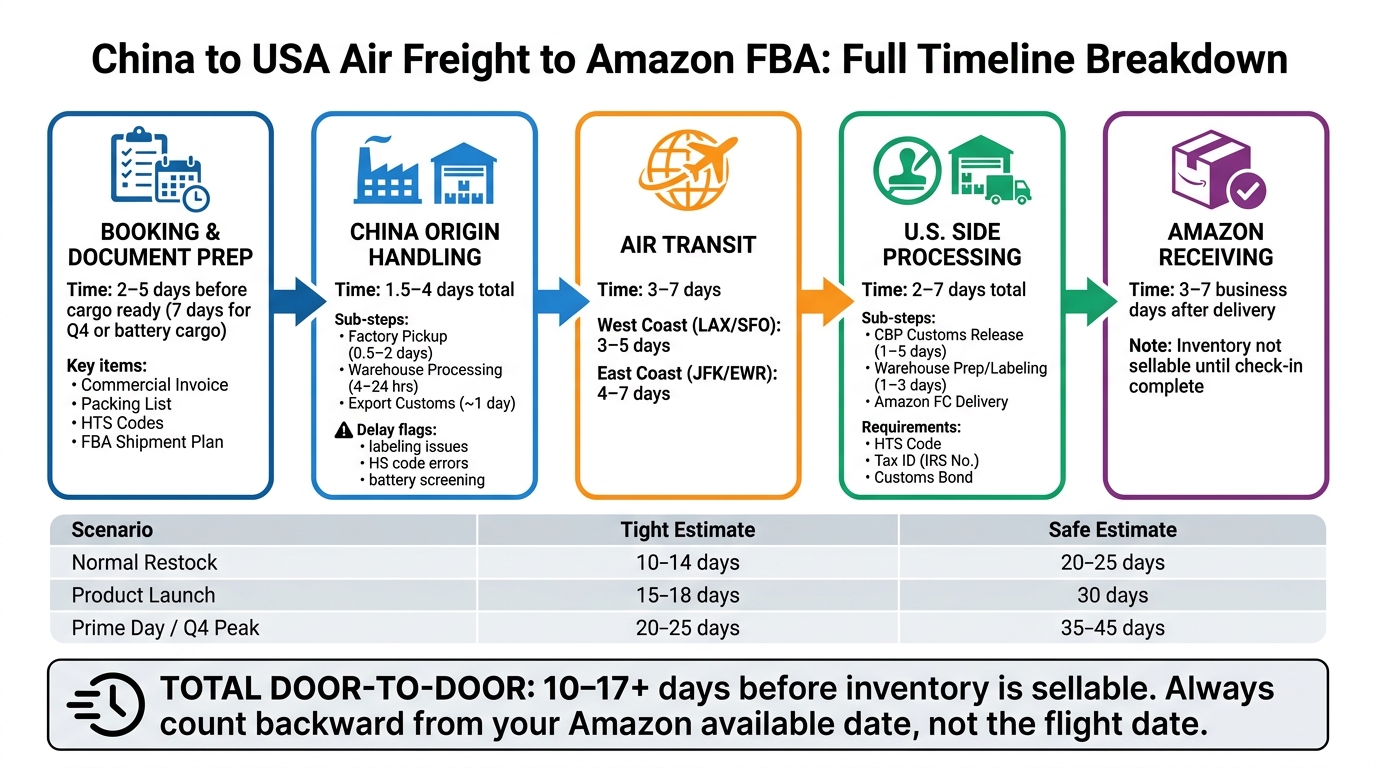
China to USA Air Freight Timeline for Amazon FBA: Full Door-to-Door Breakdown
China to Amazon FBA Shipping Explained | Air Freight vs Sea Freight Strategy for Beginners
sbb-itb-f9a91f9
Step 1: Book Air Freight Before Cargo Is Ready
Book air freight 2–5 days before the cargo-ready date. If you’re shipping in Q4 or sending battery cargo, book about 7 days ahead. Space gets tighter in Q4, so if you wait too long, your shipment is more likely to roll to the next flight.
Once space is booked, the next steps are pretty straightforward: pickup, export clearance, and flight departure.
Documents and shipment details needed to book
Send these details as early as you can so the forwarder can secure space and help you avoid a rebooking headache.
| Document / Detail | What to Include |
|---|---|
| Commercial Invoice | Unit price, total shipment value, currency, buyer/seller info, HS codes |
| Packing List | Carton count, units per carton, net/gross weight, dimensions |
| Booking Form | Supplier pickup address, cargo ready date, preferred departure airport, battery status |
| Amazon FBA Shipment Plan | Destination Amazon FC code and shipment details |
One issue trips people up all the time: chargeable weight. Air freight charges based on whichever is higher: actual weight or volumetric weight. Volumetric weight is calculated as Length × Width × Height (in cm) ÷ 6,000.
That means final packed carton dimensions matter a lot. If those numbers change late, the final invoice can jump.
Also, each carton should stay under 50 lbs (22.6 kg) to meet Amazon’s receiving rules. Go over that limit, and you could end up dealing with repacking fees or a rejected shipment at the fulfillment center.
Once the booking is confirmed, the factory can release the cargo for pickup.
Airline cutoffs, document deadlines, and booking risks
Make sure all booking data matches the commercial invoice and packing list. Even small mismatches can cause airline or customs holds. Batteries and magnets need to be declared up front. They also require MSDS and UN38.3 documents.
Using FCLGO to manage booking and FBA coordination
FCLGO can handle booking, factory pickup, export paperwork, and Amazon FBA delivery in one workflow. After that, the shipment moves into origin handling and export clearance.
Step 2: Factory Pickup, Origin Handling, and China Export Clearance
Once the booking is confirmed, the China origin stage starts. This part covers everything from the truck pulling out of the factory gate to the cargo being handed over to the airline. In a smooth shipment, this takes about 1.5 days. If things slip, it can stretch to 4 days before the flight leaves.
Factory pickup and transfer to the origin airport
Factory pickup and export handling usually take 1.5–4 days before flight handoff. The pickup itself often takes 0.5–2 days, mostly based on how far the factory is from the origin airport.
Small prep mistakes can throw off the whole schedule. If packing runs late or labels are missing, pickup gets delayed. The safest move is simple: make sure cartons are packed, weighed, and labeled with the correct FBA Box ID and FNSKU labels before the driver shows up.
Origin warehouse processing and export customs timing
After the cargo reaches the forwarder’s warehouse, it goes through check-in, security screening, weighing, and palletization. That step usually takes 4 to 24 hours. At the same time, the forwarder submits the export declaration to Chinese customs.
Export clearance usually goes through in about 1 day when the declared value, HS code, and exporter details all match. But customs can put the shipment on hold if the commercial invoice and packing list don’t line up, the HS code is wrong, or exporter details are missing. When that happens, the timeline gets pushed back. Goods with batteries or magnets need extra attention and must go through specific security screening.
| Origin Activity | Estimated Time | Common Delay Points |
|---|---|---|
| Factory Pickup | 0.5–2 days | Distance from hub, cargo not ready, labeling issues |
| Warehouse Processing | 4–24 hours | Oversized or overweight cartons, incorrect labels, consolidation needs |
| Export Customs | ~1 day | HS code errors, valuation mismatches, missing exporter details |
| Total Pre-Flight | 1.5–4 days | Combination of the above |
After export release, the shipment moves to flight departure and U.S. import processing.
Step 3: Flight Departure, U.S. Customs, Warehouse Prep, and Amazon Delivery
Flight departure and U.S. customs release timing
Once the shipment clears export in China, the next stretch is the U.S. side.
Direct air routes to West Coast gateways like LAX or SFO usually take 3–5 days, while East Coast airports like JFK or EWR often take 4–7 days. After the plane lands, the U.S. processing timeline begins.
For clean entries, CBP often releases cargo within 24 hours. But if the filing has mistakes, or if the shipment gets pulled for an exam, that can add 1–5 business days. To keep things moving, the filing needs a correct HTS code, a valid importer Tax ID (IRS No.), and an active customs bond.
Once CBP releases the shipment, it heads to warehouse prep.
U.S. warehouse prep and Amazon delivery appointment timing
After customs release, the cargo goes to a U.S. warehouse for unloading and FBA prep. At this stage, the goods are checked and made ready for Amazon. That can include FNSKU labeling, poly bagging, bubble wrapping, carton labeling, and palletizing.
This part usually takes 1–3 days, depending on how many units are involved and how much prep the shipment needs.
Small mistakes here can turn into a headache. Amazon prep errors may lead to refusal, return, disposal, or added fees. After prep is finished, the carrier books the Amazon delivery appointment. If you’re using FCLGO, that process can be handled end to end, from U.S. warehouse prep through direct delivery to Amazon fulfillment centers.
Amazon receiving after proof of delivery
Proof of delivery doesn’t mean the inventory is ready to sell.
After the carrier drops off the shipment, Amazon still has to receive the cartons and scan them into the system. In most cases, inventory becomes available for sale within 3–7 business days after receiving.
That gap matters more than many sellers expect. If you’re planning replenishment, build this extra time into your schedule, especially from August through November, when delays tend to show up more often.
| Stage | Estimated Duration | Key Delay Risks |
|---|---|---|
| Flight Transit (China to U.S. Gateway) | 3–7 days | Routing, connections, service level |
| U.S. Customs Release + Trucking | 2–5 business days | Missing Tax ID, HTS errors, no customs bond |
| Warehouse Prep (Labeling/Palletizing) | 1–3 days | Labeling errors, repackaging needs, unit volume |
| Amazon Receiving (Check-in to Available) | 3–7 business days | FC workload, inbound processing volume |
Full Timeline Summary and Buffer Planning for FBA Replenishment
Timeline breakdown table by shipment stage
Use the timeline below to count backward from the date inventory needs to be live in Amazon.
| Phase | Stages Covered | Typical Duration |
|---|---|---|
| Booking & Document Prep | Booking lead time, document submission | 1–2 days |
| China Origin Handling | Factory pickup, warehouse processing, export clearance | 2–4 days |
| Flight Transit | Departure to U.S. gateway airport | 1–3 days |
| U.S. Side | Customs clearance, warehouse prep, final delivery to Amazon FC | 2–7 days |
| Amazon Receiving | Check-in to inventory live in Seller Central | 3–7 business days |
Tight vs. safe planning windows for urgent and normal restocks
The main planning issue is simple: how much buffer should you build into each restock window?
Quoted transit time often covers the flight only. It usually does not cover the full door-to-door timeline.
| Scenario | Tight Window | Safe Window |
|---|---|---|
| Normal Restock | 10–14 days | 20–25 days |
| Product Launch | 15–18 days | 30 days |
| Prime Day / Q4 Peak | 20–25 days | 35–45 days |
Q4 bottlenecks can add 1–3 days, and air freight rates climb 15%–30% from August through December. That’s why you should plan to the available date, not the delivery date.
Key takeaways for scheduling China-to-USA air freight to FBA
A few things matter most here:
- Book early. Secure space 24–72 hours before cargo is ready, especially during peak periods.
- Verify documents first. An incorrect HTS code, missing customs bond, or incomplete invoice can hold up a shipment for days.
- Count backward from the available date. Amazon receiving adds 3–7 business days after delivery, so that time needs to be part of every replenishment window.
If you’re managing multiple SKUs or you’re cutting it close on restock timing, FCLGO can handle booking, FBA prep, customs clearance, and direct FC delivery in one workflow, which helps cut coordination delays.
FAQs
How far in advance should I book air freight for FBA?
Book your air freight as early as you can. That gives you enough time for cargo pickup, customs clearance, and any last-minute issues like flight overbooking.
In most cases, air freight takes 5 to 12 days. But booking early lowers the chance that your shipment gets rolled to a later ETD.
It also helps to lock in space well before your required in-stock date. Security checks, paperwork mistakes, and peak-season demand can all push departure timing back.
Why does air freight take longer than flight time?
Air freight takes longer than the flight itself because the plane ride is only one part of the job.
Before cargo even leaves the ground, it usually has to move through several required steps: factory pickup, cargo consolidation, export customs clearance, and terminal handling. After landing in the U.S., the shipment still needs to go through U.S. customs processing and final delivery to the Amazon fulfillment center.
That’s why a shipment can spend far more time on the ground than in the air. Paperwork, inspections, and carrier schedules can slow things down, and each stage can add a day or two.
What issues most often delay FBA air shipments?
The most common delays come from customs compliance, documentation, and Amazon receiving requirements.
Typical causes include mismatched shipping documents, missing tax, bond, or product certification details, undervalued or undeclared restricted goods, incorrect or outdated FNSKU labels, cartons over 50 pounds, poor packing, shipping before inventory is ready, and missed final-mile delivery appointments.
发表回复