FCL vs LCL Buffer Time for Amazon FBA
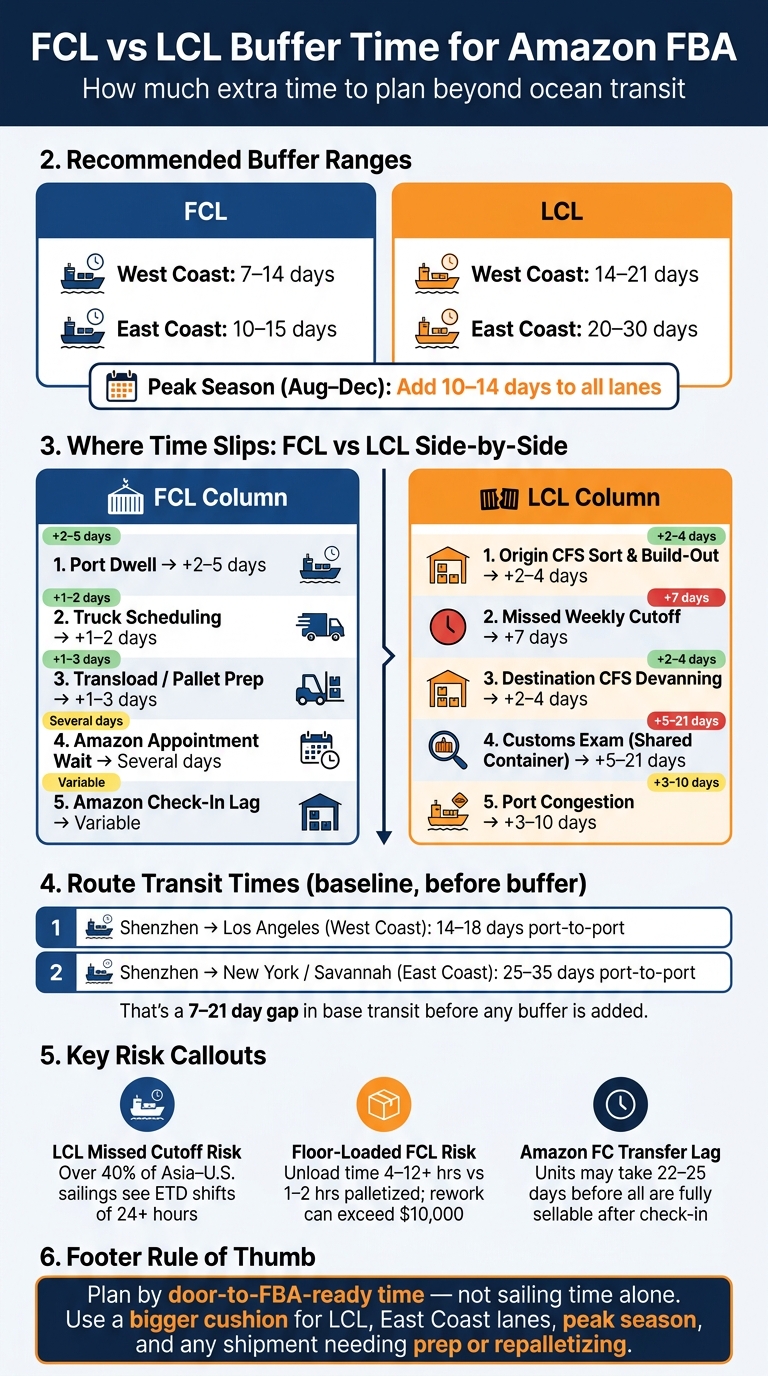
If I need one short answer, it’s this: LCL usually needs more buffer time than FCL for Amazon FBA. I’d plan about 7–14 days of extra time for FCL to the U.S. West Coast, 10–15 days for FCL to the East Coast, 14–21 days for LCL to the West Coast, and 20–30 days for LCL to the East Coast. From August to December, I’d add 10–14 more days.
Why? Because ocean transit is only part of the trip. Your stock still has to get through origin handling, customs, port pickup, inland delivery, FBA prep, appointment scheduling, and Amazon check-in before it can sell.
Here’s the short version:
- FCL has fewer touchpoints, so it often loses less time before and after sailing.
- LCL often adds 5–10 days vs. FCL because of origin consolidation and destination deconsolidation.
- If an LCL container gets a customs hold, delay can run 5 days to 3 weeks.
- FCL can still slip if you miss drayage timing, free time, or an Amazon delivery appointment.
- Amazon receiving can add its own lag, and FC transfers may take 22–25 days before all units are sellable.
FCL vs LCL Buffer Time for Amazon FBA: Complete Guide by Lane & Season
FCL vs LCL Shipping Explained | Why LCL Adds Days or Weeks to Your Amazon Inbound | AMZ Prep
sbb-itb-f9a91f9
Quick Comparison
| Mode | Where time slips first | Common extra delay | Base buffer I’d use |
|---|---|---|---|
| FCL | After arrival | Port pickup, drayage, appointment wait | 7–14 days West Coast / 10–15 days East Coast |
| LCL | Before sailing and after arrival | CFS handling, missed cutoff, shared-container hold | 14–21 days West Coast / 20–30 days East Coast |
The main point: I wouldn’t plan by sailing time alone. I’d plan by door-to-FBA-ready time, with a bigger cushion for LCL, East Coast lanes, peak season, and any shipment that needs prep or repalletizing.
2. Where LCL needs more buffer days
LCL usually needs extra time on both ends of the trip. At origin, cargo has to be grouped with other shipments. At destination, that same shared container has to be broken apart before your freight can move. And because release depends on a shared box, delays can stack up fast after the vessel lands in the U.S.
Origin consolidation and missed cutoff risk
Before LCL cargo even gets near the vessel, it has to go to an origin Container Freight Station (CFS). That’s where it gets sorted and packed together with other shipments. This step adds 2 to 4 days to the timeline.
But the bigger issue is the cutoff.
Most LCL consolidators work on a weekly sailing cycle. So if your factory delivers cargo just one day late, the shipment can miss that week’s consolidation and roll to the next sailing. That means 7 more days before the container even leaves port.
Miss the cutoff, and your ETD moves with it. Over 40% of sailings on major Asia–U.S. lanes see ETD shifts of 24 hours or more between booking and actual departure. If your ETD moves by more than 48 hours, recalculate your inbound coverage right away. For LCL sellers, ETD drift is often the first sign that more delay is coming.
Destination deconsolidation, CFS release, and port handling
Once the vessel arrives, LCL cargo still isn’t ready for pickup. The container first has to be trucked from the pier to a bonded destination CFS. There, it’s devanned, sorted, and split by shipper. That adds another 2 to 4 days.
Then comes one of the biggest LCL headaches: shared-container customs risk.
If Customs places a hold on another shipper’s cargo in the same container, everyone can get stuck waiting. That can delay release by 5 days to 3 weeks. FCL doesn’t carry that same shared-box risk.
LCL buffer drivers and lead time impact: comparison table
These are the main points where LCL tends to lose time.
| Delay Point | Buffer Impact | What’s Actually Happening |
|---|---|---|
| Origin CFS sort and build-out | +2–4 days | Cargo is sorted and grouped with other shipments before loading |
| Missed weekly cutoff | +7 days | Missing the vessel cycle rolls the booking to the next sailing |
| Destination CFS devanning | +2–4 days | Container is hauled to a bonded CFS, unloaded, and sorted before release |
| Customs exam (shared container) | +5–21 days | A hold on any co-loader’s freight can delay the entire container |
| Port congestion | +3–10 days | LCL cargo may wait for drayage to the CFS before your cargo can be released |
FCL shifts the timing problem away from consolidation and more toward what happens after arrival.
3. Where FCL needs tighter post-arrival control
LCL usually burns time before sailing and after landing. With FCL, the pressure moves somewhere else: pickup, drayage, and the final Amazon handoff.
Because FCL skips CFS handling, it can move faster after arrival. But that speed only matters if pickup and delivery stay on track once the container is discharged.
Container pickup, free time, and drayage timing
Every FCL container comes with a limited free-time window at the terminal. Miss that window, and demurrage starts. Once the container leaves the port, per diem starts running too, usually at about $200–$300 per day per container until the empty is returned.
That’s why drayage needs to be arranged before the vessel arrives, not after. Waiting until the container is already sitting at the port is asking for trouble. Port congestion and pickup delays can add 2 to 5 days on their own, so that extra time needs to be built into the plan.
At that point, the next big timing factor is simple: how the container is loaded.
Floor-loaded containers, palletizing, and Amazon appointment timing
The way a container is packed has a direct effect on how fast inventory gets checked in at Amazon. It changes unload time, detention risk, and how easy it is to lock in an appointment.
A palletized FCL container usually unloads in about 1 to 2 hours. Floor-loaded freight is much slower.
Floor-loaded containers can take 4 to 6 hours to unload, and sometimes more than 12 hours. Most trucking companies give only a short free waiting window before detention begins, often at about $75 per hour. That cost adds up fast.
There’s another problem. Floor-loaded containers are harder to book at Amazon fulfillment centers. During Q4, Amazon may reject them because manual unloading takes more labor. If that happens and the cargo has to be transloaded and palletized at a 3PL, rework costs can top $10,000, including storage and redelivery.
Book the Amazon appointment early. If the driver arrives late, the slot can be canceled, and getting a new one may take several days. If the appointment is pushed too far out, a common fix is to unload at a nearby 3PL first, then deliver later under a new appointment.
The table below shows where FCL buffer time usually slips.
FCL buffer drivers and lead time impact: comparison table
| Delay Point | Buffer Impact | What’s Actually Happening |
|---|---|---|
| Port dwell | +2–5 days | Time to secure drayage and clear terminal congestion after discharge. |
| Truck scheduling | +1–2 days | Coordinating pickup timing with Amazon appointment availability. |
| Transload/pallet prep | +1–3 days | Needed if the container must be unloaded at a 3PL before final delivery. |
| Amazon appointment wait | Several days | Time to secure an appointment slot in Carrier Central. |
| Amazon check-in lag | Time from delivery to check-in | Time from dock arrival to checked-in status. |
4. How to plan buffer time by shipment type, route, and season
Suggested buffer ranges for FCL and LCL replenishment
Use the delay points above to set a lane-specific buffer, not one global number for every shipment. And keep that buffer separate from ocean transit. The buffer is there to cover drayage, delivery appointments, and receiving lag.
For FCL, a solid planning range on the West Coast is 7 to 14 days on top of port-to-port transit time. East Coast lanes usually need 10 to 15 days. That gap matters. If you use the same buffer for both lanes, your reorder plan can get out of sync fast.
LCL should sit at the higher end because CFS handling and deconsolidation add extra time. On the West Coast, that usually means 14 to 21 days of buffer. On East Coast lanes, plan for 20 to 30 days.
From August through December, add 10 to 14 days to your base range. Port labor slowdowns, warehouse backlogs, and holiday closures can stretch both lanes. If you’re planning for a new launch, use the high end of the range.
West Coast vs East Coast timing and Amazon check-in lag
A shipment moving from Shenzhen to Los Angeles takes about 14 to 18 days port-to-port. The same cargo going to New York or Savannah takes about 25 to 35 days.
That’s a 7-to-21-day gap in base transit before you add any buffer at all. Put simply: West Coast routes give you a shorter sailing window and a bit more control after arrival. East Coast routes come with a longer sailing timeline, so they need more padding.
One more thing trips people up all the time: the 24- to 48-hour tracking gap that can happen during carrier handoffs or Amazon check-in. If you don’t account for that in your reorder math, a late scan can look like a stockout when the inventory is still moving through the system.
FCL vs LCL buffer recommendations by lane and risk level: comparison table
| Shipment Mode | Typical Route | Main Delay Drivers | Suggested Planning Buffer |
|---|---|---|---|
| FCL | China → U.S. West Coast | Port congestion, drayage, Amazon appointment lag | 7–14 days |
| LCL | China → U.S. West Coast | CFS deconsolidation, shared-container customs hold | 14–21 days |
| FCL | China → U.S. East Coast | Longer ocean transit, canal transit delays, port labor | 10–15 days |
| LCL | China → U.S. East Coast | CFS handling, extended transit, multi-port stops | 20–30 days |
| All lanes (peak season) | All routes | Port backlog, warehouse congestion, holiday closures | Add 10–14 days. |
5. Conclusion: picking the right buffer strategy for Amazon FBA
LCL usually needs a bigger buffer. FCL, on the other hand, needs tighter control after the shipment arrives.
Neither shipping mode is safer by default for your Amazon replenishment plan. The right move is to set your buffer based on the lane, the season, and the fulfillment path. For example, a floor-loaded FCL shipment going to a prep warehouse will need extra time for repalletizing before it can be delivered to Amazon.
If your cargo moves through a U.S. buffer warehouse, build in both storage time and transfer time. The best buffer isn’t the biggest one. It’s the one that fits your lane, your handling steps, and Amazon’s receiving pace.
FCLGO helps sellers move FCL and LCL shipments from China to the U.S. with customs, drayage, prep, warehousing, and Amazon delivery support.
FAQs
How do I choose FCL or LCL for Amazon FBA?
Choose based on shipment volume, inventory, and budget.
FCL is often the better pick for larger shipments – usually around 15 to 25 CBM or more. It tends to give you a lower cost per cubic meter, faster transit, and less handling along the way.
LCL is often the more cost-effective option for smaller shipments, especially those under 15 CBM.
Timing matters too. LCL shipments need consolidation and deconsolidation, which can add extra days compared with FCL. So if your stock is running low or you’re working against a tight deadline, that delay can make a big difference.
Your shipping plan also needs to match Amazon FBA rules, including:
- Palletizing
- FNSKU labeling
- Delivery appointments
When should I add more buffer than the standard range?
Add more buffer during peak seasons or holidays. During those periods, Amazon fulfillment center receiving often takes longer than the usual 24–48 hours.
You’ll also want extra time for high-risk routes, especially East Coast shipments, plus LCL or consolidated freight. Those shipments come with extra port handling and deconsolidation, which can slow things down.
If your inventory is under 10 days, switch to a faster shipping method instead of depending on standard ocean freight.
How does palletizing affect FBA delivery timing?
Palletizing can speed up FBA delivery because it makes unloading at Amazon fulfillment centers faster and easier to plan.
When a container is floor-loaded, workers have to unload it by hand. That process can take 4 to 12 hours and may lead to detention fees.
With palletized shipments, teams can use equipment to unload freight instead of doing the whole job manually. That can also help you avoid delivery rejections.
Using 40-inch by 48-inch pallets and wrapping them the right way with stretch wrap can cut delays tied to manual off-loading, rework, or warehouse capacity issues.
发表回复