If I need to choose China-to-USA FBA shipping fast, I start with one question: how soon do I need sellable inventory at Amazon? That single check usually points me to the right mode faster than looking at freight price alone.
Here’s the short version:
- Ocean FCL fits large, planned restocks with plenty of buffer
- Ocean LCL fits smaller planned shipments that can wait
- Air freight fits urgent replenishment and hard launch dates
- Split air + ocean fits orders where some units must arrive fast and the rest can come later
I also need to plan around full lead time, not just transit time. That means:
- factory pickup
- export handling
- main transit
- customs clearance
- U.S. trucking
- Amazon check-in
That last part matters. Amazon says delivered shipments often take 2–5 days to be checked in, plus up to 1 more day to move into Receiving status. And for planning, cited ranges in the article put:
- Ocean FCL: 19–47 days
- Ocean LCL: 22–50 days
- Air freight: 4–11 days
So if I have 60+ days of cover, ocean is often fine. If I have 14–30 days, air or a split shipment may fit better. If I’m under 14 days, ocean alone will often be too late.
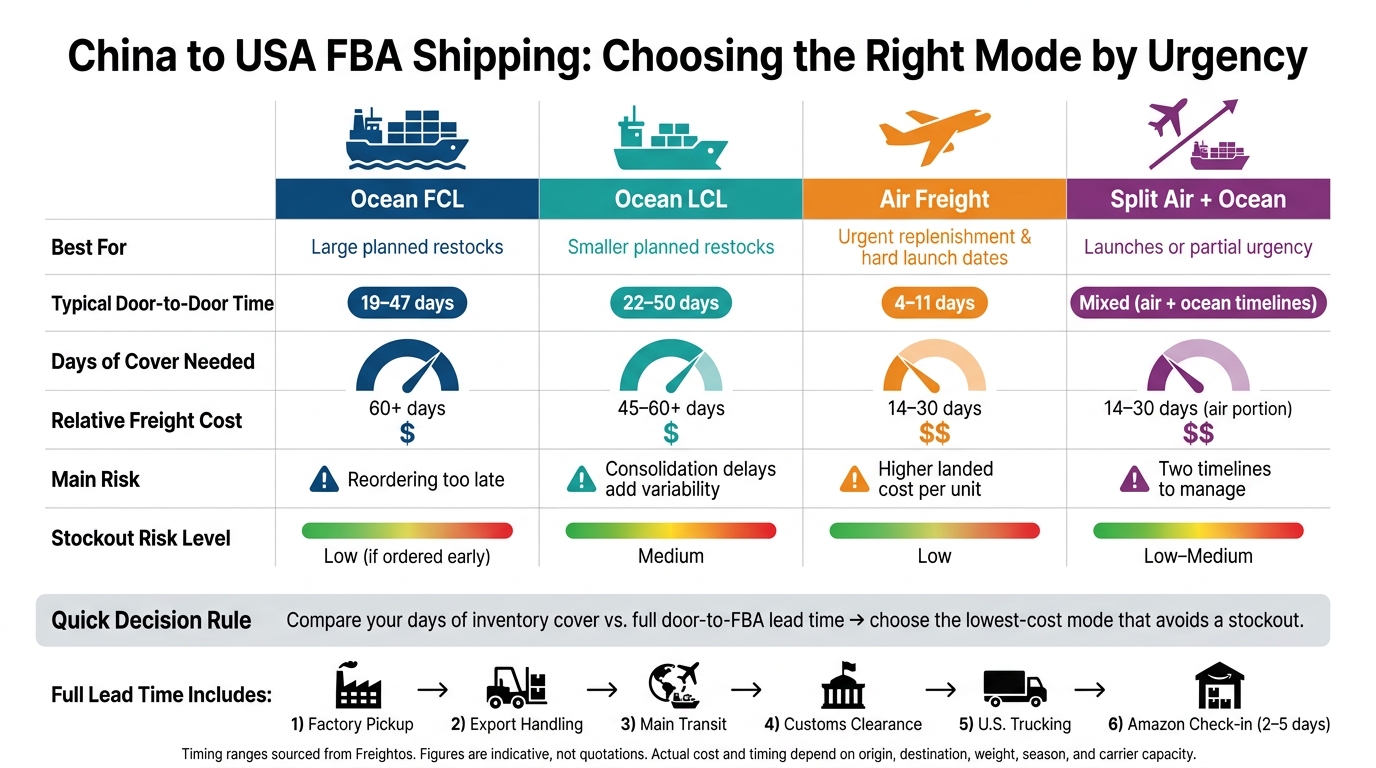
China to USA FBA Shipping Modes Compared: Cost, Speed & Stockout Risk
Shipping from Alibaba to Amazon FBA Explained | How to Ship Products From China Tutorial
sbb-itb-f9a91f9
Quick Comparison
| Mode | Best for | Typical door-to-door time | Cost level | Main watchout |
|---|---|---|---|---|
| Ocean FCL | Large planned restocks | 19–47 days | Lowest | Reordering too late |
| Ocean LCL | Smaller planned restocks | 22–50 days | Mid-range | Added consolidation delays |
| Air Freight | Urgent replenishment | 4–11 days | Highest | Higher landed cost |
| Split Air + Ocean | Launches or partial urgency | Mixed | Blended | Two timelines to track |
My rule is simple: I compare days of inventory left against total door-to-FBA lead time, then choose the lowest-cost option that still avoids a stockout. That is the core idea behind the full guide.
1. FCLGO Urgency-Based Shipping Workflow
That decision starts with one question: how much time does the shipment to Amazon FBA actually have?
FCLGO starts by looking at inventory, demand, the Amazon arrival date, cargo specs, and FBA prep status. The point is to measure the full lead time, not just the time in transit. Once that picture is clear, FCLGO picks the fastest shipping mode that still protects margin.
Urgency Fit
FCLGO matches urgency to shipping mode in a pretty direct way. Ocean works for planned restocks. Air works for urgent gaps. And when the order is big but the deadline is tight, a split shipment often makes more sense.
For planned launches, ocean handles the base volume, while air is used only when it’s needed to protect the launch date. For urgent replenishment, air covers the units needed to avoid a stockout before the ocean shipment lands. That’s where air-plus-ocean splits come in.
Cargo Volume
Volume narrows the choice even more.
- Air fits small, urgent loads
- FCL fits large loads that aren’t time-sensitive
- LCL fits mid-sized shipments that don’t fill a full container
When volume is high but timing is tight, a split shipment can change the math. You send enough units by air to protect the listing, and move the rest by ocean at a lower cost per unit.
Total Landed Cost
Freight rate alone doesn’t tell the whole story. FCLGO looks at total landed cost: pickup, handling, freight, duties, delivery, and FBA prep.
Ocean usually has the lower unit cost. But a lower freight rate won’t help much if it leads to a stockout. Air makes sense when the cost of waiting is higher than the extra freight spend.
Stockout Risk
If inventory is set to hit zero before ocean stock arrives, the move is usually air or a split shipment.
FCLGO builds in a safety buffer for things that can throw off timing, including demand swings, production delays, customs exams, port congestion, trucking delays, and Amazon receiving time. Amazon notes that delivered shipments typically take 2–5 days to be checked in, followed by up to 1 additional day before inventory moves to Receiving status.
2. Ocean FCL
Ocean FCL gives one full container to one shipper. That usually cuts the cost per unit and limits extra handling, which makes it a strong fit for large, steady shipments. But price isn’t the only thing that matters. The bigger issue is timing: can your inventory sit through ocean transit without causing problems?
Urgency Fit
FCL works best for planned restocks and product launches. It does not work well for urgent replenishment.
If you need inventory in the next 2–3 weeks, FCL is usually too slow. Ocean shipping takes time, and that timing can slip even more if ports get backed up or receiving runs behind.
Cargo Volume
FCL often starts to make sense on cost at around 12–15 CBM, though that changes by lane and local fees.
For rough capacity, here’s the usual range:
- 20-foot container: about 28 CBM
- 40-foot container: about 56 CBM
- 40-foot high-cube: about 68 CBM
A 40-foot high-cube is often the better pick for bulky, low-density goods like furniture parts or large retail packaging. On paper, that extra space looks simple. In practice, it isn’t. Carton size, pallet use, loading pattern, and weight caps all eat into the space you can use.
That’s why it’s smart to confirm usable capacity with your forwarder instead of relying on the headline number alone.
Once your shipment is big enough for FCL, the next thing to check is landed cost per unit.
Total Cost Impact
FCL can cut cost per unit on larger, steady shipments. But don’t compare options on the ocean rate alone. The number that matters is landed cost per sellable unit.
Ask for an itemized all-in quote and make sure it spells out whether the price is port-to-port or door-to-door. That one detail can change the math more than people expect.
Stockout Risk
FCL helps lower stockout risk when you order early and keep a solid reorder buffer in place. Timing matters even more before Q4, Prime Day, and Chinese holidays, when factory schedules, port flow, and Amazon receiving can all slow down.
If your volume isn’t large enough to fill a container well, FCL can turn into wasted space and tied-up cash. In that case, LCL is usually the better fit.
3. Ocean LCL
When your shipment is too small for FCL, but you still have time to wait a few weeks, LCL sits in the middle.
With Ocean LCL, your cargo shares a container with goods from other shippers. It’s consolidated at origin, shipped together, and then deconsolidated in the U.S. before final delivery.
Urgency Fit
LCL works best for slow-moving restocks. It’s a weak option for urgent replenishment.
Why? Because consolidation and deconsolidation usually add about 3–7 days on top of the base ocean transit time, and peak season can stretch that even more. It can also work for planned launches, as long as you book early.
A simple rule helps here: if your remaining inventory can cover ocean transit, port processing, inland delivery, Amazon receiving, and a delay buffer, LCL can work. If that coverage is thin, air freight or a split shipment is the safer call.
Once timing checks out, the next question is shipment size.
Cargo Volume
LCL is usually the right fit for shipments under about 13–15 CBM on China–U.S. lanes. Under that range, you avoid paying for empty container space. Once you go above it, FCL often starts to cost less because LCL adds handling fees and per-CBM surcharges.
LCL is billed on whichever is higher: volume or chargeable weight. That matters more than many shippers expect.
- Bulky, low-density products can get expensive because they take up space without weighing much.
- Dense products may be charged by weight instead.
Give your forwarder exact carton dimensions, gross weight, carton count, and SKU details before booking. If those numbers are off, your quote can be off too.
Total Cost Impact
A realistic all-in LCL quote should include pickup, documentation, consolidation, ocean freight, clearance, deconsolidation, drayage, trucking, and FBA delivery. Published 2026 market signals put LCL base rates at about $45–$160 per CBM to U.S. destinations, with destination CFS charges adding around $15–$35 per CBM on top.
This is where small shipments can surprise people. The ocean portion may look cheap, but fixed destination fees can push the full door-to-door cost much higher than the per-CBM rate suggests.
Always ask for an itemized, door-to-door quote. And make sure it covers delivery to the fulfillment center, not just to a U.S. port or warehouse.
Then look at the process itself: more handoffs usually mean more room for delay.
Stockout Risk
LCL is less predictable than FCL because it depends on consolidation and several transfer points. It adds 3–7 days of consolidation and deconsolidation to the ocean leg, and you still need to account for customs, trucking, and Amazon receiving time.
If your stock can cover the full door-to-FBA timeline plus a delay buffer, LCL is workable. If it can’t, use air or split the shipment.
4. Air Freight
When FCL or LCL won’t make the in-stock date, air freight fills the gap. It costs more, but it moves fast. And sometimes that speed is what keeps you in stock instead of watching sales slip away.
Urgency Fit
Air freight makes sense for urgent replenishment and planned launches with a hard in-stock date. It’s also a solid option for high-value products that are small or light enough to handle the higher shipping cost. A common planning range is about 5–12 days for economy air freight and 3–7 days for express service.
Those numbers are best used as a transit baseline, not a promise. For Amazon sellers, the flight schedule isn’t the main thing that matters. The date your inventory must be available on Amazon is what matters. So plan backward from the required Amazon-available date.
Air freight is usually a poor match for slow-moving inventory. The higher per-kilogram cost is hard to justify when products aren’t selling fast enough to support it.
Cargo Volume
Air freight usually works best for smaller, time-sensitive shipments – often around 50–500 kilograms. That can include compact, high-value goods, launch samples, and limited quantities of fast-selling SKUs.
That said, the cutoff isn’t fixed. It depends on product margin, dimensional weight, destination, and the cost gap between ocean and air. Bulky, low-density products can be a bad fit because carriers charge by chargeable weight, which is the greater of actual gross weight or volumetric weight.
Volumetric weight (kg) = Length (cm) × Width (cm) × Height (cm) ÷ 6,000
Total Cost Impact
Market benchmarks put economy air freight at about $4.00–$8.50 per kilogram, while express service often lands around $6.00–$12.00 per kilogram. In a like-for-like comparison, that is about three to five times the cost of ocean freight.
But freight rate alone doesn’t tell the whole story. Final landed cost can also include customs brokerage, duties, domestic trucking, and FBA delivery. That’s why an itemized door-to-FBA quote is the most useful quote to compare.
Air is the cheaper move when the extra freight cost is lower than the margin you’d lose from going out of stock.
Stockout Risk
Air freight shortens the replenishment window, but it doesn’t remove risk. Production delays, missed flight space, paperwork issues, customs holds, domestic delivery problems, appointment limits, and FBA receiving delays can still push availability back.
Before pickup, get your commercial invoice, packing list, HS codes, and Amazon shipment labels ready. Also make sure the quote includes the services you need. FCLGO can handle customs clearance, U.S. trucking, and direct delivery to Amazon fulfillment centers.
If you only need part of the shipment fast, a split air-plus-ocean shipment can cover the urgent units first while the rest moves by sea.
5. Split Air + Ocean Shipments
When air is too expensive and ocean is too slow, split the shipment.
This means sending the urgent units by air and the rest by ocean. You cover the gap without paying to fly the full inventory order.
Urgency Fit
Split shipping is the middle ground between air-only speed and ocean-only patience. It makes the most sense when your current FBA stock won’t last through the ocean transit window, or when a fixed launch date makes an all-ocean plan too risky.
Use it when your launch date or sell-through rate leaves no room for a full-ocean schedule. If a SKU moves slowly and you still have plenty of runway, a split usually doesn’t make sense. In that case, ocean is the better call.
Cargo Volume
Send your fastest-selling, highest-margin SKUs by air. Put bulky, low-value products in the ocean portion.
Air is usually practical for about 200 kilograms or less, while the ocean leg carries the main replenishment volume. Think of that number as a planning guide, not a strict cutoff. Dimensional weight, product category, and route can all change where the line falls.
Total Cost Impact
Split shipping costs more than all-ocean, but much less than flying everything.
Economy air freight usually runs about $4.50 to $8.50 per kilogram. That’s roughly 3 to 6 times the ocean rate. So the trick is simple: keep the air portion limited to the urgent quantity, and the blended cost stays within reason.
The main question is pretty straightforward: Is the added air cost lower than the margin you’d lose from a stockout?
Stockout Risk
A split shipment lowers your dependence on one transit timeline. The air portion buys time. The ocean portion carries the volume.
But there are still a few ways this can go sideways. The air allocation can run thin, ocean cargo can show up later than planned, and Amazon receiving still takes time. Watch confirmed air delivery, Amazon receiving, and days of supply together.
If the air quantity runs out before the ocean shipment is sellable, a small second air shipment or a temporary advertising pullback can help limit the damage.
That tradeoff – speed versus cost versus risk – is what the next comparison measures.
How Each Mode Compares on Cost, Timing, and Inventory Risk
The fastest way to make this call is simple: compare your days of cover with your total door-to-FBA lead time.
Then pick the mode with the lowest total replenishment cost – not just the one with the cheapest freight bill.
Total replenishment cost = freight and handling + customs and delivery + inventory carrying cost + expected stockout/lost-sales cost
Start with days of cover. If you have more than 60 days, ocean often makes sense. If you’re in the 14–30 day range, air can make sense for at least part of the order. If you’re below 14 days, ocean by itself will often miss the window.
These are planning guides, not hard cutoffs. You still need buffer time for customs clearance, U.S. trucking, and Amazon receiving. Amazon recommends allowing 3–6 days after delivery to the fulfillment center for properly packaged and prepped inventory to be received.
Ocean LCL usually comes with more timing risk because it adds both consolidation and deconsolidation time. Freightos lists planning ranges of 19–47 days for ocean FCL, 22–50 days for ocean LCL, and 4–11 days for air freight. That gap matters. A lower freight rate doesn’t help much if the shipment arrives too late to keep inventory in stock.
One more thing: prep errors can wipe out the speed advantage of any mode. Labels and FBA prep need to be right every time. A fast air shipment can still lose days if it shows up mispacked.
| Shipping Mode | Days of Cover Needed | Typical Door-to-Door | Relative Freight Cost | Main Risk |
|---|---|---|---|---|
| Ocean FCL | 60+ days | 19–47 days | Lowest | Late reorder wipes out the buffer |
| Ocean LCL | 45–60+ days | 22–50 days | Middle | Consolidation delays add timing variability |
| Standard Air | 14–30 days | 4–11 days | Higher | Higher freight cost, but much lower transit risk |
| Split Air + Ocean | 14–30 days for the air portion | Mixed | Blended | Two shipment timelines and potentially different Amazon receiving dates |
Figures are indicative ranges, not quotations. Actual cost and timing depend on origin city, destination, chargeable weight, season, and carrier capacity.
Use these tradeoffs to weigh the pros and cons of each mode.
Pros and Cons
The table below turns urgency, volume, and delivery timing into a quick mode check. Use it to match urgency to the right shipping mode at a glance.
| Option | Pros | Cons | Best Fit | Core Tradeoff |
|---|---|---|---|---|
| Ocean FCL | Lowest unit cost; fewer consolidation handoffs; better cargo control | Requires large volume; ties up working capital; book weeks ahead | Slow-moving restocks planned well in advance | Lowest landed cost versus a slower, more rigid replenishment cycle |
| Ocean LCL | No full-container commitment; pay only for space used | Slower than air; consolidation and deconsolidation add timing variability | Smaller planned restocks and test orders | Lower volume commitment versus higher handling complexity |
| Air Freight | Fastest standard option; helps prevent stockouts and keeps sales moving | Highest unit cost; uneconomical for bulky or low-margin products | Urgent replenishment, imminent stockouts, and fixed launch dates | Reduced stockout risk versus materially higher landed cost |
| Split Air + Ocean | Fast enough for the urgent units, cheaper than flying the full order | Two shipments, two timelines, more moving parts; inaccurate demand estimates can make the air portion unnecessary | Planned launches with a hard availability date, or partial urgency replenishment | Speed where it matters most versus blended cost and added coordination |
One thing trips people up all the time: they compare freight rates and stop there. That’s not enough.
What matters is total landed cost per sellable unit, not freight alone. A lower shipping bill can look good on paper and still hurt margin if the product arrives late, misses a launch window, or leaves you out of stock. At that point, the “savings” can disappear fast.
That final check drives the conclusion below.
Conclusion
After looking at all four modes through the lens of urgency, the choice comes down to one simple rule: pick the shipping mode that matches your inventory position, shipment size, and stockout risk – not just the lowest freight quote.
Ocean FCL works best for large, planned restocks. Ocean LCL makes sense for smaller planned orders. Air freight is the go-to move for urgent replenishment. Split shipments work well for product launches or cases where only part of the shipment is time-sensitive.
You also need to compare your days of supply with the full door-to-FBA lead time. That means the whole chain, not just time on the water or in the air:
- pickup
- export handling
- transit
- customs
- trucking
- Amazon receiving
If you’d rather have one provider handle the whole process, FCLGO can manage the shipment from factory pickup to Amazon FC delivery.
A cheap route can look good on paper. But if it leads to stockouts, it can cost far more than it saves. The right route helps keep inventory in place.
FAQs
How do I calculate days of cover for FBA inventory?
Divide your current sellable inventory units by your average daily sales velocity. That gives you the number of days your FBA stock can last before you run out.
For replenishment planning, use total lead time instead of only transit time. That means factoring in:
- Production
- Origin handling
- Ocean or air transit
- Customs clearance
- Final delivery
- Amazon receiving
- A 5–10 day buffer for delays
If you only look at transit time, you can end up ordering too late. Total lead time gives you a more accurate picture of when your next shipment needs to be on the way.
When should I split a shipment between air and ocean?
Split a shipment between air freight and ocean freight when inventory is getting tight and the risk of a stockout is climbing. Ship part of the order by air so product arrives sooner, then move the rest by ocean to keep costs in check.
This approach makes sense for large orders or when production is staggered. But don’t look at freight rates alone. Check the total landed cost first, because sending multiple consignments often means higher shipping, handling, and admin costs.
What delays matter most after my shipment reaches the U.S.?
Once your shipment reaches the U.S., the biggest slowdowns usually happen at customs clearance, final-mile delivery, and Amazon receiving.
Customs can take 1–5 business days if there are filing errors, missing tax IDs, or the shipment gets pulled for an exam.
After customs release, trucking or drayage can add another 1–5 days. Then Amazon check-in usually takes 3–7 business days.
A few small mistakes can slow things down fast:
- Label errors
- Incorrect FNSKU barcodes
- Missed appointments
- Peak season from August through November
Those issues can add another 24–72 hours.
发表回复