China to USA Freight Forwarding: The Ultimate Guide
Shipping from China to the U.S. usually comes down to 3 choices: air for speed, LCL for small loads, and FCL for lower per-unit cost on bigger orders. If I want fewer delays, I need to line up the right shipping mode, file customs data on time, use the right HTSUS code, and make sure Amazon FBA labels and carton rules are correct before cargo leaves China.
Here’s the short version:
- Air freight: about 5–12 days door-to-door, often $4.60–$8.50/kg
- Ocean LCL: about 35–52 days, often $110–$180/CBM
- Ocean FCL: about 25–35 days door-to-door, with common all-in ranges of $3,000–$4,500 for a 20-foot container and $3,800–$6,300 for a 40HQ
- Section 301 tariffs on many China-made goods can be 7.5%, 15%, or 25%
- Importers may also pay MPF at 0.3464% and HMF at 0.125%
- For Amazon FBA, cartons usually must stay at or under 50 lbs., and pallets often need to meet 48 × 40 in. specs
What matters most is simple:
- Pick the shipping method based on volume, timeline, and stock risk
- Keep the invoice, packing list, and ISF data matched
- Confirm who handles what under FOB, DAP, or DDP
- Check IPPC stamps on wood packaging
- Fix FNSKU, carton, and pallet issues before U.S. arrival
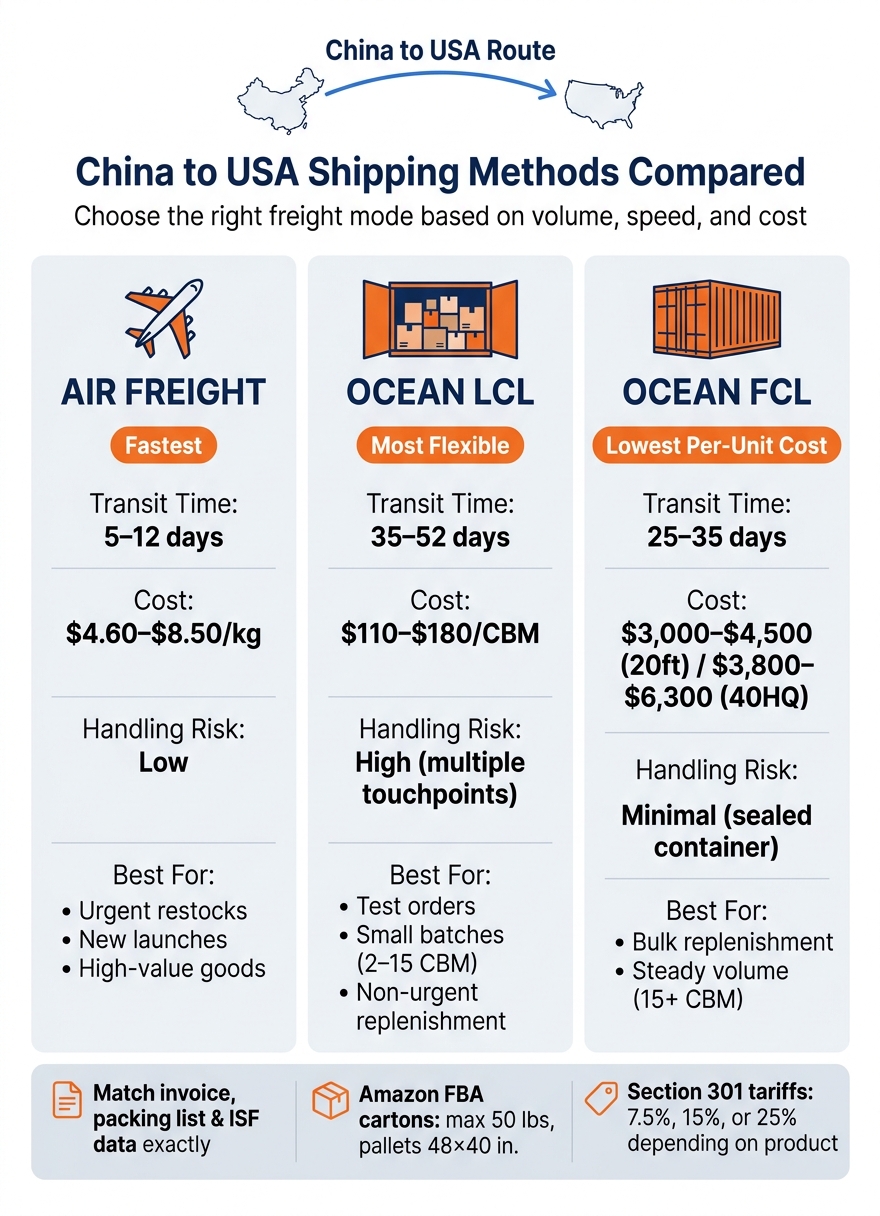
China to USA Freight Forwarding: Air vs LCL vs FCL Comparison
China to USA Freight Forwarders: In-Depth Comparison Guide #supplychainsecrets #amazonseller
sbb-itb-f9a91f9
Quick Comparison
| Method | Best For | Door-to-Door Time | Typical Cost | Main Tradeoff |
|---|---|---|---|---|
| Air Freight | Urgent restocks, launches, high-value items | 5–12 days | $4.60–$8.50/kg | Highest freight cost |
| Ocean LCL | Small orders, test shipments | 35–52 days | $110–$180/CBM | More handling and more delay risk |
| Ocean FCL | Bigger orders, steady replenishment | 25–35 days | $3,000–$6,300 depending on container | Needs more volume |
If I had to sum it up in one line: good freight forwarding is less about booking space and more about getting the paperwork, customs, and final delivery steps right.
How China to USA Freight Forwarding Works
Step-by-Step: From Factory Pickup in China to U.S. Delivery
A shipment moves through seven stages. If you know where one handoff ends and the next begins, it’s much easier to avoid delays. That’s where a freight forwarder comes in. They coordinate the move from pickup all the way to final delivery.
It starts with pickup scheduling. Your freight forwarder arranges pickup from major manufacturing hubs in China. If you’re shipping to Amazon FBA, you need to create the shipment plan in Seller Central first.
Next, the goods go to a consolidation warehouse for intake, basic quality control, and export customs declaration. For ocean freight, the forwarder also arranges VGM weighing. Once export clearance is done, the cargo moves to the port or airport for the main transit leg. That could be ocean FCL, LCL, or air freight, depending on your shipment size and how fast you need it to arrive.
When the cargo reaches a U.S. gateway, a licensed customs broker files the customs entry, classifies the goods, and handles duty payment, including Section 301 tariffs. After customs release, the cargo moves to a U.S. warehouse for FBA prep, then on to Amazon or another final destination.
Each stage relies on the right documents and clear ownership of each task.
Documents and Parties Involved at Each Shipping Stage
Most of the paperwork comes down to four parties: the supplier, the freight forwarder, the importer of record (IOR), and the licensed customs broker. Who does what depends a lot on the trade term you choose.
Under FOB, the buyer takes responsibility once the goods are loaded on board at the origin port. Under DDP, the shipment includes origin fees, transport, duties, and final delivery. Under DAP, the buyer handles import clearance and duty payment after arrival. And for Amazon FBA, that’s a problem, because Amazon warehouses do not accept DAP shipments.
| Document | Purpose | Primary Handler |
|---|---|---|
| Commercial Invoice | Product value, HTS codes, and country of origin for duty calculation | Supplier / Shipper |
| Packing List | Carton count, weight, and dimensions | Supplier / Shipper |
| Bill of Lading (B/L) | Legal title to goods and contract of carriage | Carrier / Forwarder |
| Air Waybill (AWB) | Contract of carriage for air shipments | Airline / Forwarder |
| ISF 10+2 | Security filing required at least 24 hours before vessel departure | Importer / Forwarder |
| Customs Bond | Financial guarantee to CBP for duty payment | Importer of Record |
| Arrival Notice | Confirms cargo has reached the U.S. port | Carrier / Forwarder |
Here’s one detail that trips people up: the commercial invoice, packing list, and ISF data should match exactly. Even a small mismatch can lead to customs holds or inspections.
Those documents set the next steps for the forwarder, broker, and importer.
What a Freight Forwarder Handles Beyond Booking Cargo
A freight forwarder does a lot more than reserve space with a carrier. For Amazon sellers, the job often stretches into FBA prep and delivery appointment scheduling too.
On the China side, that usually includes factory pickup, document checks, export customs declaration, AMS filing, and VGM weighing. During transit, the forwarder tracks the shipment and works with carriers as issues come up. On the U.S. side, they handle customs entry, HTS classification, Section 301 tariff consulting, duty payment, and port drayage.
For Amazon sellers, there’s another layer. Forwarders often manage FNSKU labeling, carton checks, and palletizing to 48×40 in. After that, they schedule the delivery appointment through Amazon’s Carrier Central.
The table below shows the main jobs a forwarder usually covers:
| Service Category | Tasks Handled |
|---|---|
| Origin | Factory pickup, export declaration, VGM weighing, consolidation, storage |
| Compliance & Customs | ISF 10+2 filing, AMS filing, HTS classification, customs bond, duty and tax prepayment |
| FBA Prep | FNSKU labeling, carton checks, palletization |
| Destination | Port drayage, LCL deconsolidation, Carrier Central scheduling, last-mile trucking |
HTS code consulting matters more than many importers think. A vague product description can trigger audits and penalties.
FCL, LCL, or Air Freight: How to Choose the Right Shipping Method
Pick your shipping method based on cargo volume, speed, cost, and inventory risk.
| Shipping Method | Transit Time (Door-to-Door) | Cost Profile | Handling Risk | Best-Fit Scenario |
|---|---|---|---|---|
| Air Freight | 5–12 days | Highest (per kg) | Low | Urgent restocks, new launches, high-value goods |
| Ocean LCL | 35–52 days | Moderate (per CBM) | High (multiple touchpoints) | Test orders, small batches, non-urgent replenishment |
| Ocean FCL | 25–35 days | Lowest (per unit) | Minimal (sealed container) | Regular bulk replenishment, large volume moves |
Start with volume first. Then look at speed and handling risk.
Ocean FCL: Best for Larger Shipments and Regular Replenishment
Full Container Load (FCL) means one shipper books the whole container. The most common setups are 20-foot containers for dense cargo and 40HQ containers for bulkier, lighter freight.
FCL starts to make sense once your shipment goes past 15 CBM. Under that point, you may be paying for space you don’t use. Over it, your per-unit cost usually drops compared with LCL. Your goods also move through fewer touchpoints because they skip consolidation and deconsolidation.
On price, a 20-foot FCL usually lands in the $3,000–$4,500 range all-in, while a 40HQ usually runs $3,800–$6,300 all-in, depending on the U.S. coast and market rates. If you replenish stock on a steady schedule, FCL is often the better fit.
Ocean LCL: Best for Smaller Volumes That Do Not Fill a Container
With Less than Container Load (LCL), your cargo shares a container with other shippers’ goods. You pay for only the space you use, which makes LCL a solid option for shipments in the 2–15 CBM range.
The downside is extra time and more touchpoints. Consolidation and deconsolidation usually add about 7–10 days to ocean transit, which pushes total door-to-door shipping time to about 35–52 days. And if one shipper’s cargo gets held or inspected, the whole container can get delayed.
LCL pricing usually runs $110–$180 per CBM all-in. For Amazon sellers, extra CFS handling time means you need more lead time. If you’re testing a new product or placing a first order, LCL is a practical way to start. But if your shipment size keeps going above 15 CBM, moving to FCL often cuts cost and lowers risk.
Air Freight: Best for Urgent Restocking, New Launches, and High-Value Cargo
Air freight moves goods from China to major U.S. cities in about 5–12 days. It’s also the most expensive option on a per-kilogram basis, usually $4.60–$8.50 per kg all-in.
Air shipments are billed by chargeable weight – either actual weight or volumetric weight, whichever is higher. That means carton size matters. Smaller cartons can lower chargeable weight and cut cost.
For Amazon sellers, air freight can make more sense than it seems at first glance. A stockout doesn’t only cost sales. It can also hurt your sales ranking. That’s why many sellers split shipments: send about 20% by air to cover near-term demand, while the other 80% goes by sea.
Use air freight for base-stock gaps, launches, and high-value goods when speed matters more than freight cost.
Next comes customs clearance, Amazon FBA prep, and delivery to the final destination.
Customs, Duties, Amazon FBA Prep, and Final Delivery
U.S. Customs Clearance, ISF Filing, Duties, and Common Compliance Risks
After booking and export, the shipment moves into the U.S. customs and delivery stage. At this point, origin logistics are mostly done, and customs clearance plus destination handling often become the main choke points.
ISF 10+2 has to be filed before the vessel departs. If the filing is late, missing, or wrong, you can run into major fines and delays. In most cases, your freight forwarder files the ISF for you, but the data still comes from you. If the shipment details are off, the risk is still yours.
Use the exact 10-digit HTSUS code for the product to cut down on holds and delays. It also helps to keep the commercial invoice, packing list, and ISF data aligned. When those documents don’t match, the odds of an X-ray inspection go up.
For Chinese-origin goods, duties may include the base tariff rate plus Section 301 tariffs of 7.5%, 15%, or 25%, based on the product category. On top of that, importers also pay the Merchandise Processing Fee (MPF) at 0.3464% of cargo value and the Harbor Maintenance Fee (HMF) at 0.125% of cargo value. A licensed customs broker usually handles entry filing and duty payment to CBP, and the broker fee is often $80 to $300 per shipment.
Here’s how the main tasks are usually split under FOB:
| Step / Requirement | Responsible Party (FOB) | Key Detail |
|---|---|---|
| ISF 10+2 Filing | Buyer / Forwarder | Filed 24 hours before vessel departure |
| AMS Filing | Carrier / NVOCC | Filed 24 hours before departure |
| HTS Classification | Buyer / Broker | 10-digit HTSUS code determines duty rate |
| Duties, MPF, HMF | Buyer | Base duty plus Section 301 tariffs, MPF, and HMF |
| Final Delivery | Buyer / Forwarder | Drayage, unloading, and final trucking to destination |
One issue that trips people up: wooden pallets and crates need a visible IPPC heat-treatment stamp. If that mark is missing, CBP can require forced fumigation at the terminal, which adds cost fast.
Once the cargo clears customs, the next checkpoint is Amazon prep.
Amazon FBA Prep: FNSKU Labels, Carton Labels, and Pallet Requirements
At the unit level, each sellable unit needs a scannable FNSKU. Poly bags also need suffocation warnings when required. If the FNSKU is placed wrong or can’t be scanned, Amazon may reject the units or charge relabeling fees.
At the carton level, every box needs an Amazon Box ID label on the outside. Each carton must stay at or under 50 lbs unless the item itself weighs more. This is one of those small details that turns into a headache later. Many Chinese factories pack cartons heavier by default, so it’s smart to confirm carton weight limits with your supplier before production wraps up.
For palletized shipments, check that wooden pallets show the IPPC heat-treatment stamp. If that can’t be confirmed, plywood pallets can work instead, since they don’t need the same fumigation certifications.
The safest move is to have your freight forwarder or a prep center check FNSKU labels and carton labels against the Amazon shipment plan before cargo leaves the origin warehouse. Fixing a label issue in China is usually far cheaper than fixing it after the container lands in the U.S.
U.S. Warehousing, Drayage, Trucking, and Delivery to Amazon or Other Destinations
After release, the next steps depend on whether the shipment moved as FCL or LCL. For FCL shipments, the container is picked up from the port by drayage and moved to a warehouse for unloading. For LCL shipments, the container usually goes first to a Container Freight Station (CFS) for deconsolidation, where your cargo is separated from the rest.
Sending cargo through a U.S. warehouse before Amazon gives you more control over the process. You can inspect for damage, fix label problems, build pallets that meet Amazon rules, and send inventory into FBA in smaller batches. That can help you avoid high Amazon storage fees while still keeping stock in place.
For delivery to an Amazon fulfillment center, you need a pre-scheduled appointment through Carrier Central. After Amazon receives and checks in the inventory, it is generally ready for sale within 3 to 7 business days.
Costs, Transit Times, and How to Plan Your Shipment
What Affects Total Landed Cost and Shipping Timelines
Once customs and prep are done, the next step is figuring out total landed cost and lead time.
Quoted freight is just one piece of the bill. Total landed cost also includes origin pickup, export filing, international freight, U.S. customs duties, terminal handling, drayage, and final-mile delivery to your warehouse or Amazon fulfillment center.
A few things tend to have the biggest effect on cost. Peak season is a major one: shipping between August and November usually costs 30% to 60% more than off-peak periods because of surcharges and port congestion. If you book between March and July, you can often save 20% to 40% on the same lane.
Air freight has its own pricing rules. Carriers charge based on actual weight or volumetric weight, whichever is higher. Duties and Section 301 tariffs add to landed cost too. Route matters as well. Shipping to East Coast ports like New York or Savannah usually adds about $500 to $1,000 compared with West Coast ports like Los Angeles.
The tricky part is that these cost drivers don’t hit every shipment the same way. A small test order, a steady container program, and an urgent restock can end up with very different math.
Common Shipping Scenarios for Amazon Sellers and Importers
Three shipping situations come up again and again for Amazon sellers and importers buying from China.
Scenario 1 – Small LCL test order:
If you’re launching a new product and want to test demand before paying for a full container, LCL usually makes sense. Expect door-to-door transit of about 35 to 52 days and all-in costs of roughly $110 to $180 per CBM. It’s smart to leave room in the schedule for destination handling before final delivery.
Scenario 2 – Regular FCL replenishment (20′ or 40′ container):
If the product is already selling and you need to restock on a steady schedule, FCL is often the better fit. Port-to-port transit is usually 15 to 18 days. That said, you still need buffer time for customs, booking, and peak-season congestion. On paper, the sailing might look short. In practice, the full timeline is longer.
Scenario 3 – Urgent air shipment before a stockout:
When inventory is getting tight and your next ocean shipment is still weeks out, air freight can buy you time. Air shipments from China can reach the West Coast in 3 to 5 days in transit, while standard air for larger loads often takes 7 to 12 days. Rates usually run $3.50 to $7.00 per kg. A lot of sellers handle this by sending the urgent units by air and the rest by sea.
Conclusion: Key Steps to Ship From China to the USA With Fewer Surprises
The right forwarding plan helps keep inventory moving without extra cost or delay. The best China-to-USA shipment comes down to balancing volume, speed, compliance, and total landed cost.
FAQs
How do I choose between air, LCL, and FCL?
Choose based on your timeline, budget, and cargo volume.
- FCL: Best when you can fill a 20-foot or 40-foot container. It’s often faster than LCL because the shipment goes through less handling.
- LCL: A good fit for smaller shipments, usually under 12–15 CBM, when you want to cut costs.
- Air: Best for urgent or high-value goods. But it costs a lot more, especially for bulky, lightweight items.
What documents do I need to import from China to the U.S.?
You’ll usually need a Commercial Invoice, Packing List, and a Bill of Lading or Air Waybill to clear customs and move the shipment.
For U.S. Customs, you’ll also need your Importer EIN/TIN, an ISF 10+2 filing before the vessel leaves port, a customs bond, and any product-specific compliance paperwork. That can include documents for FCC, CPSC, EPA, or FDA, depending on what you’re bringing in.
What can delay my shipment or customs clearance?
Delays usually come down to a few familiar problems: paperwork mistakes, missing documents, or failure to meet customs rules. One of the biggest trouble spots is mismatched details across the House Bill of Lading, commercial invoice, packing list, and Importer Security Filing (ISF).
Other common causes include:
- Late ISF filing
- Incorrect or unclear HTS classification
- Missing certificates for regulated goods
- Not having the required customs bond in place before arrival
It doesn’t take much. One wrong detail or one missing form can slow the whole shipment down.
发表回复