Amazon FBA Launch Cost Calculator: China to USA
If I don’t calculate landed cost before I place a PO, I’m guessing. And that guess can wipe out margin fast.
Here’s the short version: a China-to-USA Amazon FBA launch cost calculator should include product cost, origin pickup, freight, customs duty, MPF, HMF, ISF, brokerage, FBA prep, palletizing, storage, and final delivery to the Amazon FC. Then I divide the total by my unit count to get landed cost per unit in U.S. dollars.
What I need to check first:
- Shipping mode: express, air, ocean LCL, or ocean FCL
- Supplier terms: FOB or EXW
- Carton data: count, size, and gross weight
- Customs data: HTS code, FOB value, EIN/Tax ID, ISF for ocean
- Prep costs: FNSKU labels, poly bags, bubble wrap, pallet work
- Final math: total shipment cost, landed cost per unit, break-even price, and margin
A few numbers shape the decision fast:
- Ocean LCL: about $80–$150 per CBM
- Air freight: about $2–$4 per lb
- Express: about $4–$8 per lb
- Customs brokerage: about $80–$300 per shipment
- ISF filing: about $25–$50 per ocean shipment
- Late ISF penalties can start at $5,000
If I’m launching a small batch, air may cut transit time but push unit cost up hard. If I’m shipping more volume, ocean often lowers per-unit cost. The whole point of the calculator is simple: find the full cost before booking freight, then test two or three scenarios side by side.
UPDATED Amazon FBA Calculator – Google Sheets Spreadsheet
sbb-itb-f9a91f9
Step 1: Gather the inputs for your cost calculator
Before you run any numbers, get clean data from your supplier. If key details are missing – or worse, guessed – your freight quote can shift after booking. Carton dimensions and declared value are common trouble spots. And those details flow straight into the cost buckets in Step 2.
Product, order, and packaging data
Start with the core details: total unit count, your unit price, and the product category. Use either FOB or EXW pricing, since that changes who covers which costs.
If your product includes batteries, liquids, or magnets, flag it early. That can change the documents you need and, in some cases, duty rates too.
Then get the packaging data from your supplier:
- Total carton count
- Carton dimensions (L × W × H) in inches or centimeters for each carton type
- Gross weight per carton in lb/kg
You’ll use these figures to work out CBM for ocean freight and billable weight for air freight.
Quote accuracy comes down to the details matching the actual shipment: service scope, delivery point, labeling, and the weight method used by the carrier.
For air freight, calculate volumetric weight as well. The formula is:
Volumetric weight = (L × W × H in inches) ÷ 139; carriers charge the higher of actual or volumetric weight.
Freight and customs inputs
For the freight quote, collect the origin city or port in China, your destination Amazon FC code, and your shipping method.
| Shipping Method | Transit Time (China to USA) | Best For |
|---|---|---|
| Express Courier | 3–7 days | Samples, urgent lightweight goods |
| Air Freight | 5–10 days | New launches, high-value goods |
| Ocean LCL | 25–40 days | Small batches, cost-sensitive sellers |
| Ocean FCL | 25–35 days | Bulk orders, lowest per-unit cost |
Once you pick the lane, gather the customs details that affect duty and filing. You’ll need the 10-digit HTS code, the declared FOB value for duty calculation, and your Importer of Record details, including your EIN or Tax ID.
For ocean freight, the ISF must be filed at least 24 hours before vessel departure to avoid penalties. If the quote is DDP, ask for an itemized breakdown that shows ISF, brokerage, and delivery to Amazon.
Prep, labeling, and pallet inputs
Now record every prep fee that applies before the shipment reaches Amazon inbound. That includes FNSKU labeling, poly bagging, bubble wrap, FBA Box ID carton labels, and palletizing.
A couple of common benchmarks:
- FNSKU labeling starts around $0.10 per unit
- Palletizing starts at $25 per pallet
These inputs roll into the cost buckets in the next step.
Step 2: Calculate each cost bucket from China to Amazon FBA
Now that you have your inputs, the next move is simple: put a dollar amount on each cost bucket.
Some charges apply to the whole shipment. Others grow by unit, carton, or pallet. That split matters a lot. If you miss a shipment-level fee on a small test order, your margin can get hit fast.
Ocean and air shipping costs
Freight is usually the biggest number in the calculator.
For ocean LCL, you usually pay by CBM. A common range is $80–$150 per CBM from China to the US West Coast. For ocean FCL, pricing is based on the container itself: about $1,500–$3,500 for a 20-foot container and $2,500–$5,000 for a 40-foot container.
As a rule of thumb, FCL tends to make more sense once your shipment is above about 15 CBM. Below that point, LCL is often the better option.
For air freight, standard air is usually around $2–$4 per lb, while express courier is closer to $4–$8 per lb. And here’s the catch: carriers bill based on whichever is higher, actual weight or volumetric weight. So shaving down carton dimensions can lower air cost more than trimming product weight alone.
It helps to ask for an all-in quote that includes origin charges, freight, customs clearance, duty, and final delivery to the Amazon FC. That way, you see the full picture instead of chasing extra fees later. After freight is priced, move on to duty and import charges.
| Shipping Method | Typical Use Case | Main Cost Driver | Landed Cost Impact |
|---|---|---|---|
| Ocean FCL | Large volume (>15 CBM) | Per container rate | Lowest per unit |
| Ocean LCL | Small to mid-size shipments (<15 CBM) | Per CBM volume | Low to moderate |
| Air Freight | New launches, urgent restocks | Chargeable weight | High |
| Express Courier | Samples, urgent small boxes | Chargeable weight | Highest |
Customs duty, brokerage, and import charges
Duty is based on your declared value and the HTS code rate. For US imports, duty applies to the FOB value, not CIF. That detail is easy to miss, but it changes the math.
It also pays to check the HTS code early. A wrong code can change your duty rate and eat into your margin in a hurry.
On top of duty, add these import charges:
| Fee | Calculation Basis | Estimated Cost |
|---|---|---|
| Customs Brokerage | Per shipment | $80–$300 |
| ISF Filing | Per ocean shipment | $25–$50 |
| MPF | 0.3464% of cargo value | Min $31.67 / Max $614.35 |
| HMF (ocean only) | 0.125% of cargo value | 0.125% |
| Port and Terminal Fees | Per shipment/container | THC / DDC |
A good way to think about this:
- Brokerage and ISF are shipment-level fees
- MPF and HMF are based on cargo value
To find the per-unit effect, divide each shipment-level charge by your total unit count. Then fold those numbers into your launch cost per unit.
Prep, labeling, pallet, storage, and final inbound delivery
These costs show up after freight and before Amazon checks in your inventory.
Services like FNSKU labeling, poly bagging, and bubble wrapping are billed per unit. Carton labeling is billed per carton. Palletization is billed per pallet, and it’s required for LTL inbound shipments. If your goods sit in a US warehouse before the inbound appointment, storage is billed per cubic foot. Then you still have the final leg to Amazon, whether that’s SPD or LTL.
| Fee Type | Billing Unit |
|---|---|
| FNSKU Labeling | Per unit |
| Poly Bagging | Per unit |
| Carton Labeling | Per carton |
| Palletization | Per pallet |
| Customs Brokerage | Per shipment |
| Drayage/Trucking | Per shipment |
| Storage | Per cubic foot |
Step 3: Convert total shipment cost into landed cost per unit and launch margin
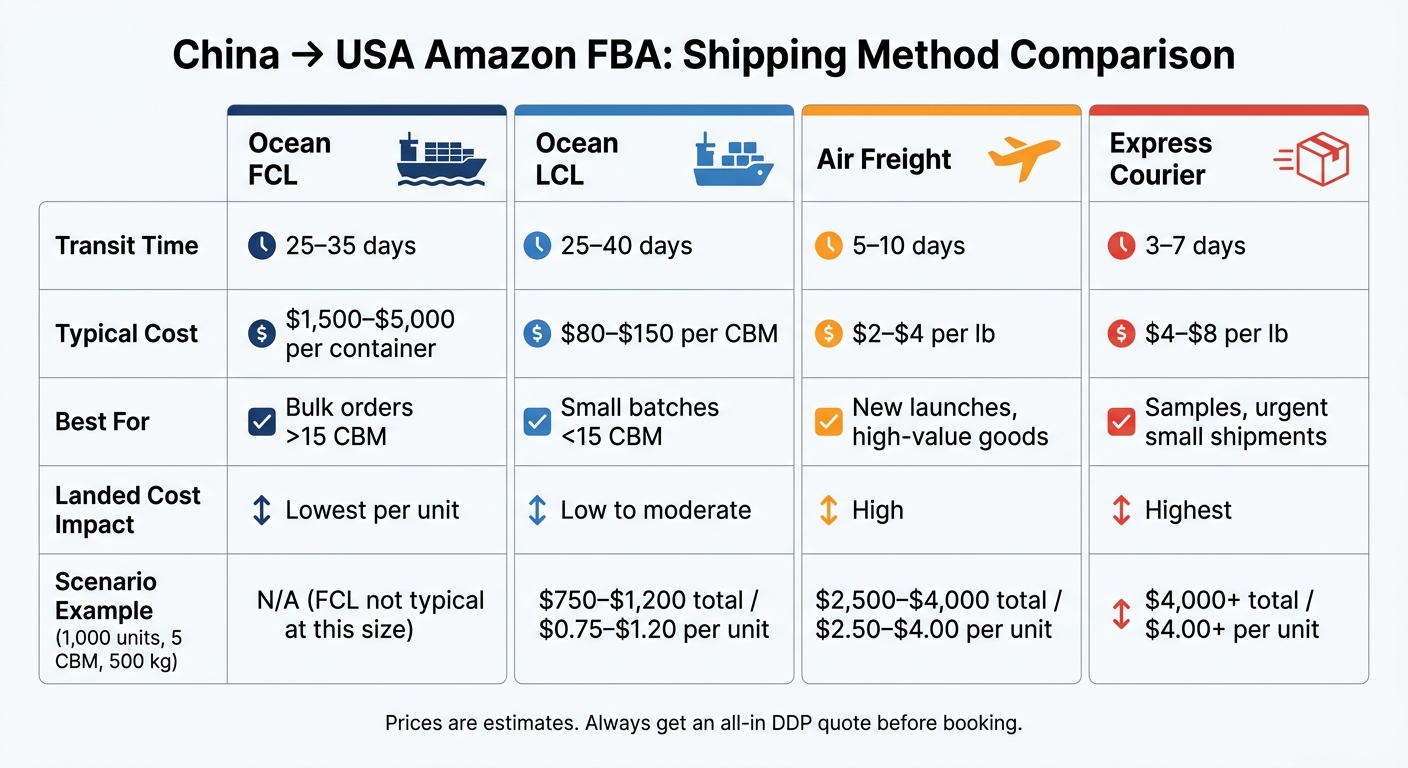
China to USA Amazon FBA Shipping Methods: Cost & Transit Time Comparison
The landed cost formula and per-unit calculation
Once you’ve priced each cost bucket, roll everything into one unit cost and check it against your target selling price.
Product cost + origin logistics + international freight + customs & duties + destination delivery + prep & labeling + pallet costs + initial storage = Total shipment cost
Then divide that total by your full unit count to get landed cost per unit.
Here’s where a lot of sellers get tripped up: some costs are fixed at the shipment level, while others apply to each unit. So you need to spread shipment-level fees across all units, then layer in the per-unit prep costs. That split matters. A shipment can look fine at 2,000 units and look much tighter at 500.
How to forecast launch margin with Amazon fees
Landed cost per unit tells you what it takes to get inventory into Amazon’s system. But it doesn’t tell you if the launch makes money.
To get that number, use this formula:
Net profit per unit = Selling price − landed cost per unit − Amazon referral fee − FBA fulfillment fee − storage
Margin % = net profit per unit ÷ selling price × 100
And if you want the floor price, use this:
Break-even price = landed cost per unit + Amazon-side fees
That gives you a quick read on whether your planned price still works after Amazon takes its share.
Compare launch scenarios before booking
Before you lock in freight, run two or three scenarios side by side. It’s a simple way to replace guesswork with math. Launch margin shifts fast when freight gets spread across different unit counts and shipping speeds.
Keep the shipment size and scope the same for each route. That way, you’re comparing apples to apples.
The table below uses a hypothetical 1,000-unit shipment (5 CBM, 500 kg) and typical China-to-USA freight ranges to show how the same product can look across three common launch routes:
| Scenario | Est. Total Shipment Cost | Landed Cost Per Unit | Transit Time | Margin Impact |
|---|---|---|---|---|
| Ocean LCL (DDP) | $750–$1,200 | $0.75–$1.20 | 30–40 days | Highest margin |
| Air Freight (DDP) | $2,500–$4,000 | $2.50–$4.00 | 7–12 days | Lower margin |
| Express Courier (DDP) | $4,000+ | $4.00+ | 3–5 days | Often uneconomical for launches |
After that, add Amazon referral and fulfillment fees to each scenario and see which route still supports your launch price.
A common play is to use air for the first batch, then switch to ocean for replenishment when speed matters more than unit cost.
Conclusion: Use the calculator to reduce cost surprises at launch
Build the calculator before you book anything. That one step helps you avoid landed-cost shocks at launch. Sellers who skip it often find margin problems after inventory is already inside Amazon’s network, and by then, fixing those problems can get expensive fast. That’s why the calculator isn’t just a spreadsheet. It’s a launch decision tool.
Use it like a checklist. First, verify your data. Then assign every cost. After that, test a few scenarios before you choose a freight method. In practice, that means four steps:
- Collect accurate shipment data, including packed carton dimensions, gross weight, and HTS codes
- Map each cost bucket from factory pickup to Amazon’s dock
- Divide the total by your unit count to get landed cost per unit
- Run at least two or three scenarios before you commit to a freight method
One more thing: always price freight by chargeable weight, not only scale weight.
For line-by-line quote inputs, FCLGO can supply the freight and fulfillment charges you need. FCLGO handles ocean and air freight, customs clearance, FBA prep, U.S. warehousing, trucking, drayage, and direct Amazon delivery.
Key takeaways for first-batch and restock planning
Keep these launch rules in mind:
- Hidden fees can eat into margins fast: ISF penalties start at $5,000 per late or incomplete filing, and customs bond costs, terminal charges, and Amazon Inbound Placement Service fees should all be part of your forecast.
- Use air for first-batch speed; switch to ocean for lower-cost replenishment.
- Check that DDP covers duties, final-mile delivery to the specific FC, and Amazon prep such as FNSKU labeling and palletizing.
Update the calculator with real quotes before every shipment.
FAQs
How do I choose between air and ocean for a launch?
Choose ocean freight for larger, planned shipments when you have 30 to 45 days of lead time. In most cases, it’s the lowest-cost option.
Choose air freight or express for launches, urgent restocks, or high-value, lightweight goods when speed matters and you need inventory in 5 to 10 days. With air, pay close attention to chargeable weight. A shipment can look light on paper but still cost more if the boxes are bulky.
What costs are often missed in landed cost?
Sellers often focus on the base freight rate and miss the extra charges that show up later.
That can include U.S. import duties, Section 301 tariffs, MPF, HMF, customs bonds, ISF penalties, and terminal handling charges.
Amazon adds its own layer of costs too. Common ones include inbound placement fees, storage, palletization, and FNSKU labeling.
Then there are the domestic shipping costs after the goods arrive, such as inland drayage and last-mile delivery. Packaging or labeling mistakes can also trigger added charges if your shipment doesn’t meet compliance rules.
How can I lower landed cost per unit before booking?
Focus on shipping prep and cost control.
If your cargo goes above 15 CBM, try to move it as FCL instead of LCL. That often cuts your cost. For smaller orders, combine shipments when you can so your LCL cost per unit drops.
Packaging matters too. Tight, efficient packing can lower dimensional weight and help you avoid paying for wasted space.
And before you book anything, ask for an all-inclusive, itemized quote. That way, destination charges or handling fees won’t sneak up and push your final cost higher.
发表回复