博客

  • FCLGO | DHgate Shipping to the US: Times, Costs, and the 2026 Customs Reality

    DHgate shipping to the US typically takes two to four weeks on standard options, one to two weeks on expedited services, and as little as 3–7 days on premium courier — with the exact window set by the individual seller, the shipping method chosen at checkout, and the season. Since 2025 there is a second half to that answer: the end of the de minimis exemption means US orders from DHgate now clear customs with duty assessed rather than entering duty-free, which changes the real cost of every method. This guide covers realistic delivery times, what drives the cost, the customs reality, and the smarter path for resellers moving volume.

    How DHgate Shipping Actually Works

    DHgate is a marketplace of independent sellers and agents — there is no single platform shipping rate. Each listing offers the shipping methods that seller has configured, priced by that seller. In practice that means:

    • The seller picks the carriers. The same product from two sellers can show different methods, prices, and delivery estimates at checkout.
    • Consolidation varies. Some sellers combine multi-item orders into one parcel; others ship separately, multiplying per-parcel minimums.
    • Tracking comes through the platform regardless of which courier is used underneath.

    This variability is why “how long does DHgate take” has no single answer — but the method tiers below hold across sellers.

    Typical DHgate Delivery Times to the US

    Method tier Typical window What it is
    Standard / economy ~2–4 weeks Postal-style and consolidated line-haul services; the default option on most listings
    Expedited ~8–15 days Faster line-haul with priority handling; mid-priced
    Premium express ~3–7 days Courier-style delivery, priced accordingly

    Treat these as planning ranges, not promises: peak season (October–December), Chinese New Year factory closures, and US customs examination can each add days to any tier. If a delivery date matters, buy the buffer, not just the cheaper method.

    What DHgate Shipping Costs

    Because sellers set prices, cost comparisons only make sense per order. The drivers, in order of impact:

    1. Chargeable weight — the greater of actual and volumetric weight, so bulky-light items (plush, foam, empty packaging) cost more than their scale suggests
    2. Method tier — premium express routinely runs several times the standard option on the same parcel
    3. Per-parcel minimums — many small parcels each pay a floor charge; consolidation into fewer, larger shipments wins on anything above a handful of items
    4. Fuel and seasonal surcharges — visible in Q4 pricing on most tiers

    The math for consolidated shipments is the same volumetric arithmetic professional forwarders use — the CBM calculator turns carton dimensions into the numbers any quote will be priced on.

    The Customs Reality Since 2025

    Through mid-2025, packages valued under USD 800 entered the US duty-free under the de minimis exemption, and most DHgate buyers never saw a customs line. That exemption was suspended — first for China-origin parcels, then across the board in August 2025 — and the suspension has continued into 2026. What that means in practice:

    • Duty is now assessed on commercial imports by HS classification, where previously small parcels often cleared free
    • Tariffs on Chinese-origin goods apply on top of standard duty rates, and those rates have moved repeatedly with trade policy — check the current schedule for your product before committing to a bulk order, not after
    • Someone handles entry. Small parcels are typically cleared under the carrier’s or platform’s arrangements with fees built into the shipping price; bulk shipments need a proper customs entry with an HS code lookup done in advance

    Buying to Resell? The DHgate-to-FBA Path

    For resellers, the checkout shipping calculator stops being the right tool once orders pass a few cartons. Shipping DHgate goods directly to an Amazon fulfillment center creates predictable problems:

    • FBA labeling. Amazon requires FNSKU labeling and compliant packaging; marketplace parcels arrive retail-packed, not FC-ready
    • Delivery appointments. FCs receive scheduled freight, not ad-hoc parcels — unannounced shipments get refused
    • No inspection layer. If the seller ships the wrong or damaged goods straight to Amazon, the problem surfaces as stranded inventory

    The standard solution is a prep-and-forward path: goods ship from the DHgate seller to a consolidation point in China, where they are inspected, relabeled, and consolidated with your other suppliers — then move to the US as one properly documented shipment. This is also where shipping as DDP pays for itself: duty is calculated upfront into one number instead of surfacing as surprise fees on arrival. The full cost anatomy of that lane is in our Amazon FBA shipping cost guide, and how these services are structured end to end is covered in the China freight forwarder guide. Sellers in the diecast and collectibles niche can see the same path applied end to end in our diecast wholesale guide.

    When a Freight Forwarder Beats the Platform Calculator

    • Volume. Above roughly half a cubic meter, consolidated freight with a forwarder typically undercuts per-parcel marketplace rates — and the gap widens with size
    • Multiple sellers. One consolidated shipment from five DHgate sellers beats five international parcels on cost, customs handling, and tracking sanity
    • Duty predictability. A forwarder’s DDP quote prices duty and fees before you commit, instead of the platform’s estimates meeting reality at the border
    • Deadlines. When inventory must hit an Amazon FC by a date, freight runs on booked capacity, not best-effort parcels

    For volume orders, a line-itemed quote through the quote form — origin charges, freight, duty, delivery, no lump sums — is the number to compare against the checkout calculator.

    Frequently Asked Questions

    How long does DHgate shipping to the US take?

    Typically 2–4 weeks on standard options, 8–15 days expedited, and 3–7 days on premium courier tiers. Add buffer in Q4 and around Chinese New Year, and always check the estimate shown on the specific listing at checkout.

    Do I have to pay customs on DHgate orders now?

    Yes, in most cases. The USD 800 de minimis exemption was suspended — for China-origin parcels first, then all countries from August 2025 — and the suspension has continued into 2026. Duty is assessed by product classification, with tariffs on Chinese-origin goods applied on top at current rates.

    Why is my DHgate tracking not updating?

    Commonly a lag between origin pickup and first line-haul scan, or a parcel sitting in consolidated transit where intermediate scans are batched. Gaps of several days are normal on economy tiers; if tracking is static for two-plus weeks, open a dispute window with the seller through the platform.

    Can I ship DHgate products directly to Amazon FBA?

    You should not. Marketplace parcels arrive without FNSKU labeling, FC-compliant packaging, or delivery appointments, and typically get refused. The standard path routes goods through prep and consolidation in China first, then to the FC as scheduled freight.

    Is it cheaper to use a freight forwarder for DHgate orders?

    Above roughly half a cubic meter — and especially across multiple sellers — consolidated freight usually wins on cost, and wins decisively on duty predictability and delivery reliability. For single small parcels, the platform’s standard shipping remains sensible.
  • FCLGO | Air vs Ocean Freight to Amazon FBA: The 2026 Decision Guide

    The air-versus-ocean decision for Amazon FBA freight from China comes down to one number: what a stockout costs you per day. Ocean moves a container for the price of a few air pallets but takes 25–40 days door to door; air delivers in 5–10 days at roughly USD 4–9 per chargeable kilogram. Every serious China-to-US seller uses both — the skill is deciding which shipment rides on which lane, and this guide gives you the framework, the 2026 cost ranges, and the crossover math to make that call shipment by shipment.

    For how forwarders structure these services, start with our China freight forwarder guide; for line-item pricing, the FBA shipping cost breakdown covers where each dollar goes. This article is the decision layer between them.

    The Decision at a Glance

    Factor Ocean freight Air freight
    Door-to-door transit 25–40 days (West Coast faster than East) 5–10 days
    Planning cost LCL USD 40–90/CBM; 40ft container USD 2,500–5,000 West Coast USD 4–9 per chargeable kg
    Best for Steady replenishment, bulky or heavy goods, margin-optimized SKUs Launches, stockout rescue, high-value dense goods, trend-driven products
    Capacity risk Port congestion, sailing schedule slips in peak season Space crunch and rate spikes around Q4 and Chinese New Year
    Cash flow impact More inventory dollars in transit longer Less capital tied up in transit

    What “Door to Door” Actually Takes

    The transit times above are not sailing schedules — they are the full chain: factory pickup, export clearance, main carriage, US customs, and final-mile delivery with an Amazon FC appointment. The main carriage is often the most predictable segment. The edges are where days disappear:

    • Ocean: a vessel may sail on schedule and still cost you a week in destination congestion, container pickup, and delivery appointment availability at the FC
    • Air: the flight itself is 1–2 days; the rest is consolidation at origin, tender to the airline, customs on arrival, and the last mile to the fulfillment center

    In Q4, add buffer to both lanes — appointment windows tighten and both ocean and air capacity runs hot from late October through the inventory cutoff season.

    The Cost Crossover: Where Air Stops Making Sense

    Air prices per chargeable kilogram — the greater of actual weight or volumetric weight (L×W×H in cm ÷ 6000 per piece). Ocean prices per cubic meter (LCL) or per container (FCL). Because the units differ, compare modes on landed cost per unit, not on the quote headline. A worked comparison for the same 5 CBM, 800 kg shipment, Shenzhen to ONT8, at mid-range 2026 planning rates:

    • Ocean LCL: 5 CBM @ ~USD 60 + origin/destination/delivery ≈ USD 900–1,200 all-in → ~7 weeks door to door
    • Air: 800 kg @ ~USD 6/kg ≈ USD 4,800 all-in → ~1 week door to door

    Four to five times the freight cost to save a month. That is the standard spread, and it frames the real question: is thirty days of extra selling time — or thirty days of avoided stockout — worth roughly USD 3,600 on this shipment? For a ranking BSR winner in Q4, yes without hesitation. For slow long-tail inventory, never.

    Run your own numbers before any quote: the CBM calculator gives you the volumetric figures both quotes will be priced on.

    When Air Freight Wins

    1. New product launches. First inventory should hit the listing fast to gather sales velocity and reviews while ad spend is live.
    2. Stockout rescue. When a best-seller is days from zero, air is not a transport decision, it is a ranking-preservation decision — recovery from a fall in organic position routinely costs more in advertising than the air premium.
    3. High-value, dense goods. When goods value per kg is high, the air premium as a percentage of landed cost shrinks to a rounding error.
    4. Trend and seasonal windows. Viral products and holiday-specific items earn nothing if they arrive after the wave — a portion of trend inventory belongs on air by default.

    Service context and current routing options are on the air freight service page.

    When Ocean Freight Wins

    • Predictable replenishment. Once a product has stable weekly sales, you can forecast 40 days ahead — ocean’s transit time becomes a calendar problem, not a risk.
    • Bulky, heavy, or low-value-density goods. Furniture, oversized items, and anything where freight per unit on air would exceed product margin.
    • Margin-optimized catalog. At scale, the 3–5× unit-cost gap between modes is the difference between a 25% and a 35% contribution margin on many imported SKUs.

    Structure options — FCL versus LCL, port pairs, and consolidation tactics — are covered on the ocean freight service page.

    The Hybrid Play: Split Shipments

    The most common advanced pattern costs nothing extra in strategy and saves five-figure mistakes: split every restock into a fast lane and a cheap lane. Send 2–4 weeks of cover stock by air, the remaining 8–12 weeks by ocean. The air tranche protects your ranking while the ocean tranche protects your margin. Sellers running this pattern typically reserve air for the top 20% of SKUs by revenue and ocean for everything else.

    Duty treatment is identical on both lanes — if you buy shipping as DDP, duty is bundled into one predictable number either way.

    Q4 2026 Planning Notes

    • Work backward from the FC, not forward from the factory. Fix your target receive date at the fulfillment center, subtract transit plus a 7–10 day buffer, and that is your booking deadline — not the day production finishes.
    • Book capacity early. Peak-season ocean space and air allocations tighten materially from late October; rates follow capacity.
    • Watch the calendar cliffs. Holiday inventory cutoffs and Chinese New Year factory closures are the two annual events that turn late booking from expensive to impossible.

    Frequently Asked Questions

    Is air or ocean better for Amazon FBA freight from China?

    Use both. Ocean for predictable replenishment and margin-sensitive goods at 25–40 days; air for launches, stockout rescue, and high-value goods at 5–10 days. Splitting each restock across both lanes is the standard pattern for established sellers.

    How much cheaper is ocean than air for FBA shipping?

    Typically 3–5× cheaper per unit on shipments above a few hundred kilograms. A 5 CBM shipment might cost USD 900–1,200 by ocean LCL versus USD 4,000+ by air at 2026 planning rates.

    How long does ocean freight take from China to a US Amazon warehouse?

    Plan on 25–40 days door to door including customs and FC delivery appointment, with West Coast destinations typically faster than East Coast. Add buffer in Q4.

    When should I use air freight to Amazon FBA?

    When a stockout or a missed launch window would cost more than the freight premium: new listings building velocity, best-sellers near zero stock, high-value dense products, and short-lived trend items.

    Can I ship part of my inventory by air and part by ocean?

    Yes — split shipments are the recommended default. Air carries 2–4 weeks of cover stock to protect ranking; ocean carries the balance to protect margin.

  • FCLGO | Amazon FBA Shipping Cost from China: 2026 Guide

    Amazon FBA shipping cost from China runs on five components: origin charges, freight (ocean or air), US import duties, destination handling, and final-mile delivery. Typical 2026 planning ranges: ocean LCL at USD 40–90 per CBM, a 40ft container at USD 2,500–5,000 to the West Coast, and air freight at USD 4–9 per chargeable kilogram — with duty added on top since the $800 de minimis exemption ended in August 2025.

    Those ranges hide as much as they reveal. This guide breaks down where each dollar goes, which numbers move week to week, and how to read a quote so the price you are shown is the price you pay. For carrier selection and service context, start with our China freight forwarder guide; this article is the cost layer on top.

    The Five Components of an FBA Shipping Quote

    Component What it covers Typical share of total
    Origin charges Pickup, export clearance, docs 5–10%
    Freight Ocean or air main carriage 40–60%
    Duty & fees HS-based duty, MPF, HMF 10–25% (product-dependent)
    Destination handling Entry filing, terminal, deconsolidation 5–15%
    Final-mile Delivery to FC with appointment 10–20%

    A quote that shows one lump number is not quoting these — it is guessing them. Ask for the breakdown; serious forwarders provide it by default.

    Ocean Freight: LCL vs FCL Cost Lines

    Below roughly 13–15 CBM, LCL (less than container load) prices per cubic meter and you pay only for the space you use. Above that threshold, a full container is almost always cheaper per unit. Two cost behaviors surprise first-time shippers:

    • LCL has minimums. A 1.5 CBM shipment often bills as 2–3 CBM minimum. Consolidating suppliers into one shipment beats three small ones on both freight and origin fees.
    • FCL quotes differ by port pair. Shenzhen–LA and Ningbo–LA can differ materially in the same week; routing flexibility is worth real money at container scale.

    Measure your cargo precisely — shippers routinely overpay by 10–20% on carton void space they never needed to ship. The CBM calculator turns your carton dimensions into the exact number your quote will be priced on.

    Air Freight: The Chargeable Weight Trap

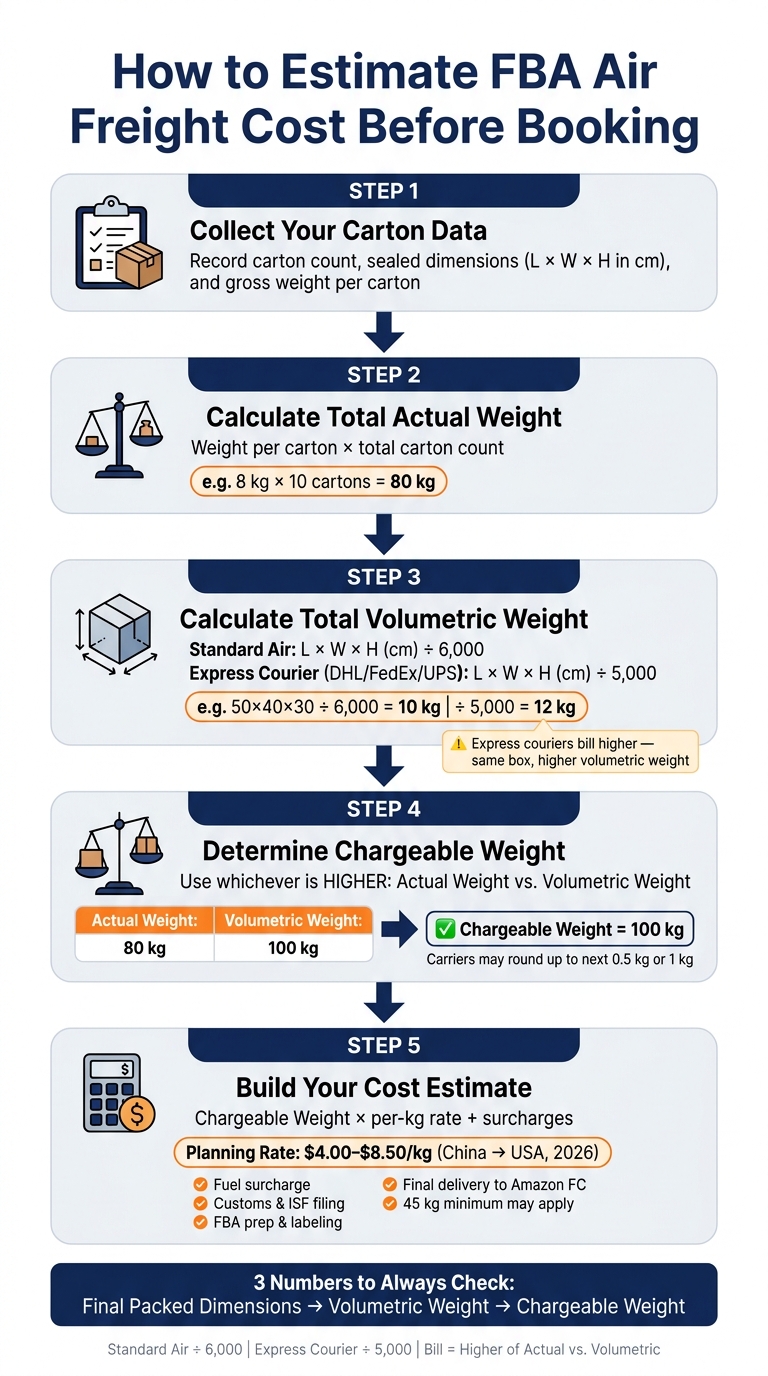
    Air prices per chargeable kilogram — the greater of actual weight or volumetric weight (L×W×H in cm ÷ 6000 per piece). Lightweight bulky cargo (plush toys, empty packaging, foam products) can pay for three “kilograms” of air per kilogram of goods. Compressing packaging before booking air is the single highest-ROI cost move in cross-border ecommerce.

    Current planning range: USD 4–9/kg door to door, tightening toward the top in Q4 and around Chinese New Year. For the time-cost tradeoff, see the transit-time tables in our DDP shipping guide. For the full decision framework between the two modes — crossover math, split-shipment strategy, and Q4 booking windows — see the air vs ocean freight comparison.

    Duties: The Cost Component That Changed

    Through mid-2025, many small sellers never saw a duty line — packages under $800 entered duty-free under de minimis. That exemption was suspended in August 2025 and the suspension was continued into 2026, so every commercial import now carries duty based on its HS classification. Practically:

    • Duty rates range from zero to double digits by product; classification errors are expensive in both directions
    • Merchandise Processing Fee and Harbor Maintenance Fee apply on formal entries
    • Buying shipping as DDP bundles duty into one predictable number; clearing it yourself (DAP) gives control at the cost of paperwork

    Look up your own codes in the HS code search tool before comparing any quote — duty is where lazy quotes hide their margins.

    Hidden Fees to Challenge in Any Quote

    1. “Destination charges” arriving after arrival — legitimate LCL charges exist (THC, drayage, deconsolidation) but must appear in the quote, not the invoice
    2. Congestion or peak-season surcharges — real in Q4, but a quote should state current surcharges, not reserve the right to add them silently
    3. Customs examination fees — exams happen; who pays when one hits should be written down before shipping, not negotiated at the port
    4. FC rejection/re-delivery — if Amazon turns the truck away, the second delivery attempt is a five-hundred-dollar surprise nobody quoted
    5. Currency and payment spread — quotes in RMB settled in USD (or vice versa) can carry a 1–3% FX margin

    A Worked Example: 8 CBM, 1,100 kg, Shenzhen to ONT8

    Planning arithmetic with mid-range 2026 numbers (your quote will differ; this is structure, not a price):

    • Origin + export: ~USD 150
    • Ocean LCL 8 CBM @ ~USD 60: ~USD 480
    • Entry + duty on, say, 5% goods value of USD 12,000: ~USD 680
    • Destination handling + final-mile to Inland Empire FC: ~USD 350
    • Landed total: ~USD 1,660 ≈ 14% of goods value — a healthy benchmark for LCL replenishment at this size

    Run your own numbers with the CBM calculator, then get a line-itemed quote through the quote form — comparing two itemized quotes against each other is how you find your real price.

    Frequently Asked Questions

    How much does it cost to ship from China to Amazon FBA?

    For planning: ocean LCL USD 40–90 per CBM, FCL 40ft USD 2,500–5,000 West Coast, air USD 4–9 per chargeable kg, plus duty at your HS rates. A typical 8 CBM LCL replenishment lands around USD 1,500–2,000 all-in.

    Is air or ocean cheaper for FBA restocking?

    Ocean is 3–5× cheaper per unit on anything above a few hundred kilograms. Air wins when a stockout would cost more than the freight premium — ranking loss during Q4 routinely exceeds the air surcharge.

    Why did my shipping cost go up in 2026?

    Two structural reasons: the de minimis suspension added duty to shipments that previously cleared free, and Q4 peak-season rates tightened capacity. Neither is temporary in the near term.

    What is the cheapest way to ship small FBA restocks?

    Consolidate multiple SKUs into one LCL or air shipment rather than shipping each separately — origin minimums and handling fees are per shipment, not per unit.

    Do freight forwarders charge for a quote?

    No. Quotes are free; treat any per-quote fee as a filter that just filtered out a forwarder.

  • FCLGO | What Is DDP Shipping? Complete 2026 Guide for Importers

    DDP shipping — Delivered Duty Paid — is an Incoterm in which the seller or their freight forwarder takes full responsibility for a shipment until it arrives at the buyer’s named destination: transport, export and import customs clearance, and all duties and taxes included in one price. The buyer receives the goods with nothing left to pay.

    Since the United States suspended the $800 de minimis duty-free exemption in August 2025 — a suspension explicitly continued into 2026 — practically every commercial import now clears customs with duty assessed. That regulatory shift turned DDP from a niche preference into one of the most searched terms in freight. This guide explains what DDP covers, how it compares to DAP and DDU, what it should cost, and when Amazon FBA sellers should use it when shipping from China with a freight forwarder.

    What DDP Shipping Includes: Who Does What

    Under DDP, one party owns the entire journey. Here is the responsibility map:

    Step Under DDP Who handles it
    Export packing & pickup Included Seller / forwarder
    Export customs clearance (China) Included Forwarder
    Main carriage (ocean / air / express) Included Forwarder
    US import customs entry Included Forwarder’s US broker
    Import duties & taxes (MPF, HMF, tariffs) Included in price Forwarder pays, bills in quote
    Final-mile delivery Included, to named destination Forwarder’s carrier

    The practical value is single accountability: when five vendors touch a shipment, DDP means one of them — the forwarder — owns the outcome end to end.

    DDP vs DAP vs DDU vs FOB vs EXW

    Most confusion around DDP comes from its neighbors. The differences come down to two questions: who clears import customs, and who pays duty.

    Incoterm Transport paid to Import clearance Duties paid by
    DDP Final destination Seller/forwarder Seller/forwarder
    DAP (Delivered At Place) Final destination Buyer Buyer
    DDU/DAP (legacy term) Final destination Buyer Buyer, on arrival
    FOB (Free On Board) Origin port only Buyer Buyer
    EXW (Ex Works) Not included Buyer Buyer

    Three notes sellers miss:

    • DDU is not a current Incoterm. It was folded into DAP in the ICC’s Incoterms 2020 rules. Quotes still say “DDU” — read them as DAP.
    • DAP plus a broker is not DDP. If your forwarder delivers DAP and hands you a customs bill at arrival, you carried the duty risk the whole way.
    • FOB looks cheaper because it is less. A FOB quote covers origin only; compare all-in totals before judging a DDP price.

    When DDP Makes Sense — and When It Doesn’t

    DDP fits best when:

    • You are an e-commerce seller without a US customs broker or importer setup
    • You ship to Amazon FBA — Amazon will not act as importer of record or pay duties
    • You want predictable, all-in cost per shipment for margin math
    • Your shipment’s value makes duty paperwork disproportionate to handle yourself

    Skip DDP (use DAP with your own broker) when you import at volume, hold your own importer-of-record number and bonds, and want to control duty timing and classification. Large importers often save meaningfully by clearing entries themselves — the DDP premium buys convenience, and at scale convenience gets expensive.

    DDP Shipping from China: How It Actually Works

    For China-origin cargo, DDP is normally sold by a freight forwarder, not the factory. A typical China-to-US DDP flow:

    1. Quote by CBM or kg — air DDP prices per chargeable kilogram, ocean DDP per cubic meter (estimate volumes with the CBM calculator)
    2. Cargo received at the forwarder’s China warehouse — inspected, consolidated, prepped
    3. Export clearance filed in China
    4. Main carriage — ocean 25–40 days door to door West Coast, air 5–10 days
    5. US entry filed by the forwarder’s broker — duties, MPF, and HMF paid under the forwarder’s importer setup or yours
    6. Final-mile delivery — to a warehouse, address, or Amazon fulfillment center with appointment

    The duty number itself comes from your product’s HS classification — which is why a serious DDP quote asks for product details first and gives a price second. Check your own codes with the HS code lookup before comparing quotes.

    Duties After the De Minimis Change

    For years, packages under $800 entered the US duty-free, and many small sellers never thought about customs. That ended: per US Customs and Border Protection, duty-free de minimis treatment was suspended for all countries effective August 29, 2025, and a February 2026 executive order continued the suspension. Every commercial import — including small e-commerce replenishments — now runs through formal or informal entry with duty assessed on its HS codes.

    The consequence for sellers is structural: someone must now own customs on every shipment. DDP is the cleanest answer when you do not want that someone to be you.

    DDP for Amazon FBA Sellers

    Amazon receives inventory; it does not import it. Amazon will not serve as importer of record, will not clear customs, and will not pay duties on your cargo. That leaves FBA sellers two options: register yourself as importer of record with a customs broker (DAP-style), or buy FBA fulfillment-bound shipping as DDP from a forwarder who handles the entry.

    This is why amazon FBA DDP shipping — door-to-door, duty-inclusive delivery from China straight into a fulfillment center — became the default question for FBA replenishment after de minimis ended. Two things to verify before you buy it:

    1. Who is the importer of record? A credible forwarder names a US entity and explains how your goods clear. A vague answer is the single biggest red flag in DDP.
    2. How is duty calculated? You should see HS codes, declared values, and duty lines in the quote — not one opaque lump sum.

    What a DDP Quote Should Include

    A professional DDP quote is itemized even though the price is all-in:

    • Origin charges and export clearance
    • Freight (with mode, routing, and transit days)
    • US entry filing, MPF and HMF fees
    • Duty by HS line, with rates shown
    • Final-mile delivery to your exact destination (an FC appointment, if FBA)

    Quotes that skip the duty breakdown are not cheaper — they are less honest. Under-declared values and misclassified goods are the two fastest routes to seized cargo, and a forwarder proposing either is proposing you take the fall. The red-flag list in our China freight forwarder guide applies doubly to DDP purchases.

    How Much More Does DDP Cost?

    Expect a DDP premium of roughly 10–20% over the same journey bought DAP with your own broker, driven by the forwarder’s duty financing and compliance overhead. Whether that premium is worth paying is arithmetic: below a few containers a month, the handling time and broker fees you avoid usually exceed the premium. At higher volumes, the math flips.

    Moving FBA inventory on a deadline? The ocean and air DDP services we run from Shenzhen cover entry, duty, prep, and FC delivery — request a line-itemed quote through the quote form and compare it against anything else you have.

    Frequently Asked Questions

    What is the difference between DDP and DAP?

    Delivery point is the same; customs responsibility differs. DDP: the seller/forwarder clears imports and pays duties. DAP: the buyer clears and pays. Post-de-minimis, a DAP buyer with no broker setup gets an expensive education at the port.

    Is DDU the same as DDP?

    No. DDU (Delivered Duty Unpaid) was renamed DAP in Incoterms 2020. Goods arrive delivered but duties and import clearance remain the buyer’s job — the opposite of DDP.

    Who is the importer of record in DDP shipping?

    Either the forwarder’s US entity or the buyer, depending on the contract — but the forwarder pays and manages the entry either way. Ask your provider to state this in writing; it defines who answers to customs if a shipment is questioned.

    Does DDP include customs clearance?

    Yes — both export clearance at origin and import clearance at destination, plus the associated fees and duties. That inclusion is the definition of the term.

    Is DDP more expensive than DAP?

    The sticker price is higher, typically 10–20%, because duty and clearance are bundled. Your true comparison is DDP price versus DAP price plus your own broker fees, duty handling time, and risk.

    Can I ship DDP by air from China?

    Yes. Air DDP is common for urgent restocks — per-kilogram pricing that includes clearance and duty, 5–10 days door to door, delivered to a warehouse or FC with an appointment.

  • FCLGO | China Freight Forwarder Guide 2026: FBA, Ocean, Air & DDP

    A China freight forwarder is a logistics company that arranges international shipping from China to overseas destinations — booking cargo space, handling export customs, preparing documentation, and coordinating delivery to Amazon FBA warehouses or other endpoints. For Amazon sellers sourcing from Chinese suppliers, the right forwarder is the difference between inventory arriving on time and stockouts that kill your ranking. For sellers buying through marketplaces, our DHgate shipping to the US guide covers delivery times, customs changes, and the consolidation path to FBA. Niche importers can also see the full chain applied to collectibles in our importing diecast cars guide.

    This guide explains what a China freight forwarder actually does, what services cost in 2026, how DDP shipping works, and how to vet a forwarder before you hand them a container of inventory. It is written from the operational side of the trade — the same questions we answer every day from sellers shipping from Shenzhen, Ningbo, and Shanghai to US fulfillment centers.

    What Is a China Freight Forwarder?

    A freight forwarder is not the ship, the plane, or the truck. It is the company that organizes all of them on your behalf: it books space with carriers, consolidates your goods with other sellers’ cargo when needed, clears exports through Chinese customs, arranges US import entry, and manages the final delivery appointment at an Amazon fulfillment center like ONT8 or SCK4.

    Sellers often confuse forwarders with the other players in the chain. Here is how they differ:

    Party What they do When you deal with them
    Freight forwarder Plans and coordinates the full door-to-FC journey; one point of responsibility You contract them; they manage the rest
    Carrier (shipping line / airline) Physically moves the cargo on a vessel or plane Only through your forwarder
    NVOCC / consolidator Issues its own bill of lading and consolidates LCL cargo Behind the scenes for LCL shipments
    US customs broker Files the import entry and pays duties on your shipment Usually engaged by the forwarder
    Amazon AGL (Amazon Global Logistics) Amazon’s own forwarding service for FBA Alternative option; fewer destinations and less flexibility

    The practical value of a forwarder is consolidation of responsibility. When five companies touch a shipment, having one of them own the outcome — rather than pointing at the others — is what you are paying for.

    What Services Does a China Freight Forwarder Provide?

    Ocean Freight: FCL and LCL

    Ocean is the backbone of China-to-US FBA replenishment. Full Container Load (FCL) means your cargo fills a 20-foot or 40-foot container alone — best above roughly 15 CBM. Less than Container Load (LCL) means your goods share a container with other cargo; you pay per cubic meter, and transit runs a few days longer due to consolidation and deconsolidation at both ends. Use our CBM calculator to see where your shipment falls.

    Air Freight

    Air moves in 5–10 days door to door and makes sense for restocks during a stockout, new product launches, or lightweight high-value goods. It is priced per chargeable kilogram (the higher of actual weight or volumetric weight), so dense cargo pays a premium. During Q4 peak season air capacity tightens and rates move weekly.

    Express and Small Parcel

    For samples, initial test orders, or sub-100 kg shipments, express networks (DHL, FedEx, UPS) booked through a forwarder are often cheaper than retail rates and arrive in 3–7 days.

    DDP Shipping to Amazon FBA

    DDP (Delivered Duty Paid) means your forwarder handles everything through delivery at the Amazon warehouse — export customs, ocean or air freight, US import clearance, and duties. The alternative, DAP or “self-clear,” means you or a separate broker act as importer of record and pay duties yourself.

    DDP is popular with FBA sellers because Amazon will not act as importer of record (see how FBA fulfillment works). A capable DDP forwarder has a US entity or broker partnership, provides a clean commercial invoice, and can show you exactly how duties are calculated — not just a lump number. Ask any DDP provider who the importer of record is and how duty is computed; vague answers here are the most common warning sign in the industry.

    FBA Prep Services

    Chinese-side prep includes FNSKU labeling, poly bagging, bubble wrap, carton repack, and palletizing to Amazon’s carton marking and pallet requirements. Doing prep in China is typically cheaper than US warehouse prep and reduces the risk of check-in problems at the fulfillment center.

    Customs Clearance and Documentation

    Export declaration in China, ISF filing for US ocean imports, HS code classification (see our HS code lookup), commercial invoices, packing lists, and certificates of origin. Misclassification and under-declared values are the two issues that most often trigger customs holds.

    Incoterms You Will Actually Use: EXW, FOB, DDP

    Three Incoterms cover almost every FBA shipment, and choosing among them decides who controls the journey:

    Incoterm Where responsibility starts Typical use
    EXW (Ex Works) Supplier’s factory floor — your forwarder picks up When you want full control and the best freight rate
    FOB (Free on Board) Goods loaded at the Chinese port The default with most suppliers; forwarder books from port onward
    DDP (Delivered Duty Paid) Everything through the FC door, duty included Hands-off shipping when the forwarder’s duty structure is sound

    EXW often yields the lowest total cost because your forwarder negotiates trucking and freight instead of the supplier marking those up — but it means your forwarder must handle factory pickup quality. FOB is the safe middle. DDP is simplest at the price of trusting your forwarder’s customs setup. Ask for quotes in two Incoterms and compare the totals before deciding.

    China to Amazon FBA: Routes, Times, and Costs

    Most FBA ocean cargo leaves from Shenzhen (Yantian), Ningbo, or Shanghai and discharges at Los Angeles/Long Beach or Oakland for West Coast fulfillment centers, or New York/Norfolk for East Coast destinations. From port, cargo trucks to the Inland Empire, Phoenix, or Stockton warehouse clusters where most FBA capacity sits.

    Route Typical door-to-door time Best for
    Shenzhen → LA/LB → ONT8 / LAX9 area FCs 25–35 days ocean Standard replenishment to West Coast FCs
    Shanghai → LA/LB → Phoenix / Goodyear area 28–40 days ocean GYR3, PHX7 and Southwest destinations
    Ningbo → Oakland → SCK4 / West Coast North 28–40 days ocean Northern California FCs
    Any port → East Coast ports 35–50 days ocean East Coast FCs when West Coast drayage is congested
    Air freight (any major airport) 5–10 days Stockout recovery, launches, Q4

    Costs move with fuel, capacity, and season. The ranges below are planning figures for 2026, not quotes — always confirm current rates for your specific cargo:

    Mode Typical 2026 range Notes
    Ocean LCL USD 40–90 per CBM Plus destination charges; break-even vs FCL around 13–15 CBM
    Ocean FCL (40ft, West Coast) USD 2,500–5,000 Highly seasonal; Q4 premium
    Air freight USD 4–9 per kg Chargeable weight = max(actual, volumetric)
    Express USD 6–12 per kg Small shipments only
    DDP surcharge Included or +10–20% Depends on duty profile of your HS codes

    When comparing quotes, insist on all-in pricing: origin charges, documentation, ISF, destination handling, and duty. A quote that looks 20% cheaper and later adds “destination charges” at arrival is not cheaper.

    How to Choose a China Freight Forwarder: 7-Point Checklist

    1. FBA-specific experience. Ask how many FBA shipments they moved last month and to which fulfillment centers. General cargo forwarders regularly mishandle Amazon’s appointment and labeling requirements.
    2. US import capability. A real broker relationship, ISF filing in-house, and a clear DDP structure — or the ability to ship DAP when you prefer your own importer of record.
    3. Appointment and delivery record. Delivery to an FBA center requires a carrier with an Amazon delivery appointment. Ask how they book and what happens when a FC rejects a truck.
    4. Transparent, all-in quotes. Line items you can reconcile: freight, origin, docs, clearance, duties, delivery. No lump sums.
    5. Communication cadence. One responsive contact who answers in hours, not days, and proactive updates when a vessel slips.
    6. Compliance basics. Help with HS classification, correct declared values, and product compliance (FDA, CPC, lithium marks) before cargo ships, not after it is held.
    7. References and track record. Years in operation, seller references, and a physical office you can visit or video-verify. A company with five years of FBA shipments can show all three.

    Freight Forwarder vs. Shipping Direct: Which Is Right for You?

    Situation Better option Why
    Supplier offers “free shipping to FBA” Independent forwarder Free shipping is priced in, often via slow consolidations with no visibility
    Large steady FCL volume, own customs broker Direct with carrier or NVOCC You have scale and control; a forwarder adds less
    New seller, first shipments Forwarder One accountable partner; mistakes are expensive to learn solo
    Urgent restock Forwarder with air expertise Booking speed and chargeable-weight optimization matter most

    Most sellers under roughly 10 containers a month get better outcomes with a forwarder: the coordination cost of managing carriers, brokers, and truckers yourself exceeds the margin you give up.

    Red Flags: Common Scams and Mistakes

    • Quotes far below market. Either capacity that does not exist or fees that appear after your cargo is in their warehouse — when you have no leverage.
    • Requests for 100% upfront payment to a personal account, or no written contract at all.
    • No company registration or physical address. Verify the business license (Chinese forwarders all have one) and video-verify the office if you cannot visit.
    • “DDP” with no explanation of duty. If they cannot say who the importer of record is and how duty is calculated, the “all-in” price is fiction — or your goods clear under someone else’s name, which creates risk for your account.
    • Under-declaration of value. It lowers duty slightly and exposes you to seizure and penalties. A forwarder proposing it is proposing you take the fall.
    • One WhatsApp handle and no company domain. Fraud almost always arrives with a personal account and a Gmail address.

    How to Reduce Your China-to-FBA Shipping Costs

    1. Consolidate suppliers before shipping. Three suppliers shipping 2 CBM each pay three minimum charges. One consolidation at a Shenzhen warehouse pays one. If your suppliers are clustered in one region, consolidation routinely saves 15–30% on LCL.
    2. Right-size the carton, not just the pallet. Air and express bill volumetric weight; ocean LCL bills CBM. Cutting carton void space 20% cuts the freight line item roughly the same.
    3. Ship ocean whenever your inventory plan allows. The classic discipline: replenish on a fixed ocean cadence (for example every 4 weeks) and reserve air for genuine stockout risk, not for schedule sloppiness. A single 500 kg air rescue flight can erase the savings of a quarter’s ocean shipments.
    4. Classify products correctly the first time. Wrong HS codes mean re-work fees and sometimes penalties. A forwarder who classifies before shipping (rather than guessing at the port) protects both cost and clearance speed.
    5. Avoid Q4 and pre-Chinese New Year peaks when possible. Ocean rates from China regularly jump 30–100% in the weeks before Chinese New Year and stay elevated through Q4. Shippers who move Q4 inventory in August and September buy the same service for materially less.

    Step-by-Step: Your First FBA Shipment Through a Forwarder

    1. Send your details for a quote: pickup city or supplier address, CBM and weight (calculate with the CBM calculator), destination FC code, and Incoterm (DDP or DAP).
    2. Confirm the plan and lead time. Get the all-in quote in writing, including duty treatment and the delivery appointment process.
    3. Ship or pickup from your supplier. The forwarder receives cargo at its Shenzhen or Yiwu warehouse, inspects quantity, and photographs condition.
    4. Prep and labeling. FNSKU labels, cartons to Amazon spec, pallets built to the FC’s requirements — verified against the checklist before dispatch.
    5. Export clearance and main carriage. Export declaration, vessel or flight booking, and tracking milestones shared with you.
    6. US import and delivery. ISF, entry, duty payment (DDP), then the final-mile appointment at the FC. Confirm check-in with photos of the signed delivery.

    Done well, your involvement is a handful of approvals — the forwarder’s job is that the rest happens without you chasing five vendors.

    Frequently Asked Questions

    Do I need a freight forwarder to ship from China to Amazon FBA?

    No, but you need someone to perform every function a forwarder performs: export handling, carriage, US clearance, and FC delivery. Suppliers’ “free shipping” and Amazon AGL both work in simple cases; a forwarder earns their fee on prep quality, duty structure, and problem recovery.

    What is the cheapest way to ship from China to Amazon FBA?

    Ocean LCL is usually cheapest per unit below ~13 CBM, FCL above it. The real cost question is all-in: a slightly higher freight rate with clean prep and no destination surprises usually beats the lowest headline number.

    What does DDP mean for Amazon sellers?

    Delivered Duty Paid — the forwarder clears US customs and pays duty, delivering to the FC with nothing owed at destination. Since Amazon will not act as importer of record, DDP (or setting up your own US importer of record) is the standard solution.

    How long does ocean shipping from China to a US fulfillment center take?

    Plan 25–40 days door to door to West Coast FCs and 35–50 days to East Coast, including customs and the delivery appointment. Add buffer during Q4 and Chinese New Year.

    Can a freight forwarder deliver directly to any Amazon warehouse?

    To most, yes — delivery requires an appointment and a carrier that meets Amazon’s requirements. Your forwarder should confirm the specific FC (for example GYR3 in Phoenix or ONT8 in Moreno Valley) before booking, since appointment availability varies by site and season.

    How are chargeable weight and CBM calculated?

    Air uses the greater of actual weight or volumetric weight (length × width × height in cm ÷ 6000 per piece). Ocean LCL prices per cubic meter — 1 CBM is one cubic meter of space. Both are calculated for you in our CBM and volumetric weight calculator.

    When should I ship to avoid Q4 and Chinese New Year delays?

    Move Q4 inventory by early September, and pre-CNY replenishment at least 3–4 weeks before factories close (CNY dates shift yearly; late January to mid February). Carriers cut sailings around CNY while pre-holiday volume spikes — capacity, not paperwork, is what gets tight.

    Get a China-to-FBA Shipping Quote

    FCLGO is a Shenzhen-based freight forwarder specializing in China-to-US Amazon FBA shipping — ocean, air, DDP, prep, and final-mile delivery to fulfillment centers nationwide, with five years of FBA shipments and 500+ seller clients. Send your pickup city, CBM and weight, and destination FC code through the quote form and you will receive an all-in, line-itemed quote — no lump sums, no destination surprises.

  • FCLGO | China to USA Ocean Freight Transit Times

    How Long Does Ocean Freight from China to USA Take?

    If I plan ocean freight from China to the U.S., I don’t use the carrier’s sailing time alone. I use the full door-to-door range: about 24–45 days for FCL and 40–70 days for LCL, with East Coast shipments (such as ABE1 in Pennsylvania) often taking 10–15 more days than West Coast moves — common West Coast destinations include ONT8 (Ontario, CA) and LAX9 (Los Angeles).

    Here’s the short version:

    • Port-to-port is not the full timeline
    • FCL usually arrives sooner than LCL
    • West Coast routes usually take less time than East Coast routes
    • Customs, port release, drayage, and Amazon FBA appointments can add days or weeks
    • I should add a 5–10 day buffer for planning, and more during August–November and before Chinese New Year

    How long does it take to ship from China to the US?

    Quick Comparison

    Shipment Type West Coast Door-to-Door East Coast Door-to-Door Main Reason It Takes Longer
    FCL 18–35 days 28–45 days Port handling, customs, inland delivery
    LCL 25–40 days 40–55 days CFS consolidation and deconsolidation

    A few numbers matter most:

    • Origin handling in China: 3–7 days
    • Ocean transit to West Coast: 12–22 days
    • Ocean transit to East Coast: 25–35+ days
    • U.S. customs and port release: 1–3 days, or 5–7 days if examined
    • Final delivery: 1–5 days
    • Peak season delays: often +7 days to +2 weeks

    So if I’m restocking inventory or sending goods to Amazon FBA, I should plan from the in-stock date backward, not from vessel departure. That keeps the schedule grounded in what happens in the full shipping chain, not just on the water.

    Shipping Time by Route and Shipment Type

    FCL Transit Times From Major China Ports to US West and East Coast Ports

    Once you know the overall shipping range, the next step is figuring out which route gets there faster.

    That mostly comes down to the lane you choose. Shipments from China to West Coast ports usually arrive sooner. If you’re shipping to East Coast ports like New York/New Jersey, expect more time because the ocean leg is longer.

    Use the table below as a benchmark for common lanes. These are total timelines, not just time spent at sea.

    For Amazon FBA, a good planning range is about 20–30 days to West Coast centers and 35–45 days to East Coast centers.

    LCL Transit Times and Why LCL Usually Takes Longer

    LCL uses the same ocean routes as FCL, but the total timeline is longer. The reason is simple: there are more stops and more handoffs.

    At origin, LCL cargo goes to a Container Freight Station (CFS), where it waits to be grouped with other shipments before the container is sealed and sent to the port. After arrival in the U.S., that same container is moved to another CFS, unpacked, sorted, and then sent out for final delivery.

    There’s also a timing gap at cut-off. LCL cargo usually needs to reach the CFS 2–4 days before the vessel’s estimated departure. FCL cut-offs are often just 1–2 days before departure. So if you miss the weekly LCL consolidation window, you may have to wait for the next vessel.

    And because LCL is shared space, one company’s paperwork problem can hold up the whole container.

    That’s why LCL usually takes longer than FCL even when both move on the same route.

    FCL vs. LCL by Common China–USA Routes: Comparison Table

    The table below shows how transit ranges shift across common China–US lanes.

    Route FCL Port-to-Port FCL Door-to-Door LCL Port-to-Port LCL Door-to-Door Extra Days (LCL)
    Shanghai to Los Angeles 14–18 days 20–35 days 15–21 days 28–38 days 3–10 days
    Shenzhen to Los Angeles 14–18 days 20–30 days 17–25 days 28–38 days 3–10 days
    Ningbo to Seattle 15–20 days 25–35 days 18–24 days 30–40 days 5–7 days
    Shanghai to New York/New Jersey 25–35 days 35–50 days 32–42 days 45–60 days 5–10 days
    Shenzhen to Savannah 25–35 days 35–50 days 32–42 days 45–60 days 5–10 days

    Door-to-door times include origin handling, U.S. customs clearance, and final delivery.

    If your shipment is over 15 CBM, it’s smart to compare 20-foot FCL pricing with LCL. At that size, FCL often arrives faster and can come in at a similar or even lower total cost.

    Step-by-Step Timeline From Supplier Pickup to Final Delivery

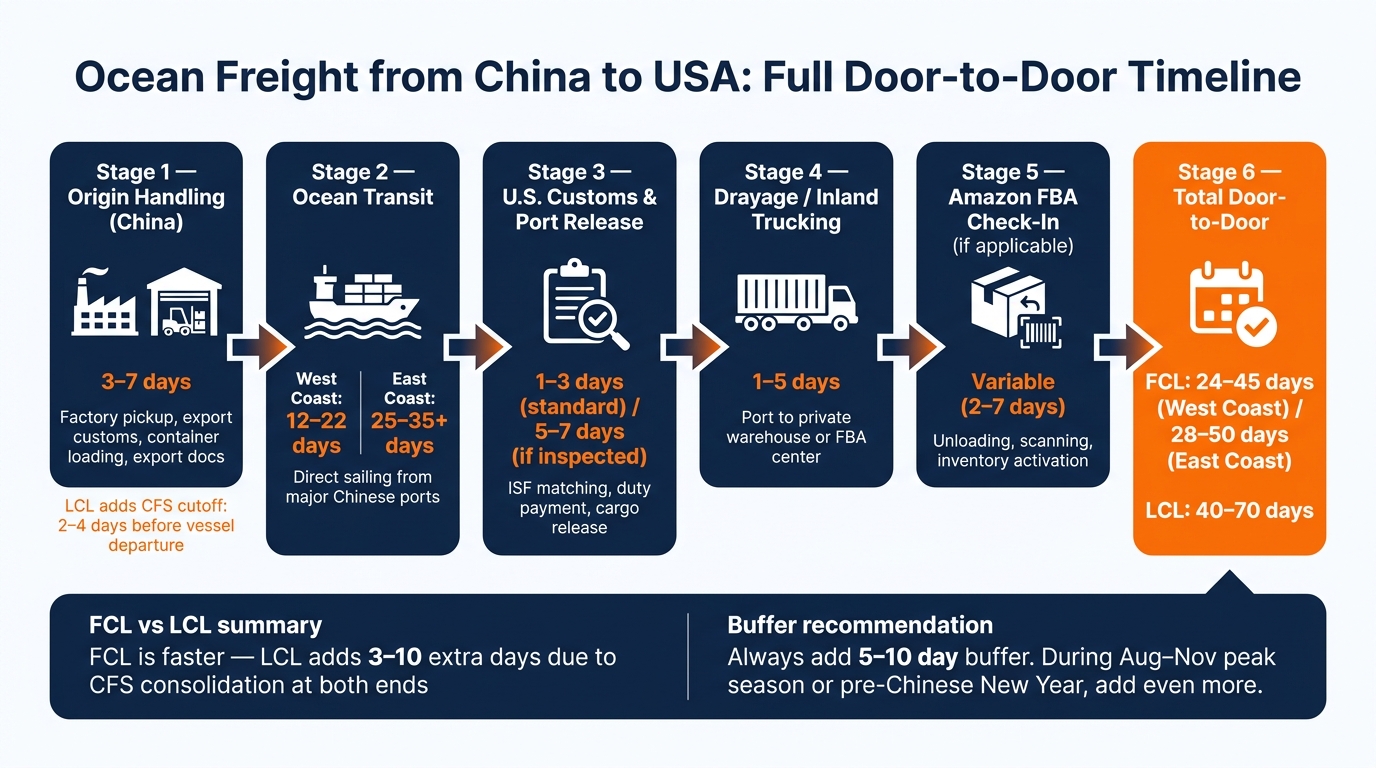
    Ocean Freight from China to USA: Full Door-to-Door Timeline

    Ocean Freight from China to USA: Full Door-to-Door Timeline

    The ranges above are total door-to-door estimates. This breakdown shows where the time actually goes.

    Origin Handling in China

    Origin handling in China usually adds 3–7 days before the vessel sails. That includes supplier pickup, container loading for FCL or delivery to a Container Freight Station for LCL, export paperwork, and Chinese customs clearance.

    For LCL, one timing issue matters a lot: the CFS cutoff. It’s usually 2–4 days before vessel departure. Miss that cutoff, and your cargo may wait for the next sailing.

    File the Importer Security Filing (ISF 10+2) early. It must be submitted to U.S. Customs at least 24 hours before the vessel departs China. If you miss that deadline, you can face $5,000+ in penalties and slower cargo release.

    Ocean Sailing, U.S. Customs, and Port Release

    Ocean transit usually takes 12–22 days to the West Coast and 25–35+ days to the East Coast.

    After the vessel arrives, U.S. Customs clearance and port release often take 1–3 days if your commercial invoice, packing list, bill of lading, and ISF filing are all in order. If CBP selects the shipment for an X-ray or physical exam, that can push the timeline to 5–7 days. And yes, that often means extra storage and labor charges too.

    Final Delivery to a Warehouse or Amazon FBA Center

    Amazon FBA

    Once the shipment clears the port, drayage and inland trucking to a private warehouse usually add 1–5 days.

    Amazon FBA adds one more step. Delivery to a fulfillment center needs a pre-scheduled appointment, and Amazon’s receiving and check-in process can add several more days before your inventory shows as available.

    Here’s how the full timeline stacks up:

    Shipping Stage Typical Duration What Happens
    Origin Handling 3–7 days Factory pickup, export customs, loading, export documentation
    Ocean Transit (West Coast) 12–22 days Direct sailing from major Chinese ports
    Ocean Transit (East Coast) 25–35+ days Sailing to East Coast ports
    U.S. Customs & Port Release 1–3 days (up to 5–7 days with exam) ISF matching, duty payment, cargo release
    Final Delivery / Drayage 1–5 days Trucking to warehouse or Amazon FBA center
    Amazon FBA Appointment and Check-In Variable Unloading, scanning, and inventory activation

    Add those stages together, and FCL door-to-door usually takes 20–50 days. LCL usually takes 30–70 days because of consolidation and deconsolidation at both origin and destination.

    These stages give you the baseline. The next part is what slows things down.

    What Speeds Up or Delays an Ocean Freight Shipment

    Route, Port, and Seasonal Factors

    Once you know the baseline transit time, the next thing to watch is what pushes that timing up or down. One of the biggest factors is which U.S. coast your shipment is heading to. West Coast ports usually land in the 12–20 day range, while East Coast ports are more like 25–35 days.

    Routing matters too. If your cargo goes on a transshipment route instead of a direct sailing, that can tack on 5–10 extra days. It’s the shipping version of taking a connecting flight instead of flying nonstop.

    Season timing can also throw things off fast. Peak season runs from August through November, and the period before Chinese New Year – usually January and February – often brings vessel congestion, blank sailings, and equipment shortages. In those windows, 7+ day delays are common. Booking 2–4 weeks in advance can help lower the odds of missing your planned sailing.

    Documentation, Customs, and Delivery Appointment Issues

    A lot of delays don’t happen on the water. They happen on paper.

    If your commercial invoice, packing list, and bill of lading don’t match, or your HTS codes are wrong, customs may hold the shipment. That can add 3–7 days, and in some cases it can even lead to seizure.

    And even after the cargo clears the port, the last leg can still slow you down. Busy Amazon fulfillment centers often need pre-scheduled delivery appointments, and a missed appointment window can add several more days.

    Common Delay Factors and Their Typical Time Impact: Comparison Table

    Use the table below to see how each delay affects transit time.

    Delay Factor Where It Occurs Typical Time Added What to Do
    Peak Season / Chinese New Year Entire route +1–2 weeks Book 2–4 weeks in advance
    Blank Sailings Origin port +7 days or more Build extra buffer time into your plan
    Direct vs. Transshipment Routing Ocean transit +5–10 days Choose direct service when lead time is tight
    Customs Inspection or HS Code Error US port / customs entry +3–10 days Verify HTS codes and ensure all documents match exactly
    Missed Consolidation Cutoff Origin +7–10 days Use FCL for shipments over 15 CBM
    Port Congestion US port +2–5 days Build in extra buffer time
    Amazon FBA Appointment Final mile +2–7 days Confirm warehouse appointments early
    Missing Required Certificates Destination port Multi-week delay at port Check FCC, CPSC, or EPA requirements before shipping

    These buffer days matter when you’re planning restocks and setting delivery dates. A shipment can look on time on paper, then slip by a week because of one missed cutoff or one customs issue.

    How to Plan Ocean Freight for Inventory Restocking and FBA Replenishment

    How to Work Backward From Your Target In-Stock Date

    The best way to build a shipping schedule is simple: start with the date your inventory needs to be available at your warehouse or Amazon FBA fulfillment center, then work backward from there.

    That means you don’t plan from the day the factory says it’s done. You plan from the day the stock must be live, then subtract each part of the trip.

    Use these stages to map out your shipment calendar:

    Phase FCL Time LCL Time
    Origin handling (China) 3–7 days 7–14 days
    Ocean transit (West Coast) 14–18 days 20–30 days
    Ocean transit (East Coast) 25–35 days 32–45 days
    US customs & port release 5–7 days 7–10 days
    Final delivery to FBA 2–5 days 3–7 days
    Total door-to-door 24–45 days 40–70 days

    You’ll also need to subtract production lead time before transit and delivery. And don’t skip the buffer. Add 5–10 days for customs holds, appointment changes, or carrier schedule shifts. During peak season, add even more.

    How FCLGO Reduces Handoffs and Timeline Risk

    FCLGO

    Every handoff in the shipping process creates one more place where things can slow down. Factory to trucker. Trucker to port. Port to customs broker. Customs broker to drayage carrier. It adds up fast.

    More handoffs usually means more room for delay, missed updates, or simple confusion.

    Once your schedule is in place, one of the biggest problems is avoidable handoff delay. FCLGO can handle pickup, booking, customs, drayage, and FBA prep in one workflow. That cuts down on handoff delays and helps keep shipments on schedule. With one coordinator managing the flow, it’s easier to avoid missed deadlines.

    Conclusion: The Transit Time Numbers Importers Should Use for Planning

    FCL door-to-door from China to the US West Coast typically runs 24–45 days; LCL runs 40–70 days. If you’re routing to the East Coast, plan for about 10–15 extra days compared with the West Coast.

    For day-to-day planning, the takeaway is pretty clear:

    • FCL is faster and more predictable than LCL
    • West Coast ports are quicker than East Coast ports
    • A carrier’s quoted transit time is not your full door-to-door timeline

    So if you’re planning a restock or an FBA replenishment, use the full lead time, not just the time on the water. That means production, origin handling, ocean transit, customs, and final delivery all need to be in the calendar. Then add a 5–10 day buffer so one delay doesn’t turn into a stockout or a missed launch window.

    FAQs

    How early should I book ocean freight from China?

    Book ocean freight as early as you can, especially when you’re working toward a hard deadline. Once your cargo details are set, lock in the booking. That gives you a better shot at securing space, since rates and carrier availability can shift.

    It also helps to plan for the entire move, not just the time on the water. That includes export operations, ocean transit, customs clearance, and inland delivery. With total door-to-door transit times often landing between 20 and 70 days, it’s smart to begin the booking process weeks before your target replenishment or launch date.

    When should I choose FCL instead of LCL?

    Choose FCL (Full Container Load) when your shipment is more than 15 cubic meters. It usually makes more sense for large, regular inventory restocks because the cost per cubic meter is lower, and transit is often faster.

    FCL can also cut handling risk. The container stays sealed from origin to destination, which means fewer touchpoints along the way. It also skips the extra port time that comes with LCL consolidation and deconsolidation.

    What is the safest buffer to add for Amazon FBA shipments?

    For Amazon FBA shipments, the safest buffer is at least two to four weeks beyond your estimated port-to-port transit time.

    Ocean transit to the U.S. West Coast usually takes 25 to 35 days. But that’s only the water portion of the trip. Origin handling, customs clearance, port congestion, and final trucking to Amazon fulfillment centers can all slow things down.

  • FCLGO | FBA Partial vs Split Shipments

    Partial vs Split Shipments for FBA

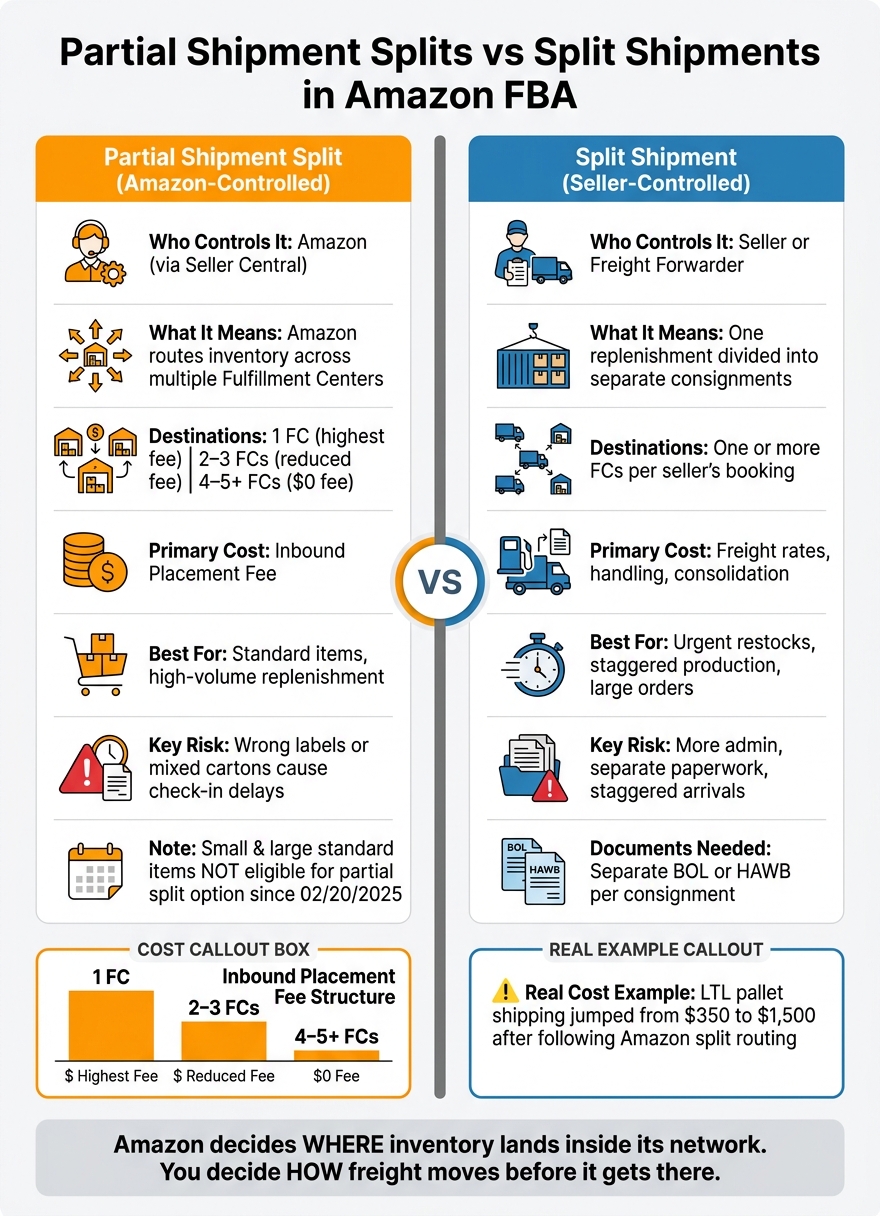
    These two terms are not the same, and mixing them up can cost you money. In Amazon FBA, a partial shipment split is Amazon’s inbound placement choice. A split shipment is your freight choice, like sending part by air and part by ocean.

    Here’s the short version:

    • Amazon controls partial shipment splits
    • You control freight split shipments
    • Amazon may route inventory to multiple fulfillment centers — for example, West Coast units often go to ONT8 or PHX7, while East Coast units may be directed to ABE1 or BFI1y to 1 FC, 2–3 FCs, or 4–5+ FCs
    • 1 FC usually means the highest placement fee
    • 2–3 FCs can mean a lower fee
    • 4–5+ FCs can mean $0 placement fee
    • Since 02/20/2025, small standard and large standard items are not eligible for the partial shipment split option
    • If cartons, labels, or Shipment IDs do not match Amazon’s routing, check-in can slow down if you don’t follow a step-by-step shipping guide
    • One seller reported LTL pallet shipping jumping from $350 to $1,500 after following Amazon’s split routing

    If I had to sum it up in one line, it would be this: Amazon decides where inventory goes inside its network, while I decide how the freight moves before it gets there.

    Partial Shipment Splits vs Split Shipments: Amazon FBA Guide

    Partial Shipment Splits vs Split Shipments: Amazon FBA Guide

    How To Get Amazon Optimized Shipment Splits – FBA Send to Amazon Flows

    Quick Comparison

    Point Partial Shipment Split Split Shipment
    Who controls it Amazon Seller or forwarder
    What it means Amazon places inventory across FCs I divide one replenishment into separate consignments
    Main cost Inbound placement fee Freight, handling, and paperwork
    Common use Lower Amazon placement cost Urgent air freight restocks, batch production, large orders
    Paperwork Shipment IDs and FBA labels Separate tracking and transport documents
    Main risk Wrong labels or mixed cartons More admin and separate arrivals

    So when I book freight, print labels, or plan replenishment timing, I need to treat these as two separate decisions. That’s the whole point of this article.

    How Partial Shipment Splits Work in Amazon FBA

    How Amazon Routes Inventory Across Fulfillment Centers

    Amazon gives sellers three inbound placement options in the Send to Amazon workflow. Each option sends inventory to a different number of fulfillment centers.

    Destinations Fee
    1 FC Highest fee
    2–3 FCs Reduced fee
    4–5+ FCs No fee ($0)

    Amazon decides placement based on product mix, inventory levels, customer demand, and FC capacity.

    After Amazon assigns those FCs, your part is pretty simple in theory: make sure each split is prepped right and each carton gets the right label. That’s where a lot of sellers trip up.

    Booking Steps After Amazon Assigns Multiple FCs

    Start by matching every Shipment ID to its FC code before you print labels. That matters because Amazon can assign separate Shipment IDs even when two splits are headed to the same FC.

    If you want the $0 option, there’s a strict rule: each SKU must ship in at least five identical cartons or pallets, with the same quantities and the same carton mix.

    One thing to keep straight: Amazon controls the placement split. The freight split is a separate piece.

    Receiving Timelines and Check-In Delays

    Each FC in a split receives and checks in inbound freight on its own timeline. So it’s normal for one destination to move ahead while another lags behind.

    Delays often happen when sellers mix split shipments together or use the wrong labels and Shipment IDs. In plain English, if the cartons don’t match the routing Amazon set, check-in can slow down fast.

    That’s Amazon-controlled routing, not seller-controlled freight planning.

    Split Shipments as a Freight Planning Tool for FBA

    Seller-controlled split shipments are a freight planning move. One replenishment goes out in two or more separate consignments. After Amazon assigns the destination FCs, the seller chooses how to divide the freight.

    When to Split One Replenishment Into Multiple Consignments

    The most common reason is stockout risk. Splitting a replenishment lets you send part of the inventory on a faster mode while the rest moves on a lower-cost option.

    Another common reason is large orders or staggered production. A supplier might finish goods in batches, or the purchase order may be too big for one load. In those cases, breaking the shipment into smaller consignments can make planning easier. The tradeoff is cost: multiple smaller consignments usually increase freight spend, so it makes sense to compare total landed cost before you commit to the split.

    Booking and Documentation Across Each Consignment

    Each consignment needs its own booking reference, label set, and transport documents. For LTL, that also means a separate Bill of Lading. Even when the goods are the same or headed to the same fulfillment center, Amazon treats each consignment as its own shipment. So each one must be labeled and prepped separately.

    A freight forwarder can handle the moving parts across both consignments, including air, ocean, customs clearance, warehousing, and delivery.

    How Staggered Consignments Affect Amazon Receiving

    When split consignments show up at different times, Amazon receives and processes each one on its own. If one consignment has different prep standards or missing paperwork, the later arrival is more likely to run into check-in delays. That’s why it helps to keep labels, carton prep, and shipment details the same across all consignments.

    Those shipment-level choices shape cost, booking workload, and receiving speed.

    Partial Shipment Splits vs Split Shipments: Direct Comparison

    Amazon controls inbound placement splits. You control freight splits. Once that line is clear, the main issue comes down to cost, control, and receiving speed.

    Who Controls the Split, Where Inventory Goes, and What It Costs

    Amazon splits mainly affect placement fees. Freight splits mainly affect freight spend, handling, and consolidation costs. For small and large standard items, sellers can choose between a single-FC split with a fee or an Amazon-optimized split to 4 or more FCs if the shipment qualifies. Amazon-optimized routing can remove the placement fee, but it can also push up your total shipping spend because you’re sending smaller loads to more destinations.

    Factor Amazon-Controlled Split Freight Split Shipment
    Controlled by Amazon via Seller Central Seller or freight forwarder
    Destinations Multiple FCs based on Amazon routing One or more FCs per your booking
    Primary cost Inbound placement fees Freight rates, handling, consolidation
    Best for Standard items and high-volume replenishment Urgent restocks and larger replenishments

    A simple way to think about it: Amazon decides where inventory lands inside its network, while you decide how freight moves before it gets there. That difference matters. One choice can trim placement fees. The other can help you time inventory flow with a lot more precision.

    Booking Steps, Tracking, and Receiving Complexity

    Amazon-controlled splits live inside Seller Central. Freight split shipments happen across separate bookings with your carrier or FBA prep and warehousing partner. That means more moving parts.

    Each freight consignment needs its own booking reference, transport documents, and tracking number – whether that’s a Bill of Lading for ocean freight or a House Air Waybill (HAWB) for air. If something breaks, gets delayed, or goes missing, you need to trace it back to the exact consignment, not just the Shipment ID.

    Step Amazon-Controlled Split Freight Split Shipment
    Booking Inside Seller Central workflow Separate bookings per consignment
    Documents Multiple Shipment IDs + FBA labels Multiple BOLs or HAWBs
    Tracking Integrated in Seller Central Managed via carrier or forwarder
    Receiving Each Shipment ID checked in separately Each consignment received independently

    In plain English: Amazon splits are easier to manage day to day. Freight splits give you more say, but they also bring more admin work. More bookings. More paperwork. More chances for one piece of the shipment to drift off schedule.

    Matching Each Option to Bulky Items, Urgent Restocks, and Large Orders

    The right split depends on SKU size, urgency, and total landed cost. You can use a CBM calculator to determine if your shipment volume justifies the extra freight spend.

    Bulky SKUs often work better with a minimal split. If sending inventory to several FCs drives freight spend above the placement fee, paying Amazon’s fee may be the cheaper move.

    Urgent restocks are where freight-level splits make a lot of sense. You can send a small portion by air while the rest moves by ocean. That helps prevent stockouts without forcing the whole order onto a higher-cost shipping mode.

    Large replenishment orders can fit either option. It depends on how the supplier ships and how much inventory you’re moving. If the order comes in batches, or if it’s too large for one load, a freight-level split lets you break it into separate consignments and control timing more closely.

    Conclusion: Pick the Right Split and Reduce Check-In Delays

    Partial shipment splits are Amazon inbound placement splits set up in Seller Central. Split shipments, on the other hand, are a freight planning move where one replenishment is divided into separate consignments. That distinction matters because the right split keeps Amazon routing, freight booking, and receiving documents lined up from origin to FC.

    The biggest problem is usually a mismatch. If Amazon assigns one routing path but the freight documents point to something else, issues can start fast. In most cases, check-in delays begin when labels, Shipment IDs, or paperwork don’t match Amazon’s routing.

    If you’re using Amazon inbound placement splits, there’s one last rule to follow: keep carton contents identical across the required cartons or pallets.

    For China-to-USA sellers, tighter coordination across freight, prep, customs, and delivery can cut down hand-off gaps. FCLGO offers end-to-end support for shipments moving from China to Amazon fulfillment centers.

    FAQs

    How do I know whether Amazon or I control the split?

    Amazon controls the exact split. In Seller Central, you can only pick from the inbound placement options Amazon shows you, such as Minimal, Partial, or Amazon-optimized splits.

    Which options you see depends on things like product type, shipment quantity, current network inventory, regional demand, and whether your shipment qualifies. In plain English, you can’t force a specific split.

    When is paying the placement fee cheaper than splitting to more FCs?

    Paying the inbound placement fee can be the lower-cost option when the extra logistics and shipping expense of sending inventory to several fulfillment centers ends up costing more than the fee itself.

    Amazon-optimized splits may get rid of the placement fee. But they can also drive up freight and handling costs. Before you book anything, compare the total inbound shipping cost for each option against the placement fee.

    What mistakes usually cause FBA check-in delays?

    FBA check-in delays usually come down to one thing: Amazon’s rules weren’t followed exactly.

    The most common problems are:

    • Incorrect or old FNSKU barcodes
    • Weak packaging that leads to damage or items shifting in transit
    • Cartons that go over Amazon’s weight limits: 50 pounds for standard items and 30 pounds for hazardous materials

    Other mistakes show up a lot too. Sellers sometimes mix different SKUs inside the same case-packed box, which can create problems at receiving. Another common issue is sending inventory to a fulfillment center that doesn’t match the routing Amazon assigned.

  • FCLGO | Amazon Pallet Labels & Stretch Wrap

    Amazon Pallet Labels And Stretch Wrap Guide

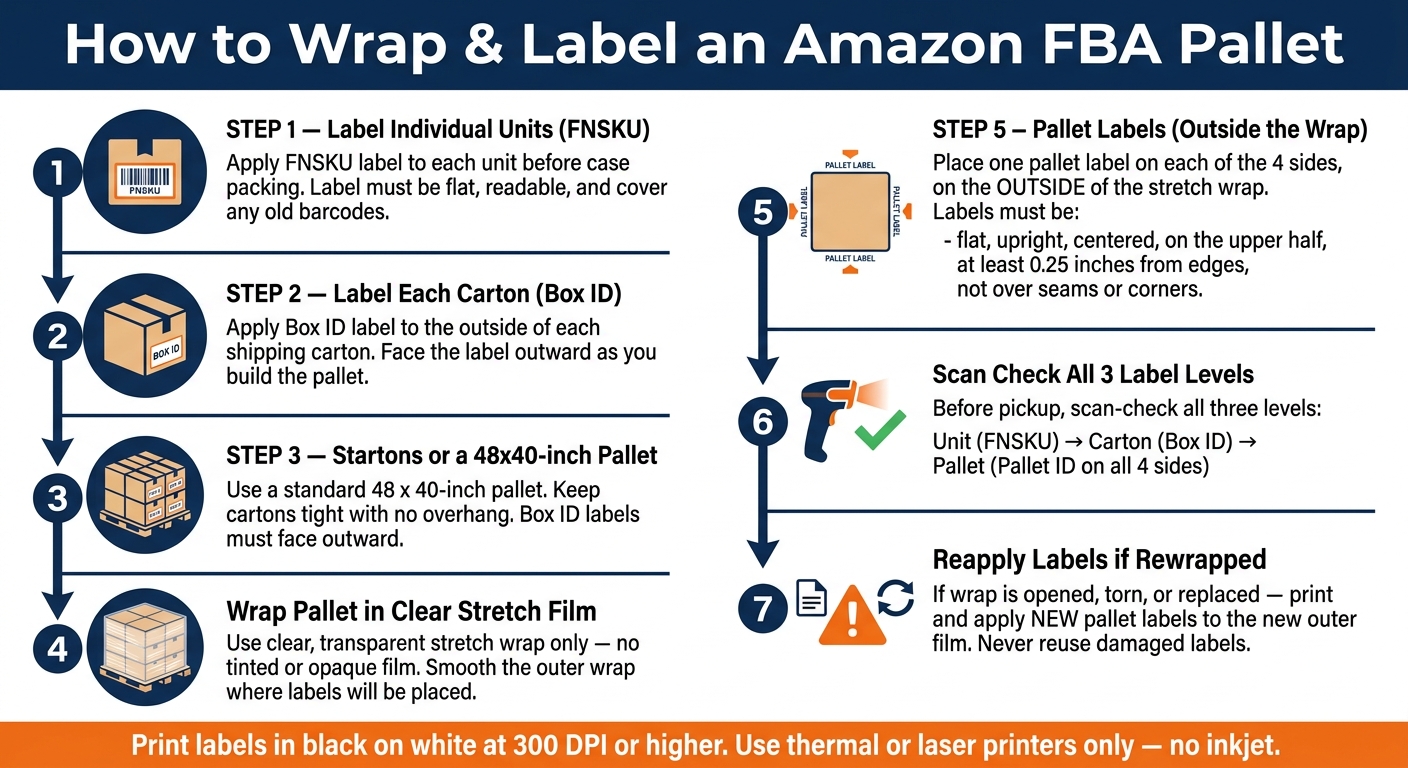
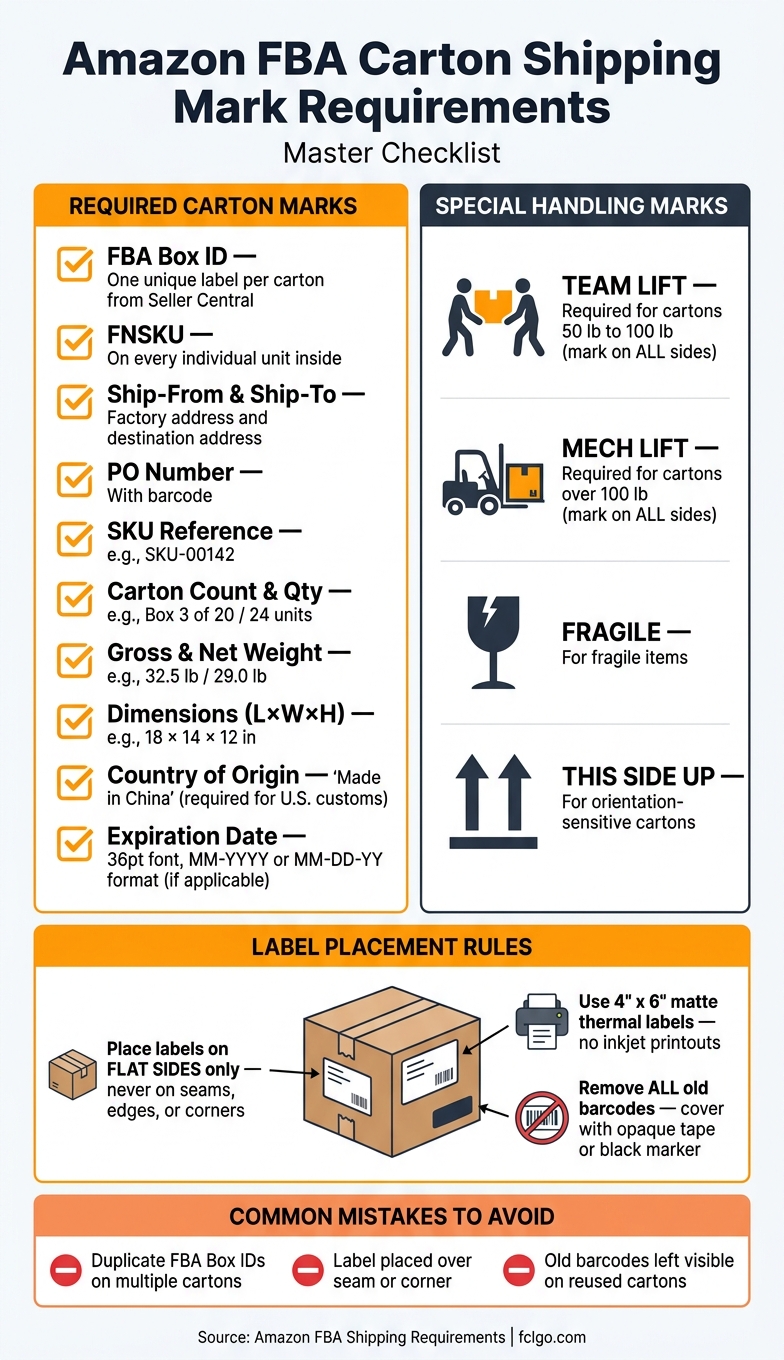
    If Amazon can’t scan your pallet fast, your shipment can get held up. The short version is simple: put FNSKU labels on each unit, Box ID labels on each carton, and 4 pallet labels on the outside of the clear stretch wrap – one on each side.

    Here’s what I’d check before a pallet leaves:

    • 3 label levels: unit, carton, and pallet
    • 4 pallet labels: one per side
    • Clear wrap only: no tinted or opaque film
    • Upper half placement: pallet labels should sit high enough to scan
    • Flat labels only: no corners, folds, seams, or wrinkles
    • Re-label after rewrapping: if the outer wrap changes, print and apply new pallet labels

    A few details matter a lot here. Amazon wants labels printed in black on white at 300 dpi or higher, with at least 0.25 inches of space from edges. The pallet label goes on after wrapping, while FNSKU and carton labels go on before palletizing. And if one side is missing a pallet label, or the barcode sits under bad wrap glare, receiving can slow down.

    I’d sum it up like this: label units first, cartons next, wrap the pallet, then add 4 pallet labels to the outside film and scan-check all 3 levels before pickup.

    Send to Amazon Step 5: Print Pallet Labels | Seller University

    Seller University

    Amazon pallet label and stretch wrap rules

    Getting pallet labels right comes down to placement and wrapping. If either one is off, Amazon fulfillment center teams may have trouble scanning the load when it arrives.

    Place pallet labels on all 4 sides, outside the wrap

    Once the label types are set, the next job is making sure the pallet label stays readable after the pallet is wrapped. Carton and FNSKU labels remain on the boxes and units. Pallet labels belong on the finished load.

    Place four pallet labels on the pallet, with one label on each side, squarely on the outside of the stretch wrap so forklift operators can see them and scan them at a glance. Don’t fold a label over a corner or edge, and keep it at least 0.25 inches away from any edge. It also helps to avoid spots with straps, seams, or crushed and uneven surfaces, since those can make labels harder to scan.

    Use clear stretch film and position labels on the upper half

    Label placement only works if the wrap itself doesn’t get in the way. Amazon requires clear, transparent stretch film. Tinted or opaque wrap can block barcode scans.

    Wrap the pallet first, then place the pallet labels on the outermost layer of the wrap. Put each label on the upper half of the load, high enough for teams to scan it without pulling or lifting the wrap.

    How to wrap and label a pallet, step by step

    Amazon FBA Pallet Labeling & Stretch Wrap: Step-by-Step Checklist

    Amazon FBA Pallet Labeling & Stretch Wrap: Step-by-Step Checklist

    Stack cartons so Box ID labels face outward

    Once you’ve set label placement, stack the cartons in a way that keeps every barcode easy to see. Use a 48 x 40-inch pallet. Keep cartons tight, with no overhang. The FNSKU stays on each unit, and the Box ID label stays on each carton.

    As you build the pallet, turn each carton so its Box ID label faces outward. That way, the label is still visible after the pallet is wrapped.

    Wrap the pallet first, then apply pallet labels

    Secure the load with clear plastic stretch wrap. Before you add labels, smooth the outer wrap anywhere a label will go. If the wrap is bunched up or creased, barcode scanners can struggle to read it.

    Then place one pallet label on each of the four sides. Each label should go on the outside of the stretch wrap, laid flat, kept upright, and centered on the side. This makes life easier for warehouse staff who need to scan the pallet fast.

    Reapply labels after damage, inspection, or rewrapping

    If the outer wrap gets opened, torn, or replaced, add new pallet labels to the new outside layer. Don’t reuse a damaged label.

    After rewrapping, do a quick scan check before shipment.

    How to keep FNSKU, carton, and pallet labels scannable

    Once the pallet is wrapped, do one last scan check at every label level. If a label won’t scan, receiving slows down. Most scan issues come from three things: weak print quality, poor placement, or barcodes getting covered.

    Avoid glare, wrinkles, and corner placement

    Use black ink on white, non-reflective labels at 300 dpi or higher. Stick with thermal or laser printers. Inkjet printers can smudge or fade, and Amazon does not allow them for FBA labels.

    When you print label PDFs, set printer scaling to "None" or "100%". If the file gets scaled, the barcode can warp and fail to scan.

    Amazon rejects labels that are smudged, reflective, curved, or wrapped around a corner. Keep each label on a flat, smooth area. Don’t place labels over seams, folds, corners, or edges. You also need enough empty space around the barcode: at least 0.25 inches of quiet zone on the left and right, and 0.125 inches on the top and bottom.

    Check every label level before the shipment leaves

    Before the shipment goes out, check all three label levels. Start at the unit, then the carton, then the pallet.

    Label Level What to Check When to Check
    Unit (FNSKU) Readable, flat, no old barcodes showing Before case packing
    Carton (Box ID) Facing outward, not over a seam After palletizing
    Pallet (Pallet ID) Scannable on all 4 sides, outside the wrap After stretch wrapping

    Full pallet prep workflow for China-to-USA FBA shipments

    Once label placement is set, the next step is the full prep flow from unit to pallet. For China-to-USA FBA shipments, apply labels in this order: unit labels first, carton labels next, pallet labels last. That order helps you avoid rework after the load is wrapped.

    Where each label type is applied in the workflow

    Apply FNSKU labels to individual units, Box ID labels to cartons, and pallet labels only after stacking and stretch wrapping are done. If carton labels are missing once the pallet is sealed, you’ll need to break down the load and fix it.

    Label Type Applied At
    FNSKU Individual unit
    Carton (Box ID) Outside of each shipping box
    Pallet ID All 4 sides, outside stretch wrap

    This sequence matters even more on China-to-USA shipments, where every handoff needs clear, visible labels.

    How FCLGO can support compliant pallet prep and delivery

    FCLGO

    For shipments moving from China to Amazon fulfillment centers, using one prep process helps keep labeling consistent all the way through delivery. FCLGO can handle:

    • FNSKU labeling
    • Carton labeling
    • Palletizing
    • Clear stretch wrapping
    • Final Amazon-bound delivery from China to the U.S.

    It also supports customs clearance, U.S. warehousing, trucking, and direct delivery to Amazon fulfillment centers.

    Conclusion: Key rules to prevent scan and receiving problems

    Before pickup, do one last check. Keep each carton labeled, wrap the pallet in clear stretch film, and place four pallet labels on the outside of the wrap. Each label should be centered on the upper half of a different side. Then make sure every label is flat, easy to see, and scannable.

    If the pallet gets inspected, damaged, or rewrapped, add new pallet labels to the new outer film. Don’t reuse damaged labels. Print new pallet labels instead.

    Receiving problems usually happen for a few simple reasons: labels are covered by wrap, a label is missing from one side, or one pallet has mixed shipment IDs.

    FAQs

    Can pallet labels go under stretch wrap?

    Pallet labels must go outside the clear stretch wrap so Amazon fulfillment center teams can scan them without trouble.

    Place FBA pallet labels on all four sides of the pallet, in the top center of each side. You should also add a clear note such as "Do Not Break Down" or "Do Not Break Stretch Wrap".

    What happens if I rewrap the pallet?

    If you rewrap a pallet, apply four new FBA pallet labels to the outside of the new stretch wrap. Don’t reuse or photocopy old labels, because each pallet label is linked to a specific shipment.

    Place the new labels at the top center on all four sides of the pallet. Make sure each one stays easy to see and easy to scan.

    Do FNSKU and Box ID labels still need to show after wrapping?

    Yes. Apply FNSKU and Box ID labels before you stack cartons and stretch-wrap the pallet.

    Why? Amazon checks in inbound freight with box-level scanning. Once the pallet is sealed, you can’t add those labels afterward.

    A couple of things matter here:

    • Keep carton labels visible on the outside of each carton.
    • Place pallet labels on the outside of the final stretch wrap on all four sides so Amazon can scan them.

  • FCLGO | Amazon FBA Carton Shipping Marks Guide

    Carton Shipping Mark Requirements For Amazon FBA

    If one carton label is wrong, Amazon can slow or stop receiving for the whole shipment. This is especially critical when shipping to high-volume centers like ONT8, ABE1, or BFI1.

    I’d boil this article down to four points: use the right Amazon labels, print the right carton marks, place labels where scanners can read them, and remove old barcodes before pickup. For many sellers, the biggest risks are duplicate Box IDs, missing country-of-origin marks, bad label placement, and cartons that do not match the shipment plan.

    Before freight leaves China, when using Amazon FBA shipping from China, I’d check these items on every master carton:

    • 1 FBA Box ID per carton from Seller Central
    • FNSKU on each unit
    • Ship-from and ship-to details
    • PO number, SKU, carton count, weights, and dimensions
    • “Made in China” on each carton for U.S. customs
    • Expiration date in large print if the product is date-sensitive
    • “Team Lift” for 50 lb to 100 lb cartons
    • “Mech Lift” for cartons over 100 lb
    • No old labels or old barcodes showing
    • Labels on a flat side, not on seams, edges, or corners

    A simple mistake can turn into relabeling fees, storage charges, or redelivery costs. So if I want fewer receiving problems, I’d treat carton marking as a final pre-shipment check, not a last-minute task.

    That’s the full picture in plain English: the carton needs freight marks, Amazon box labels, clean placement, and a final inspection before it ships.

    Amazon FBA Carton Shipping Mark Requirements Checklist

    Amazon FBA Carton Shipping Mark Requirements Checklist

    How To Prepare Your Carton Labelling For Amazon FBA for Imported Goods from China to USA UK CA AU

    What to Put on Each Master Carton for Amazon FBA

    Every master carton needs two things: the FBA Box ID and the shipping marks used by Amazon, carriers, and customs as part of the shipping process to Amazon FBA.

    Amazon-Required Carton Identifiers

    Print one unique FBA Box ID label on every carton from Seller Central. That label needs to match the shipment plan exactly.

    Standard Carton Shipping Mark Fields

    Once the Box ID is handled, add the carton details that Amazon, carriers, and customs look for.

    Field Example
    Case packed marking, if applicable Case Packed
    Ship-from / ship-to addresses and consignee Factory address / Destination address / ACME Brands
    PO number (with barcode) PO 123456
    SKU reference SKU-00142
    Carton number / total cartons and quantity per carton Box 3 of 20 / 24 units
    Gross weight / Net weight 32.5 lb / 29.0 lb
    Dimensions (L × W × H) 18 × 14 × 12 in
    Country of origin Made in China

    For U.S. customs, mark each carton "Made in China". If the products have expiration dates, print the expiration date on every master carton in 36-point type or larger using MM-YYYY or MM-DD-YY format.

    Handling and Compliance Marks for Special Cartons

    If a carton weighs 50 lb to 100 lb, mark it "Team Lift" on all sides. If it weighs more than 100 lb, mark it "Mech Lift" on all sides. For cartons that need extra care, add "Fragile" and "This Side Up".

    After you print the required marks, place them where they stay easy to see and easy to scan.

    Where and How to Place Carton Marks and Labels

    Once the carton data is printed, label placement and Amazon FBA prep services decide whether Amazon can scan the box at receiving.

    Where to Place FBA Box ID and Carrier Labels

    Put every label on a flat side of the carton. Don’t place it over a seam, edge, or corner.

    For SPD shipments, place the carrier label and FBA Box ID on the same flat face, side by side, with no overlap.

    For floor-loaded shipments, place labels on the side or top of each carton so they stay visible during unloading.

    Palletized freight follows that same visibility rule. But pallet labels do not take the place of carton labels.

    Pallet Labels and Carton Labels Are Not Interchangeable

    A pallet label identifies the pallet itself. It does not replace the carton labels on the boxes under the wrap.

    Apply four pallet labels to the outside of the stretch wrap, one on each side. At the same time, make sure every carton’s Box ID label stays visible.

    Use 4" x 6" matte thermal labels, not inkjet printouts. Matte, smudge-resistant label stock helps cut glare and makes barcodes easier to scan.

    Don’t place clear tape over a barcode. The shine can reflect light and stop the scanner from reading it.

    If you’re using reused cartons, remove or fully cover old labels, barcodes, and markings with opaque tape or a black marker.

    These rules help avoid scan failures that slow down receiving.

    Common Carton Marking Mistakes That Delay Amazon Receiving

    These are the carton-marking errors that most often lead to Amazon receiving delays. Even when the required marks are in place, small labeling slip-ups can still stop cartons from scanning at check-in.

    Wrong, Duplicate, or Missing Box Labels

    One of the most common mistakes is reusing the same FBA Box ID on more than one carton. Each carton needs its own FBA Box ID. If the wrong label ends up on the wrong carton, Amazon can treat it as a shipment mismatch and move it into manual receiving.

    Missing labels cause the same kind of slowdown. So do labels that are faded, torn, or hard to read. In practice, one bad label can hold up the entire shipment.

    Content Mismatches and Wrong Carton Data

    A label can be printed correctly and still cause trouble if the carton contents don’t match it. If the unit count shown on the carton is different from what’s actually inside, Amazon may flag the shipment during check-in.

    Dated products need extra care. Print the date clearly, and make sure the stock falls within Amazon’s shelf-life rules. If the date is hard to read or the product is outside the allowed window, receiving can stall fast.

    Bad Label Placement, Damaged Labels, and Old Barcodes Left on Cartons

    Good data doesn’t help if the scanner can’t read the label. Labels placed on seams, corners, or crushed sides often fail to scan cleanly.

    Reused cartons can create another problem: old barcodes and old markings. If those are still visible, Amazon may scan the wrong code at receiving. Remove them or fully cover them before you add the new label.

    A Carton Marking Workflow to Follow Before Freight Leaves China

    Catch labeling mistakes before pickup in China so you don’t run into receiving delays in the U.S. This is the last carton check to run before freight leaves the factory.

    Pre-Shipment Carton Marking Checklist

    Make sure every unit has an FNSKU label and every carton has its own FBA Box ID from Seller Central. The carton count, weight, and dimensions should match the shipment plan and bill of lading. If the freight is palletized, place four pallet labels on each pallet and use clear stretch wrap. Also, remove or fully cover any old barcodes and labels before pickup.

    If your factory handles prep in China, have one person own this step and sign off before pickup. That simple handoff can help stop last-minute mix-ups.

    How FCLGO Can Help With Carton Compliance for FBA Shipments

    FCLGO

    FCLGO can handle FBA prep, carton labeling, palletizing, inspection, customs clearance, and direct delivery to Amazon. That support helps keep cartons compliant before they reach the carrier.

    Key Carton Marking Points Sellers Should Not Miss

    Before pickup, confirm that each carton has a unique Box ID, correct carton data, a visible origin mark, and no exposed old barcodes. When these details are checked before departure, you’re far less likely to deal with receiving delays.

    FAQs

    Do inner cartons need FBA Box ID labels?

    No. Inner cartons do not need their own FBA Box ID labels.

    If you pack multiple case packs inside one master carton, place the unique FBA Box ID label only on the outside of the master carton.

    That said, any box handled as its own shipment unit still needs its own unique label, even if it’s stacked on a pallet.

    What happens if a carton label is unreadable?

    A hard-to-read carton label can slow down receiving or even get a shipment turned away at an Amazon fulfillment center.

    Amazon needs each carton’s FBA shipment label to be clear and easy to scan so staff can confirm what’s inside and where it needs to go.

    If a label is damaged, covered up, or missing, Amazon may not be able to process the inventory without manual work.

    Can Amazon reject cartons with missing origin marks?

    Yes. Amazon may reject shipments that don’t meet its labeling and documentation rules.

    Amazon mainly checks the FBA Box ID label on each carton. But sellers also need to enter the correct country of origin in Seller Central. If that origin info is missing or wrong, Amazon can reject the shipment, charge storage fees, and delay processing.

  • FCLGO | Air Cargo Volume Weight — FBA Guide 2026

    Air Cargo Volume Weight for FBA: 2026 Guide

    Your air freight bill is based on chargeable weight – not just the rate per kg. If you ship light but bulky FBA cartons, the carrier may bill you by size instead of scale weight. That one rule can shift a shipment from a rough $4.00/kg idea to a much higher total once dimensions are measured.

    Here’s the short version:

    • Actual weight = what your packed cartons weigh on a scale
    • Volumetric weight = space used in the plane
    • Chargeable weight = the higher of the two
    • Standard air freight usually uses cm ÷ 6,000
    • Express couriers like DHL, FedEx, and UPS often use cm ÷ 5,000
    • Carriers may round up dimensions and billable weight
    • Many quotes also include extra costs like fuel, customs, pickup, and delivery

    A fast example: a 50 × 40 × 30 cm carton has a volume weight of 10 kg under standard air freight, but 12 kg under express rules. If the box only weighs 8 kg, you still pay based on 10 kg or 12 kg.

    If I were checking a quote before booking, I’d focus on just 3 things: <u>final carton size</u>, <u>volume weight</u>, and <u>chargeable weight</u>. That’s where most FBA air cargo cost mistakes start.

    Item What I’d check
    Packed size Measure the sealed carton, not the product
    Formula Use ÷ 6,000 for standard air, ÷ 5,000 for express
    Billing weight Use the higher of actual vs. volume weight
    Extra fees Check fuel, customs, prep, and final delivery
    Planning rate Roughly $4.00–$8.50/kg China to USA

    This guide to shipping to Amazon FBA walks through the math, the measuring rules, the rounding issues, and the main cost points so you can estimate your FBA air shipment before you book.

    Air Cargo Weight Terms Every FBA Seller Should Know

    Actual Weight, Volumetric Weight, and Chargeable Weight Explained

    These are the three billing weights. If you want to price air freight the right way, you need to know what each one means.

    Actual weight is the gross scale weight of your packed cartons or pallets, including packaging. Volumetric weight is a calculated figure based on the space a shipment occupies. Carriers use it for cargo that takes up a lot of room but doesn’t weigh much. Chargeable weight is the invoice weight, which means the higher of actual weight or volumetric weight.

    The standard air cargo density rule is about 167 kg per cubic meter. That matches a divisor of 6,000 cm³ per kg.

    2026 Air Freight Formulas in Metric and Imperial Units

    Use the formula that matches your unit system:

    Unit System Formula Output
    Metric (standard air) L × W × H (cm) ÷ 6,000 Volumetric weight in kg
    Metric via CBM Total CBM × 167 Volumetric weight in kg
    Imperial (to lb) L × W × H (in) ÷ 166 Volumetric weight in lb
    Imperial (to kg) L × W × H (in) ÷ 366 Volumetric weight in kg
    Express courier (DHL/FedEx/UPS) L × W × H (cm) ÷ 5,000 Volumetric weight in kg

    One small detail can make a big difference here: express couriers often use 5,000 instead of 6,000. That means the same box can be billed at a higher volumetric weight when you ship with DHL, FedEx, or UPS.

    Rounding Rules That Change the Final Bill

    Rounding can change the final invoice more than many sellers expect. Carriers often round each dimension up to the next whole centimeter or inch. They also tend to round chargeable weight up to the next 0.5 kg or 1 kg, depending on the tariff.

    So if one side of a carton measures 40.2 cm, it will usually be billed as 41 cm.

    Once you know the billing weight, the next step is measuring the carton correctly.

    Stop Overpaying! How to Calculate Air Freight Volume & Chargeable Weight 🔥

    How To Measure FBA Cartons and Pallets Correctly

    Use the billing rules above to measure the shipment the same way the carrier will.

    Always Measure the Final Sealed Carton, Not the Product

    Measure the final sealed carton after packing and taping.

    A box that measures 40 cm when flat can easily end up at 42 cm once it’s packed and sealed. That extra 2 cm might not sound like much, but it can be enough for automated dimension scanners to log a higher billable size.

    Record the longest side as length, the next longest as width, and the shortest side as height. Include everything that sticks out: tape bulges, poly bag knots, straps, handles, and any overhang. Carriers charge based on the largest point on each side, not the average.

    These dimensions help decide whether actual weight or volumetric weight becomes the billable figure.

    Per-Carton vs. Per-Pallet Calculation

    For SPD (small parcel) shipments, volumetric weight is worked out for each carton on its own and then added across all boxes. Each carton is measured and billed separately, so box sizing matters a lot.

    For pallets, the carrier bills the full footprint plus the total stack height, not each carton by itself. That pallet height should include the pallet base too, which is about 6 in. (15 cm). Empty gaps on the pallet still count as billed space.

    If any carton sticks out past the pallet edge, the carrier uses that outermost point as the pallet dimension.

    Feature Per-Carton (SPD) Per-Pallet
    Measurement basis Individual box dimensions Full pallet footprint + total stack height
    Unused space billed? Only internal box air Includes gaps between boxes and pallet base

    Those measurements feed the chargeable-weight calculation next.

    When Volume Weight Replaces Actual Weight

    Use your carton or pallet measurements to work out the billable weight. Carriers charge whichever is higher: the actual weight or the volumetric weight.

    The Higher-of-Two Rule for Air Freight Billing

    Air freight pricing follows a simple rule: carriers bill the higher of actual weight or volumetric weight. If the volumetric weight comes out higher, that number replaces the actual weight on the invoice.

    This usually affects products that are light but take up a lot of space. Common examples include pillows, bedding, plush toys, apparel, and plastic storage bins. If you are shipping oversized items, professional FBA prep services can help optimize packaging to reduce volume. Heavier, denser goods like ceramic mugs, metal tools, or machine parts usually bill by actual weight because the scale weight is higher than the volumetric weight.

    Density Thresholds for Low-Density Cargo

    Next, compare those dimensions with the shipment’s actual weight. Once volumetric weight is higher than actual weight, volume-based billing takes over.

    Express couriers such as DHL, FedEx, and UPS use a stricter divisor of 5,000 cm³/kg instead of the standard air freight divisor of 6,000 cm³/kg. That means the same box can bill at a higher weight even when the dimensions stay the same. For example, a 50 × 40 × 30 cm carton that weighs 8 kg bills at 10 kg under standard air freight and 12 kg with an express courier.

    Shipping Method Metric Divisor Billed By
    Standard Air Freight 6,000 cm³/kg Higher of actual or volumetric
    Express Courier (DHL/FedEx/UPS) 5,000 cm³/kg Higher of actual or volumetric

    Before booking, compare the volumetric weight with the actual weight. The higher figure becomes the chargeable weight, and that’s the number to use when estimating freight costs ahead of booking.

    How To Estimate FBA Air Freight Cost Before Booking

    Air Cargo Chargeable Weight: How FBA Air Freight Is Billed

    Air Cargo Chargeable Weight: How FBA Air Freight Is Billed

    Once you have the chargeable weight from the last step, you can put together a rough cost estimate before you book. It won’t be your final invoice, but it gives you a solid planning number.

    Step-by-Step Cost Estimate Using Chargeable Weight

    • Collect your carton data. Write down the carton count, sealed-carton dimensions (L × W × H in cm), and gross weight for each carton.
    • Calculate total actual weight. Multiply the weight per carton by the total carton count.
    • Calculate total volumetric weight. Use L × W × H ÷ 6,000 for standard air freight, or ÷ 5,000 for express couriers, then multiply by the carton count.
    • Determine chargeable weight. Use whichever total is higher.
    • Build your cost estimate. Multiply the chargeable weight by the per-kg rate, then add fuel and other surcharges. Many carriers also apply a 45 kg minimum.

    For DDP or door-to-door quotes, make sure pickup, export clearance, customs, ISF filing, duties and taxes, FBA prep, and final delivery are all included.

    If you’re reviewing a door-to-door or DDP quote, check each line item instead of assuming it’s covered:

    Cost Category What to Confirm Is Included
    Origin Factory pickup, export clearance, documentation
    Freight surcharges Fuel, oversized carton fees, minimum weight
    Customs ISF filing, brokerage, import duties, bond
    FBA prep FNSKU labeling, carton labeling, palletizing
    Destination Airport handling, warehousing, trucking to Amazon FC

    2026 China-to-USA Air Freight Rate Ranges for Planning

    For planning, expect $4.00 to $8.50 per kg for standard China-to-USA air freight, based on urgency and volume. Rates often drop once shipments hit 100 kg+, 300 kg+, and 500 kg+. Items like batteries or magnets can push routing costs higher. These numbers are planning figures only. Your actual rate depends on the quote tied to your shipment.

    Using FCLGO To Check Your Pre-Booking Estimate

    FCLGO

    After you build your rough estimate, compare it against an itemized quote. Send your carton count, dimensions, gross weights, and destination fulfillment center details to FCLGO for an itemized quote before booking.

    Conclusion: 3 Numbers To Check Before You Book

    Once you have a rough quote, check these three numbers before you book. Final packed dimensions, volumetric weight, and chargeable weight drive most air freight invoices.

    • Final packed dimensions – Measure the sealed carton, not the product inside. Even a small bump in size can increase chargeable weight across a large shipment.
    • Volumetric weight – Use the correct divisor for your shipping mode. Standard air freight uses L × W × H (cm) ÷ 6,000. Express couriers usually use ÷ 5,000 instead of ÷ 6,000.
    • Chargeable weight – This is the number used for billing. The carrier charges whichever is higher: actual weight or volumetric weight.

    If these three line up with your quote, your freight estimate is probably on the right track. It’s worth checking all three before you ask for a quote, so you can price the shipment more accurately before booking.

    FAQs

    How do I know if my shipment will bill by volume weight?

    Compare your shipment’s actual gross weight with its calculated volumetric weight.

    Volumetric weight = length × width × height in cm ÷ the carrier’s divisor, which is usually 5,000 or 6,000.

    If the volumetric weight is higher than the scale weight, you’ll be billed based on volume weight. Carriers charge whichever number is higher.

    Should I calculate air freight by carton or pallet?

    It depends on how the shipment moves through the carrier’s system.

    For individual cartons, carriers usually work out volumetric weight from each box’s dimensions. For palletized cargo, some carriers look at the pallet’s full footprint and stack height instead.

    Because carriers charge whichever is higher – actual weight or volumetric weight – it’s smart to share both carton and pallet dimensions if you want the most accurate estimate.

    What fees are usually missing from air freight quotes?

    Many air freight quotes leave out costs beyond the base shipping rate. So before you book, check whether export and destination handling, customs clearance, duties, and final delivery to Amazon fulfillment centers are part of the price.

    Some fees slip through the cracks all the time. Common examples include:

    • Airport security and X-ray scanning
    • Air Waybill documentation
    • Terminal handling
    • Destination local charges for cargo release
    • Remote delivery surcharges

    If those items aren’t included upfront, your total landed cost can end up much higher than the original quote.