Importing diecast cars from China means buying scale-model vehicles from Guangdong factories and moving them to the US as a formal commercial import — complete with HS classification, duty assessment, quality control, and freight planning. In 2026, two things changed the math for every importer in this niche: the de minimis exemption ended in August 2025, so all commercial shipments now clear with duty assessed, and toy-category tariffs that date to 2019 still stack on top. This guide walks the entire chain — sourcing, samples, compliance, freight, and timelines — for sellers building a diecast business on Chinese supply.
Where Do You Start When Importing Diecast From China?
The import chain has six stages, and the expensive mistakes happen when stages are skipped:
Map suppliers — Shantou’s Chenghai district for mainline-grade and custom factories; the Dongguan / Pearl River Delta belt for licensed-premium contract manufacturers
Buy samples — 1–24 units at 2–5× bulk price; inspect paint, tampo alignment, box finish, and actual weight against the spec sheet
Confirm classification and duty — diecast vehicles generally sit under HS 9503 (toys); verify your exact code in the HS code search tool and price duty plus applicable tariffs into your landed cost
Place the bulk order with QC terms — pre-shipment inspection written into the purchase agreement, covering paint chips, decal alignment, and carton crush resistance
Consolidate and ship — one freight shipment, DDP where predictability matters, ocean LCL as the default mode for dense metal cargo
Receive and route to your sales channel — FBA prep and labeling if Amazon-bound; case-friendly storage if you sell mint-in-box elsewhere
What Does Compliance Require for Diecast Imports?
Regulatory treatment depends on how the product is positioned, and the distinction matters at customs:
Toys intended for children — US toy safety requirements apply, including testing and documentation obligations under CPSIA for products marketed to children under 12
Adult collectibles and display models — commonly marketed and shipped as collectibles, which changes labeling expectations; many importers split their catalog explicitly by intended audience
Licensed likenesses — real-car liveries and brand marks require the factory to hold licenses; unlicensed product risks seizure regardless of duty paid
Import compliance is a moving target — have your forwarder or broker confirm current requirements for your exact product line before the first bulk order ships.
How Long Does the Whole Cycle Take?
A realistic 2026 timeline from first contact to sellable US inventory:
End to end, plan on roughly 8–12 weeks for a first ocean order, or 5–7 weeks for an air-freight first batch. The mode tradeoffs are covered in depth in our air vs ocean comparison.
What Does Landed Cost Really Consist Of?
Four layers, in order of how often importers underestimate them:
Product price — the quote you negotiated; basic 1:64 wholesale sits in low single-digit dollars per unit
Duty and tariffs — HS-based duty plus Section 301 layers on many toy categories since 2019; formally assessed on everything since de minimis ended in August 2025
Freight and handling — ocean LCL at roughly USD 40–90 per CBM planning range; dense diecast cargo prices well per unit by sea
Shrinkage and rework — the QC pass exists to keep this near zero; budget 1–3% anyway on first orders with a new factory
When Should You Place Orders Around Chinese New Year?
The Chinese New Year holiday (February 6 in 2027) is the single largest scheduled disruption: factories pause one to three weeks, pre-holiday demand concentrates into early January, and post-holiday restarts trickle through late February. The working rule from our January-capacity guidance: reserve ocean capacity in December for cargo ready in early January, and expect air space to tighten from mid-January.
Frequently Asked Questions
How do I import diecast cars from China to the US?
Shortlist Guangdong suppliers, buy samples, confirm HS 9503 classification and duty, order with pre-shipment QC written in, consolidate into one freight shipment, and clear customs with duty formally assessed — then route stock to your sales channel. First ocean orders typically run 8–12 weeks end to end.
Do I pay duty on diecast imports in 2026?
Yes. The USD 800 de minimis exemption ended in August 2025, so all commercial imports clear with formal duty assessment, and Section 301 tariffs have applied to many Chinese toy categories since 2019 on top of base duty.
Are diecast cars regulated as toys or collectibles?
It depends on positioning: products marketed to children under 12 fall under US toy safety requirements including CPSIA testing documentation, while adult collectibles carry different labeling expectations. Licensed liveries additionally require the factory to hold the license.
What is the cheapest way to import diecast from China?
Consolidated ocean LCL — diecast is dense metal cargo that prices well per cubic meter (roughly USD 40–90 per CBM planning range), and combining multiple suppliers into one shipment and one customs entry cuts per-unit costs further.
Diecast wholesale is the bulk purchase of scale-model vehicles directly from factories or trading companies, typically at 50–70% below US retail prices. For resellers, eBay and Amazon sellers, and hobby-shop owners, buying diecast wholesale from China is the standard way to stock mainline-grade 1:64 cars, licensed premiums, and display models — but the real margin is decided after the product price, by MOQs, toy tariffs, and how a metal-heavy cargo actually ships. This guide covers the full 2026 picture: where the factories are, what minimums they ask, what landed cost really looks like, and how to move it from China to a US warehouse.
FCLGO, a Shenzhen-based freight forwarder for China-to-US Amazon and e-commerce shipments, handles diecast and collectible cargo weekly — this guide reflects the planning numbers that matter for that trade lane.
Where Are Diecast Cars Manufactured in China?
China concentrates the majority of global diecast production in one province: Guangdong. Two clusters dominate:
Shantou (Chenghai district) — the traditional toy-manufacturing capital, dense with small and mid-size factories producing mainline-grade vehicles, unlicensed replicas, and custom runs at aggressive price points
Dongguan and the Pearl River Delta — larger, export-oriented plants, including contract manufacturers behind recognized international model brands; stronger tooling, paint, and tampo-printing capability for licensed products
Practical consequence: most diecast wholesale orders ship from a single province, which makes multi-supplier consolidation into one shipment straightforward. The consolidation logic is the same as for marketplace sourcing covered in our DHgate shipping guide — one consolidated shipment beats many small ones on cost and customs handling.
What MOQs Do Diecast Factories Require?
Minimum order quantities in this industry are tiered by product type, and 2026 quotes generally cluster as follows:
Product type
Typical MOQ
Notes
Stock mainline 1:64 models
100–500 units per SKU
Often mixed-case options from trading companies
Licensed premium scales (1:24, 1:18)
300–1,000 units
License holder approval may apply
Custom runs (own livery, custom tampo)
500–2,000+ units
Mold and setup fees on top of unit price
Sample orders
1–24 units
2–5× unit price; always order samples first
How Do You Source Diecast Wholesale in 5 Steps?
Verify the supplier — business license, export history, and at least one physical address you can match against a map; Guangdong registration is a positive signal
Order paid samples — inspect paint finish, decal alignment, box condition, and weight against the spec sheet before any bulk commitment
Negotiate unit price against MOQ tiers — quotes at 300, 500, and 1,000 units usually differ by 10–25%; buy the tier your sales velocity supports, not the cheapest one
Book third-party QC — a pre-shipment inspection catching paint chips and crushed boxes costs a few hundred dollars and protects margins on the whole order
Consolidate and ship as one freight shipment — collect from multiple factories into one consolidation point, then move one documented shipment to the US
What Does Diecast Wholesale Actually Cost in 2026?
Three cost layers stack on the factory price, and each one is where inexperienced buyers get surprised:
Product — basic 1:64 mainline-grade models wholesale at low single-digit dollar figures per unit; licensed premium scales run an order of magnitude higher; custom runs add setup fees amortized across the batch
Duty and tariffs — diecast vehicles generally classify under HS 9503, the toy heading. Since 2019, many Chinese toy categories have carried additional Section 301 tariffs on top of base duty, and the end of the de minimis exemption in August 2025 extended formal duty assessment to essentially all commercial imports. Look up your exact code in the HS code search tool and price duty before ordering, not after
Freight — diecast is dense metal cargo: a carton of 1:64 cars commonly weighs three to five times its volumetric equivalent, which makes ocean freight the default economics (planning range USD 40–90 per CBM for LCL) with air (USD 4–9 per chargeable kg) reserved for restock emergencies
Run your carton dimensions through the CBM calculator before requesting quotes — dense cargo prices out surprisingly well per unit.
How Should You Ship Wholesale Diecast From China?
Because mint boxes are part of the product value in this niche, shipping is not just transportation — it is condition control. The standard pattern for wholesale orders:
Factory packaging review at QC — inner boxes and master cartons checked before sealing, because a crushed master carton can write off an entire layer of stock
Buying shipping as DDP — one predictable landed number that already includes duty, instead of border surprises on licensed goods
Ocean LCL for replenishment, air for gaps — the split-shipment pattern from our China freight forwarder guide applies directly to diecast
For a landed-cost estimate on a specific order, a line-itemed quote through the quote form prices origin, freight, duty, and delivery separately so you can compare against your wholesale math. Our complete importing guide covers the longer checklist, and the custom diecast guide covers commission runs.
Frequently Asked Questions
What is the MOQ for diecast wholesale from China?
Stock 1:64 models typically start at 100–500 units per SKU; licensed premium scales at 300–1,000; custom runs usually begin at 500–2,000 units plus setup fees. Sample orders of 1–24 units are standard first steps.
What HS code applies to diecast cars, and what duty applies?
Diecast vehicles generally classify under HS 9503 (toys). Base duty varies by classification, Section 301 tariffs have applied to many Chinese toy categories since 2019, and since August 2025 all commercial imports clear with formal duty assessment. Verify your exact rate before ordering.
Is ocean or air freight better for diecast imports?
Ocean is the default: diecast is dense metal cargo that prices well per CBM, at roughly USD 40–90 per CBM for LCL versus USD 4–9 per chargeable kg for air. Air makes sense for stockout rescue and small restocks.
Can I mix multiple diecast factories in one shipment?
Yes, and you should — most factories sit in Guangdong province, so consolidating several suppliers into one shipment and one customs entry is cheaper and simpler than separate parcels.
Do I need QC inspection for diecast orders?
Yes. Paint chips, decal misalignment, and crushed boxes are the three common defects, and box condition directly affects resale value in this niche. A pre-shipment inspection typically costs a few hundred dollars against an entire order.
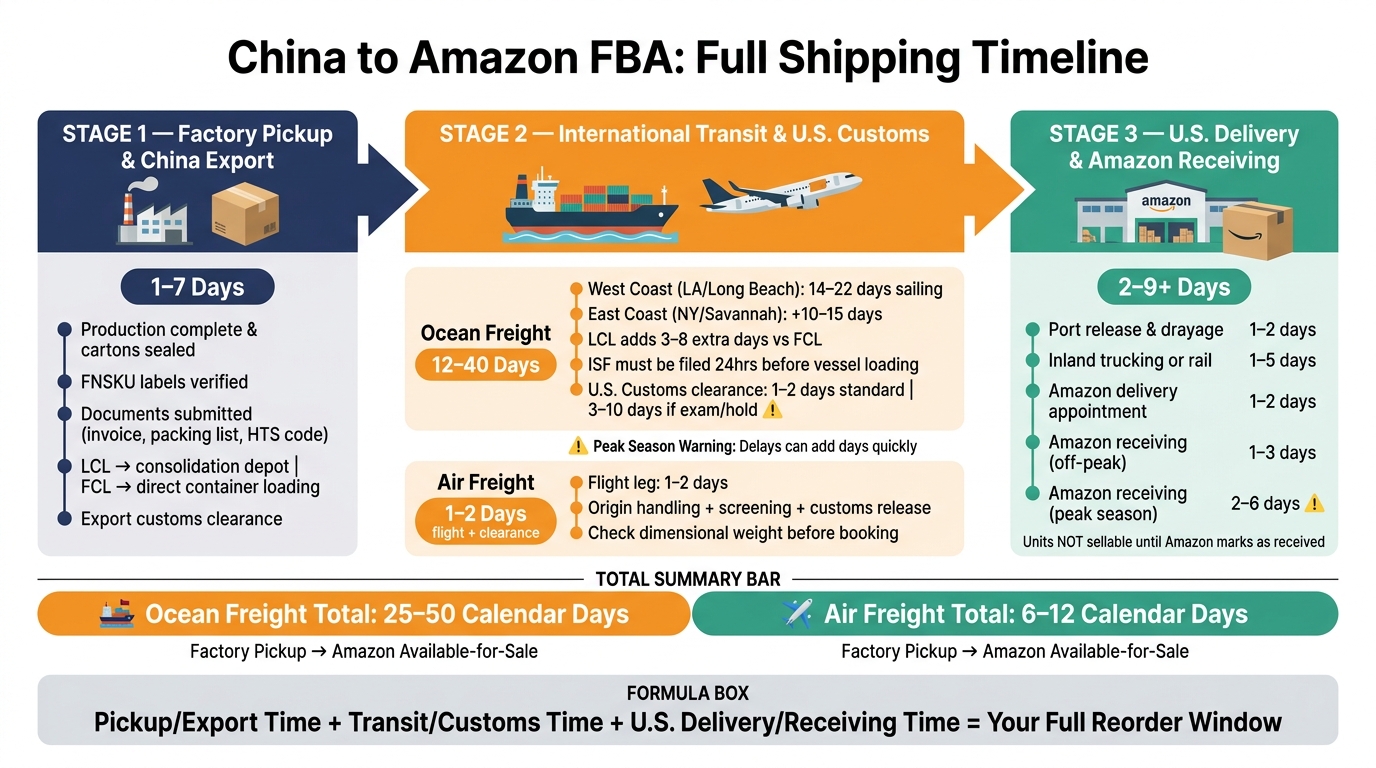
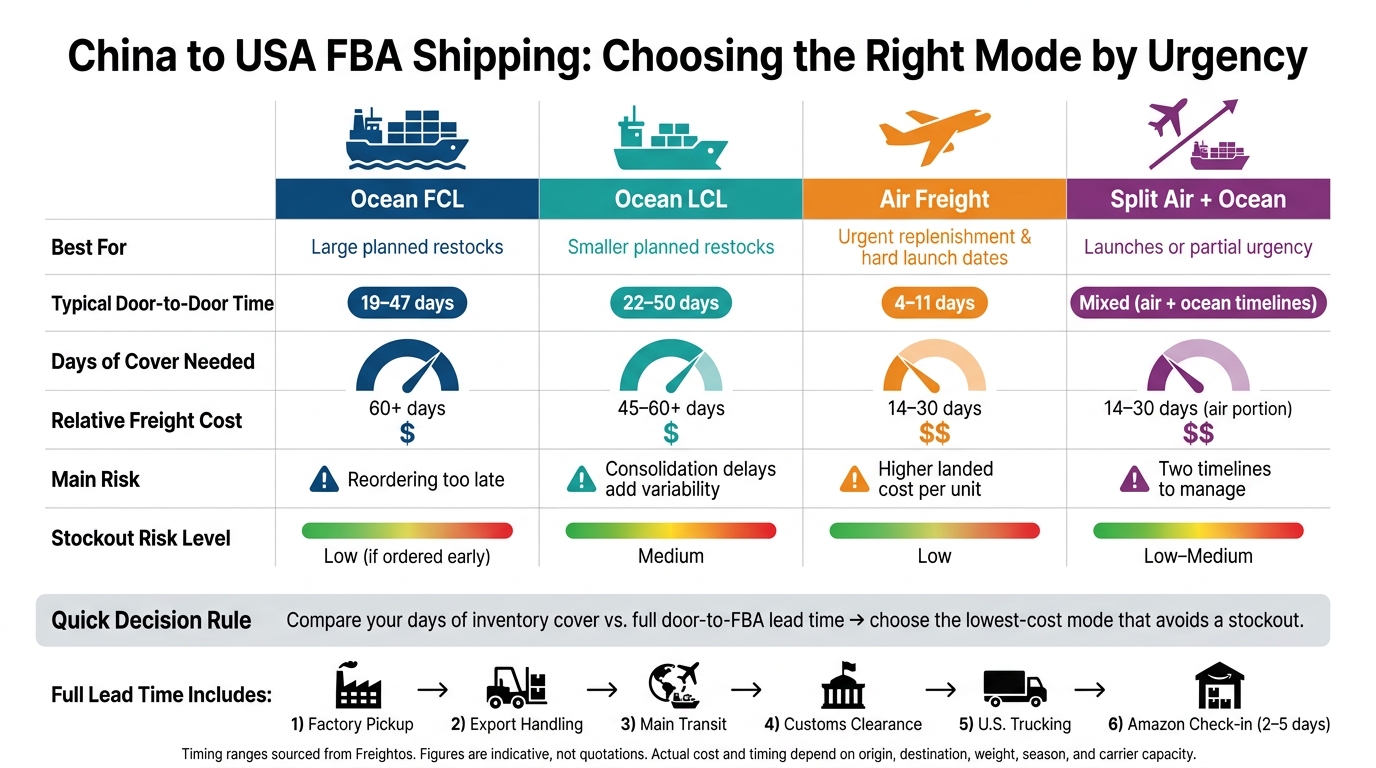
If I need a simple answer, I use this: China to Amazon FBA usually takes 25–50 calendar days by ocean and 6–12 calendar days by air from factory pickup to Amazon check-in.
That number matters because port-to-port time is not the same as sellable inventory time. I have to count factory pickup, export work, transit, customs, U.S. delivery, Amazon appointments, and Amazon receiving. And even after delivery, Amazon may take 1–5 business days or more to receive the shipment.
Here’s the short version:
Ocean freight: lower shipping cost, but more time and more delay points
Air freight: much faster, but often costs 8–12x more than ocean
West Coast FBA: usually arrives sooner than East Coast or inland FCs
LCL: often adds 3–8 extra days vs. FCL because of consolidation and deconsolidation
Peak season: customs, delivery appointments, and Amazon receiving can add days fast
Amazon FBA Sea Shipping Explained – Shipping To Amazon FBA From China – Lesson 3
My main takeaway: I should plan from the date inventory must be available for sale, not from the vessel or flight departure date.
Step-by-Step Timeline: Factory Pickup to Amazon Delivery
China to Amazon FBA Shipping Timeline: Full Lead Time Breakdown
Amazon FBA shipping from China usually moves through three parts: factory pickup and export, transit and customs, then U.S. delivery and receiving. Each part adds time to your total door-to-FBA lead time.
Put simply: pickup/export time + transit/customs time + U.S. delivery/receiving time = your full reorder window.
Factory Pickup and China Export Handling: 1–7 Days
This stage begins when your freight forwarder books factory pickup and ends when the cargo clears Chinese export customs and gets loaded onto a vessel or aircraft. In most cases, plan for 1–7 days.
Before pickup, make sure production is done, cartons are sealed, and carton sizes and weights are correct. You can use a CBM calculator to verify these dimensions before booking. It also helps to check carton labels and FNSKU barcodes before the truck arrives. If relabeling is needed, that can add 1–2 business days.
You’ll also want to send the commercial invoice, packing list, product details, declared value, origin, and HTS code before pickup day. If those documents show up late, the shipment can miss cutoff. And that happens more often than many sellers expect. Waiting until pickup day is one of the most common reasons cargo misses its port or airport cutoff. During peak periods, a missed cutoff can push cargo to the next sailing and add a week or more. Distance from the factory to the export gateway also affects cutoff timing.
Once the cargo is picked up, the path depends on the shipment type:
LCL cargo goes to consolidation
FCL cargo goes straight to container loading before cutoff
After the cargo leaves the factory, transit time becomes the main variable.
International Transit and U.S. Customs: Ocean 12–40 Days, Air 1–2 Days Plus Clearance
For ocean freight, sailing time from China to a U.S. West Coast port like Los Angeles/Long Beach usually falls in the 14–22 day range. East Coast ports like New York or Savannah often add about 10–15 more days on top of that.
Air freight cuts the flight leg to about 1–2 days, but that doesn’t mean the full trip takes only a day or two. Air shipments still go through origin handling, screening, customs, and release.
For ocean freight, make sure ISF is filed before vessel loading. Errors here can hold up departure. On the U.S. side, customs clearance can move fast when documents match and everything looks clean, often in 1–2 days. But if Customs flags an exam, asks a valuation question, or places a classification hold, several more days can disappear without much warning.
After clearance, the clock shifts to U.S. delivery and Amazon receiving.
U.S. Delivery, Amazon Appointment, and Receiving: 2–9+ Days
Once customs releases the cargo, the shipment still has one more stretch to finish. That usually includes port pickup, drayage, possible transloading or warehouse transfer, long-haul trucking if the destination is inland or on the East Coast, and then an Amazon delivery appointment.
For this final leg, plan for 2–9+ days. During peak season, limited appointment slots can push that window out even more.
Amazon receiving also takes time. Off-peak, it often takes 1–3 days. In peak season, that can stretch to 2–6 days. Until Amazon marks those units as received and available, they do not count as sellable inventory.
U.S. Delivery Stage
Typical Duration
Main Delay Risks
Port release and drayage
1–2 days
Chassis shortage, port congestion, appointment backlog
Inland trucking or rail
1–5 days
Distance to destination, carrier availability
Amazon delivery appointment
1–2 days
Limited slots, routing changes, delivery refusals
Amazon receiving (non-peak)
1–3 days
Quantity discrepancies, labeling issues, transfer to another FC
Amazon receiving (peak season)
2–6 days
Receiving backlog, high inbound volume
These ranges make it easier to compare ocean and air when you’re planning replenishment.
Ocean vs. Air: Choosing the Right Shipping Method for Your Replenishment Plan
Once you have the full China-to-FBA timeline in view, the next move is simple: pick the shipping mode that fits your replenishment window. Compare total door-to-Amazon transit time with your sell-through rate and reorder point. If the cost of going out of stock is higher than the extra amount you’d pay for air, air is usually the better call.
The table below helps match shipping speed, cargo type, and delay risk to your next reorder. Treat these as planning ranges, not guarantees.
Comparison Table: Timeline, Cost, Shipment Fit, and Delay Risks
Factor
Ocean Freight
Air Freight
Typical door-to-Amazon time
About 20–40 days; add time for LCL consolidation
About 5–10 days
Cost profile
Lowest per unit for larger or heavier shipments; usually quoted by container, cubic meter, or weight/volume
Higher per unit; typically based on chargeable weight
Best for
FCL for a full container; LCL for consolidated cargo
Small, urgent, high-value, or lightweight replenishment
Best fit
Planned replenishment, bulky products, and shipments with enough safety stock
Stockout prevention, product launches, small test orders, and high-margin goods
Main delay risks
Port congestion, vessel schedule changes, blank sailings, customs, container availability, LCL consolidation, trucking, drayage, and Amazon appointments
Limited flight capacity, cargo cutoffs, customs holds, inspections, documentation errors, weather, and trucking or Amazon receiving delays
Book and verify
Book early and focus on total landed cost and inventory coverage
Confirm flight space, documentation, customs readiness, and delivery appointment availability
When FCL, LCL, and Air Freight Make Sense
FCL makes the most sense when your shipment fills most of a container, or when the cargo is expensive enough that skipping consolidation delays is worth the container cost. Since the goods move as one sealed unit, there are fewer handoffs along the way. That usually means a steadier schedule. As shipment volume grows, FCL also tends to make more financial sense.
LCL works when you need to move smaller quantities and don’t want to pay for a full container. That’s often helpful if you’re watching cash flow or testing a new product. The downside is extra handling. Your cargo gets combined with other shipments at origin, then split apart again at a U.S. deconsolidation site. That step often adds about 3–8 days compared with FCL, and it creates more chances for delays.
Air freight is the better fit when your inventory can’t wait out the full ocean timeline. Before you book, line up your lead time with your daily sales pace and safety stock. If ocean leaves too little room, a split plan can help: send a smaller air shipment to keep inventory available while the bulk of the order travels by ocean. One more thing – check dimensional weight before booking. Bulky cartons that don’t weigh much can still make air shipping cost far more than the per-kilogram quote suggests.
FCLGO can handle FCL, LCL, and air shipments from start to finish, which gives sellers a way to compare total door-to-Amazon cost and transit time side by side.
Once the mode is set, the next step is planning around delay points and adding buffer time.
Delay Points and Buffer Planning for 2026
Where Delays Happen Most Often
Once you know the base transit range, the next step is figuring out where time starts slipping.
Factory delays push every later step back. The usual problems are production running long, failed quality checks, missing labels, and cartons that don’t meet Amazon FBA packaging requirements. Get a confirmed cargo-ready date from your supplier and leave room for rework. Your target ship date needs to cover every step after production, not just the time it takes to make the goods. For a broader look at the logistics chain, see our guide on how to ship to Amazon FBA.
Origin delays at China export often come from missed cutoffs, warehouse backlogs, and document mismatches between the commercial invoice and packing list. With LCL, cargo may sit and wait for the container to fill before departure. That can add about 3–7 days on top of the quoted ocean transit.
U.S. customs delays can turn a same-day process into a multi-day problem. This usually happens when CBP flags a classification issue, asks for extra admissibility documents, or spots a mismatch between the invoice and the entry summary. In those cases, clearance can stretch to 3–10 days. A pre-departure document audit helps a lot: check HTS codes, importer-of-record details, declared values, quantities, and product descriptions before the shipment leaves China.
U.S. inland delivery and Amazon receiving can slow down because of chassis shortages, drayage limits, trucking delays, and a lack of appointments. Amazon appointment scarcity alone can add 1–14 days, depending on FC volume.
Ocean schedules remain volatile in 2026. So even if you have a confirmed booking, that doesn’t mean the vessel will leave on time. Treat the sailing date as an estimate, not a promise.
How to Calculate Your Target Ship Date
Use those delay points to work backward from the date your inventory needs to be available for sale.
Target factory-ready date = Available-for-sale date − Amazon receiving buffer − U.S. delivery − customs clearance − international transit − origin handling
After that, subtract manufacturing time and FBA prep time to find your production start date.
Work backward from the sale date, not the port-arrival date. If you need inventory available by November 15, and you use the high end of each range – 35 days for ocean and port variability, 5 days for customs or deconsolidation, 7 days for inland delivery and appointment handling, and 6 days for Amazon receiving – your factory-ready date lands around September 23. And that’s before production time is added.
Stage
Standard Range
Peak-Season Buffer
China export prep and origin handling
2–5 days
3–7 days
Ocean transit (West Coast)
14–25 days
20–30 days
U.S. customs clearance
1–3 days
3–10 days
U.S. inland delivery and drayage
1–4 days
2–7 days
Amazon receiving
3–6 days
5–14 days
Use the upper end of each range when the shipment is tied to a promotion, product launch, or holiday deadline. One missed vessel cutoff or one customs hold can wipe out your whole buffer in a single step. That’s why a conservative plan isn’t pessimistic. It’s just accurate.
FCLGO tracks each milestone from factory pickup through Amazon delivery, making it easier to spot a delay before it affects your available-for-sale date.
Conclusion and Seller Checklist
The number that matters most is your total lead time from factory pickup to the moment your inventory shows as available for sale in Seller Central.
For ocean freight, plan for about 25–50 days. For air freight, plan for about 6–12 days. Those ranges assume the shipment moves without hiccups. That’s why it makes sense to build extra time into your schedule before you book anything.
Start with your stockout date and work backward. Don’t plan around vessel departure alone. A shipment can leave China on schedule and still lead to a stockout if production takes longer than expected, customs holds the entry, or Amazon’s receiving line slows things down. Use the checklist below before each shipment leaves the factory.
FCLGO can handle ocean and air freight, FBA prep, customs clearance, warehousing, trucking, drayage, and direct delivery to Amazon.
Checklist for Smoother China-to-FBA Shipments
[ ] Production complete; units counted and packaging finalized
[ ] Pre-shipment inspection passed; defects and shortages resolved in China
[ ] Verify carton count, dimensions, weight, and units per carton against the packing list and shipment plan
[ ] Match descriptions, quantities, values, and consignee details across the invoice, packing list, and bill of lading
[ ] Confirm HTS code, importer of record, country of origin, and required permits with your customs broker
[ ] ISF filed no later than 24 hours before vessel loading for ocean shipments
[ ] Amazon shipment created in Seller Central before cartons are labeled
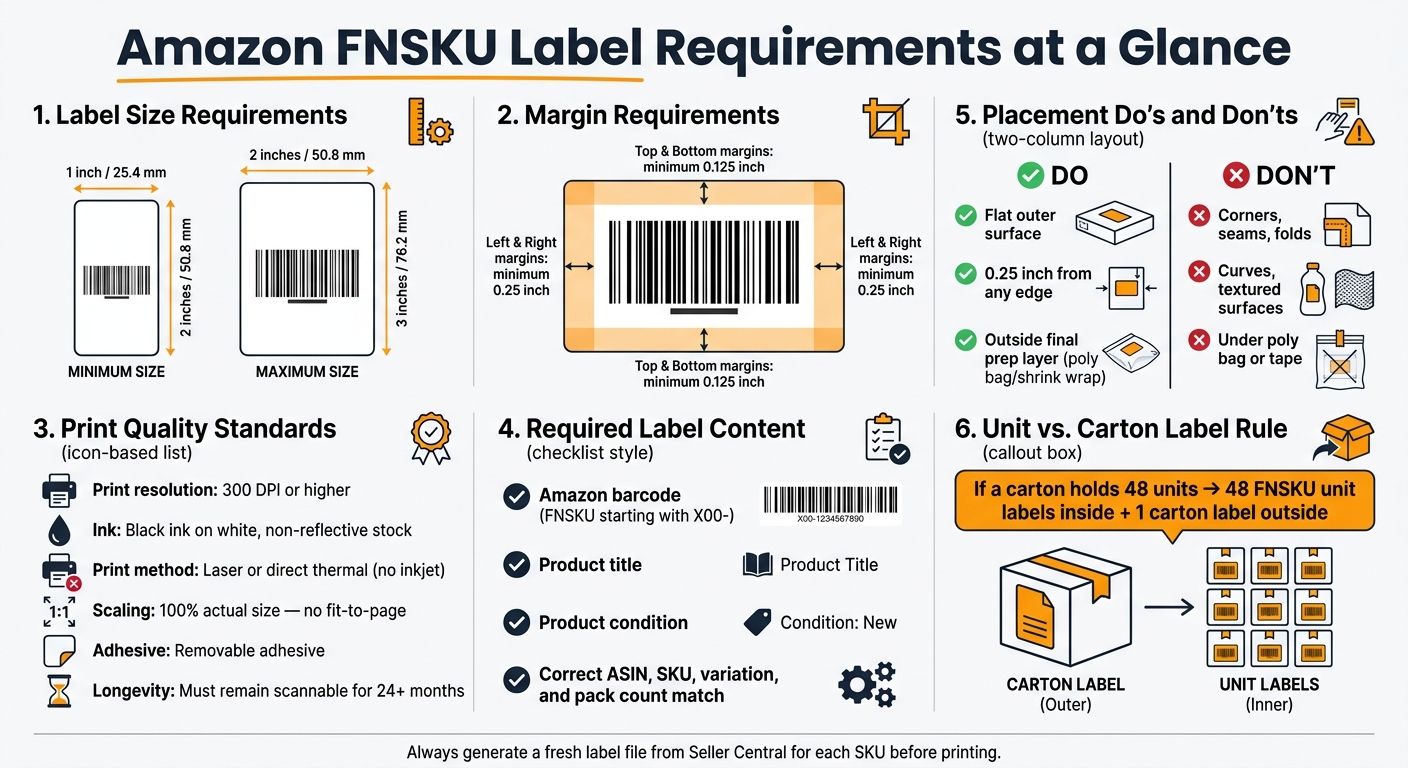
[ ] Correct FNSKU label applied to every sellable unit; labels match the exact SKU and variation
[ ] Unique FBA Box ID label applied to every carton – not photocopied or reused
[ ] Apply four pallet labels, one on each side near the top center, where applicable
[ ] Carrier confirmed and the Amazon delivery appointment scheduled and accepted
[ ] Track customs release, drayage pickup, and Amazon receiving in real time
[ ] Safety stock on hand to cover the full replenishment lead time plus a disruption buffer
FAQs
How much buffer should I add?
Add buffer time based on the lane, shipping mode, and time of year.
For ocean freight to the U.S. West Coast, plan at least 2–4 weeks beyond port-to-port transit. On top of that, set aside 5–10 days for customs holds or delivery appointments.
Typical buffer looks like this:
FCL:7–14 days for the West Coast, 10–15 days for the East Coast
LCL:14–21 days for the West Coast, 20–30 days for the East Coast
If you’re shipping during peak season (Aug–Nov), add 10–14 more days. Shipping plans can get tight fast during that stretch, so extra time gives you some breathing room.
When should I choose air over ocean?
Choose air instead of ocean when you need to move fast, like for an urgent Amazon FBA restock, a new product launch, or items with a high price tag or a tight timeline.
Air freight from China usually takes about 5–10 days door-to-door. After that, Amazon receiving often adds another 3–7 business days once the shipment is delivered.
Ocean freight to the U.S. West Coast usually takes 25–35 days, and that’s before customs clearance and final-mile delivery are added to the total transit time.
Why does Amazon receiving sometimes take longer?
Amazon receiving can take longer than the usual 24 to 48 hours when fulfillment centers are busy. This happens most often from August through November.
Delays can also happen when delivery appointments are missed or a shipment needs extra handling. Common reasons include damaged or unreadable FBA labels, carton weight discrepancies, or floor-loaded containers that need manual unloading.
When that happens, receiving may take an extra 24 to 72 hours.
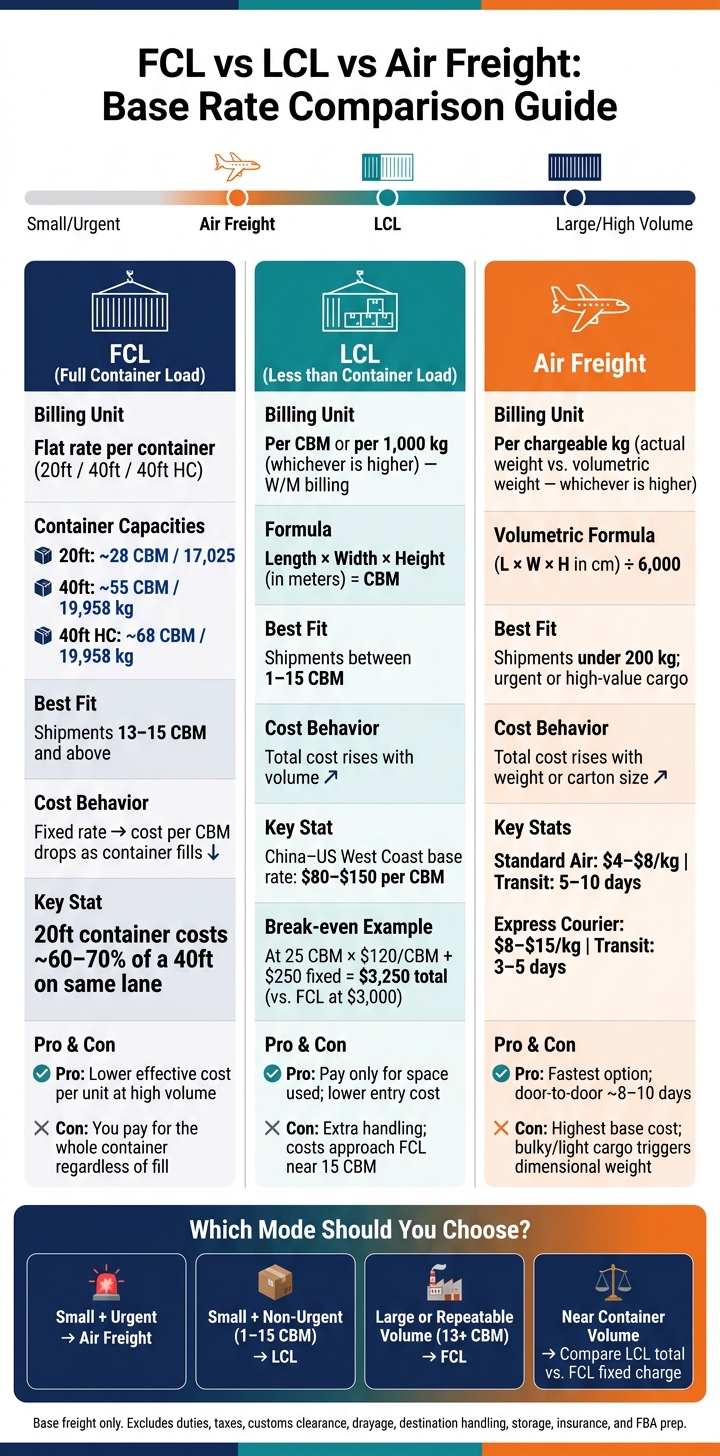
If I had to boil this down to one point, it’s this: the lowest freight rate depends on how your shipment is billed. FCL is priced per container, LCL is priced per CBM or 1,000 kg, and air freight is priced per chargeable kg. So the same cargo can look cheap in one mode and expensive in another.
Here’s the short version:
FCL usually fits larger shipments, often when volume gets close to 13–15 CBM or more
LCL usually fits smaller ocean shipments, often around 1–15 CBM
Air freight usually fits urgent or small shipments, often under 200 kg
Base freight is only the main transport charge
It does not include items like duties, taxes, customs clearance, drayage, destination handling, storage, insurance, or Amazon FBA shipping prep
If I’m comparing quotes, I’d check:
packed CBM
gross weight
carton dimensions
origin and destination
what fees are included
whether the quote is port-to-port or door-to-door
FCL vs LCL vs Air Freight: Base Rate Comparison Guide
FCL vs LCL Shipping: When to Switch (Break-Even Point Explained)
To determine your shipment’s volume and identify this break-even point, you can use a CBM calculator to compare ocean and air freight dimensions.
sbb-itb-f9a91f9
Quick Comparison
Mode
How it’s billed
Common fit
Base rate pattern
Main tradeoff
FCL
Flat rate per container
Larger loads
Cost per CBM drops as container use goes up
You pay for the whole container
LCL
Per CBM or per 1,000 kg, whichever is higher
Small-to-mid ocean loads
Total cost rises with volume
More handling and break-even can get close to FCL
Air Freight
Per chargeable kg
Small or urgent loads
Total cost rises with weight or carton size
Highest cost, but fastest transit
A simple example shows why this matters: if LCL is $120 per CBM + $250 fixed, then 25 CBM = $3,250. If a 20-foot container shipping quote is $3,000, FCL is already the lower-cost pick at that size.
So when I read this article, the main takeaway is clear: don’t compare freight modes by headline price alone – compare the billing method, shipment size, and full quote scope side by side.
1. FCL Ocean Freight
Charging Unit
FCL is priced per container – usually a 20-foot, 40-foot, or 40-foot high-cube unit. That means the base ocean freight rate stays the same whether the container is packed tight or only partly loaded.
So the big pricing lever is simple: how much of that container you use.
Shipment Size Fit
A 20-foot container holds about 28 CBM and 17,025 kg. A standard 40-foot container holds about 55 CBM and 19,958 kg. A 40-foot high-cube holds about 68 CBM and 19,958 kg.
In practice, you may not get all of that space. Carton dimensions, pallets, product limits, and carrier rules often cut into usable volume.
Most industry sources put the FCL decision point at around 13–15 CBM, which is about half of a 20-foot container. Below that, LCL often costs less. Above that, FCL often becomes the lower-cost and simpler option to run.
That said, this is a comparison trigger, not a hard cutoff. The break-even point can move based on the route, destination charges, and accessorial fees. And the more container space you use, the lower your base cost per CBM tends to be. Once you know your usable volume, the next step is figuring out how that fixed rate spreads across it.
Cost Behavior
Because FCL uses a fixed container rate, your cost per CBM drops as you load more cargo.
Here’s where it gets interesting: a 20-foot container often costs about 60%–70% of a 40-foot container on the same lane, while a 40-foot container gives you about twice the volume. That setup can lower your unit cost. But it only works if you can use the extra space without creating too much stock or storage pressure at Amazon.
FCL works well for high-volume, repeatable shipments with steady demand. If you’re shipping a near-full 40-foot container of standard-size, nonhazardous goods, that’s usually a strong fit for FCL.
Amazon fulfillment centers can receive FCL ocean shipments when the load is easy to unload and set up to avoid product damage in transit. Still, FCL doesn’t replace Amazon’s shipment plan, carton and pallet rules, labeling, or delivery appointment steps. You still need to follow the Amazon FBA shipping process.
If you use FCLGO, it can handle customs clearance, drayage, and delivery to your assigned Amazon fulfillment center.
When shipment volume falls below this range, LCL is the next option to compare.
2. LCL Ocean Freight
Charging Unit
LCL usually uses W/M billing. That means you’re charged by whichever is higher:
1 CBM
1,000 kg
CBM is worked out by multiplying length × width × height in meters. That number becomes your billable volume.
Shipment Size Fit
Unlike FCL, which comes with a fixed container price, LCL scales with volume. So the more space your cargo takes up, the more you pay.
LCL makes sense when a shipment is below the FCL break-even point. In plain English, it’s often the right fit when the shipment is too big for air freight but too small to fill a full container.
Here’s how it works: your cargo shares container space with other shipments. It’s consolidated at origin and then broken out at destination. That shared setup is useful, but it also adds extra handling steps.
Cost Behavior
Base LCL freight from China to the U.S. West Coast usually lands in the $80 to $150 per CBM range.
Because pricing is tied to CBM, the base freight cost goes up as shipment size grows. Once you get close to 15 CBM, it’s smart to compare LCL with a 20-foot FCL. At that point, the price gap can get a lot tighter.
That’s why LCL often sits in the middle: not as expensive as air for this size range, but more flexible than booking a full container.
For Amazon FBA, LCL is a solid option for non-urgent restocks or new product launches when volume falls between 1 and 15 CBM. It’s often used to move goods from Chinese factories to U.S. Amazon fulfillment centers such as ONT8, SCK4, and LAX9.
In many cases, LCL cargo arrives as loose cartons. Before Amazon will accept it, the shipment often needs palletizing and FNSKU labeling. FCLGO can take care of that prep before the last trucking leg to the fulfillment center.
Air freight follows a different base-rate formula, so once you switch modes, the size and cost math changes too.
3. Air Freight
Charging Unit
Air freight is billed by chargeable weight. That means you pay based on whichever is higher: the actual (gross) weight or the volumetric (dimensional) weight.
Volumetric weight is worked out with this formula: (Length × Width × Height in cm) ÷ 6,000.
So if a shipment is light but takes up a lot of space, the size of the cartons can drive the price more than the scale does.
Shipment Size Fit
Air freight tends to make the most sense for shipments under 200 kg. There’s also no minimum weight, which makes it a solid option for very small shipments.
That’s the catch with air: pricing is tied to weight, so costs can climb fast as the shipment gets bigger.
Cost Behavior
Standard air freight from China to the U.S. usually costs $4–$8 per kg. Express courier air is higher, at $8–$15 per kg.
Service Type
Cost per kg
Transit Time
Standard Air Freight
$4–$8
5–10 days
Express Air Courier
$8–$15
3–5 days
Air freight doesn’t behave like LCL. LCL costs move with volume, but air freight costs are driven mostly by weight. As shipment size increases, the price gap between air and ocean shipping gets much larger.
For Amazon sellers, that makes air freight a speed-first choice, not the best pick for moving a lot of inventory at once.
Amazon FBA Use Case
Air freight is the right fit when speed matters more than price. Common use cases include:
urgent inventory restocks to avoid going out of stock
small test orders for new product launches
high-value or fragile products, such as electronics
Typical door-to-door air transit is about 8–10 days. FCLGO also handles air freight, including customs clearance and delivery to Amazon fulfillment centers.
How Shipment Size Affects the Base Rate
Unit pricing only shows part of the picture. Your total base freight cost shifts as shipment size grows because each shipping mode scales in its own way. The practical question is simple: at what point does one option stop being the lowest-cost choice?
Shipment Condition
Rate Structure to Prioritize
Reason
Small and urgent
Air freight by chargeable weight
Speed may justify the premium, and smaller cartons lower dimensional weight.
Small and non-urgent
LCL by chargeable CBM
Pay for the ocean space you use instead of reserving a full container.
Large shipment
FCL per container
A fixed container charge is spread across more inventory, lowering the effective cost per CBM.
Near-container volume
Compare LCL total cost vs. FCL fixed charge
LCL may approach or exceed FCL, and FCL can also reduce handling complexity.
Bulky or lightweight
Compare air chargeable weight vs. LCL CBM pricing
Large, light cartons can trigger high dimensional weight in air freight, while ocean pricing is based on space.
When you’re close to container volume, do a quick FCL vs. LCL break-even check. Here’s a simple example: if LCL costs $120 per CBM plus $250 fixed, the total hits $3,250 at 25 CBM. If an FCL quote is $3,000, FCL is already the lower-cost move at that volume.
Of course, pricing doesn’t happen in a vacuum. Actual results will vary by lane, season, container availability, and what each quote includes. That’s why apples-to-apples quoting matters.
Ask for quotes using the same shipment details:
packed CBM
gross weight
carton dimensions
origin
destination
fee split
That way, the base rate comparison is clean. FCLGO can quote ocean freight, air freight, customs clearance, and delivery under the same quote scope.
Those break-even points are what shape the tradeoffs between modes.
Pros and Cons by Freight Mode
Each freight mode comes with its own pricing logic. The right pick usually comes down to three things: shipment size, delivery speed, and how much cost your margins can handle. The big difference is how you’re charged – fixed container, shared CBM space, or chargeable kilogram.
Freight Mode
Pros
Cons
Best-Fit Scenario
FCL
Lower effective cost per unit at higher volume; fewer consolidation and handling steps; simpler logistics
Higher upfront cost; inefficient if the container is only partly filled
Predictable replenishment with high container utilization
LCL
Pay only for the space or weight used; lower entry cost for smaller shipments
Billed by chargeable volume or weight, so handling charges can add up as volume rises
Shipments under about 15 CBM; new product launches with uncertain demand; irregular replenishment cycles
Air Freight
Fastest option – best for urgent restocking
Highest base cost per kilogram; bulky but light cargo can be priced by dimensional weight
Stockout prevention, launches, high-value goods, and small bridge shipments
The table gives you the short version. What matters in practice is how each mode changes as shipment size grows.
FCL tends to look better as you fill more of the container. Since the rate is fixed, the cost per unit drops as utilization goes up. That makes it a strong fit for steady replenishment and larger-volume moves.
LCL usually starts out cheaper for smaller shipments. You only pay for the space or weight you use, which keeps the entry cost lower. But there’s a catch: as volume climbs, consolidation and handling charges can start eating into the savings. At some point, the gap between LCL and FCL gets a lot smaller.
Air freight is the speed play. It’s the fastest option by far, but also the most expensive on a per-kilogram basis. And if your cargo is light but bulky, dimensional weight can push the rate up fast. That’s why air tends to make sense when timing matters more than cost – like avoiding a stockout, supporting a launch, or moving a small bridge shipment.
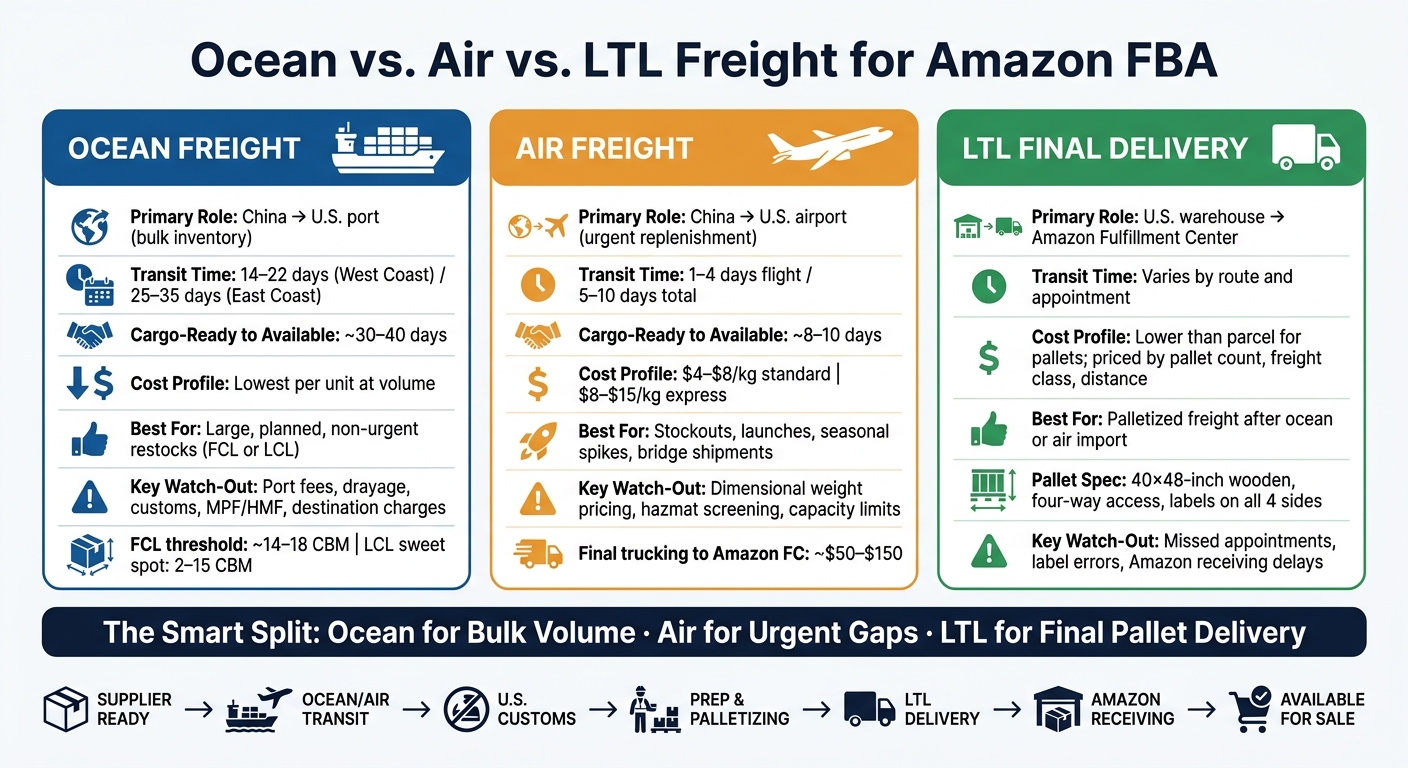
A common move is to send the main replenishment by FCL or LCL, then use air for a smaller top-up shipment while the ocean freight is still on the water. It’s not fancy, but it works.
If you’re comparing quotes, FCLGO can help line up FCL, LCL, and air freight alongside customs clearance, U.S. warehousing, trucking, drayage, FBA prep, and direct delivery to Amazon fulfillment centers.
For sellers, the day-to-day question is simple: which pricing model lines up with the shipment’s size and timing?
Conclusion
After looking at all three billing models, the main takeaway is simple: choose the shipping mode that fits your shipment size, timeline, and the way that mode charges for freight. Use FCL when your cargo is close to filling a container, LCL for smaller ocean shipments, and air freight when time matters most.
Before you make a call, compare quotes using the same scope. That means checking line by line for:
consolidation
destination handling
drayage
customs clearance
FBA prep
delivery
Price is only one part of the decision. If a top-selling ASIN is getting close to a stockout, the lost sales can cost more than what you save with ocean freight. In that case, air freight isn’t just faster. It can be the better inventory move.
FCLGO handles China-to-U.S. ocean freight, air freight, customs clearance, FBA prep, U.S. warehousing, trucking, drayage, and delivery to Amazon fulfillment centers.
FAQs
What’s included in a base freight quote?
A base freight quote usually covers the main cost of moving your goods from origin to destination. But that number is often just one piece of your total landed cost.
For FCLGO, the quote may include pickup, export customs clearance, ocean or air transit, U.S. customs clearance, destination handling, and final trucking to your warehouse or Amazon fulfillment center.
That said, don’t assume every charge is already baked in. It’s smart to confirm whether the quote includes:
Fuel surcharges
Documentation
Terminal handling
Duties
Taxes
FBA prep
A quote can look low at first glance, then grow once these line items show up. That’s why it helps to check exactly what’s included before you book.
How do I find the break-even point between LCL and FCL?
Calculate the total cost for each option based on your shipment’s volume and weight. LCL is usually priced per cubic meter (CBM) or per 2,204.6 lbs. (1,000 kg), while FCL comes with a fixed rate for the entire container.
As a rule of thumb, LCL tends to cost less for shipments under 15 CBM. Once you get above 15 CBM, FCL often starts to make more sense on price. To make the comparison easier, divide each total quote by your number of units.
Why can air freight cost more for lightweight cargo?
Air freight charges are based on whichever is higher: actual weight or volumetric weight.
Volumetric weight reflects how much space your cargo takes up, and it’s calculated like this:
(Length × Width × Height in cm) ÷ 6,000
Here’s the idea in plain English: a shipment might not weigh much, but if it takes up a lot of room, the airline still has to give that space over to your cargo.
So if your shipment is light but bulky, its volumetric weight can end up higher than its actual weight. When that happens, you’re charged for the space it uses, not just the pounds or kilos on the scale.
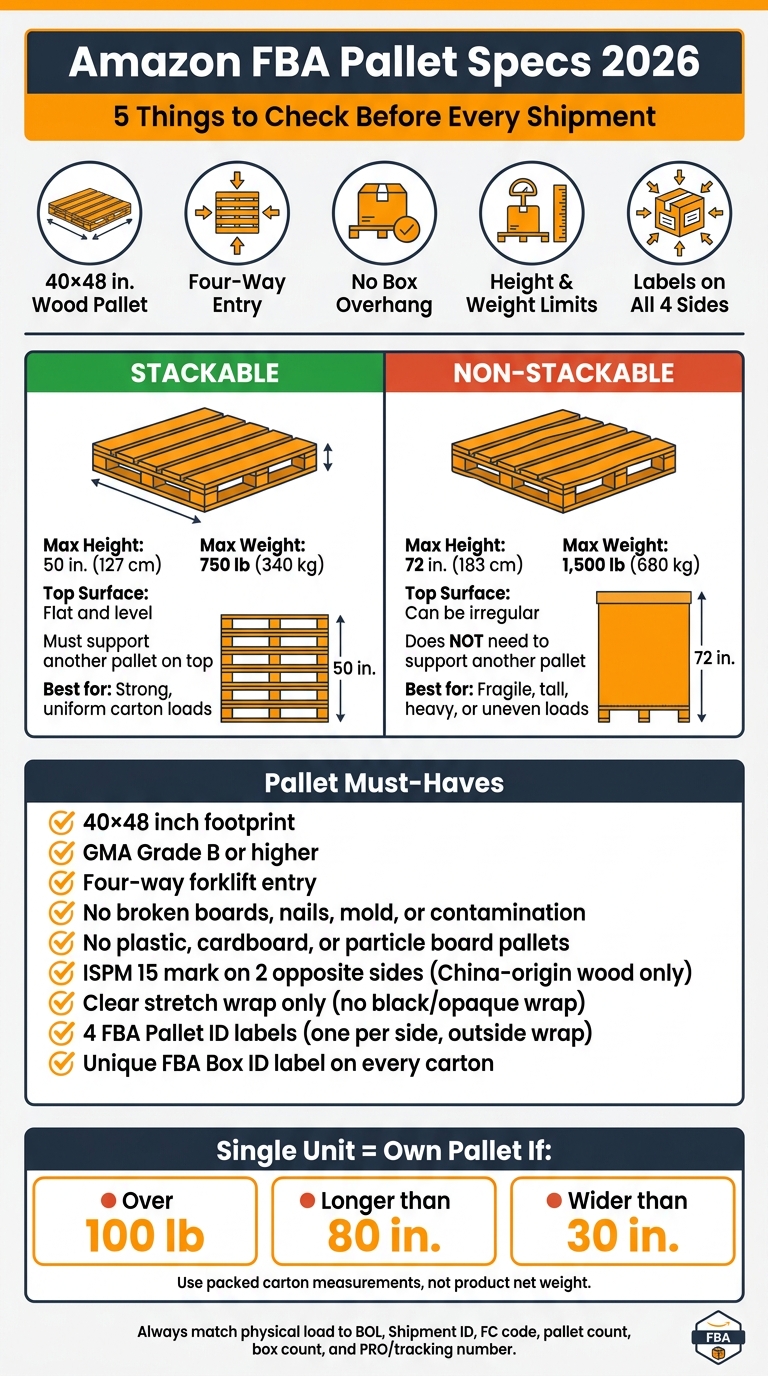
If your pallet misses Amazon’s rules, your shipment can be refused, delayed, or reworked at your cost. I’d check 5 things first: 40 x 48-inch wooden pallet, four-way entry, no box overhang, correct height/weight, and labels on every pallet side plus every box.
I match the physical load to the paperwork: BOL, Shipment ID, FC code, pallet count, box count, and tracking/PRO details.
A few numbers matter most here. Amazon’s pallet footprint is 40 x 48 inches. Stackable loads top out at 50 inches / 750 lb. Non-stackable loads top out at 72 inches / 1,500 lb. And if one packed unit is over 100 lb, over 80 inches long, or over 30 inches wide, I put it on its own pallet.
Amazon FBA Pallet Specs: Stackable vs Non-Stackable at a Glance
Pallet LTL Shipping Tips with Amazon FBA – How to Avoid Common Mistakes
sbb-itb-f9a91f9
Quick comparison
Item
Stackable
Non-stackable
Max total height
50 in.
72 in.
Max total weight
750 lb
1,500 lb
Top surface
Flat and level
Can be irregular
Strength
Must hold another pallet on top
Does not need to support another pallet
Best use
Even, strong carton loads
Fragile, tall, heavy, or uneven loads
In other words: this guide is about passing Amazon receiving the first time. I’d use it as a last-check list before pickup and again before delivery. For a broader look at the logistics process, see our guide to shipping to Amazon FBA.
Amazon pallet specs: size, material, condition, and access
Amazon’s standard pallet for U.S. fulfillment center shipments is a 40 × 48-inch, four-way-entry wooden pallet rated GMA Standard Grade B or higher. That means forks from a forklift or pallet jack can go in from all four sides. It also means the load has to stay neat: cartons must sit fully inside the 40 × 48-inch footprint, with no overhang. If one oversized unit can’t fit that footprint, use a pallet size that fits the unit.
Once the pallet type is set, the next step is simple: check the footprint, the pallet’s build, and any export marks before pickup.
Approved pallet construction and condition
Grade B pallets need six or seven top boards, at least four bottom boards, intact stringers, four-way entry, and no block repairs. Amazon also does not allow plastic, cardboard, and particle board pallets for these shipments.
Before you wrap anything, inspect the pallet closely. Look for broken or missing boards, protruding nails, damaged stringers, warping, mold, or signs of chemical or water contamination. Amazon says broken or damaged pallets may be rejected at the seller’s expense.
If you’re using China-origin wood pallets, check for a clear ISPM 15 mark on at least two opposite sides. The mark should include the IPPC symbol, country code, producer code, and treatment code. USDA APHIS says regulated wood packaging material entering the United States must be treated and certified under ISPM 15.
Specification table: Amazon rules, planning targets, and Seller Central checks
Use the table below to separate Amazon requirements from planning targets and Seller Central checks.
Item
Amazon requirement
Planning target
Seller Central check
Footprint
40 × 48 inches
No carton overhang; load flush within the deck
Confirm whether an oversized unit or special program changes the requirement
Material
Wooden pallet; no plastic, cardboard, or particle board
Use a durable, export-grade wooden pallet
Check for any carrier or fulfillment center-specific instructions
Access
Four-way entry
Keep all fork-entry openings clear and unobstructed
Review partnered-carrier and appointment instructions
Grade
GMA Standard Grade B or higher
Use Grade A or heavy-duty equivalent where available
Verify whether the carrier has stricter pallet standards
Condition
No broken or damaged pallets
Reject pallets with mold, contamination, protruding nails, or unstable repairs
Document the inspection before pickup
Export treatment
ISPM 15 treatment and marking for regulated wood packaging
Inspect marks before container loading
Retain supplier or treatment records
Next, measure total pallet height, weight, and stackability before release.
How to calculate pallet height, weight, and stackability
Once you’ve confirmed the pallet type, measure the loaded pallet – not just the cartons.
Height and weight limits to measure before pickup
Measure height from the floor to the top of the load. Weight should include everything: the pallet, cartons, stretch wrap, corner boards, and any other packaging materials.
Amazon’s limits change based on whether the pallet is stackable. A stackable pallet must stay at or below 50 inches in total height and 750 lb in total weight. In Amazon’s planning example, that 50-inch limit is split into about 45 inches of cartons on top of a 5-inch pallet. A non-stackable pallet can go up to 72 inches in total height and 1,500 lb in total weight.
Both limits have to pass. If one is over, the pallet doesn’t qualify. That’s why it’s smart to measure again after wrapping. Stretch wrap and other materials can add just enough height to put a load over the line.
When a product needs its own pallet
A single unit or set should go on its own pallet if it is:
Over 100 lb
Longer than 80 inches
Wider than 30 inches
Use the packed carton measurements, not the product inside.
Before pickup, check the pallet step by step. Record the carton count, each carton’s packed dimensions, each carton’s gross weight, and the pallet’s tare weight. Then use these formulas:
Total loaded height = pallet height + height of the carton stack
Use actual packed weights, not product net weights.
Stackable vs. non-stackable pallets
A pallet is stackable only if it meets both the size limits and the load-strength rule. That means the load needs to be level, evenly spread, and built from cartons strong enough to hold another pallet on top.
Mark a pallet non-stackable if the cartons are weak, wet, or visibly compressed; if the top surface is uneven or irregular; if the product is fragile or easy to crush; or if the total goes over 50 inches or 750 lb. Don’t label a pallet stackable unless it clears every part of the rule.
Amazon treats stackable pallets as the preferred setup because they use trailer space more efficiently.
Factor
Stackable pallet
Non-stackable pallet
Total height
Up to 50 in. (127 cm), including pallet
Up to 72 in. (183 cm), including pallet
Total weight
Up to 750 lb (340 kg), including pallet
Up to 1,500 lb (680 kg), including pallet
Load stability
Must safely support another pallet; level, uniform, compression-resistant
Must stay stable during transit without carrying another pallet
Trailer-space impact
More efficient; carrier may place another pallet above it
Less efficient; vertical space above the load is unused
When it applies
Strong, uniform cartons; even load shape; within 50 in./750 lb limits
Fragile, irregular, heavy, or tall loads that cannot safely support another pallet
If the pallet clears these limits, you’re ready to build, wrap, and label it next.
How to build, wrap, and label an FBA pallet
Once the pallet clears height, weight, and stackability checks, it’s time to get it ready for handling and receiving.
Build a stable load with no box overhang
Start with a pallet that isn’t damaged. Put the heaviest and most rigid cartons on first, then stack lighter cartons on top. Keep the weight centered so the load doesn’t tilt or lean. Every carton should sit flush within the pallet footprint. Don’t build it into a pyramid shape – the top layer should stay flat and level. Also, keep forklift and pallet jack entry points fully open.
Use clear stretch wrap and place labels on all four sides
Wrap the load with clear stretch wrap only. Begin at the pallet base and work your way up, overlapping each pass so the wrap helps secure the cartons to the pallet. Don’t use black or opaque wrap. It hides the condition of the cartons and can block labels from view. Add this carrier instruction where it can be seen: Do not break stretch wrap.[3]
Each pallet needs four FBA pallet labels. Place one at the top center of each side, on the outside of the stretch wrap. Every carton on the pallet must also have its own unique FBA Box ID label. Don’t photocopy labels or reuse them.
Prep steps before release
Use this checklist before pickup:
Inspect the pallet condition and carton labels.
Build a centered load with all carton edges inside the pallet footprint.
Measure the finished height and gross weight.
Wrap the pallet in clear stretch wrap.
Apply four pallet labels and confirm all carton Box IDs.
Take photos of all four sides, the top, and all labels, then save the shipment records.
Hold the pallet if labels are missing, the wrap is loose, overhang is present, or the measurements don’t match.
Next, verify carrier and Amazon delivery rules before release. This includes checking the specific requirements for your assigned Amazon fulfillment centers.
Final pre-delivery checks for China-to-USA FBA shipments
Carrier and fulfillment center checks before delivery
Once the pallet is built and labeled, you’re at the last gate before dispatch: making sure the physical load matches the booking and the delivery paperwork.
Before the truck shows up, confirm the finished pallet still matches Amazon’s approved spec and that the shipment documents line up with the load. A pallet can meet the physical rules and still get turned away if the BOL, shipment ID, or FC code doesn’t match the booked shipment.
Check the load itself first. Make sure the total loaded height is correct, the gross weight is within the allowed limit, the pallet labels are in place, and forklift access is open on all four sides. Also look at the wrap from every angle. The stretch wrap should be clear, secure, and not block entry points.
Then review the paperwork. The carrier needs an accurate bill of lading, the correct FBA Shipment ID, exact pallet and box counts, and the exact fulfillment center code and address. Confirm box and pallet counts before the delivery appointment, and list the Amazon reference IDs, shipment ID, and PRO/tracking number on the BOL. Verify the fulfillment center code on every document before dispatch.
Conclusion: release-or-hold checklist for Amazon pallet compliance
Use this final dispatch check before the truck leaves.
Check
Pass standard
If it fails
Pallet size
40 × 48 in., four-way access, GMA Standard Grade B or higher
Re-palletize
Pallet condition
No broken boards, protruding nails, contamination, or water damage
Replace pallet
Total height
72 in. or under, including the pallet
Re-stack or split load
Gross weight
Within the shipment-specific Seller Central limit
Re-palletize or split load
Overhang
Zero – all cartons flush within the pallet footprint
Re-stack
Stretch wrap
Clear, fully secured, load cannot shift
Rewrap
Pallet labels
Four FBA Pallet ID labels, one per side, outside the wrap
Relabel
Carton labels
Every box has a unique, visible FBA Box ID label
Relabel affected cartons
Forklift access
All four entry points unobstructed
Reposition wrap or straps
BOL and shipment ID
Accurate counts, correct FBA Shipment ID, Amazon reference IDs, and PRO/tracking number
Update documents before departure
Fulfillment center address
Exact FC code and address matches Seller Central
Correct all documents
Delivery appointment
Confirmed through the required process
Reschedule before dispatch
FAQs
How do I know if my pallet is truly stackable?
A pallet is stackable only when the load is stable, flat, and even enough to carry extra weight without shifting or collapsing.
That means cartons should be stacked tight with no overhang, the top should stay level, the pallet base should be in good shape, and clear stretch wrap should keep the whole load locked together.
What happens if my pallet is slightly over Amazon’s limits?
If your pallet goes over Amazon’s limits, Amazon may reject it, delay the shipment, or charge extra manual handling fees.
There’s another catch: if any cargo hangs over the pallet edge, carriers may measure from that farthest point. That can bump up your shipping costs.
To avoid problems, check that your pallet meets Amazon’s rules for size, weight, stacking, labeling, and stretch wrap before delivery.
Do all boxes need labels even if the pallet is labeled?
No. Even if the pallet has labels, each box still needs its own Box ID label, and each unit still needs its FNSKU.
Pallet labels identify the pallet only. They don’t replace box labels. So keep carton labels visible on each box, and place pallet labels on all four sides outside the final stretch wrap.
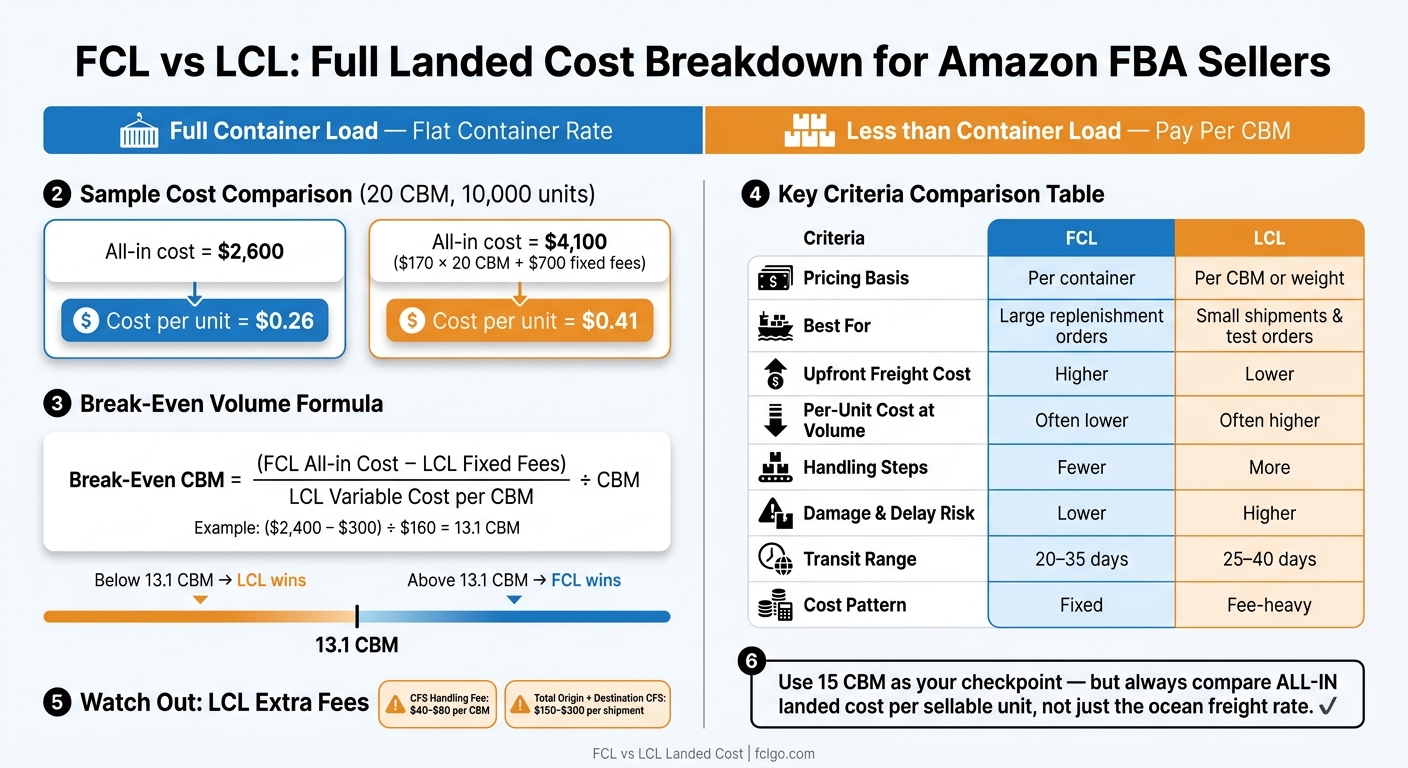
The lowest freight quote is often not the lowest FBA landed cost. If I’m shipping from China to the U.S., I need to compare cost per sellable unit, not just cost per container or cost per CBM.
Here’s the short version:
FCL often works better when my shipment is large enough to spread flat container costs across more units.
LCL often works better for smaller orders, launches, and test shipments, but it can bring extra CFS, deconsolidation, and handling fees.
A rough checkpoint is 15 CBM, but my actual break-even point depends on my quote, carton size, unit count, duties, prep fees, and delivery costs.
Transit time on a quote is not the same as Amazon-ready time. LCL often adds more handling steps and can add delay risk.
If inventory arrives late, my true cost can go up through stockouts, damage, and fewer sellable units.
Simple rule: I should choose the option with the lower all-in landed cost per sellable unit, as long as it also fits my restock date and risk level.
The rest of the article breaks down how to run that math in a clean, side-by-side way.
Build a full landed cost comparison before choosing a shipping method
Don’t choose between FCL and LCL based on ocean freight alone. Compare both options using total landed cost per sellable unit from the factory door to the Amazon fulfillment center.
The simplest way to do that is to use one worksheet for both quotes. That way, you’re comparing the same charges side by side, and the only thing that changes is how each fee scales.
Line Item
Billing Basis
Applies To
Base ocean freight
Per container (FCL) / Per cubic meter (CBM) (LCL)
Both
Fuel surcharge (BAF)
% of freight or per container/CBM
Both
Peak season surcharge
Per container (FCL) / Per CBM (LCL)
Both
Origin terminal handling (OTHC)
Per container (FCL) / Per CBM (LCL)
Both
Import paperwork and brokerage
Per shipment
Both
Consolidation fee
Per CBM
LCL only
CFS handling and deconsolidation fee
Per CBM or per shipment
LCL only
Customs duties and taxes
% of cargo value
Both
Destination terminal fees
Per container or per shipment
Both
Inland drayage / trucking
Per container (FCL) / per delivery (LCL)
Both
Cargo insurance
% of cargo value
Both
FNSKU labeling
Per unit
Both
Palletization
Per pallet
Both
Separate fixed charges from variable charges
After you list every cost, split them into two groups.
Some fees stay fixed per shipment or per delivery, like import paperwork, brokerage, and inland delivery. Others change with shipment size or cargo value. Ocean freight and terminal handling work this way: for FCL, they’re charged at the container level; for LCL, they’re tied to volume. Duties, insurance, and FBA prep also move with cargo value or unit count.
This matters because FCL and LCL spread those costs in different ways. With FCL, the container rate and terminal handling sit at the container level, so adding more units can bring the cost per unit down. With LCL, freight is billed by volume or weight, and destination handling fees get spread across fewer sellable units. That can make the cost per unit climb faster than expected.
Why a lower LCL rate per CBM can still cost more per unit
LCL is billed by volume or weight, whichever is higher. So a low rate per CBM doesn’t tell the whole story. The bigger issue is the extra handling built into LCL shipments.
CFS handling and deconsolidation fees often run $40–$80 per CBM combined at origin and destination, or $150–$300 total. On a small shipment, those charges can eat up any savings from a lower ocean rate.
Ask for one itemized quote for both modes, then compare:
landed cost per unit
break-even volume
That’s the number that shows which option gives you the lower landed cost per unit. And once you have that, the break-even point becomes much easier to spot.
How FCL and LCL differ in cost structure and break-even volume
FCL vs LCL Shipping: Full Landed Cost Comparison for Amazon FBA
Using the landed-cost worksheet above, the next step is to find the shipment size where FCL’s flat container price starts to beat LCL’s pay-for-what-you-use model.
Here’s the core idea: FCL is a flat container charge. As you load more sellable units into that container, the freight cost per unit goes down. LCL works differently. It’s billed on whichever is higher: volume or weight. So if you ship 4 CBM that weighs 6 metric tons, the charge may be based on weight, not volume. LCL freight also passes through origin and destination container freight stations, which adds steps that FCL skips.
When FCL lowers per-unit cost
Take a simple example. Say an all-in 20-foot FCL shipment costs $2,400 and holds 8,000 units across 16 CBM. That puts freight at $0.30 per unit.
Now compare that with LCL. If the same shipment moves at an all-in rate of $180 per CBM, the total comes to $2,880, or $0.36 per unit. That’s the freight part of landed cost for each sellable unit.
FCL can also work well for repeat replenishment orders. If you can line up shipments with container departures, you cut out repeated CFS handling and usually get steadier costs from one order to the next.
When LCL makes sense despite added fees
LCL still has a clear place. If your cargo doesn’t come close to filling a container, paying only for the space you use can make more business sense, even when the per-unit freight cost is higher.
That often applies to:
a product launch
a market test
a small replenishment order meant to avoid a stockout
For example, if a launch order uses 5 CBM and includes 2,000 units, LCL may still be the better move. Why? Because it lets you avoid buying and storing thousands of extra units just to fill a container. Those added handling steps matter too, since they can affect timing and damage risk.
So, below 13.1 CBM, LCL is usually cheaper. Above that, FCL often starts to win.
If you want to turn that into a per-unit check, use your own carton size and unit count:
FCL cost per unit = All-in FCL cost ÷ total sellable units
LCL cost per unit = (LCL rate × CBM + fixed LCL fees) ÷ total sellable units
Here’s a concrete example using 500 cartons at 0.04 CBM each, with 20 units per carton. That’s 10,000 units total and 20 CBM.
FCL
LCL
All-in cost
$2,600
($170 × 20 CBM) + $700 fixed = $4,100
Cost per unit
$0.26
$0.41
Use your own quote for the final call. Destination charges and handling fees often shift the break-even point.
And once freight cost gets close, the choice usually comes down to the other moving parts: handling, port fees, transit time, and inventory risk.
How handling, port fees, transit time, and inventory risk affect landed cost
Once freight rates get close, handling and timing start to drive the real landed cost. The quote in front of you is only part of the picture. Add handling, port fees, delays, and stockout risk, and the gap between FCL and LCL can get a lot bigger than the ocean rate suggests.
How LCL handling and CFS fees add cost and risk
LCL cargo moves through origin and destination CFS facilities. That means more handling fees, more rehandling, and more sorting. Every extra touch adds a chance for damage or delay, which is a bigger issue for fragile cartons or tightly packed goods. And if one shipper on the container has a paperwork problem, the whole container can get held up.
That’s why these charges shouldn’t be treated as random add-ons. They belong in your landed cost math.
The next move is to line those charges up against the full shipment timeline.
Why published transit time is not the same as Amazon-ready time
Published transit time leaves out a lot: pickup, export handling, customs, drayage, and Amazon appointment timing. For Amazon sellers, actual door-to-Amazon shipping time starts when the supplier releases the goods and ends when Amazon has the inventory in hand.
Put simply, published transit time makes the delivery window look shorter than it is.
Stage
Responsible Party
Cost Category
Unique to LCL?
Supplier Pickup
Freight Forwarder
Inland Freight
No
Export Prep & Customs
Forwarder / Broker
Documentation / Export Fees
No
Consolidation (CFS)
Forwarder / CFS
CFS Stuffing / Handling Fee
Yes
Ocean Transit
Ocean Carrier
Ocean Freight
No
U.S. Discharge
Port Terminal
Terminal Handling (THC)
No
Customs Clearance
Customs Broker
Duties / MPF / HMF / ISF
No
Deconsolidation (CFS)
Forwarder / CFS
CFS Stripping / Handling Fee
Yes
Drayage / Trucking
Trucking Company
Inland Freight
No
FBA Prep / Palletizing
Prep Center / Warehouse
Labeling / Pallet Fees
Optional
Amazon Appointment
Carrier / Amazon
Waiting / Accessorials
No
Amazon Receiving
Amazon
FBA Fees
No
LCL usually takes 25–40 days, while FCL usually lands in the 20–35 day range, mostly because LCL cargo spends extra time at origin and destination CFS points. So don’t plan from ship date forward. Plan backward from the date you need inventory in the U.S.
FCL vs. LCL: damage exposure and cost predictability
After rate and timing, the next big issue is control. With FCL, your cargo stays in one sealed container from the factory to the destination or prep center. That cuts down handling risk and gives you more say over the shipment environment. For fragile or high-value products, that can matter a lot.
Criteria
FCL
LCL
Shared container handling
No – single shipper
Yes – multiple shippers
Port and CFS charges
Fixed THC at port
Variable CFS fees per CBM
Damage risk
Low – minimal touchpoints
Higher – frequent extra rehandling
Cost stability
High – fixed container rate
Moderate – varies by CBM / weight
Customs delay risk
Independent
Shared – one hold can delay all cargo
Best Fit
Larger or fragile shipments
Small trial shipments
If your inventory buffer is thin, delay risk can end up costing more than the freight savings.
How to choose between FCL and LCL for your Amazon shipment
A step-by-step decision process for Amazon sellers
Once you know your break-even point, the next step is simple: check the shipment in front of you against a short decision process. Start with volume, then work through cost and timing.
Measure your shipment: Calculate total CBM, carton count, unit count, and gross weight. Those numbers shape both your shipping mode and your rate. They also help you gauge handling risk.
Get itemized quotes for both options: Ask for line-item quotes for FCL and LCL on the same route. Don’t compare headline rates alone. Compare the full breakdown.
Add every downstream cost: Include duties, drayage, FBA prep, and warehousing. Then divide total landed cost by sellable units to get your per-unit cost.
Cost by itself doesn’t tell the whole story. Timing also affects how much inventory risk you carry.
Check your timing: Use door-to-Amazon timing, not the ship date, because LCL often adds CFS time. Work backward from the date Amazon needs the inventory, not the date the goods leave port.
Use 15 CBM as a rough checkpoint, not a hard rule.
Conditions that favor LCL and conditions that favor FCL
Condition
Favors LCL
Favors FCL
Shipment volume
Under 15 CBM
15+ CBM
Shipment type
Launches or test orders
Recurring, high-volume replenishment
Handling preference
More touchpoints are acceptable
Fewer touchpoints and lower handling risk
LCL is often a good fit when you’re launching a new product or moving a smaller test order and the volume doesn’t justify a full container. FCL usually makes more sense when you’re restocking at volume and want fewer touchpoints and steadier handling.
Conclusion: base your decision on all-in cost, timing, and control
When the numbers are close, go with the option that protects timing and cuts handling.
The freight rate is only the starting point. Landed cost needs to include every dollar from the factory in China to the Amazon fulfillment center – origin charges, ocean freight, customs, duties, drayage, and FBA prep. LCL can look cheaper at first glance, but the extra handling and slower transit often shrink the gap between the quoted rate and the actual landed cost. FCL comes with a higher fixed cost, but once volume is high enough, it can lower per-unit cost and cut the number of times your cargo is handled.
The choice comes down to shipment size, delivery timing, and how much handling risk you can take on. Run the full math on both options before you book.
FCLGO can help with China-to-U.S. FCL or LCL shipping, customs clearance, warehousing, trucking, FBA prep, and delivery to Amazon.
FAQs
How do I find my FCL vs. LCL break-even point?
Compare the total cost of an LCL shipment with the fixed rate of a 20-foot container. With LCL, carriers charge by cubic meter (CBM) or per 1,000 kg, whichever is greater. That means the cost per unit often climbs as your shipment gets bigger.
A common rule of thumb: at around 15 CBM, FCL often starts to make more sense on price and speed.
To find your exact break-even point, get quotes for both options. Then divide each total shipping cost by your number of units to calculate the per-unit landed cost.
What charges are usually missing from an LCL quote?
An LCL quote often leaves out charges that show up at destination after the shipment arrives. Common examples include:
Destination port fees and terminal handling
Inland trucking or drayage to the Amazon fulfillment center or warehouse
Customs-related costs, including ISF or entry processing, customs clearance, and duty payment
It can also leave out added storage or labor charges if customs release or port release gets delayed.
How should I plan for Amazon-ready timing, not just transit time?
Work backward from your target in-stock date, not just the ocean transit window.
That means your timeline should cover the whole trip:
Production
Origin handling
Customs clearance
Final delivery
A separate buffer for Amazon appointment scheduling and receiving delays
Here’s the part many sellers miss: freight can arrive at the port and still NOT be available for sale. Amazon check-in delays and appointment backlogs can eat up days fast.
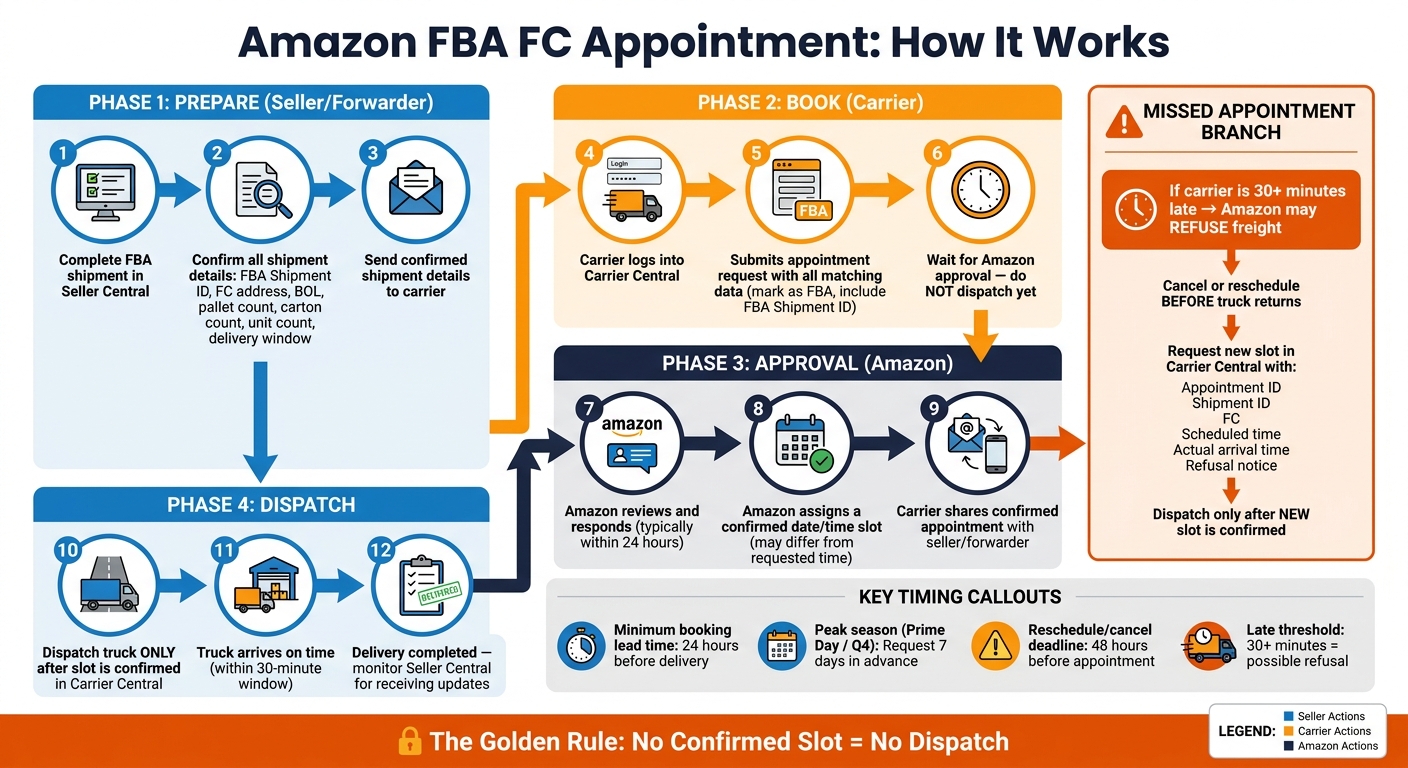
If your carrier does not have a confirmed Amazon FC appointment, the truck should not go. That is the main rule. For many FBA inbound shipments – especially LTL, FTL, and FCL – Amazon wants a booked delivery slot, and a truck that arrives 30 minutes late or more can be refused.
The seller or forwarder sends the shipment details from Seller Central.
Those details must match the BOL, pallet count, carton count, and FC destination.
Amazon usually replies in about 24 hours, but peak periods can take more planning.
Peak seasons may call for 7 days of lead time.
If the slot is missed, the carrier usually needs to cancel or reschedule before trying again.
If the load changes after booking, the appointment data should be updated before dispatch.
In other words: no confirmation, no dispatch. If you get the data wrong or miss the time window, costs can stack up fast – detention, extra truck moves, storage, drayage, demurrage, and late inventory.
I’d read this article as a simple playbook for four things: who books the slot, what data must match, when to request it, and what to do if the appointment is missed.
Amazon FBA FC Appointment Process: Step-by-Step Guide
Who books the appointment and what the carrier needs
The carrier submits the appointment in Carrier Central. The seller or freight forwarder provides the shipment data, and the carrier should book only after those details are checked and then wait for approval before dispatching. A requested date is not a confirmed appointment. Do not dispatch the truck until Amazon approves the slot.
Before the carrier submits the request, the shipment details need to match exactly.
The carrier’s role vs. the seller’s role
The seller completes the FBA shipment in Seller Central and sends the full shipment details to the carrier. The carrier then checks those details against the bill of lading, submits the request in Carrier Central, marks it as FBA, and includes the correct FBA Shipment ID.
After submission, the carrier keeps an eye on Carrier Central for Amazon’s response and shares the confirmed appointment with the seller or freight forwarder.
Shipment details that must match before booking
Every data point entered in Carrier Central should match what appears in Seller Central and on the bill of lading. Even small mismatches can cause problems. The table below shows the minimum data the carrier needs in order to submit the appointment.
Required Data Point
Where It Comes From
FBA Shipment ID
Summary page in Seller Central
Amazon reference number
Seller Central shipment plan
Fulfillment center name and full address
Seller Central shipment destination
Shipper name
Shipment documentation
Bill of lading details
Carrier-issued BOL
PRO number (if applicable)
Assigned by the LTL carrier
Pallet count and carton count
Physical load confirmation
Total unit count (if available)
Packing list or Seller Central
Approved delivery date
Coordinated between seller and carrier
If the physical load changes after booking – for example, the warehouse confirms 11 pallets instead of 12 – the carrier and forwarder should update the appointment details in Carrier Central before the truck leaves.
For China-to-USA shipments, FCLGO can help line up customs clearance, drayage, U.S. warehousing, and delivery paperwork so the carrier books with the right shipment data.
Next: when to request the appointment and how long Amazon takes to approve it.
When to book and how long approval takes
Amazon requires carriers to request a fulfillment center appointment at least 24 hours before delivery. Treat that as the bare minimum. Send the request only after the shipment is fully ready to move. If the pallet count, carton count, routing, or arrival date changes after submission, Amazon may require a new request, which can slow down receiving.
Once the request is in, the big thing to watch is how fast Amazon confirms the slot.
When to request the appointment
Before the carrier submits anything in Carrier Central, check these details first:
Confirm the FC address, shipment ID, reference numbers, and BOL match Seller Central.
Lock in the final pallet and carton totals, including whether the freight is floor-loaded or palletized.
Make sure the carrier has a confirmed delivery window that’s realistic.
For ocean shipments, leave room for the usual hiccups: drayage delays, terminal hold-ups, port congestion, chassis shortages, weather, and traffic. Those issues can throw off timing fast.
During peak periods like Prime Day or the Q4 holiday season, Amazon recommends requesting the appointment at least 7 days in advance. If it fits the shipment, a freight forwarder like FCLGO can help confirm cargo readiness, line up BOL details, and coordinate drayage timing so the carrier submits clean, accurate information.
What Amazon’s appointment status stages mean
Amazon usually responds to an appointment request within about 24 hours, though it may assign a time that’s different from the one requested. And even after a slot is confirmed, it may still change. Amazon can reschedule a confirmed appointment if FC capacity shifts. So don’t dispatch the truck until the slot is officially confirmed.
Amazon’s appointment updates usually move through three stages:
Appointment stage
Meaning
Who controls the next step
What to do next
Request submitted
The request is in Carrier Central and pending Amazon review.
Amazon assigns the slot.
Keep freight ready and wait for confirmation.
Appointment confirmed
Amazon has approved a specific delivery date and time.
The carrier is responsible for meeting the confirmed slot.
Record the confirmed date and time, update dispatch instructions, and send the truck with the BOL and FBA references.
Delivery completed
The shipment has been delivered at the FC.
Amazon controls receiving and inventory check-in.
Keep proof of delivery and monitor Seller Central for receiving updates.
Missed the slot? The next section covers late deliveries and rescheduling.
What happens after a missed appointment and how to reschedule
If a confirmed slot is missed, the delivery has to be reset before the truck comes back. Amazon can delay receiving a missed FC appointment and require a new slot before redelivery. If a carrier shows up 30 minutes or more late, Amazon may refuse the freight at no cost to Amazon. So don’t send the truck back until a new appointment has been requested and approved.
What happens next depends on why the appointment was missed. If the carrier already knows it can’t make the slot, it should cancel or reschedule as early as possible. A no-show may be marked as a missed-appointment record, and that can affect delivery-performance records.
Situation
Typical Amazon response
Main cost or timing risk
Late but within gate window
Amazon may still receive the truck
Waiting, detention, or a lost slot
Carrier arrives 30 minutes or more late
Amazon may refuse the freight; a new appointment is required
Extra trucking, storage, detention, and possible missed-appointment record
Cancellation or reschedule made in advance
Usually better if the cutoff is met
A later slot may delay inventory availability
No-show
Amazon may flag the appointment as a missed-appointment record
Performance impact plus added transport or storage costs
Steps to take after a late or missed delivery
As soon as the outcome is clear, document the miss and start the reset process. Once the delay is confirmed, check whether the truck is still on the way or whether Amazon refused it. Then record:
Appointment ID
Shipment ID
FC
Scheduled time
Actual arrival time
Refusal notice
Send those same details to the seller, freight forwarder, or logistics coordinator right away.
If FCLGO is handling the China-to-U.S. move, it can keep drayage, customs, and final-mile updates lined up while the carrier works the appointment inside Carrier Central.
How to cancel or reschedule correctly
Carriers can manage appointments in Carrier Central by finding the record with the appointment request ID, appointment ID, or shipment ID, then choosing the edit or reschedule option. In Seller Central, go to Inventory → Manage FBA Shipments → Manage FC Appointments. Open the record, click Reschedule or Cancel, pick a new open date and time if needed, add a clear reason, and submit it.
Amazon’s Seller Central guidance says changes should be made at least 48 hours before the scheduled appointment. Other Amazon guidance uses 24 hours for some cancel or reschedule cases, and some programs use different deadlines. That’s why the safest move is to follow the deadline shown in the exact appointment record. If no workable slot appears, escalate with the appointment ID, shipment ID, refusal proof, and requested delivery date. After Amazon confirms the new slot, dispatch the freight only for that revised appointment.
Key rules to follow for smoother FC delivery
Use these last checks before every appointment request. Before you book anything, confirm the shipment details: FBA shipment ID, FC address, BOL, pallet and carton counts, weights, dimensions, and the delivery window. Even one mismatch can hold up approval or slow down receiving.
One rule is simple: don’t send the truck out until Carrier Central shows a confirmed slot. Amazon usually replies within 24 hours.
Once the slot is locked in, timing becomes the whole game. Add extra buffer time during Q4 and other busy periods.
If there are port delays, customs holds, or equipment problems, report them right away so the carrier can reschedule before the slot expires. If FCLGO is handling the China-to-USA move, send transit updates early so the appointment request matches the latest drayage and customs timing.
A good way to think about it: plan backward from the appointment date. Every update should connect to that slot.
FAQs
What if Amazon changes my confirmed appointment?
If Amazon changes your confirmed appointment, you’ll need to book a new slot through the Carrier Appointment System in Seller Central. And because open slots can be hard to get, that can push your shipment back by several days.
To soften the hit, add a 5- to 10-day buffer to your logistics plan. If you work with FCLGO, its team can track appointment status and coordinate with Amazon to help cut down delays.
Can I reuse the same appointment if the load changes?
No. You can’t reuse an existing appointment if your load details change.
Amazon needs appointment details to match the load that actually shows up. That helps the company manage facility congestion and keep inventory moving through the building without backups.
If the load size or configuration changes in a major way, work with your carrier to update or reschedule the appointment in Amazon Carrier Central. If the appointment doesn’t match the actual load, you could miss your delivery window, lose the slot, and run into delays.
Who should fix a missed FC appointment?
If an Amazon fulfillment center delivery appointment is missed, the carrier has to book a new slot through the Carrier Appointment System in Seller Central.
Because a new appointment can take several days to get, stay in close contact with your logistics provider. If you use FCLGO, its team takes care of scheduling the appointment and rescheduling it if something goes wrong.
If I need to choose China-to-USA FBA shipping fast, I start with one question: how soon do I need sellable inventory at Amazon? That single check usually points me to the right mode faster than looking at freight price alone.
Here’s the short version:
Ocean FCL fits large, planned restocks with plenty of buffer
Ocean LCL fits smaller planned shipments that can wait
Air freight fits urgent replenishment and hard launch dates
Split air + ocean fits orders where some units must arrive fast and the rest can come later
I also need to plan around full lead time, not just transit time. That means:
factory pickup
export handling
main transit
customs clearance
U.S. trucking
Amazon check-in
That last part matters. Amazon says delivered shipments often take 2–5 days to be checked in, plus up to 1 more day to move into Receiving status. And for planning, cited ranges in the article put:
Ocean FCL:19–47 days
Ocean LCL:22–50 days
Air freight:4–11 days
So if I have 60+ days of cover, ocean is often fine. If I have 14–30 days, air or a split shipment may fit better. If I’m under 14 days, ocean alone will often be too late.
China to USA FBA Shipping Modes Compared: Cost, Speed & Stockout Risk
Shipping from Alibaba to Amazon FBA Explained | How to Ship Products From China Tutorial
My rule is simple: I compare days of inventory left against total door-to-FBA lead time, then choose the lowest-cost option that still avoids a stockout. That is the core idea behind the full guide.
That decision starts with one question: how much time does the shipment to Amazon FBA actually have?
FCLGO starts by looking at inventory, demand, the Amazon arrival date, cargo specs, and FBA prep status. The point is to measure the full lead time, not just the time in transit. Once that picture is clear, FCLGO picks the fastest shipping mode that still protects margin.
Urgency Fit
FCLGO matches urgency to shipping mode in a pretty direct way. Ocean works for planned restocks. Air works for urgent gaps. And when the order is big but the deadline is tight, a split shipment often makes more sense.
For planned launches, ocean handles the base volume, while air is used only when it’s needed to protect the launch date. For urgent replenishment, air covers the units needed to avoid a stockout before the ocean shipment lands. That’s where air-plus-ocean splits come in.
Cargo Volume
Volume narrows the choice even more.
Air fits small, urgent loads
FCL fits large loads that aren’t time-sensitive
LCL fits mid-sized shipments that don’t fill a full container
When volume is high but timing is tight, a split shipment can change the math. You send enough units by air to protect the listing, and move the rest by ocean at a lower cost per unit.
Total Landed Cost
Freight rate alone doesn’t tell the whole story. FCLGO looks at total landed cost: pickup, handling, freight, duties, delivery, and FBA prep.
Ocean usually has the lower unit cost. But a lower freight rate won’t help much if it leads to a stockout. Air makes sense when the cost of waiting is higher than the extra freight spend.
Stockout Risk
If inventory is set to hit zero before ocean stock arrives, the move is usually air or a split shipment.
FCLGO builds in a safety buffer for things that can throw off timing, including demand swings, production delays, customs exams, port congestion, trucking delays, and Amazon receiving time. Amazon notes that delivered shipments typically take 2–5 days to be checked in, followed by up to 1 additional day before inventory moves to Receiving status.
2. Ocean FCL
Ocean FCL gives one full container to one shipper. That usually cuts the cost per unit and limits extra handling, which makes it a strong fit for large, steady shipments. But price isn’t the only thing that matters. The bigger issue is timing: can your inventory sit through ocean transit without causing problems?
Urgency Fit
FCL works best for planned restocks and product launches. It does not work well for urgent replenishment.
If you need inventory in the next 2–3 weeks, FCL is usually too slow. Ocean shipping takes time, and that timing can slip even more if ports get backed up or receiving runs behind.
Cargo Volume
FCL often starts to make sense on cost at around 12–15 CBM, though that changes by lane and local fees.
For rough capacity, here’s the usual range:
20-foot container: about 28 CBM
40-foot container: about 56 CBM
40-foot high-cube: about 68 CBM
A 40-foot high-cube is often the better pick for bulky, low-density goods like furniture parts or large retail packaging. On paper, that extra space looks simple. In practice, it isn’t. Carton size, pallet use, loading pattern, and weight caps all eat into the space you can use.
That’s why it’s smart to confirm usable capacity with your forwarder instead of relying on the headline number alone.
Once your shipment is big enough for FCL, the next thing to check is landed cost per unit.
Total Cost Impact
FCL can cut cost per unit on larger, steady shipments. But don’t compare options on the ocean rate alone. The number that matters is landed cost per sellable unit.
Ask for an itemized all-in quote and make sure it spells out whether the price is port-to-port or door-to-door. That one detail can change the math more than people expect.
Stockout Risk
FCL helps lower stockout risk when you order early and keep a solid reorder buffer in place. Timing matters even more before Q4, Prime Day, and Chinese holidays, when factory schedules, port flow, and Amazon receiving can all slow down.
If your volume isn’t large enough to fill a container well, FCL can turn into wasted space and tied-up cash. In that case, LCL is usually the better fit.
3. Ocean LCL
When your shipment is too small for FCL, but you still have time to wait a few weeks, LCL sits in the middle.
With Ocean LCL, your cargo shares a container with goods from other shippers. It’s consolidated at origin, shipped together, and then deconsolidated in the U.S. before final delivery.
Urgency Fit
LCL works best for slow-moving restocks. It’s a weak option for urgent replenishment.
Why? Because consolidation and deconsolidation usually add about 3–7 days on top of the base ocean transit time, and peak season can stretch that even more. It can also work for planned launches, as long as you book early.
A simple rule helps here: if your remaining inventory can cover ocean transit, port processing, inland delivery, Amazon receiving, and a delay buffer, LCL can work. If that coverage is thin, air freight or a split shipment is the safer call.
Once timing checks out, the next question is shipment size.
Cargo Volume
LCL is usually the right fit for shipments under about 13–15 CBM on China–U.S. lanes. Under that range, you avoid paying for empty container space. Once you go above it, FCL often starts to cost less because LCL adds handling fees and per-CBM surcharges.
LCL is billed on whichever is higher: volume or chargeable weight. That matters more than many shippers expect.
Bulky, low-density products can get expensive because they take up space without weighing much.
Dense products may be charged by weight instead.
Give your forwarder exact carton dimensions, gross weight, carton count, and SKU details before booking. If those numbers are off, your quote can be off too.
Total Cost Impact
A realistic all-in LCL quote should include pickup, documentation, consolidation, ocean freight, clearance, deconsolidation, drayage, trucking, and FBA delivery. Published 2026 market signals put LCL base rates at about $45–$160 per CBM to U.S. destinations, with destination CFS charges adding around $15–$35 per CBM on top.
This is where small shipments can surprise people. The ocean portion may look cheap, but fixed destination fees can push the full door-to-door cost much higher than the per-CBM rate suggests.
Always ask for an itemized, door-to-door quote. And make sure it covers delivery to the fulfillment center, not just to a U.S. port or warehouse.
Then look at the process itself: more handoffs usually mean more room for delay.
Stockout Risk
LCL is less predictable than FCL because it depends on consolidation and several transfer points. It adds 3–7 days of consolidation and deconsolidation to the ocean leg, and you still need to account for customs, trucking, and Amazon receiving time.
If your stock can cover the full door-to-FBA timeline plus a delay buffer, LCL is workable. If it can’t, use air or split the shipment.
4. Air Freight
When FCL or LCL won’t make the in-stock date, air freight fills the gap. It costs more, but it moves fast. And sometimes that speed is what keeps you in stock instead of watching sales slip away.
Urgency Fit
Air freight makes sense for urgent replenishment and planned launches with a hard in-stock date. It’s also a solid option for high-value products that are small or light enough to handle the higher shipping cost. A common planning range is about 5–12 days for economy air freight and 3–7 days for express service.
Those numbers are best used as a transit baseline, not a promise. For Amazon sellers, the flight schedule isn’t the main thing that matters. The date your inventory must be available on Amazon is what matters. So plan backward from the required Amazon-available date.
Air freight is usually a poor match for slow-moving inventory. The higher per-kilogram cost is hard to justify when products aren’t selling fast enough to support it.
Cargo Volume
Air freight usually works best for smaller, time-sensitive shipments – often around 50–500 kilograms. That can include compact, high-value goods, launch samples, and limited quantities of fast-selling SKUs.
That said, the cutoff isn’t fixed. It depends on product margin, dimensional weight, destination, and the cost gap between ocean and air. Bulky, low-density products can be a bad fit because carriers charge by chargeable weight, which is the greater of actual gross weight or volumetric weight.
Market benchmarks put economy air freight at about $4.00–$8.50 per kilogram, while express service often lands around $6.00–$12.00 per kilogram. In a like-for-like comparison, that is about three to five times the cost of ocean freight.
But freight rate alone doesn’t tell the whole story. Final landed cost can also include customs brokerage, duties, domestic trucking, and FBA delivery. That’s why an itemized door-to-FBA quote is the most useful quote to compare.
Air is the cheaper move when the extra freight cost is lower than the margin you’d lose from going out of stock.
Stockout Risk
Air freight shortens the replenishment window, but it doesn’t remove risk. Production delays, missed flight space, paperwork issues, customs holds, domestic delivery problems, appointment limits, and FBA receiving delays can still push availability back.
Before pickup, get your commercial invoice, packing list, HS codes, and Amazon shipment labels ready. Also make sure the quote includes the services you need. FCLGO can handle customs clearance, U.S. trucking, and direct delivery to Amazon fulfillment centers.
If you only need part of the shipment fast, a split air-plus-ocean shipment can cover the urgent units first while the rest moves by sea.
5. Split Air + Ocean Shipments
When air is too expensive and ocean is too slow, split the shipment.
This means sending the urgent units by air and the rest by ocean. You cover the gap without paying to fly the full inventory order.
Urgency Fit
Split shipping is the middle ground between air-only speed and ocean-only patience. It makes the most sense when your current FBA stock won’t last through the ocean transit window, or when a fixed launch date makes an all-ocean plan too risky.
Use it when your launch date or sell-through rate leaves no room for a full-ocean schedule. If a SKU moves slowly and you still have plenty of runway, a split usually doesn’t make sense. In that case, ocean is the better call.
Cargo Volume
Send your fastest-selling, highest-margin SKUs by air. Put bulky, low-value products in the ocean portion.
Air is usually practical for about 200 kilograms or less, while the ocean leg carries the main replenishment volume. Think of that number as a planning guide, not a strict cutoff. Dimensional weight, product category, and route can all change where the line falls.
Total Cost Impact
Split shipping costs more than all-ocean, but much less than flying everything.
Economy air freight usually runs about $4.50 to $8.50 per kilogram. That’s roughly 3 to 6 times the ocean rate. So the trick is simple: keep the air portion limited to the urgent quantity, and the blended cost stays within reason.
The main question is pretty straightforward: Is the added air cost lower than the margin you’d lose from a stockout?
Stockout Risk
A split shipment lowers your dependence on one transit timeline. The air portion buys time. The ocean portion carries the volume.
But there are still a few ways this can go sideways. The air allocation can run thin, ocean cargo can show up later than planned, and Amazon receiving still takes time. Watch confirmed air delivery, Amazon receiving, and days of supply together.
If the air quantity runs out before the ocean shipment is sellable, a small second air shipment or a temporary advertising pullback can help limit the damage.
That tradeoff – speed versus cost versus risk – is what the next comparison measures.
How Each Mode Compares on Cost, Timing, and Inventory Risk
The fastest way to make this call is simple: compare your days of cover with your total door-to-FBA lead time.
Then pick the mode with the lowest total replenishment cost – not just the one with the cheapest freight bill.
Total replenishment cost = freight and handling + customs and delivery + inventory carrying cost + expected stockout/lost-sales cost
Start with days of cover. If you have more than 60 days, ocean often makes sense. If you’re in the 14–30 day range, air can make sense for at least part of the order. If you’re below 14 days, ocean by itself will often miss the window.
These are planning guides, not hard cutoffs. You still need buffer time for customs clearance, U.S. trucking, and Amazon receiving. Amazon recommends allowing 3–6 days after delivery to the fulfillment center for properly packaged and prepped inventory to be received.
Ocean LCL usually comes with more timing risk because it adds both consolidation and deconsolidation time. Freightos lists planning ranges of 19–47 days for ocean FCL, 22–50 days for ocean LCL, and 4–11 days for air freight. That gap matters. A lower freight rate doesn’t help much if the shipment arrives too late to keep inventory in stock.
One more thing: prep errors can wipe out the speed advantage of any mode. Labels and FBA prep need to be right every time. A fast air shipment can still lose days if it shows up mispacked.
Shipping Mode
Days of Cover Needed
Typical Door-to-Door
Relative Freight Cost
Main Risk
Ocean FCL
60+ days
19–47 days
Lowest
Late reorder wipes out the buffer
Ocean LCL
45–60+ days
22–50 days
Middle
Consolidation delays add timing variability
Standard Air
14–30 days
4–11 days
Higher
Higher freight cost, but much lower transit risk
Split Air + Ocean
14–30 days for the air portion
Mixed
Blended
Two shipment timelines and potentially different Amazon receiving dates
Figures are indicative ranges, not quotations. Actual cost and timing depend on origin city, destination, chargeable weight, season, and carrier capacity.
Use these tradeoffs to weigh the pros and cons of each mode.
Pros and Cons
The table below turns urgency, volume, and delivery timing into a quick mode check. Use it to match urgency to the right shipping mode at a glance.
Option
Pros
Cons
Best Fit
Core Tradeoff
Ocean FCL
Lowest unit cost; fewer consolidation handoffs; better cargo control
Requires large volume; ties up working capital; book weeks ahead
Slow-moving restocks planned well in advance
Lowest landed cost versus a slower, more rigid replenishment cycle
Ocean LCL
No full-container commitment; pay only for space used
Slower than air; consolidation and deconsolidation add timing variability
Smaller planned restocks and test orders
Lower volume commitment versus higher handling complexity
Air Freight
Fastest standard option; helps prevent stockouts and keeps sales moving
Highest unit cost; uneconomical for bulky or low-margin products
Urgent replenishment, imminent stockouts, and fixed launch dates
Reduced stockout risk versus materially higher landed cost
Split Air + Ocean
Fast enough for the urgent units, cheaper than flying the full order
Two shipments, two timelines, more moving parts; inaccurate demand estimates can make the air portion unnecessary
Planned launches with a hard availability date, or partial urgency replenishment
Speed where it matters most versus blended cost and added coordination
One thing trips people up all the time: they compare freight rates and stop there. That’s not enough.
What matters is total landed cost per sellable unit, not freight alone. A lower shipping bill can look good on paper and still hurt margin if the product arrives late, misses a launch window, or leaves you out of stock. At that point, the “savings” can disappear fast.
That final check drives the conclusion below.
Conclusion
After looking at all four modes through the lens of urgency, the choice comes down to one simple rule: pick the shipping mode that matches your inventory position, shipment size, and stockout risk – not just the lowest freight quote.
Ocean FCL works best for large, planned restocks. Ocean LCL makes sense for smaller planned orders. Air freight is the go-to move for urgent replenishment. Split shipments work well for product launches or cases where only part of the shipment is time-sensitive.
You also need to compare your days of supply with the full door-to-FBA lead time. That means the whole chain, not just time on the water or in the air:
pickup
export handling
transit
customs
trucking
Amazon receiving
If you’d rather have one provider handle the whole process, FCLGO can manage the shipment from factory pickup to Amazon FC delivery.
A cheap route can look good on paper. But if it leads to stockouts, it can cost far more than it saves. The right route helps keep inventory in place.
FAQs
How do I calculate days of cover for FBA inventory?
Divide your current sellable inventory units by your average daily sales velocity. That gives you the number of days your FBA stock can last before you run out.
For replenishment planning, use total lead time instead of only transit time. That means factoring in:
Production
Origin handling
Ocean or air transit
Customs clearance
Final delivery
Amazon receiving
A 5–10 day buffer for delays
If you only look at transit time, you can end up ordering too late. Total lead time gives you a more accurate picture of when your next shipment needs to be on the way.
When should I split a shipment between air and ocean?
Split a shipment between air freight and ocean freight when inventory is getting tight and the risk of a stockout is climbing. Ship part of the order by air so product arrives sooner, then move the rest by ocean to keep costs in check.
This approach makes sense for large orders or when production is staggered. But don’t look at freight rates alone. Check the total landed cost first, because sending multiple consignments often means higher shipping, handling, and admin costs.
What delays matter most after my shipment reaches the U.S.?
Once your shipment reaches the U.S., the biggest slowdowns usually happen at customs clearance, final-mile delivery, and Amazon receiving.
Customs can take 1–5 business days if there are filing errors, missing tax IDs, or the shipment gets pulled for an exam.
After customs release, trucking or drayage can add another 1–5 days. Then Amazon check-in usually takes 3–7 business days.
If I had to boil it down to one line: I’d use ocean for low-cost bulk restocks, air for urgent gaps, and LTL for the final pallet delivery into Amazon.
If you sell on Amazon and import from China, I think about this in two parts:
Ocean or air gets goods into the United States
LTL gets palletized freight from a U.S. point to Amazon FBA
That matters because transit time is only part of the story. In many cases, I have to plan for:
So even if ocean transit is about 14–35 days and air is often about 5–10 days, the sellable timeline is longer. A common planning range is about 30–40 days for ocean and about 8–10 days for air from cargo-ready to available-for-sale.
Here’s the short version:
Ocean freight: lowest per-unit shipping cost at scale, but the longest lead time
Air freight: fastest option, but often $4–$8/kg for standard air and $8–$15/kg for express
LTL: used after import for pallet delivery into Amazon; timing often depends on appointments and receiving
I’d also watch one cost trap with air: charges are based on the higher of actual weight or dimensional weight. And with ocean, I would not stop at the base quote because destination fees, drayage, MPF, HMF, prep, and final delivery can change the total.
Ocean vs. Air vs. LTL Freight for Amazon FBA: At-a-Glance Comparison
Amazon Inbound Freight Guide: How to Stop Losing Thousands on Every FBA Shipment | AMZ Prep
sbb-itb-f9a91f9
Quick Comparison
Method
Main Job
Best For
Time Range
Cost Pattern
Main Watch-Out
Ocean freight
China to U.S. port
Bulk, heavy, planned restocks
About 14–35 days in transit
Lowest per unit at volume
Added port, customs, drayage, and receiving time
Air freight
China to U.S. airport
Urgent, lighter, higher-margin restocks
About 5–10 days
Highest cost per kg
Dim-weight pricing and product restrictions
LTL
U.S. delivery to Amazon FC
Palletized freight
Varies by route and appointment
Lower than parcel for pallets
Pallet rules, labels, and appointment delays
For me, the decision comes down to timing, landed cost, shipment size, and warehouse flow. If I miss any of those, the shipping process to Amazon FBA can look fine on paper and still fail at Amazon check-in.
Ocean freight from China to the United States
Ocean freight is usually the lowest-cost way to move large amounts of inventory from China to the United States. The trade-off is simple: it’s slow. If you need fast restocks, ocean often won’t cut it.
For China-to-U.S. shipments, ocean transit is usually 14–22 days to the West Coast and 25–35 days to the East Coast. And that’s before customs, drayage, prep work, and Amazon receiving. So when people look only at vessel transit time, they miss a big part of the timeline.
FCL vs. LCL for Amazon inventory
The first big choice is FCL vs. LCL.
FCL means your goods fill a full 20-ft or 40-ft container. LCL means your shipment shares container space with cargo from other importers. That shared setup changes more than price. It also affects handling, timing, and how smoothly inventory moves into Amazon.
Factor
FCL
LCL
Shipment size
Best for larger, recurring shipments that can use a large part of a container
Best for smaller shipments that don’t justify a full container
Cargo control
Seller has exclusive container use
Cargo shares container space
Handling steps
Fewer – container is sealed at origin and opened at destination
More – consolidation at origin, deconsolidation at destination
Timing predictability
Usually more predictable
Less predictable because of extra handling
Cost structure
Flat rate per container; lower cost per CBM at volume
Priced per CBM; pay only for space used
As a rule of thumb, LCL usually makes sense for shipments around 2–15 CBM. FCL starts to make more sense at about 14–18 CBM.
Why does this matter so much? Because LCL has extra touchpoints. Your cargo has to be combined with other freight at origin, then split apart again at destination. Those added steps can tack on 5–10 days and create more chances for carton damage, labeling issues, or cargo getting sent the wrong way.
How ocean freight affects cost and timing
The ocean quote you get upfront often tells only part of the story. The number that matters is total landed cost.
For an ocean shipment going to Amazon, that usually includes origin charges, export documents, the ocean freight itself, customs clearance, and final delivery to the fulfillment center. You also need to budget for ocean-related import fees like MPF and HMF, plus destination charges, drayage, prep, and final delivery.
That’s why a low base rate can be misleading. If key fees are missing, that “cheap” quote can end up costing more than a higher all-in price.
Warehouse planning for ocean shipment arrivals
Ocean freight also pushes your planning window back. Purchase orders need to be placed earlier. Safety stock usually needs to be higher. And your prep center or warehouse partner needs notice before the shipment lands.
A simple way to size safety stock is:
daily sales × replenishment days, plus a delay buffer.
After cargo reaches a U.S. port, the work still isn’t done. The shipment may still need customs release, drayage to a warehouse, carton checks, FBA packaging and labeling, palletizing, and a delivery appointment before Amazon will receive it.
Vessel arrival is not the same as inventory availability.
That’s the part sellers often underestimate. Planning to the port arrival date sounds fine on paper, but it leaves out the last stretch – the part where delays tend to pile up.
Air freight from China to the United States
Air freight gets cargo from China to a U.S. gateway in about 1–4 days of flight transit. That’s fast, no doubt. But the flight is only one piece of the puzzle. Customs, transfers, prep work, and final receiving still add extra days, which means the slow point often isn’t the plane ride at all. It’s what happens before and after.
When air freight makes sense for FBA sellers
Air freight makes sense when speed matters more than price. That usually means situations like:
stopping an immediate stockout
meeting a fixed launch date
covering a seasonal sales spike
sending a bridge shipment while the main ocean order is still on the water
For a lot of FBA sellers, that last use case is the sweet spot. Air can fill the gap while the bulk shipment moves by ocean.
Where air tends to fall apart is with large, bulky, low-margin products. If shipping starts taking up too much of your landed cost, the numbers can turn ugly fast. A simple way to think about it: compare the extra air cost per unit against the profit you’d lose from going out of stock.
How air freight is priced and screened
Air freight is usually priced by chargeable weight. That means the carrier charges based on whichever is higher: the actual gross weight or the dimensional weight. So a carton that’s light but takes up a lot of space can cost more than a smaller, heavier carton.
When you ask for a quote, send the full details upfront:
outer-carton dimensions
gross weight per carton
total carton count
declared value
Standard air freight from China to the U.S. often costs $4–$8 per kg all-in. Express services like DHL, FedEx, and UPS usually land in the $8–$15 per kg range, plus about $50–$150 for final trucking to the Amazon fulfillment center, depending on the destination.
You also need to screen the product before it moves. Batteries, aerosols, liquids, chemicals, magnets, cosmetics, and other goods that may be treated as hazardous can trigger extra rules. That may mean dangerous-goods classification, special packaging, or carrier approval. Don’t assume that if a product can move by ocean, it can also move by air. Get written confirmation.
It’s smart to have these ready before the cargo reaches the airport:
safety data sheets
battery chemistry details
accurate customs documents
For formal U.S. customs entries valued at $2,500 or more, CBP identifies documents such as the importer number, entry summary, release documentation, commercial invoice, packing list, shipping documents, and any required special documents.
Managing warehouse flow when air freight arrives fast
When the cartons land, the next limit is usually prep and receiving. If the shipment isn’t Amazon-ready, fast air transit doesn’t help much.
Before the cargo leaves China, make sure your U.S. prep center has room to take it in. Schedule labeling and palletizing ahead of time. Then match the supplier’s packing list against the carton labels so nothing slips through the cracks.
Each carton going to an Amazon fulfillment center needs its own FBA Box ID label. The label needs to be scannable, flat, and unobstructed. If labels are missing or damaged, receiving can slow down even if the shipment arrived right on time.
Amazon inventory doesn’t become sellable the moment it reaches the airport or even the fulfillment center. The status usually moves through In Transit → Delivered → Checked In → Receiving → Available. That’s why air freight works best when labeling, palletizing, and receiving are lined up before arrival.
For the last U.S. leg into Amazon, palletized freight usually moves by LTL.
LTL delivery to Amazon fulfillment centers
Once the U.S. leg is done, palletized freight usually goes to Amazon by LTL. This is the final U.S. delivery leg after ocean or air freight reaches a warehouse or cross-dock. From there, the freight moves on pallets to the Amazon fulfillment center listed in Seller Central.
When LTL is the right final delivery leg
LTL works best when your inventory fills one or more pallets but doesn’t need a full truckload. After the cargo clears customs and gets palletized in the U.S., LTL carries it to the assigned fulfillment center.
If you’re shipping only a few cartons, parcel delivery is often the better option. It’s a simpler fit for small loads and can save you from paying for pallet-based freight when you don’t need it.
Pallet requirements, labels, and appointment scheduling
Amazon generally wants 40 × 48-inch wooden pallets with four-way access, and it’s smart to avoid weak pallet materials. Cartons should sit evenly on the pallet, without overhang, and the load should be wrapped well enough to stay steady during transit and forklift handling.
Each pallet needs labels on all four sides, and those labels should go outside the stretch wrap so they can be seen from any angle. The labels also need to be unique. Don’t photocopy or reuse them. And even if the freight is palletized, each carton still needs its own scannable FBA box ID label.
Before pickup, the bill of lading should include:
Shipper and consignee details
Carrier information
PRO number
Pallet and carton counts
Freight terms
Amazon reference IDs tied to the shipment
The carrier also has to book an Amazon delivery appointment before the freight arrives. Those same shipment details affect both LTL pricing and delivery speed, so small errors can snowball fast.
What drives LTL cost and timing
LTL pricing and transit time usually come down to the shipment’s pallet setup, freight class, travel distance, and appointment timing. In plain terms: if the pallet build is off, labels are wrong, or the appointment isn’t set, the whole delivery can slow down or cost more than expected.
Reduces handling damage and pallet acceptance risks
Label Accuracy
Four pallet labels on all sides; unique carton labels; correct shipment IDs
Helps Amazon identify and route the shipment efficiently
Appointment Scheduling
Carrier has the BOL, Amazon reference IDs, pallet/carton counts, and a confirmed appointment
Prevents missed appointments, rebooking, and delivery refusal
Receiving Impact
Add time for appointment availability, unloading, check-in, and Amazon receiving
Amazon receiving can add more time after delivery
Freight Quote
Confirm pallet count, weight, dimensions, freight class, distance, and accessorials
Reduces reclassification surprises and invoice disputes
FCLGO can coordinate customs clearance, warehousing, palletizing, trucking, drayage, and direct delivery to Amazon fulfillment centers. Even if another provider handles the shipment, sellers should still check the shipment plan, label accuracy, appointment status, and receiving progress in Seller Central.
Comparing ocean, air, and LTL for shipment planning
Ocean, air, and LTL each do a different job in the same inbound flow. Ocean and air move inventory from China to the United States. LTL handles palletized freight inside the U.S., moving it from a warehouse, port, or cross-dock to an Amazon fulfillment center. When you plan all three together, it’s much easier to keep restocking on schedule.
Ocean vs. air vs. LTL: side-by-side decision table
Use this table to pick the mode that fits the shipment, then use the workflow below to turn that choice into a workable shipment plan.
Planning Factor
Ocean Freight
Air Freight
LTL Final Delivery
Primary Role
International movement of planned bulk inventory
Rapid international replenishment or launch support
Domestic movement of palletized freight to an Amazon fulfillment center
Restock Speed
Slowest overall option
Fastest international option
Domestic leg only; appointments, terminal transfers, and Amazon receiving can still affect the final timeline
Cost Profile
Lowest per unit for dense, high-volume shipments
Highest per kilogram
Priced by pallet count, freight class, distance, and accessorials
Best Shipment Profile
Large, stable-demand, non-urgent replenishment; FCL for container-scale volume and LCL for smaller consolidated shipments
Smaller, lighter, higher-value, seasonal, urgent, or stockout-sensitive goods
Cartonized, palletized freight already prepared for domestic delivery
Main Risks
Port congestion, sailing changes, customs delays, container rollovers, destination charges, and longer cash-conversion time
Missed appointments, incorrect pallet or box labels, reclassification, and Amazon receiving delays
Warehouse Impact
Requires advance capacity planning and may create a large inbound surge
Creates faster, smaller replenishment waves but may require frequent receiving and prep coordination
Requires pallet staging, appointment coordination, and space for freight awaiting pickup or Amazon receiving
A shipment-planning workflow from supplier to Amazon receiving
After you choose the mode, the next job is turning supplier readiness into Amazon receiving. That means working backward from the confirmed cargo-ready date, locking the FBA shipment plan, finishing prep, and booking LTL once the U.S. leg is set.
One step gets missed all the time: Amazon receiving time. A shipment marked delivered by the carrier is not automatically ready for sale. Amazon may still take several days to receive it. If you skip that buffer, your timeline can look fine on paper and still leave you short on stock.
Choosing the right mix for cost, speed, and stock availability
For mixed restocks, it often makes sense to split the order by urgency. Air handles the near-term gap, while ocean moves the bulk of the inventory. Put simply: use ocean for planned volume, air for urgent needs, and LTL for palletized delivery inside the U.S.
When you’re thinking about a split shipment, don’t just look at freight cost. Compare the air premium with the actual cost of a stockout: lost margin, ad disruption, and ranking impact. FCLGO can coordinate the full China-to-Amazon chain, which makes it easier to manage several legs under one inbound plan.
FAQs
When should I split a shipment between ocean and air?
Split a shipment between ocean and air when inventory is running low or the deadline is tight and you need to cut the risk of a stockout.
The idea is simple: send part of the order by air so you can restock sooner, while the rest goes by ocean at a lower freight cost. It’s a smart middle ground when you need speed but don’t want to pay air rates for the full shipment.
This approach can also work well for large orders or staggered production runs. If only part of the goods is ready now, you can move that portion first and ship the balance later.
Before you choose this route, compare the total landed cost against the revenue you could lose from a stockout.
How do I estimate the true landed cost for Amazon FBA?
Add up every cost from the factory floor to the Amazon fulfillment center:
Product cost
Origin charges, pickup, and export customs clearance
Main freight by ocean or air. For air shipments, carriers bill by actual weight or volumetric weight
U.S. charges like duties, ISF filing, terminal handling, and trucking
Amazon prep fees, plus possible transloading or rework if the shipment gets rejected
What delays usually happen after my freight reaches the U.S.?
After your freight reaches the U.S., it still might not be ready to sell right away. A few steps happen between arrival and live inventory, and each one can slow things down.
Customs clearance usually takes 2–5 days. Then warehouse prep, like labeling or palletizing, can add another 1–3 days.
Final-mile delivery can also slip due to drayage scheduling, port congestion, or Amazon appointment availability. And even after the shipment is delivered, Amazon receiving usually takes 3–7 business days. During peak season, that window can stretch by another 24–72 hours.
If Amazon uses its own barcode for your SKU, every sellable unit needs its own FNSKU label before the shipment leaves China. If I miss that step, Amazon can hit the shipment with scan failures, prep fees, relabeling work, or receiving delays.
Here’s the short version:
I check each SKU in Seller Central to see whether it uses Amazon barcodes or manufacturer barcodes
I match each FNSKU to the exact ASIN, seller SKU, variation, pack, and condition
I print labels at the right size, with clear black-on-white barcode quality
I place the label on a flat outer surface of the final unit packaging
I cover other scannable barcodes unless Amazon says they must stay visible
I scan sample units before loading and keep a record of the checks
I confirm unit counts match the shipment plan as part of the process to ship to Amazon FBA before freight moves to the U.S.
A few numbers matter here. Amazon label size should fall between 1 x 2 inches and 2 x 3 inches. Side margins should be at least 0.25 inch, and top and bottom margins at least 0.125 inch. Print quality should be 300 DPI or higher. If a carton holds 48 separately sold units, I need 48 unit labels inside that carton, plus the carton label on the outside.
The main point is simple: the unit label identifies the product for Amazon receiving, while the carton label identifies the shipping box. <u>They do different jobs, and I may need both.</u>
This article walks through when I need an FNSKU, how I print it, where I place it, what I inspect before export, and which mistakes tend to cause trouble at the fulfillment center.
Amazon FBA Barcode Labels FULL GUIDE – Everything about FNSKUs or UPC Product Labels
sbb-itb-f9a91f9
Confirm Whether Each Sellable Unit Needs an FNSKU
Check each SKU in Seller Central before you print anything. If a SKU is set to Amazon barcodes, that unit needs an FNSKU. If it’s set to manufacturer barcodes, you can use a UPC, EAN, or ISBN instead.
Review each SKU one by one. A single shipment can include items that use different barcode methods, so don’t assume one setting covers the whole batch.
Open the FBA product barcode preferences in Seller Central and confirm the setting for each SKU. That setting tells you whether the batch needs FNSKU labels.
Match the FNSKU to the Correct ASIN, SKU, Variation, and Condition
An FNSKU is linked to a specific seller account, ASIN, seller SKU, and product condition. That means a label made for one listing can’t be used on another one, even if the items look almost the same.
Variation, pack count, and condition can each create a separate sellable unit, and each one gets its own FNSKU.
Before you start batch labeling, record the seller SKU, ASIN, FNSKU, variation, condition, and quantity. Then match each physical unit to the right listing record. It’s a small check, but it can save you from a messy mix-up later.
Label Every Unit Inside the Case Pack, Not Just the Outer Carton
If a SKU needs Amazon barcodes, every individual sellable unit inside the case pack must have its own FNSKU. A case pack counts as one sellable unit only if Amazon is selling the case itself.
If the case is not the sellable unit, label each inner unit on its own. For example, if an outer carton holds 48 phone cases, you need one carton label on the outside and 48 FNSKU labels inside – one for each phone case.
The same rule applies to factory-packed inventory. If a supplier packs 24 individually sold cosmetic organizers into one outer carton, all 24 organizers need the right FNSKU on their own packaging. Labeling only the carton leaves the inner units unidentified, which can lead to receiving or inventory-processing problems at the fulfillment center.
Download a fresh label file for the current SKU, ASIN, variation, and condition before printing. After you confirm the match, move on to print size and barcode quality.
Next, print the label file in the correct format and verify scan quality.
After you confirm the SKU and barcode type, generate the label file and lock down the print specs.
In Seller Central, go to Manage All Inventory, choose the SKU, and print item labels or SKU labels for the full unit count.
Only print the label file for that exact SKU. Before anything goes into production, check the PDF and make sure it shows the right Amazon barcode, product title, and condition. FNSKUs usually start with X00-.
Once the file and print specs are set, move to the next gate: the physical label itself.
Meet Amazon’s Size, Color, Margin, and Print Quality Standards
Print one test label first. Then measure it and scan it on the actual product packaging before you run the full batch.
The table below sums up Amazon’s main physical label rules and how to check each one on the production floor.
Requirement
Amazon Standard
Inspection Method
Label size
1 × 2 in. to 2 × 3 in.
Measure with a ruler before mass printing
Ink and surface
Black ink on white, non-reflective stock
Check contrast and glare under warehouse lighting
Side margins
At least 0.25 in. on left and right
Measure blank space beside the barcode
Top and bottom margins
At least 0.125 in. above and below
Measure blank space above and below barcode content
Print resolution
300 DPI or greater
Inspect bars under magnification; scan multiple samples
Scaling
100% or actual size; no fit-to-page
Confirm printer settings before every production run
Adhesive
Removable adhesive
Confirm label lies flat and removes cleanly
Barcode quality
Sharp, high-contrast, scannable
Scan from the angle and distance used in a fulfillment center
Required content
Amazon barcode, product title, condition
Match printed text against the Seller Central listing
A blurry label can cause a mess fast. Skip inkjet labels that smear or feather. Use 300 DPI laser or direct thermal printing instead. Labels also need to stay readable and scannable for at least 24 months.
If you’re sending size instructions to a supplier in China, include the metric conversion too: about 25.4 × 50.8 mm to 50.8 × 76.2 mm. Still, the inch measurement should be the controlling instruction for the U.S. FBA shipment.
Apply and Inspect FNSKU Labels Before Freight Leaves China
Once the file and print settings are approved, the next step is simple: apply the labels and check them before the freight leaves China.
This part matters more than it seems. A label can look fine at a glance and still fail when scanned. That’s why the process needs both application and scan checks before loading.
Place One FNSKU on the Outside of Each Sellable Unit
Apply the FNSKU to the final sellable unit surface before packing or loading.
Put the label on a smooth, flat, visible area that sits at least 0.25 inch from any edge. Stay away from corners, seams, folds, closures, curved spots, and textured surfaces.
If the unit will be poly bagged, shrink wrapped, or bubble wrapped after labeling, the FNSKU must still stay on the outside of the final prep layer.
Cover all other scannable barcodes on the unit so Amazon scans only the FNSKU. Serial-number barcodes and Transparency codes should stay visible unless the program instructions say something else.
Run a Barcode Inspection Checkpoint Before Loading
A quick look isn’t enough here. Scan verification is required.
After labeling, check every unit against the approved file and run a barcode scan.
Checkpoint
What to Verify
Identity
FNSKU matches the intended ASIN, SKU, variation, size, color, and condition
Coverage
Every sellable unit has one label on the outside of its final packaging
Placement
Label lies flat, firmly attached, away from edges, curves, seams, folds, and openings
Print quality
Barcode scans cleanly after application
Other barcodes
All unauthorized codes are covered; permitted codes remain visible
Scan the first and last unit from each labeling run, along with several random units from every carton. The goal is to confirm the scanner returns the correct FNSKU, not just any barcode reading. If the shipment includes mixed variations, relabeled units, or hand-applied labels, increase the sample size. If the batch has a history of quality problems, scan every unit.
Keep a record of the date, SKU, variation, carton or batch ID, units checked, scan results, defects, corrections, and inspector name. Photos of both approved and corrected units should also be saved.
Use FCLGO for Prep Support When Labels Are Applied in China
If you need prep help in China, FCLGO’s Amazon FBA prep service can handle FNSKU labeling and barcode inspection before freight moves from China to the USA.
Before the work starts, send FCLGO:
The approved FNSKU label files
A clear mapping of each FNSKU to its ASIN, seller SKU, variation, and condition
Exact unit quantities by product
Your Amazon prep instructions
If any units need serial-number barcodes or Transparency codes to stay visible, put that in writing before labeling begins. Do the same for your inspection and photo requirements.
Avoid Receiving Delays and Finalize the Shipment Correctly
Labeling Errors That Commonly Cause Receiving Problems
After labeling and scan checks, one last problem can still slow everything down: receiving delays caused by basic label mistakes. Amazon flags issues like "barcode label missing", "barcode cannot be scanned", and "barcode label inaccessible" as inbound performance problems. When that happens, units may need manual identification, relabeling, investigation, or reconciliation before Amazon can receive them into inventory.
Use the table below as a final factory checkpoint before freight leaves China.
Error
Likely Receiving Impact
Corrective Action
Wrong ASIN, variation, condition, or SKU label
Unit may be received against the wrong FNSKU record
Quarantine mismatched units and relabel from the correct file
Labeling only the master carton
Units cannot be identified at receiving
Apply one FNSKU to every sellable unit inside the case pack
Manufacturer barcode left visible
Scanners may read the manufacturer barcode instead of the FNSKU
Cover the entire conflicting barcode; preserve only Amazon-permitted exceptions such as serial-number or Transparency codes
Label outside Amazon size or margin limits
Bars or human-readable text can be cut off, causing scan failures
Reprint to Amazon’s size and margin limits
Unreadable, damaged, or low-contrast label
No-read scans and slower manual receiving
Reprint any unreadable label and replace damaged or reflective stock
Label placed over a seam, corner, fold, or curve
Barcode becomes unreadable
Move the label to a flat surface
Barcode blocked by poly bag, tape, or shrink-wrap glare
Barcode cannot be scanned through glare or wrinkles
Keep tape away from the barcode area
Differently labeled units mixed in one carton
Units may be received against the wrong SKU or create shipment discrepancies
Keep each ASIN, SKU, variation, and condition in separate work batches and perform a final count by SKU
Physical quantity doesn’t match the Seller Central shipment plan
Shipment discrepancies
Reconcile the unit count against the plan for every SKU before loading and correct differences in China
Once those errors are cleared, do one more count check and release the shipment.
Conclusion: Unit-Level Checks That Help Protect Faster FBA Receiving
Before freight leaves China, verify every unit label, scan sample units, and match the final count to the shipment plan.
FAQs
Do all units in a case pack need their own FNSKU?
Yes. Every single unit needs its own scannable FNSKU label, even when the items are packed in a case or sold as a multi-pack.
The FBA Box ID label on the outer shipping carton does not replace the unit-level FNSKU labels inside.
When can I use a UPC instead of an FNSKU?
You can use a manufacturer barcode, such as a UPC, EAN, or GTIN, instead of an FNSKU if you choose the manufacturer barcode system.
Most new sellers stick with Amazon-generated FNSKU labels. It’s usually the safer route and helps avoid mix-ups. More established brands may choose manufacturer barcodes instead to cut labeling costs.
If you go with a manufacturer barcode, it must be the only visible, scannable barcode on the unit. That means you need to remove or cover any other barcodes. If you don’t, scanners can pick up the wrong code, which can lead to errors and inventory mix-ups.
What label mistakes cause Amazon receiving delays?
Amazon receiving delays often happen for one simple reason: the barcode label won’t scan.
That usually comes down to label placement. If a label sits over a seam, edge, fold, or curved surface, scanners can struggle to read it. The same thing can happen when the label is covered by stretch wrap or hit with glare.
Print quality matters too. Smudged, faded, or low-quality barcodes can fail at the dock. Missing quiet zones can also make a barcode hard to read.
Other delays come from shipment mix-ups, like:
Old barcodes left on reused cartons
More than one barcode on the same product
The wrong or outdated FNSKU
Carton contents that don’t match the shipment plan
It’s not flashy, but this stuff matters. A barcode that looks fine to the eye can still trip up a scanner and slow the whole receiving process.