Ocean Freight vs Air Freight: Cost and Speed Compared
If you need the lowest shipping cost, use ocean freight. If you need inventory in Amazon FBA fast, use air freight.
When I compare the two for China-to-USA FBA shipments, the tradeoff is clear:
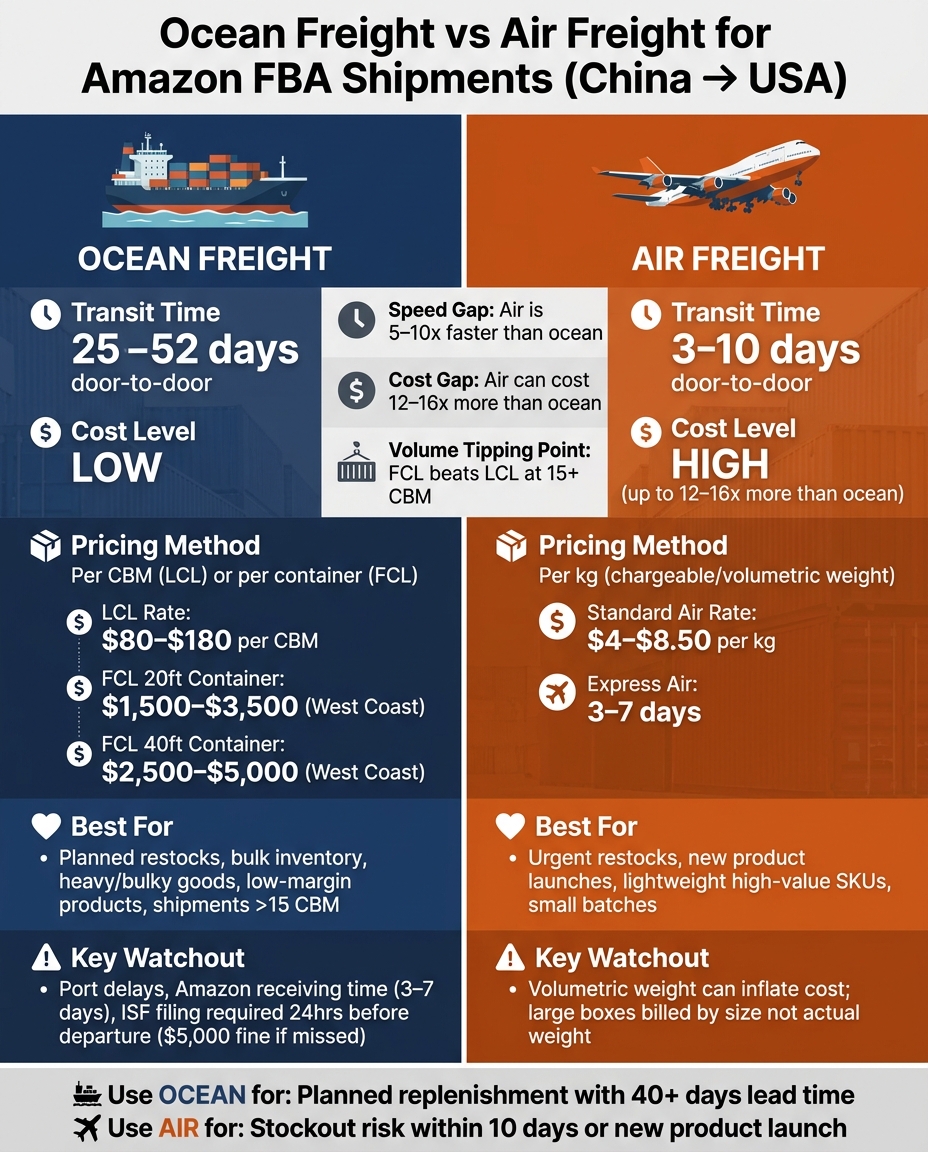
- Ocean freight: about 25–52 days door-to-door, with lower cost
- Air freight: about 3–10 days door-to-door, with much higher cost
- FCL ocean: often makes more sense once a shipment gets above 15 CBM (use a CBM calculator to check your volume)
- Air freight: often runs about $4–$8.50 per kg
- LCL ocean: often runs about $80–$180 per CBM
- Air can cost 12x to 16x more than sea on similar cargo
That means your choice usually comes down to three things:
- How soon you may run out of stock
- How big and heavy the shipment is
- How much shipping cost your margin can absorb
If I had to boil the whole article down to one line, it would be this: use ocean for planned restocks and air for urgent restocks.
Ocean Freight vs Air Freight: Cost & Speed Comparison for Amazon FBA
China to Amazon FBA Shipping Explained | Air Freight vs Sea Freight Strategy for Beginners
Quick Comparison
| Factor | Ocean Freight | Air Freight |
|---|---|---|
| Door-to-door transit | 25–52 days | 3–10 days |
| Main pricing method | Per container or CBM | Per kg |
| Cost level | Lower | Higher |
| Best for | Bulk restocks, heavy cargo, lower-margin goods | Urgent restocks, launches, lighter goods |
| Common shipment types | FCL and LCL | Standard air and express air |
| Key watchout | More delays from port handling and Amazon check-in | Volumetric weight can push cost up |
A few points matter right away.
With ocean freight, the low base rate is only part of the bill. You still need to account for origin charges, customs, destination fees, trucking, and Amazon receiving time. With air freight, the main trap is chargeable weight, because carriers may bill on box size instead of actual scale weight.
I’d also keep one deadline in mind: the Importer Security Filing (ISF) for ocean shipments must be filed 24 hours before the vessel leaves China, or the fine can be $5,000 per shipment.
So before I book anything, I’d ask one simple question: am I trying to cut freight cost, or am I trying to prevent a stockout? That answer usually points to the right shipping mode fast.
Ocean Freight: Lower Cost, Longer Transit Time
Ocean freight works best when you can plan your inventory in advance.
How Ocean Freight Costs Are Calculated
Ocean pricing changes based on one simple thing: are you booking a whole container, or just part of one?
With FCL (Full Container Load), you pay one flat rate for the entire container, no matter how packed it is. A 20-foot container holds about 33 CBM and usually costs $1,500–$3,500 to the U.S. West Coast. A 40-foot container holds about 67 CBM and usually runs $2,500–$5,000 to the same ports. If you’re shipping to East Coast ports like New York or Savannah, expect to add about $500–$1,000.
With LCL (Less than Container Load), you share container space with other shippers, so pricing is based on volume. All-in rates to the U.S. West Coast are usually $80–$150 per CBM. This can work well for smaller shipments. But once you get past about 15 CBM, FCL often gives you better value.
The base ocean rate is only part of the bill. Your total landed cost also includes origin charges, U.S. customs fees, destination charges, and final-mile trucking to the Amazon fulfillment center. That’s why it’s smart to ask for an all-in quote that covers delivery all the way to the FBA warehouse. A quote to a U.S. port is not the same as a quote to your Amazon FC.
There’s also one deadline you don’t want to miss: the Importer Security Filing (ISF). It has to be filed at least 24 hours before the vessel leaves China. Miss it, and you can face a mandatory $5,000 fine per shipment.
Lower shipping cost sounds great on paper. But it only works if the goods show up before your stock gets tight.
Typical Ocean Freight Transit Time from China to the USA for FBA Shipments
For door-to-door delivery, standard ocean freight from China to the USA usually takes 25–35 days to the West Coast and 38–52 days to the East Coast.
| Origin Port | Destination Port | Port-to-Port Transit |
|---|---|---|
| Shenzhen / Yantian | Los Angeles / Long Beach | 14–18 days |
| Shanghai | Los Angeles / Long Beach | 16–22 days |
| Ningbo | Los Angeles / Seattle | 15–20 days |
| Any China Port | New York / Savannah / Houston | 25–35 days |
The sailing time is only one piece of the timeline. You also need to factor in origin handling, export customs, U.S. customs clearance, port congestion, drayage from the port to the warehouse, and Amazon’s own receiving process. After the carrier delivers to the fulfillment center, Amazon can take 3–7 business days to receive the inventory internally. A lot of sellers get tripped up here. Your units are not sellable the minute they reach the dock.
FCL is usually faster than LCL because it skips the extra consolidation and deconsolidation steps at the port. LCL can add several days to the full timeline because of that added handling.
If that transit window doesn’t fit your inventory cycle, air freight is the faster fallback.
sbb-itb-f9a91f9
Air Freight: Higher Cost, Much Faster Delivery
If ocean freight works for planned replenishment, air freight is what you use when stock can’t sit around and wait. When inventory is getting thin, air is often the go-to move for urgent restocks.
How Air Freight Pricing Works
Air freight pricing isn’t based only on what your shipment actually weighs. Carriers bill based on chargeable weight, which means they use whichever is higher: the actual weight or the volumetric (dimensional) weight.
Here’s the catch: volumetric weight can change the math fast. It’s worked out by multiplying a carton’s length × width × height (in cm) and dividing by a carrier-set divisor, usually 5,000 or 6,000 depending on the airline. So if you’re shipping something light in a big box, the box size can push the price up a lot.
Standard air freight from China to the USA usually costs $4–$8 per kg.
If you use DDP air service, the rate often rolls several costs into one per-kg price, including freight, customs brokerage, duties, and final delivery.
Typical Air Freight Transit Time from China to the USA for FBA Shipments
For door-to-door delivery, air freight from China to a U.S. Amazon fulfillment center usually takes 5–10 days. If the shipment is smaller and time-sensitive, express service can trim that down to 3–7 days.
| Phase | Estimated Duration |
|---|---|
| Pickup & Export Handling | 1–2 days |
| Flight Time & Airport Handling | 2–5 days |
| US Customs & Last-Mile Delivery | 1–2 days |
| Total Door-to-Door | 5–10 days |
This is where air freight stands apart. You pay more, but you get speed. And when you’re lining up shipment size, urgency, and profit margin side by side, that tradeoff matters a lot.
Ocean Freight vs Air Freight: Cost and Speed Compared Side by Side
Once you know how to ship to Amazon FBA and understand the basic cost and transit ranges, the next step is simple: line them up against your restock deadline or replenishment window.
| Factor | Ocean Freight | Air Freight |
|---|---|---|
| Typical Transit Time | 25–45 days door-to-door | 5–10 days door-to-door |
| Typical Cost | Low – priced per CBM or container | High – priced per kg |
| Best Use Case | Planned replenishment, bulk inventory | Urgent restocks, new product launches |
| Best Fit | Large volumes (>15 CBM), heavy or bulky goods | Small, lightweight shipments; light, high-value items |
Cost Difference by Shipment Size and Product Margin
This is where the gap hits hardest, especially if your margins are tight.
Air freight runs $4–$8.50 per kg. By contrast, LCL ocean freight costs about $80–$180 per CBM. On the same cargo, air freight can cost 12 to 16 times more than sea freight.
That kind of spread changes the math fast. If you’re shipping high-margin SKUs or trying to cover an emergency restock, paying more for air can make sense. It can help you avoid stockouts and protect Amazon sales rank. But if the product is heavy or your margin is slim, ocean freight is usually the safer play on cost.
Speed Difference: Planned Replenishment vs Urgent Restocks
Price is only half the story. Timing can make the call for you.
Air freight works when your lead-time buffer is gone. It cuts door-to-door delivery to 5–10 days, compared with 25–45 days for ocean freight. If you planned ahead, ocean is often fine. If inventory is getting low and the clock is ticking, air gives you a much shorter path.
When to Choose Ocean Freight and When to Choose Air Freight
For most sellers, the choice comes down to three things: time, shipment weight, and margin.
| Scenario | Recommended Mode |
|---|---|
| Predictable demand, at least 4–6 weeks of lead time | Ocean Freight |
| Stockout risk soon | Air Freight |
| Heavy, bulky, or low-margin products | Ocean Freight |
| Lightweight, high-value SKU | Air Freight |
| New product launch needing fast market entry | Air Freight |
| Large bulk restock (>15 CBM) | Ocean Freight |
"Choosing the wrong freight method can destroy your margins and leave your customers waiting for weeks." – Bruce, CEO & Founder, MBMLog
Use ocean for planned replenishment. Use air for urgent restocks.
How to Choose Between Ocean and Air Freight With FCLGO
Now that the cost and speed tradeoff is clear, the next move is simple: pick the shipping mode that fits your inventory risk.
Look at three things: lead time, shipment size, and margin. Ocean freight makes sense when you have 40+ days of lead time and you’re moving larger, heavier shipments. Air freight is a better fit when you’re facing sub-10-day stock risk, planning a launch, or sending small, high-value batches where faster restocking makes financial sense.
Sometimes the best answer isn’t one or the other. Split shipping can help you cover urgent demand: send part of the inventory by air to get stock in fast, then move the rest by sea.
After you pick the mode, execution matters just as much. A delay in pickup, customs, or FBA check-in can throw off the whole plan. FCLGO handles pickup, export documents, customs clearance, FBA prep, warehousing, and delivery to Amazon fulfillment centers.
Ocean freight cuts cost. Air freight cuts lead time. The right choice comes down to your margin and how much stock risk you can afford.
FAQs
How do I estimate chargeable weight for air freight?
Estimate both the actual gross weight and the volumetric weight of your shipment. Air carriers bill based on whichever number is higher.
For volumetric weight, use this formula:
(length × width × height in centimeters) ÷ 6,000
Then multiply the result by the number of packages.
Before you ask for a quote, double-check each carton’s dimensions and weight. That small step can help you avoid billing adjustments later.
When should I split a shipment between air and ocean?
Split a shipment when you need to keep inventory available without letting shipping costs get out of hand. The idea is simple: move part of the order fast, and move the rest at a lower cost.
A common play is to send a small share – say, 20% by air – so it arrives within 10 days, while the remaining 80% goes by ocean to keep per-unit costs down. This works well for urgent restocks and for peak-season planning, when timing matters but so does your budget.
What extra fees should I budget beyond the freight rate?
Beyond the base freight rate, plan for destination handling, customs duties and taxes, and brokerage fees unless your quote is all-inclusive.
You’ll also want to factor in Amazon-related charges like FNSKU labeling, palletization, and possible long-term storage or inbound placement fees. On top of that, shipping insurance and professional packaging are optional, but they’re usually a smart call.
The big thing is simple: confirm exactly what’s included in your quote so your landed cost lines up with what you expect.
发表回复